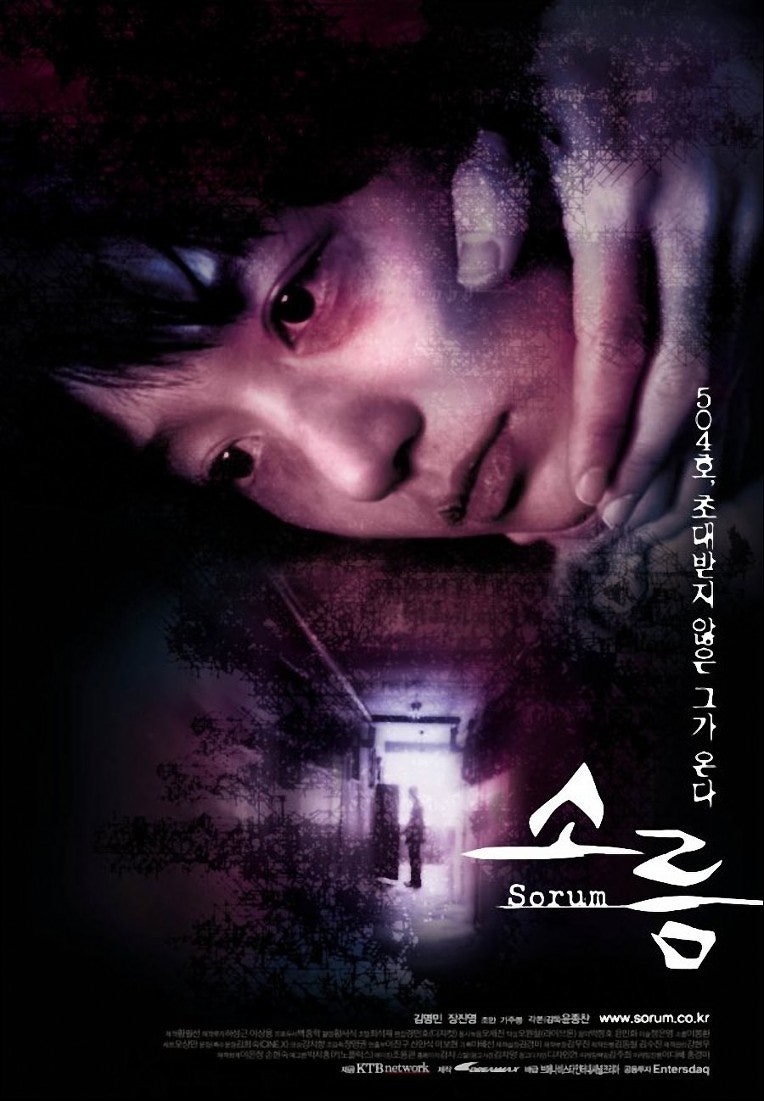
Sorum (소름, Yoon Jong-chan, 2001)

There are different types of ghosts, according to frustrated novelist Lee (Gi Ju-bong) in Yoon Jong-chan’s supernaturally tinged noir, Sorum (소름). Some don’t know they’re dead yet, others possess the bodies of living people. In their own way, the residents of the Migum apartment block all seem to be wandering ghosts themselves, stuck in this place that’s somewhere between life and death that they otherwise seem unable to escape while the building saps the life out of them with its depressing decor and flickering lights.

One might ask themselves why it is that taxi driver Yong-hyeon (Kim Myung-min) has chosen to move in here given that the building is scheduled for demolition. Obviously, the rent is cheap, not least because the previous tenant died in mysterious circumstances, though Yong-hyeon appears to have been unaware of that. Not that it bothers him. For all intents and purposes, he is our hero, a newcomer to this strange and lonely building meeting its ghostly inhabitants for the time. But gradually, we start to wonder about him. Police start sniffing round in connection with the disappearance of a woman said to have embezzled money and borrowed signifiant amounts from friends for no clear purpose. Suspiciously, Yong-hyeon has a bag of women’s jewellery including a ring hidden in his fridge, which would at least have paid a deposit on a nicer apartment if he were able to sell them. 

It’s the ring that attracts the attention of his neighbour, Seon-yeong (Jang Jin-young), who is trapped in an abusive relationship with a man who has a gambling problem. Whether driven or drawn here, Yong-hyeon develops a fascination with Seon-yeong that he later finds difficult to categorise. When she appears before him covered in blood, he helps her bury her husband’s body and then enters a sexual relationship with her that is equally ill-defined. Hearing her say that anyone would have done while arguing with her friend and neighbour Eun-soo (Jo An) causes him to doubt her motivations. Perhaps she’d been waiting for an opportunity to kill her husband and merely made use of his attraction to her to help her do it.

But at the same time, there’s a curiously incestuous quality to their relationship in that Seon-yeong is trapped in the inertia of grief having “lost” her son. Yong-hyeon is an orphan who has no place to call home and on some level is in search of a mother, latching on the maternal quality he sees in Seon-yeong. She buys a scarf for him, as a mother might for a son, while he is touched by her bending down to tie his shoelaces, wondering if his mother would have been kind like her had he had one. Their connection is also echoed in the mysterious history of the apartment in which a woman is said to have been murdered by her husband 30 years previously. The couple had a baby who was left alone there and likely would have starved to death if it had not been for a fire which led to his rescue by other residents. 

The apartment’s previous tenant, aspiring novelist Gwang-tae, had been investigating the murder as material for a book before he died in mysterious circumstances, apparently the victim of a hyper-localised fire which occurred only in the centre of the room. Gwang-tae had claimed that the apartment was haunted by the ghost of a woman singing a lullaby who insisted her son would soon return. Gwang-tae told his girlfriend Eun-soo, pregnant with their child, that he needed to leave this building or something bad would happen to him, but like everyone else, he found himself unable to. His story then becomes fodder Lee, whose latest attempt to make a literary comeback may not all be his work though he continues to try to write the story we are currently watching by constructing a fanciful narrative around Yong-hyeon and the apartment and then convincing himself that what he’s writing is coming true. 

In that sense, he may have an authorial god complex or extreme main character syndrome, while for Yeong-hyeon it’s the opposite. He’s learned to live a carefree life by acting on his impulses and then giving them no more thought. The last thing he wanted to be was the protagonist of this story, though he begins to discover strange and unexpected connections with the building and the tragedy that occurred there 30 years previously. This is the “invisible fear” that Lee proclaims as the high point of his novel, a noirish sense of dread that suddenly reorders an ordinary person’s existence. Yeong-hyeon is no longer someone who exists within the world. The world now exists around him. Lee suggests the ghost in 504 is trying to trap her adult son within this purgatorial space in order to escape her loneliness, just as everyone else is trapped in this building by irresolvable despair. Yeong-hyeon knows he has to get out, but at the same time, where else is there to go? All he can see is the building blinking back at him, refusing to give up its ghosts.
Ghost in Love (자귀모, Lee Kwang-hoon, 1999)

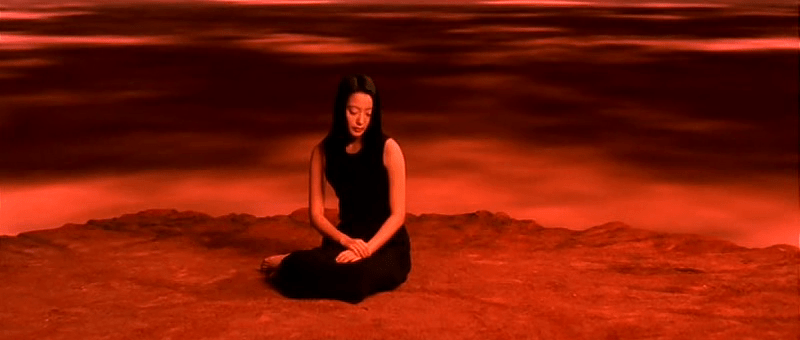
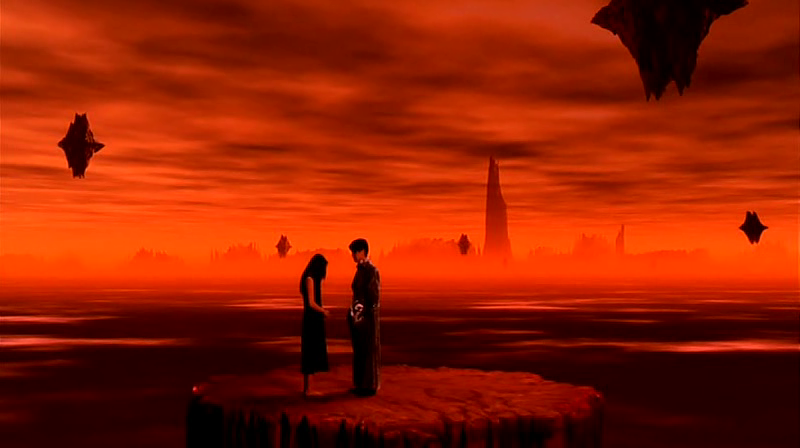
Caught in limbo, a young woman finds herself torn between the desire for revenge and letting go in Lee Kwang-hoon’s supernatural drama, Ghost in Love (자귀모, Jagwimo). Is love really what Chae-byul (Kim Hee-sun) was in, or is it more the sense of humiliation that’s she’s carried into the afterlife while obsessing over her cheating ex-boyfriend who was two-timing her with the boss’ daughter? Her colleague Kantorates (Lee Sung-jae), by contrast, had a love that was purer and reminds her that though it’s painful, if she really loved him, she’d be rooting for her ex’s future happiness rather than plotting how to mess up his life. 

Then again, the Korean title is “Suicide Ghost Club” and refers to the group into which Chae-byul is press-ganged after two of its grim reaper agents help her on her way having overheard her say she wanted to die because of all the romantic drama in her life. This literal purgatorial space located between heaven and hell is run like an exploitative company/cult in which the only metric of success is claiming more members. Chae-byul is warned that she doesn’t really have any choice but to join them, because otherwise she’ll become a vengeful spirit and lose all her memories, though she’s drawn to a mysterious presence known as Pale Face who does indeed become a terrifying spirit of vengeance, taking revenge primarily on the men who gang raped her while her fiancé, who later dumped her, looked on helplessly.

There is a kind of misogyny that’s most obvious in the afterlife but exists in the real world too. The film opens with a woman about to take her own life because of persistent fat shaming. She’s fat shamed by the grim reapers too and on into the afterlife, though in ghost form it’s revealed that she could be skinny if she wanted but is happiest in herself like this. Meanwhile, the grim reappears make other suggestive comments, leering over Chae-byul and remarking that a girl should have nice hips. Pale Face took her own life because of the trauma of her rape, the stigma of being a rape victim, and the betrayal of her fiancé who she says broke up with her because he thought that she was tainted. Even in the afterlife, she’s constantly washing in an attempt to make herself clean which is why she’s become so pale. 

Despite being told primarily from Chae-byul’s perspective, the film more or less normalises her boyfriend’s sexist views and behaviour in which he sees nothing really wrong with two-timing each of the women. Chae-byul tries to confront him, but he tells her Hyun-ju (Kim Si-won) was only visiting “to check on her stock transactions,” and shifts the blame onto Chae-byul for being paranoid and unreasonable. He says he liked her because she was “nice and comfortable,” but now she’s changed, so if she’s going to carry on “nagging” him like this, he may as well break up with her. HIs domineering attitude and characterisation of Chae-byul as a crazy girlfriend have the desired effect of causing her to back down and apologise to him. He may be a bit pathetic and materialistic in dating the boss’ daughter solely for advancement claiming it was his only chance to get on, but his behaviour isn’t really regarded as being particularly negative while Chae-byul’s desire for vengeance is, belittled in part because it involves disrupting not only his bright future but pointlessly harming Hyun-ju too.

Then again, perhaps these attitudes are intrinsic to the latent authoritarianism of the afterlife which is governed by the mysterious “messengers” who punish the transgressions of wandering ghosts. One grumpily rants about now having to work for a living, unlike in the old days in which some people would even try to bribe them for a longer life which they don’t do anymore in an allusion to Korea’s recent democratisation. The Messengers From Hades have a serious whiff of the KCIA mercilessly pursuing those who threaten to destabilise the system and then “disappearing” them. Nevertheless, Chae-byul eventually begins to come around to Kantorates point of view while quietly falling for him even as he struggles to move on from his own lost love. He knows he can’t be with her any more, but needs to find a way to tell her to move on so that he can do the same. A strange twist of fate gives them another chance at life and at love to live without wanting to die and try to find happiness even in a world of financial anxiety where consumerist desire has replaced spiritual fulfilment.


The Foul King (반칙왕, Kim Jee-woon, 2000)

A dejected office worker seeks release from a mundane life of constant degradation as a masked wrestler but finds himself ultimately unable to escape the headlock of the corporate society in Kim Jee-woon’s pro wrestling farce The Foul King (반칙왕, Banchikwang). As the title may suggest, you might have to play a little dirty in order to claw back some dignity but then perhaps everyone’s struggling to free themselves from something be it old debts, middle-aged disappointment, or complicity with the dubious business practices of turn of the century capitalism. 

Even before he enters the ring, Dae-ho (Song Kang-ho) is wrestling, fighting his way onto and out of a packed rush hour train only to arrive at work a few minutes late to be given a passive aggressive dressing down from his boss (Song Young-chang) during the morning pep talk. His boss then in absurd fashion corners him in the gents and places him in a headlock while telling him off some more just to ram the message home. Poor Dae-ho finds this so humiliating that all he really thinks of is a short term solution of learning how to evade his boss’ control while mooning over his attractive desk mate Miss Jo and further berating himself for being too shy to ask her out. His other problem is that he’s not very good at his job as a low-level bank cashier. He and his work friend Doo-sik (Jung Woong-in) are bottom in the office rankings for failing to secure any new accounts.

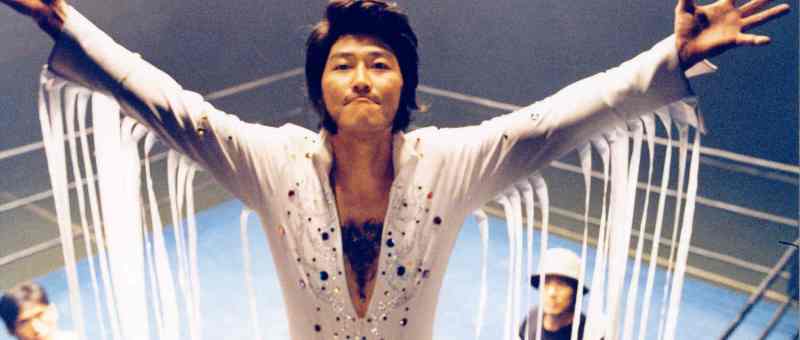
Trapped between his abusive boss and dismissive father (Shin Goo) with whom he still lives, Dae-ho finds himself both emasculated and infantilised while continuing to indulge childhood fantasies drifting off into a dream sequence in which he is Elvis in the wrestling ring trying to impress Miss Jo but still defeated by his giant bug of a boss. He first turns to a friend who teaches Taekwondo to children but he tells him Taekwondo is a “mental discipline” while a real martial artist would never end up in a headlock anyway. But then as if by magic he wanders past a moribund wrestling gym and ventures inside only for the coach, Jang (Jang Jin-young), to throw him out for being a bit odd. Threatened by a gangster into training up a comic relief character specialising in cheating to bolster the profile of another wrestler, Yubiho (Kim Su-ro), hoping to drum up publicity for a Japan tour, Jang relents remembering Dae-ho’s manic rank about his love for classic heel Ultra Tiger Mask as seen on TV decades earlier. 

Being a heel is not quite what Dae-ho had in mind, after all what he wants is to figure out how to escape a headlock yet he finds himself bizarrely in his element if a little clumsily rejoicing in moustache twirling villainy, cartoonish pranks, and comic pratfalls. He begins to grow in confidence but also overreaches, managing to teach a gang of youths (amusingly standing under a huge mural ironically reading “Korea! Fighting!”) a lesson and redeeming his sense of masculine pride after a defeat while making a total drunken fool of himself in his unrequited love for Miss Jo at the office karaoke party once again getting pummelled by his boss. While Dae-ho turns to wrestling in search of freedom and personal fulfilment, Doo-sik tries to regain his self-respect by doing the right thing refusing to be a part of his boss’ obviously dodgy business practices while threatening to blow the whistle if like Dae-ho perhaps realising that there is no way to beat this system while remaining inside it. 

Dae-ho discovers that he gains confidence by putting on a mask, specially the Ultra Tiger Mask worn by his childhood hero, while “winning” in the ring through “cheating” getting audience laughs with zany cartoon stunts. Only when the mask is torn by an unnecessarily aggressive Yubiho does he enter full on rage mode attempting to take revenge for his constant belittlement by ignoring the script to teach Yubiho a lesson as the pair of them brawl all over the stadium making weapons of random chairs and even at one point the session bell itself. Yet in a real sense Dae-ho never really achieves much of anything, scoring a symbolic victory in provoking a tie but never figuring out how to escape the corporate headlock while continuing to be bullied by his boss, rendered entirely powerless within the hierarchal corporatised society of early 2000s Korea. A darkly comic take on existential futility, Foul King meditates on the compromises inherent in playing the game Dae-ho ironically finding confidence in wilful humiliation as a dishonourable heel while unable to escape his constant degradation wrestling for agency within the confines of his regular office worker life. 


The Foul King streams in Poland until Nov. 29 as part of the 15th Five Flavours Film Festival.

Trailer (English subtitles)