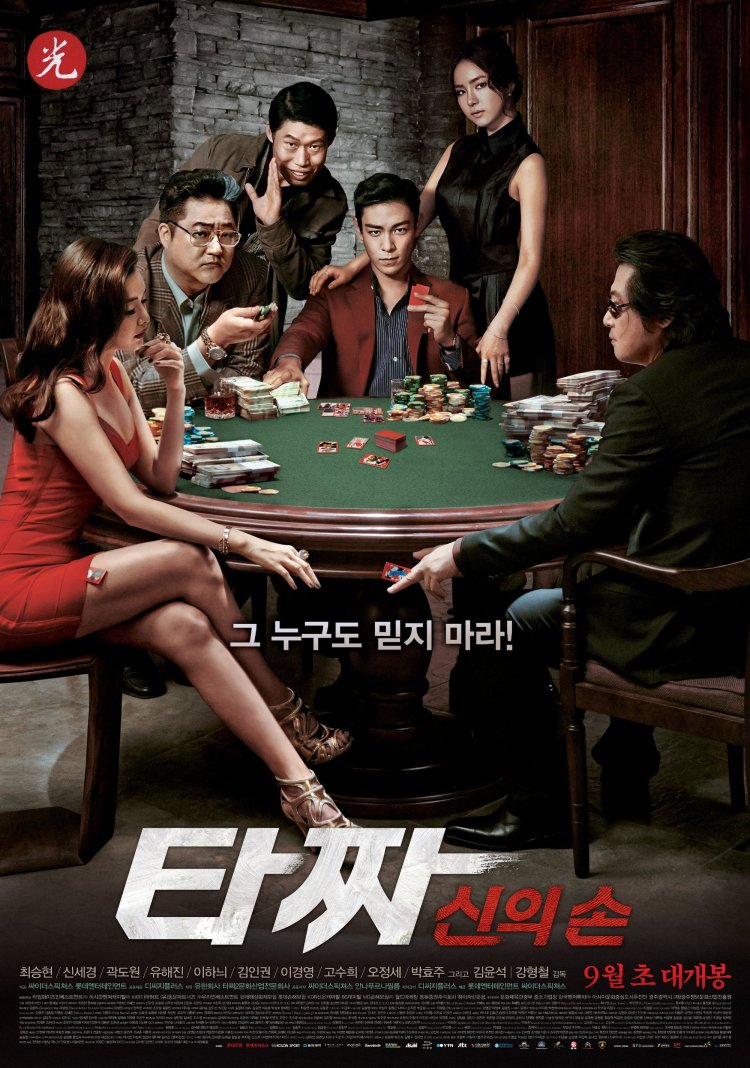
Tazza: The Hidden Card (타짜-신의 손, Kang Hyung-Chul, 2014)

tazza posterYou gotta know how to hold ‘em, know when to fold ‘em, know when to walk away and know when to run. Apparently these rules of the table are just as important in the cutthroat world of the Korean card game Hwatu as they are in the rootinest tootinest saloon bar. Like most card games, having the winning hand is less important than the ability to play your opponent and so it’s more a question of who can cheat the best (without actually breaking the rules, or at least being caught doing so) than it is of skill or luck. A second generation sequel to 2006’s Tazza: The High Rollers, The Hidden Card (타짜-신의 손, Tajja: Shinui Son) is a slick, if overlong, journey into the dark, underground world of gambling addicted card players which turns out to be much more shady than the shiny suits and cheesy grins would suggest.

Wisecracking kid Dae-gil (T.O.P) comes into contact with the first film’s fast talking hustler Go (Yu Hae-Jin) and realises he has a talent for trickery. As a young man he gets himself into trouble trying to save a family member from a gangster whom he winds up stabbing meaning he has to go on the run and leave the girl he’s fallen head over heels for, Mina (Shin Se-Kyung), far behind him with only the promise to come back for her when he’s made something of himself. With nothing to fall back on Dae-gil ends up working for cardsharping gangsters in what is really a series of high level con operations. His first problem occurs when he temporarily forsakes the memory of Mina for the attentions of the alluring Mrs. Woo (Lee Honey) who becomes both his secret girlfriend and the gang’s latest mark.

Things do not go to plan and Dae-gil is left carrying the can for the gang’s heavy losses. Getting into trouble with another mark who turns out to be a high level gangster himself, Dae-gil finds out Mina has been sold into prostitution as payment for a family debt but also winds up losing a kidney as recompense for his mounting gambling debts. Now Dae-gil is out for revenge against pretty much everyone, hoping to rescue Mina and win her heart in the process but his adversaries are old hands at this sort of thing and it’s going to take more than a rigged deck to beat them at their own game.

Taking over from the first film’s Choi Dong-hoon, Kang Hyung-chul opts for a slick and charming Oceans 11 inspired aesthetic full of quirky humour and tricky slight of hand photography. With retro musical choices from a smooth cover of Spooky to the ‘80s synth pop kicking in for an exciting car chase, Kang piles on the nostalgia as Dae-gil rides high as a wisecracking conflicted member of this underhanded outfit. Taking inspiration from its manwha roots, The Hidden Card maintains its breezy tone even whilst the atmosphere darkens as Dae-gil taps out with this gangster credit, beaten up, drugged and waking up in a filthy room with a bandaged hand and a crude scar across his abdomen where his kidney used to be. Apparently making a quick recovery from serious surgery, Dae-gil’s discovery of Mina’s fate is likewise another addition to his quest narrative rather than more evidence of the savagery of this trick or be tricked world.

The Hidden Card’s biggest problem is an unavoidable one given its genre – the sheer structural repetitiveness of moving from one card game to another. Lack of familiarity with Hwatu itself is not exactly a problem even if mildly frustrating, but the nature of the way the game is played means that a great deal of screen time is occupied with watching people watching each other, moodily, only to be left unsure of what’s going on or who’s won at the end of it. This is all the more true of the film’s final showdown which brings back a major player from the first instalment in which the stakes have been raised supposedly to “prevent” cheating, but only really aim to make it more “challenging”. Still, away from the gaming table there are enough high octane fist fights and a lengthy car chase to break up the more cerebral thrills.

Undeniably slick and filled with a host of likeable characters offering snappy dialogue and silly humour, Tazza: The Hidden Card is far too long at two and a half hours. Uneven pacing does not help the feeling of scale and a similarly unbalanced plot structure produces a misleading sense of progression. Still, keeping one step ahead of the card sharks is fun in itself and even if the action drags here and there, there is enough character driven drama and ironic comedy to keep things moving right up until the consciously cool finale.


International trailer (English subtitles)
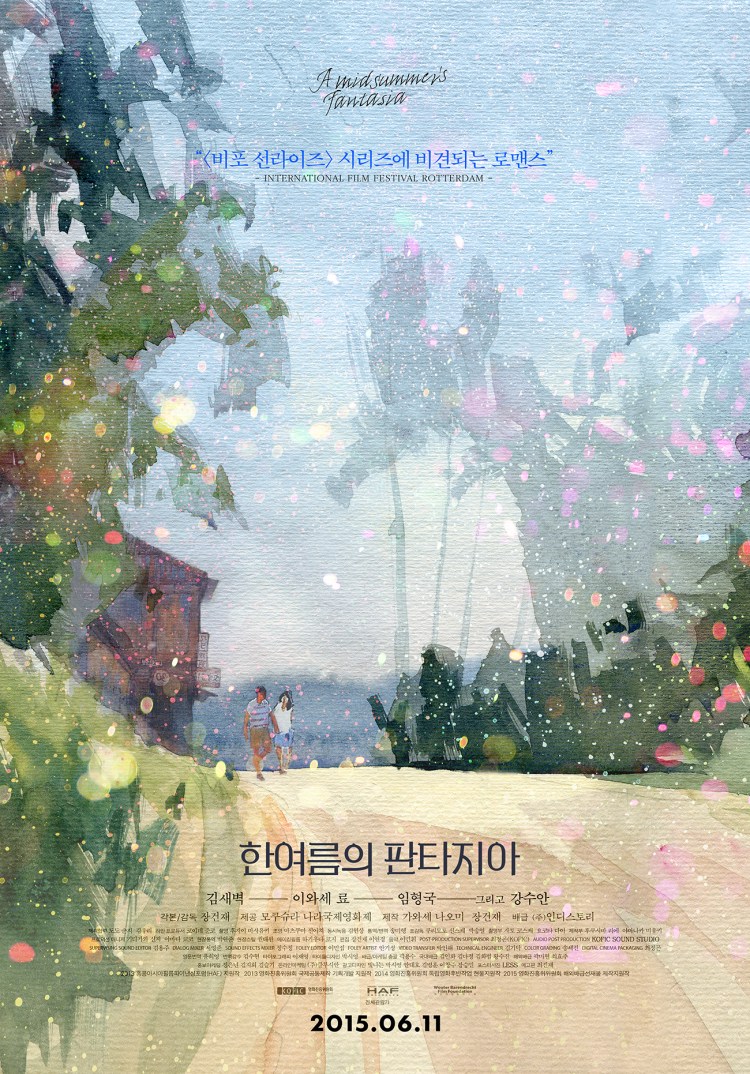
A Midsummer’s Fantasia (한여름의 판타지아, Jang Kun-jae, 2014)

Midsummer FantasiaFollowing his “sleeper” hit, Sleepless Night, Korean indie director Jang Kun-jae gets a touch of the Hong Sang-soos in the bifurcated tale of artistic inspiration found in a foreign land with the Korean/Japanese co-production A Midsummer’s Fantasia (한여름의 판타지아, Hanyeoreumui Pantajia). Mixing naturalism with hyperreality, Jang’s exploration of cross cultural pollination is one which offers both fireworks and quiet contemplation.

Neatly split into two parts, the film begins with a black and white sequence titled First Love in which a Korean director travels to a tiny Japanese town on a location shoot accompanied only by his assistant playing the role of interpreter. A beautiful country idyll, the village is also dying as the population ages leaving the local school abandoned for over 25 years with only the elderly left behind by their children who’ve fled to the cities. After talking with some of the residents, the director is captivated by the romantic tales of a local civil servant who acted as a guide for a young Korean girl some years previously and that of a slightly older man who once worked in the big city of Osaka and took a liking to a Korean bargirl who reminded him of his first love but tragically lost touch with her after deciding to return home.

Inspired by these twin tales of frustrated cross cultural romance, part two switches to colour for a story titled The Well of Sakura in which a Korean woman pays a visit to the same small town before heading home. A local man from the tourist office helps her out by showing her around a little and is, in truth, disappointed that she will be leaving soon never to be seen again.

The first half is shot entirely in black and white with a documentary style approach filled with ugly jump cuts and direct to camera speeches from the local residents about their daily lives in the town. Wandering around the picturesque settlement and listening to the stories of its lonely older population, what the director is most taken with is the wistfulness of the place – the sense of unresolved longing, faded promise and missed opportunities the abandoned village seems to evoke.

Part two is his response, a constructed tale of unresolved romantic connection between a Japanese man and a Korean tourist who’s ventured somewhat off the beaten path both physically and spiritually in visiting this quiet backwater before returning to the various problems which seem to be proving disruptive in her everyday life in Korea. Picking up elements from part one such as the abandoned school and its mysterious photograph, it weaves an ordinary tale of love as two people begin a dialogue they may never have the opportunity to end.

However, part one is not quite as naturalistic as it first seems with its wandering ghosts and strange symbolism. Even if the bright colours of the film’s second half are intended to feel more “cinematic” and therefore less “real” than the black and white, talking heads doc meets indie movie feel of part one it’s clear that both segments are involved in a dialogue, or perhaps even a romance, with each other – a case of call and response which begins and ends with fireworks.

It’s difficult to unsee Hong Sang-soo in Jang’s dual structure and straightforward if occasionally whimsical approach, yet he’s a little less flippant than Hong’s often ironic tone and is content to let even his imagined tale of a failure to launch romance say something more meaningful if only through simple conversation. Filled with cross cultural detail, A Midsummer’s Fantasia is both about place and not as it, like the director of the first half, is keen to point us to the who and not the where – people rather than place are the name of the day. Filled with an oddly melancholy warmth, A Midsummer’s Fantasia is another excellently produced character piece from Jang which explores larger themes with a poetic economy and heart filled with “romance” in much a larger sense.


A Midsummer’s Fantasia is available on English subtitled Region 3 DVD from Korea.

Romance Joe (로맨스 조, Lee Kwang-kuk, 2011)

romance-joeReview of Lee Kwang-kuk’s Romance Joe (로맨스 조) up at UK Anime Network. First saw this at the LFF a couple of years ago but now it’s back alongside Lee’s latest film A Matter of Interpretation at the London Korean Film Festival.


Lee Kwang-kuk’s meta romantic comedy drama first got a London outing at the BFI film festival back in 2012 but now makes a welcome return visit as part of the 2015 Korean film festival in a strand dedicated to its director. Playing alongside a short film, Hard to Say, which was completed by Lee in-between Romance Joe and his new film A Matter of Interpretation, the film brings Lee’s meta concerns to the fore and offers plenty of Alice in Wonderland inspired absurdity to its otherwise straightforward plot elements.

Romance Joe is a film with many levels. On the first layer, we have an elderly couple arriving in Seoul to look for their son who came to the city to be a director 18 years ago but he’s not been in contact recently so they’re worried. His friend greets them and tells them their son had been feeling depressed lately over the suicide of a well known actress. He then starts to tell them about an idea for a screenplay he’s had about a director with writer’s block who checks into a motel where he’s told another set of stories by a prostitute who delivers coffee as a cover. From here the stories radiate out like cracks in a broken mirror though we never quite get the answers we’ve been looking for.

Lee has worked extensively with Korean auteur Hong Sang-soo and his shadow looms large over the film. From the cutesy title cards to the static camera with occasional creeping zooms and often unbearably awkward situations, there is certainly a lot of Hong in Lee’s film. However, where Hong takes the same situation and replays it with a different outcome, Lee gives you a set of intersecting stories which spring forth from each other. Lee’s interests are more surreal and metaphysical than Hong’s which are, ostensibly, more naturalistic in feeling than Lee’s almost hyperreal world.

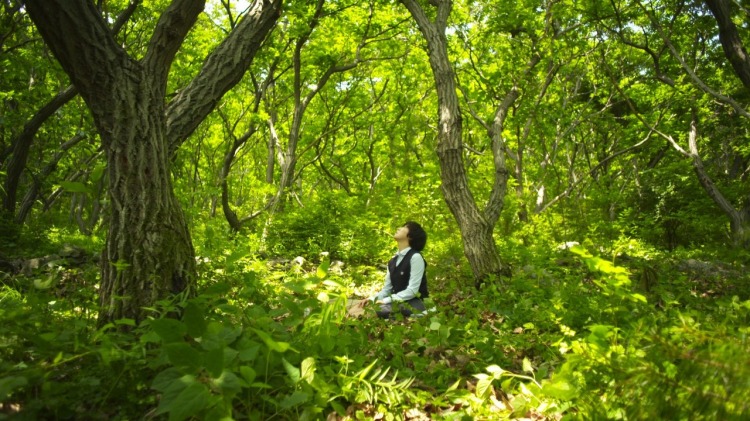
In contrast to Hong’s social comedies, Lee also digs a little darker into the Korean psyche and reveals a strange preoccupation with suicide and abandoned children. The furthest point back in the film deals with the lonely mid forest suicide attempt of a teenage schoolgirl who’s become a figure of fun thanks to a loud mouth “boyfriend”. Her rescuer may (or may not be) the man we later come to know as Romance Joe. Though the two eventually bond, the story is not an altogether happy one as they’re rushed into fairly adult decisions which neither of them is really ready for.

Later, a young boy who may (or may not) be the child of the high school girl arrives at the “cafe” from which the prostitute operates looking for his mother who apparently last wrote to him from that address sometime ago and has since disappeared. Later, the prostitute receives a call from her own son safely in the country being cared for by grandparents while his mother earns the money in the city.

In many ways it’s a series of sad yet inevitable stories leaping out from inside each other each more heart rending than the last, though somehow it never becomes as affecting as you’d like it to be. Romance Joe feels like a deliberate experiment in form or at least a dedication to pushing conventional narrative structures into new and exciting places but it does so in a way that’s self consciously about form rather than content so that it never quite takes hold. It wants to discuss time and memories and stories but ends up mostly talking about itself and, in truth, a little lengthily, still Romance Joe does at least manage to offer an intriguing, beautifully filmed and often enjoyable surrealist tale that will have your mind in knots long after you see it.


Reviewed at the London Korean Film Festival 2015.

http://www.youtube.com/watch?v=gby8x6X-AWI