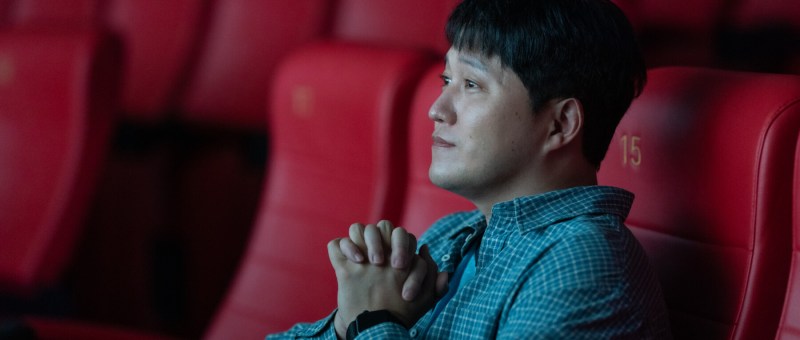
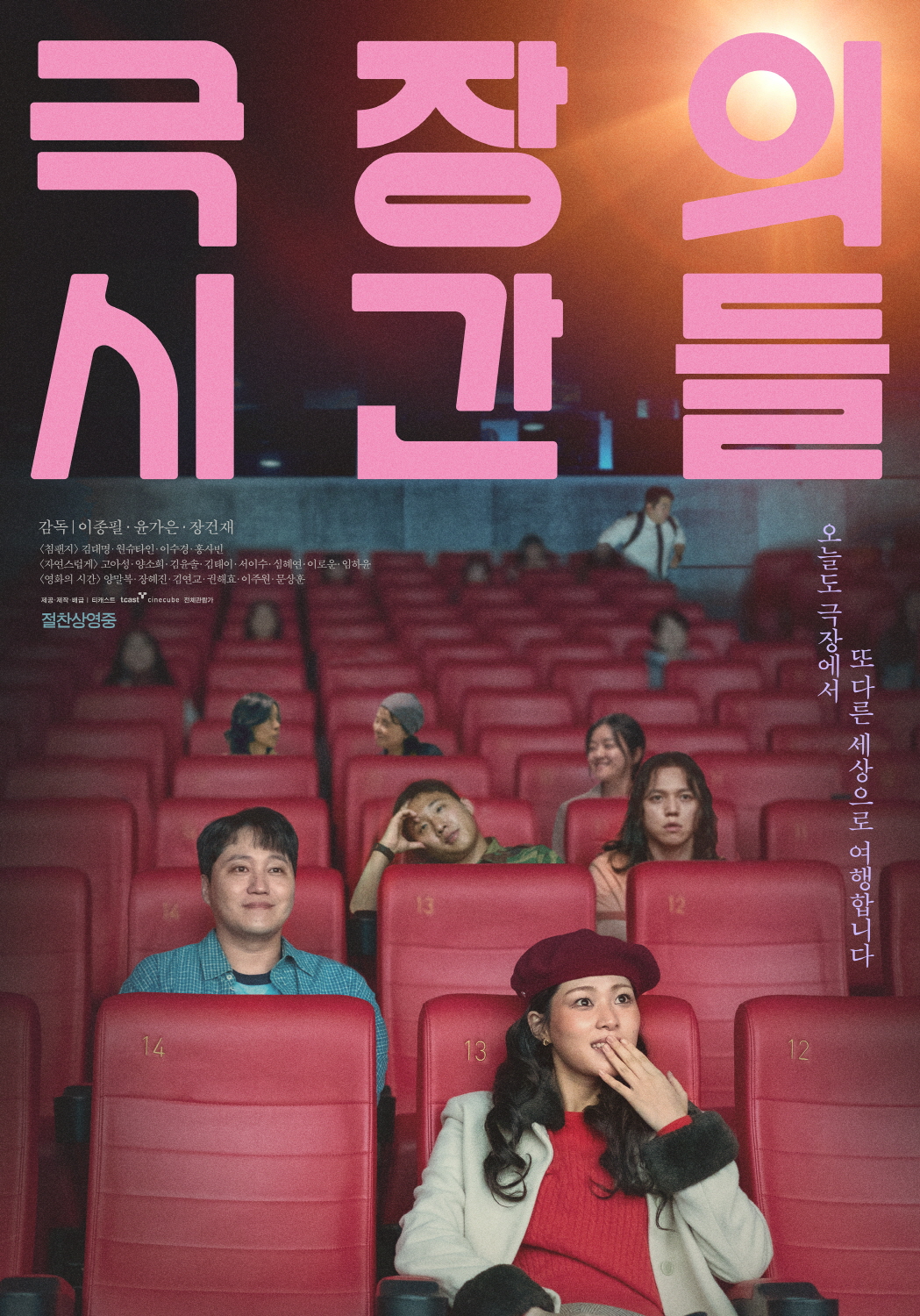
Time of Cinema (극장의 시간들, Lee Jong-pil, Yoon Ga-eun, Jang Kun-jae, 2025)

Made in celebration of the 25th anniversary of the Cinecube cinema in Seoul, Time of Cinema (극장의 시간들, Geugjang-ui Sigandeul) is an anthology film featuring three segments and bookended with a sequence set in the venue as a young woman takes lessons from the projectionist while classic films such as Ozu’s Late Spring play in the background. As such, each of the films has a kind of meta commentary on the nature of film, the industry and buildings as well as the impact it can have on people’s lives even if they happen to fall asleep during the movie.

This kind of reflexivity is evident in the opening segment, Chimpanzee, which features its protagonists recreating the dance from Godard’s Bande à part. This segment also is set across two time periods and is revealed to be “a film” based on the recollections of the director’s youth in which he spent time watching movies with two close friends while in the military. This sense of loss for shared experiences of the past is something that echoes through the other sequences and in the last seems as if it could in some senses be returned through unexpected reunion. In any case, the director appears to reclaim them through imprinting his memories in the film as a means of reliving them. Its protagonists also have a kind of truth revealed to them that something they assumed to be merely a legend was perhaps true after all.

The second sequence, meanwhile, directed by Yoon Ga-eun plays with the nature of film itself as we’re show several scenes that turn out to be in progress shots from the filming of another movie in which a collection of little girls are asked to repeat the same scene in a frustrated attempt to make it seem more “natural.” At the end, they all sit down to watch the film they’ve made, but this is also a part of the “film”, while we have also already been watching them, leading us to ponder on these many levels of refection within the video footage. Well known for her films featuring children such as The House of Us, Yoon gets the most from her young cast while at the same time demonstrating how difficult it can be work with child actors even if what she mainly does is to leave them to their own devices, capturing their spontaneity and enthusiasm in the most natural way possible.

The third sequence meanwhile is more firmly rooted in Cinecube and explores the less glamorous side of filmmaking in taking a leaf out of Goodbye Dragon Inn’s book as the cleaning lady walks up and down the aisles collecting rubbish even if, as they mentioned in the first segment, this place is too fancy to sell popcorn. Though the cleaning lady rarely has time to watch any films, she ends up running into an old friend who’s just come in to use the bathroom and pressures her into seeing whatever’s playing which happens to be a special screening of a movie with a director Q&A. The old friend’s name also has the same pronunciation of the word for “film”, and though she and everyone else in the cinema falls asleep, her time spent there seems to return something precious that she had lost while she also reunites with her old friend.

In this way it paints cinema as an interactive experience and all the more so when visiting a cinema rather than watching passively, or inattentively, though a TV screen. By the same token, it shows the cinema staff working hard from the put upon box office lady trying to tell a desperate cinephile that he’s arrived too late to enter the auditorium and, in any case, has booked his ticket for the following day, to the cleaning lady and projectionist who meticulously keeps an eye on everything, both digital and analogue, to ensure that the film is being projected as intended. Cinemas are in that sense social spaces in which people share experiences with both strangers and friends while in some ways unaware of the relationship that’s arising between themselves and the screen and the images that may also be changing them in ways untold.


Time of Cinema screened as part of this year’s London Korean Film Festival.

Trailer (no subtitles)
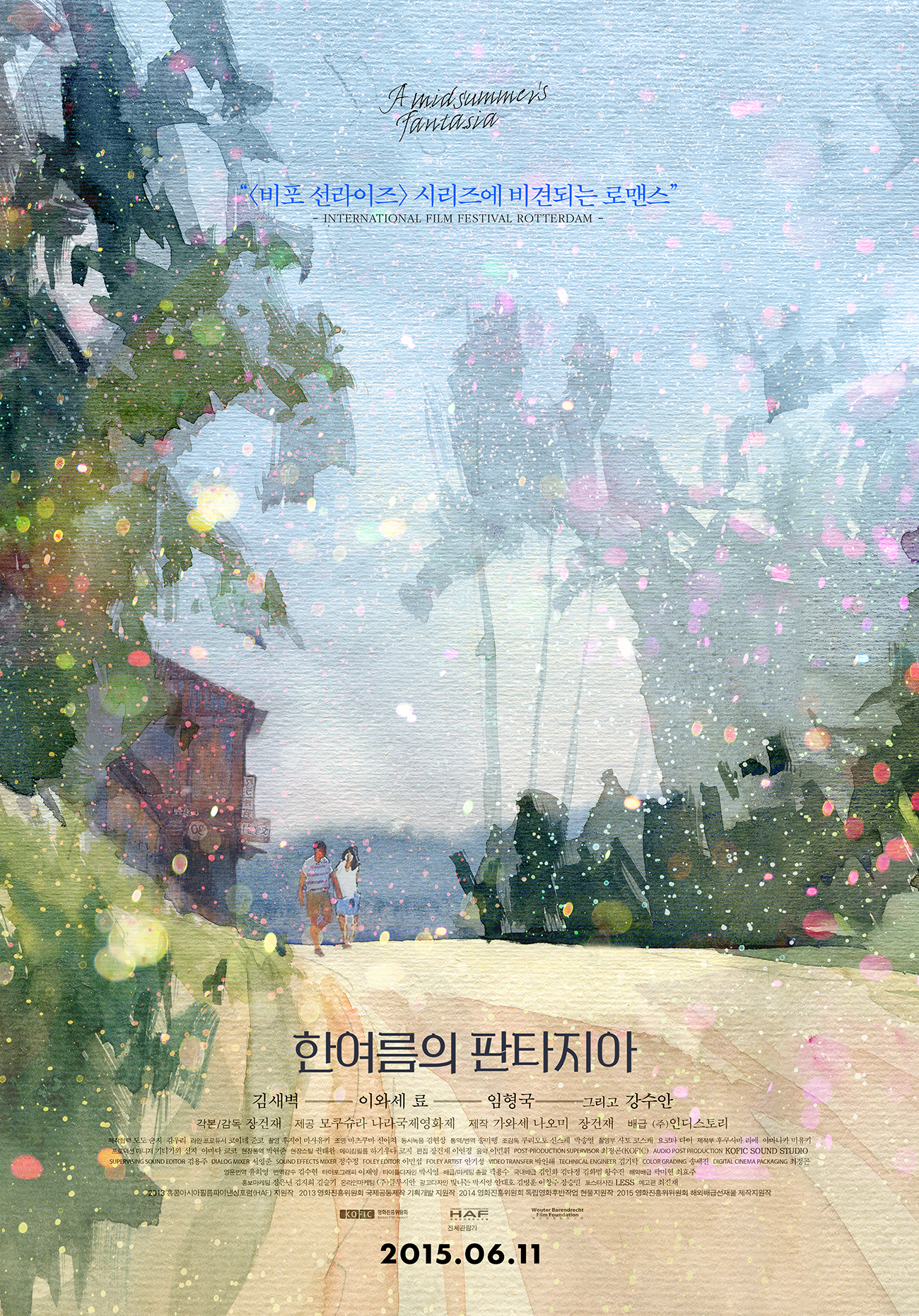
A Midsummer’s Fantasia (한여름의 판타지아, Jang Kun-jae, 2014)

Midsummer FantasiaFollowing his “sleeper” hit, Sleepless Night, Korean indie director Jang Kun-jae gets a touch of the Hong Sang-soos in the bifurcated tale of artistic inspiration found in a foreign land with the Korean/Japanese co-production A Midsummer’s Fantasia (한여름의 판타지아, Hanyeoreumui Pantajia). Mixing naturalism with hyperreality, Jang’s exploration of cross cultural pollination is one which offers both fireworks and quiet contemplation.

Neatly split into two parts, the film begins with a black and white sequence titled First Love in which a Korean director travels to a tiny Japanese town on a location shoot accompanied only by his assistant playing the role of interpreter. A beautiful country idyll, the village is also dying as the population ages leaving the local school abandoned for over 25 years with only the elderly left behind by their children who’ve fled to the cities. After talking with some of the residents, the director is captivated by the romantic tales of a local civil servant who acted as a guide for a young Korean girl some years previously and that of a slightly older man who once worked in the big city of Osaka and took a liking to a Korean bargirl who reminded him of his first love but tragically lost touch with her after deciding to return home.

Inspired by these twin tales of frustrated cross cultural romance, part two switches to colour for a story titled The Well of Sakura in which a Korean woman pays a visit to the same small town before heading home. A local man from the tourist office helps her out by showing her around a little and is, in truth, disappointed that she will be leaving soon never to be seen again.

The first half is shot entirely in black and white with a documentary style approach filled with ugly jump cuts and direct to camera speeches from the local residents about their daily lives in the town. Wandering around the picturesque settlement and listening to the stories of its lonely older population, what the director is most taken with is the wistfulness of the place – the sense of unresolved longing, faded promise and missed opportunities the abandoned village seems to evoke.

Part two is his response, a constructed tale of unresolved romantic connection between a Japanese man and a Korean tourist who’s ventured somewhat off the beaten path both physically and spiritually in visiting this quiet backwater before returning to the various problems which seem to be proving disruptive in her everyday life in Korea. Picking up elements from part one such as the abandoned school and its mysterious photograph, it weaves an ordinary tale of love as two people begin a dialogue they may never have the opportunity to end.

However, part one is not quite as naturalistic as it first seems with its wandering ghosts and strange symbolism. Even if the bright colours of the film’s second half are intended to feel more “cinematic” and therefore less “real” than the black and white, talking heads doc meets indie movie feel of part one it’s clear that both segments are involved in a dialogue, or perhaps even a romance, with each other – a case of call and response which begins and ends with fireworks.

It’s difficult to unsee Hong Sang-soo in Jang’s dual structure and straightforward if occasionally whimsical approach, yet he’s a little less flippant than Hong’s often ironic tone and is content to let even his imagined tale of a failure to launch romance say something more meaningful if only through simple conversation. Filled with cross cultural detail, A Midsummer’s Fantasia is both about place and not as it, like the director of the first half, is keen to point us to the who and not the where – people rather than place are the name of the day. Filled with an oddly melancholy warmth, A Midsummer’s Fantasia is another excellently produced character piece from Jang which explores larger themes with a poetic economy and heart filled with “romance” in much a larger sense.


A Midsummer’s Fantasia is available on English subtitled Region 3 DVD from Korea.