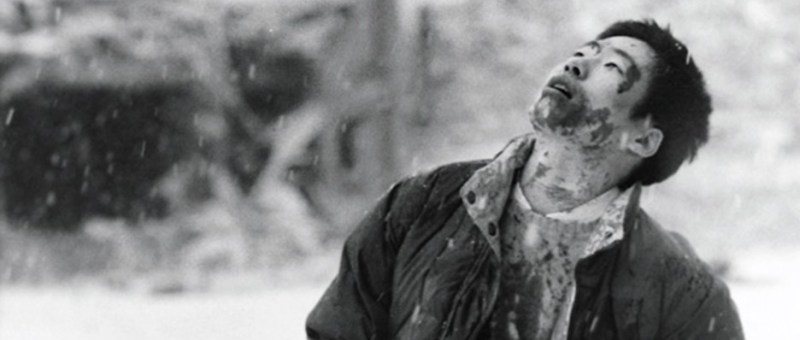
 Ryoo Seung-wan is now one of Korea’s top directors with such high profile box office hits as Berlin File, Veteran, and Battleship Island to his name. Back in 2000, he was just a young punk trying to make his mark in the film industry. Die Bad (죽거나 혹은 나쁘거나, Jukgeona Hokeun Nabbeugeona), Ryoo’s feature debut is, in reality, a series of four connected shorts (some of which were screened individually) telling an all too familiar story of a life ruined in adolescence giving way to a gangland nightmare and a nihilistic struggle for survival. Shot on grainy, low budget 16mm, Ryoo’s aesthetic is clearly influenced by the cinema of Sogo Ishii and perhaps Shinya Tsukamoto in its intensely kinetic, punk rock rhythms but he brings to it a youthful, angry fatalism so often seen in Korean youth drama.
Told in four chapters each of which is filmed with a different conceit, Die Bad is the story of Sung-bin (Park Sung-bin), a young man whose future is derailed after he kills a boy by accident in a pool room scuffle. When he gets out of jail, his father doesn’t want to know him and his friends have moved on but his brother gets him a job in a garage and it seems as if he’s finding his feet. When he comes across a guy getting beaten up in the street, he’s hesitant to get involved – literally seeing the ghost of the boy he killed in amongst the aggressors. Eventually he intercedes and rescues the guy who turns out to be a well connected mobster.
Meanwhile, while Sung-bin was inside, his friend who started the fight that fateful night, Seok-hwan (Ryoo Seung-wan), has become a policeman. Seok-hwan’s little brother, Sang-hwan, is getting involved in the same typically teenage punk violence which defined the adolescence of Sung-bin and Seok-hwan. A police round up engineers a fateful reunion between Seok-hwan and Sung-bin who discovers a way of getting back at the “friend” he feels destroyed his life though targeting the impressionable little brother with big time gangster dreams.
Given the unusual production circumstances behind Die Bad – the decision to incorporate two existing short films and combine them with two new ones to create a single feature, it’s no surprise that it can feel disjointed. The first segment, The Rumble, is pure punk spectacle. Set to a ferocious beat, the camera becomes a protagonist as Ryoo mixes frequent POV shots careering down narrow streets with more abstract sequences of the boys fighting the camera, extreme close-ups and artful contemplations of the awful beauty of violence.
Nightmare continues in more or less the same vein but “grows up” along with Sung-bin, dropping the frenetic, testosterone fuelled pace for a slower kind of melancholy as Sung-bin tries to find his feet as an ex-con in an unforgiving society. The Rumble was an indictment on the hopeless situation of young men without prospects – unlikely to escape through academic success, Sung-bin and Seok-hwan exorcised their feelings of impotence and impossibility through violence, but The Nightmare is its inescapable aftermath in which Sung-bin, having paid for his crimes, is unable to come to terms with his guilt and is haunted by the face of the boy he killed by accident. Given no real hope for a positive future, Sung-bin gives in to the lure of violence and eventually pursues gangland success rather than a life on the straight and narrow.
The ironically titled Modern Men rams this point home in its deliberate contrasting of Sung-bin and Seok-hwan – the gangster and the cop. Ryu moves away from the naturalism of the earlier scenes for a docudrama conceit as both Seok-hwan and Sung-bin’s mentor Tae-hoon give direct to camera interviews talking about their respective careers. Tae-hoon wound up a gangster for similar reasons to Sung-bin, he was a regular punk teen with no prospects who was handy with his fists so he joined a gang where his talents could be of the most use. Seok-hwan joined the police but his job involves a lot of tussling with thugs and there are times he’s not even sure if he’s a policeman or state sponsored gangster. He no longer has hopes or dreams and his only desire is to work hard without encountering any hassle. Both men define themselves through violence, they dress for the fight and chart their success through defeats and conquests. Yet both also claim that their violence is in the name of “maintaining order” even as they create chaos in facing each other.
For the final segment, Die Bad, Ryoo shifts to black and white as the stories of Seok-hwan and Sung-bin reunite. Times have changed, but not all that much. Sang-hwan, Seok-hwan’s little brother, hangs around in arcades with his buddies but Streetfighter soon gives way to Streefighting as the boys determine to work out their youthful frustrations through violence. Sang-hwan, brought up on an image of violence as masculinity is eager to prove himself, and dreams of the glamorous gangster life. Sung-bin, the jaded, reluctant veteran, makes cynical use of Sang-hwan’s desperation to get revenge on his brother for ruining his life by engineering the fight that cost both Sung-bin and his victim their lives. Cop or thug, there are no winners in Ryoo’s violent world in which the disenfranchised masses are encouraged to scrap to the death for the mere crumbs thrown to them. Fiercely kinetic and filled with the fire of youth Ryoo’s debut is an extraordinary meditation on the fatalism of violence as the most intimate, or perhaps the only, means of communication between men.
Screened at London Korean Film Festival 2017.
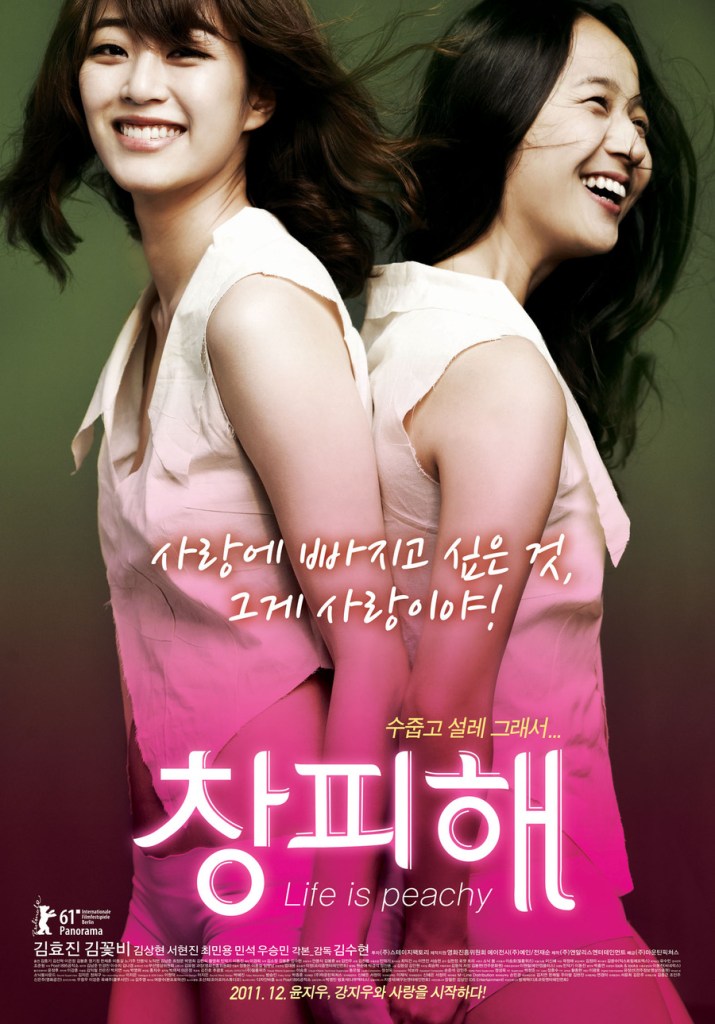 One of the very earliest films to address female same sex love in Korea, Ashamed (yes, really, but not quite – we’ll get to this later, 창피해, Changpihae, retitled Life is Peachy for US release) had a lot riding on it. Perhaps too much, but does at least manage to outline a convincing, refreshingly ordinary failed love romance even if hampered by a heavy handed structuring device and a lack of chemistry between its leading ladies.
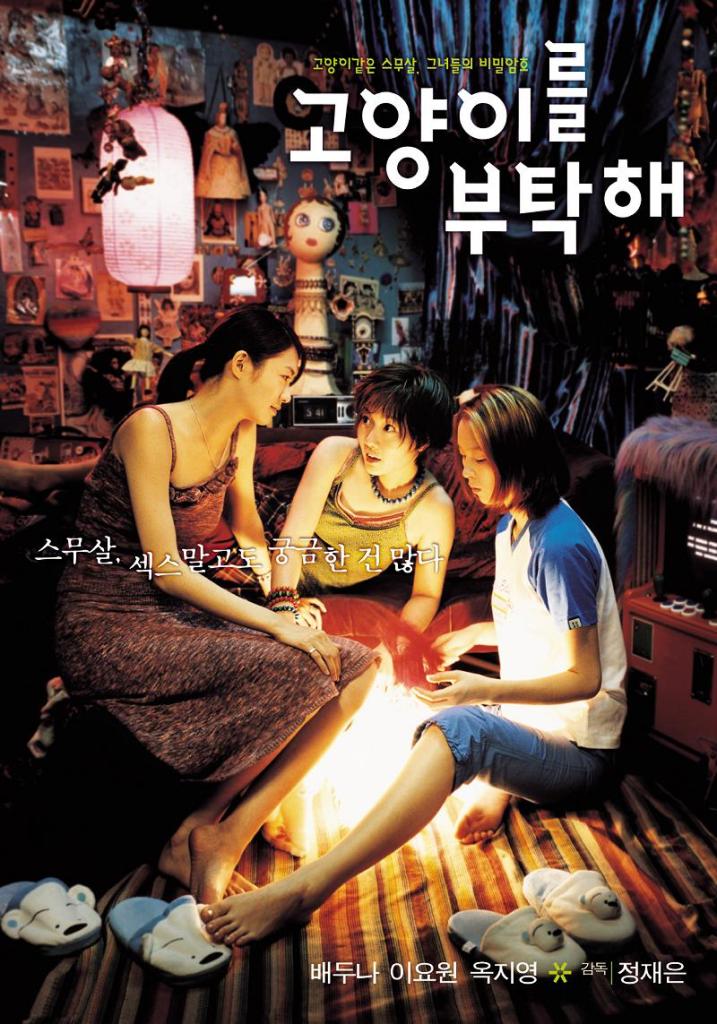 The time after high school is often destabilising as even once close groups of friends find themselves being pulled in all kinds of different directions. So it is for the group of five young women at the centre of Jeong Jae-eun’s debut feature, Take Care of My Cat (고양이를 부탁해, Goyangileul Butaghae). All at or around 20, the age of majority in Korea, the girls were a tightly banded unit during high school but have all sought different paths on leaving. Lynchpin Tae-hee (Bae Doo-na) is responsible for trying to keep the gang together through organising regular meet ups but it’s getting harder to get everyone in the same place and minor differences which hardly mattered during school grow ever wider as adulthood sets in.
 Sometimes God’s comic timing is impeccable. You might hear it said that love transcends death, becomes an eternal force all of its own, but the “love story”, if you can call it that, of the two characters at the centre of Song Hae-sung’s Failan (파이란, Pairan), who, by the way, never actually meet, occurs entirely in the wrong order. It’s one thing to fall in love in a whirlwind only to have that love cruelly snatched away by death what feels like only moments later, but to fall in love with a woman already dead? Fate can be a cruel master.
 Windows on Worlds