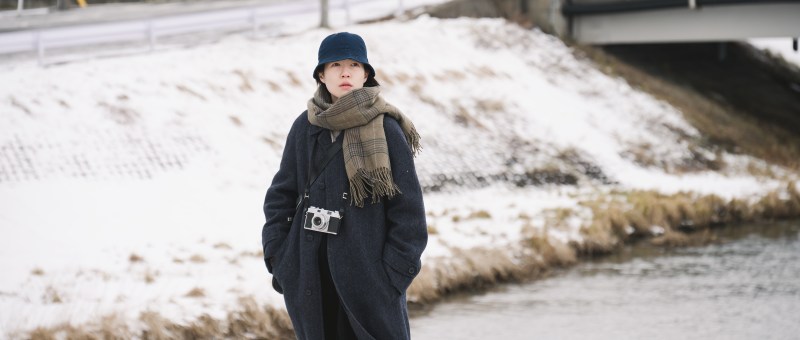
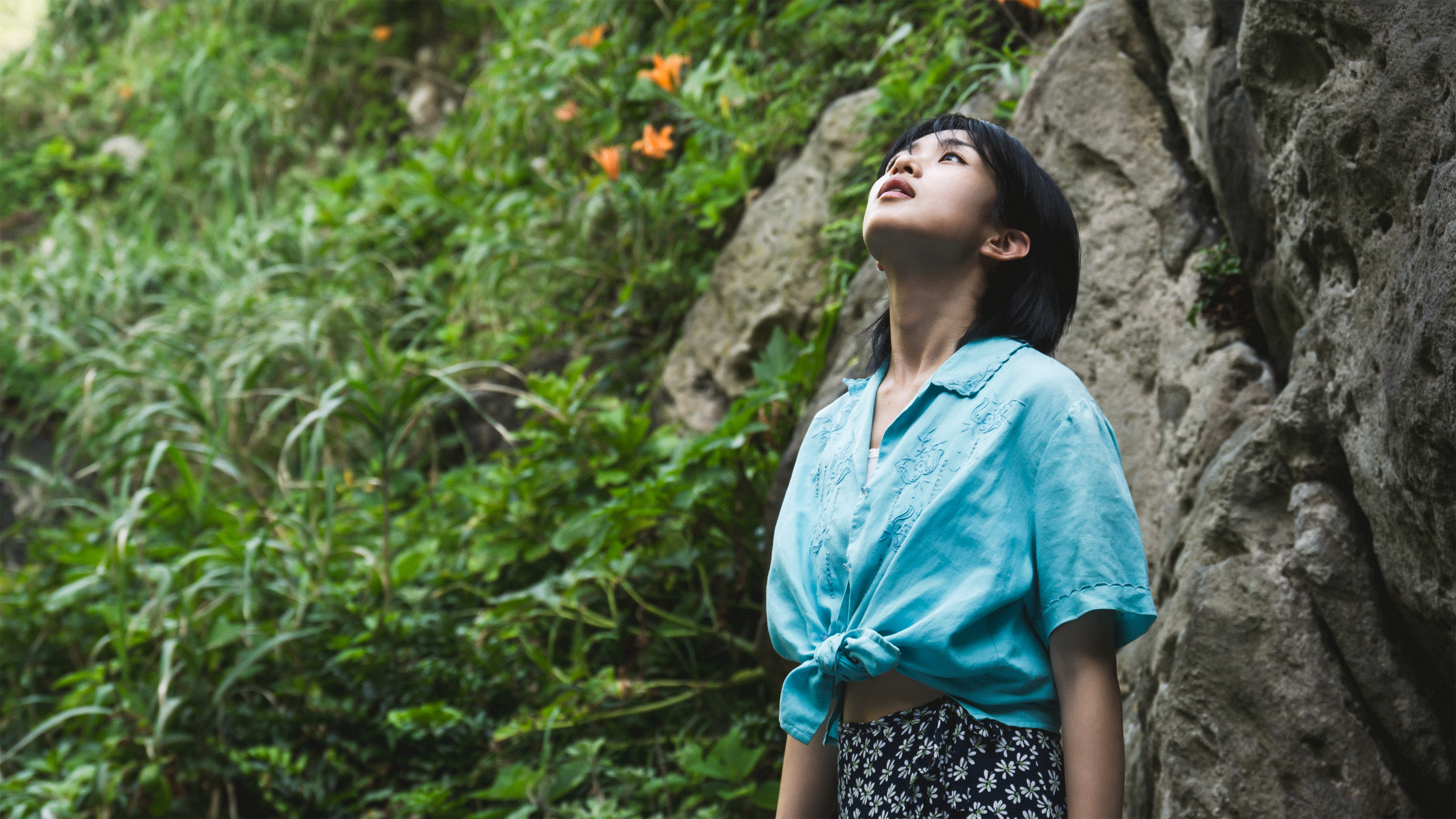
A young woman in flight from the city asks what if you could go on a journey and never return, start again in another place pretending to be someone else or perhaps truly be reborn? Her suggestion may hint a desire to escape oneself in travel, as if it were possible to leave unpleasant things behind and become an idealised version of oneself somewhere where no one knows you. Inspired by two manga stories by Yoshiharu Tsuge, Sho Miyake’s Two Seasons, Two Strangers (旅と日々, Tabi to Hibi), isn’t really so concerned with whether that is actually possible, but with the idea of travel as a means of liberation as the writer heroine struggles to free herself from “a cage of words” and somehow move beyond language.
Li (Shim Eun-kyung) writes in her native Korean which takes on a poetic quality at odds with the way she expresses herself verbally in Japanese which tends to be plainer, though warm and curious despite her outward shyness. She opens her screenplay with a woman waking up in a car “at a dead end” which is where she may feel herself be, though her isolation is echoed at a scene at a beach in which an Italian photography student tries to get a reserved Japanese man (Mansaku Takada) to pose naturally, taking off his sunglasses as if in an attempt to unmask him. He obviously can’t understand anything she’s saying, though the woman doesn’t seem bothered by it, and soon leaves the beach feeling uncomfortable to have been looked at in this way without much in the way of reciprocity.
A returned gaze might be what he finds in Nagisa (Yumi Kawai), a young woman on an impromptu island holiday trying to get away from something in the city. A professor at a screening of Li’s film describes it as sensual and erotic, which seems to confuse Li and perhaps hints at the ways he sees himself in it rather than what might have been intended. Another student, meanwhile, is moved by its depiction of loneliness and the impossibility of communication. Though set in the summer on a southern island, the scene is shot in blues that express the melancholy of the young couple who share a poignant connection that’s destined to end in sadness as Nagisa will soon return home. The final scene, set amid a typhoon, then becomes desperate and ominous despite its seeming serenity as Nagisa urges Natsuo to swim out further in the hope seeing fish with the suggestion that she is pushing him toward his death.
Benzo (Shinichi Tsutsumi), a gruff old man Li ends up staying with on an impromptu trip of her own only this time to snow country, echoing the famous novel as her train leaves the tunnel into a snowy landscape, says that he measures a piece of art on how well it depicts human sadness, which is something Li perhaps tried to do with her screenplay even if she says that her thoughts on seeing the film were that she has no talent. She tries to come up with something more organic inspired by the surroundings at Benzo’s mountain lodge, only to feel guilty and that perhaps she’s intruded on a private sorrow he may not actually have wanted to share despite suggesting she base her screenplay on her stay in an attempt to drum up business. Nevertheless, she strikes up an odd friendship with him and tagging along on his mission to steal a carp from a pond that turns out to belong to his ex-wife’s family as a kind of petty revenge.
Like Nagisa, she too will soon be moving on, to a new place to discover more of herself. While others make meta comments about the nature of drama, it may be that through the gift of a camera Li learns to look outward and gains an excuse for travel that takes her away from the introspection of her writing. As Natsuo had said, too much time to think can make you depressed, and though the stories she writes are sad rather than scary, as Nagisa had described Natsuo’s grim anecdote, they have an underlying darkness and sense of despair. Nevertheless, while the idyllic beachside setting of the summer segment may seem unusually chilly, Miyake finds warmth in snowy vistas of northern Japan which are, in their own way, a kind of blank canvas or a story waiting to be written by a traveller in search connection with oneself and the world.
Two Seasons, Two Strangers opens at New York’s Metrograph on April 24 with a limited nationwide rollout to follow.
Trailer (English subtitles)





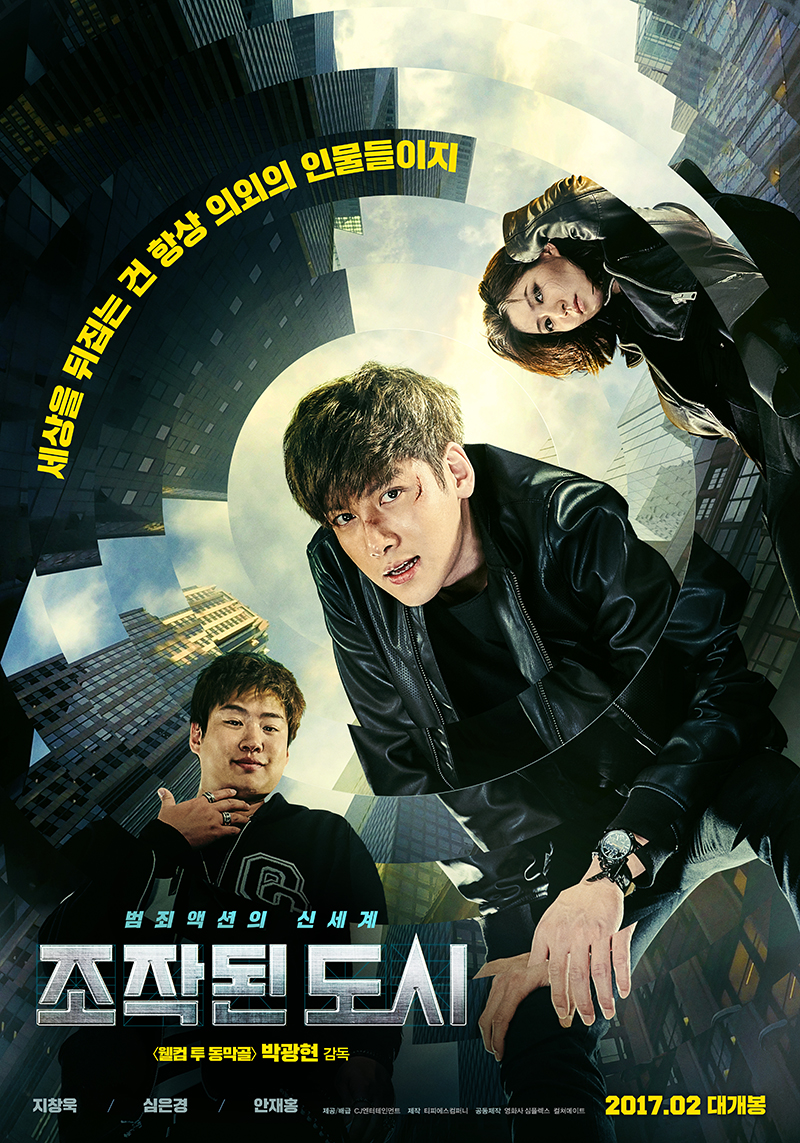 The real and the unreal. In the era of fake news, it’s become ever harder to draw a clear line between the two but when you live online, the borders are even more permeable. Twelve years after the wartime comedy Welcome to Dongmakgol, director Park Kwang-hyun finally makes a return to the director’s chair with an action packed cyberpunk thriller which joins the ranks of recent Korean films bemoaning the country’s hardwired tendency to social inequality where the rich and powerful are free to run roughshod over the merely ordinary. Fabricated City (조작된 도시, Jojakdwen Doshi) refers to more than just the literally manufactured online world, but to the social reality in which unseen forces govern and define the lives of others, operating in secret behind a government backed curtain.
 Many people all over the world find themselves on the zombie express each day, ready for arrival at drone central, but at least their fellow passengers are of the slack jawed and sleep deprived kind, soon be revived at their chosen destination with the magic elixir known as coffee. The unfortunate passengers on an early morning train to Busan have something much more serious to deal with. The live action debut from one of the leading lights of Korean animation Yeon Sang-ho, Train to Busan (부산행, Busanhaeng) pays homage to the best of the zombie genre providing both high octane action from its fast zombie monsters and subtle political commentary as a humanity’s best and worst qualities battle it out for survival in the most extreme of situations.