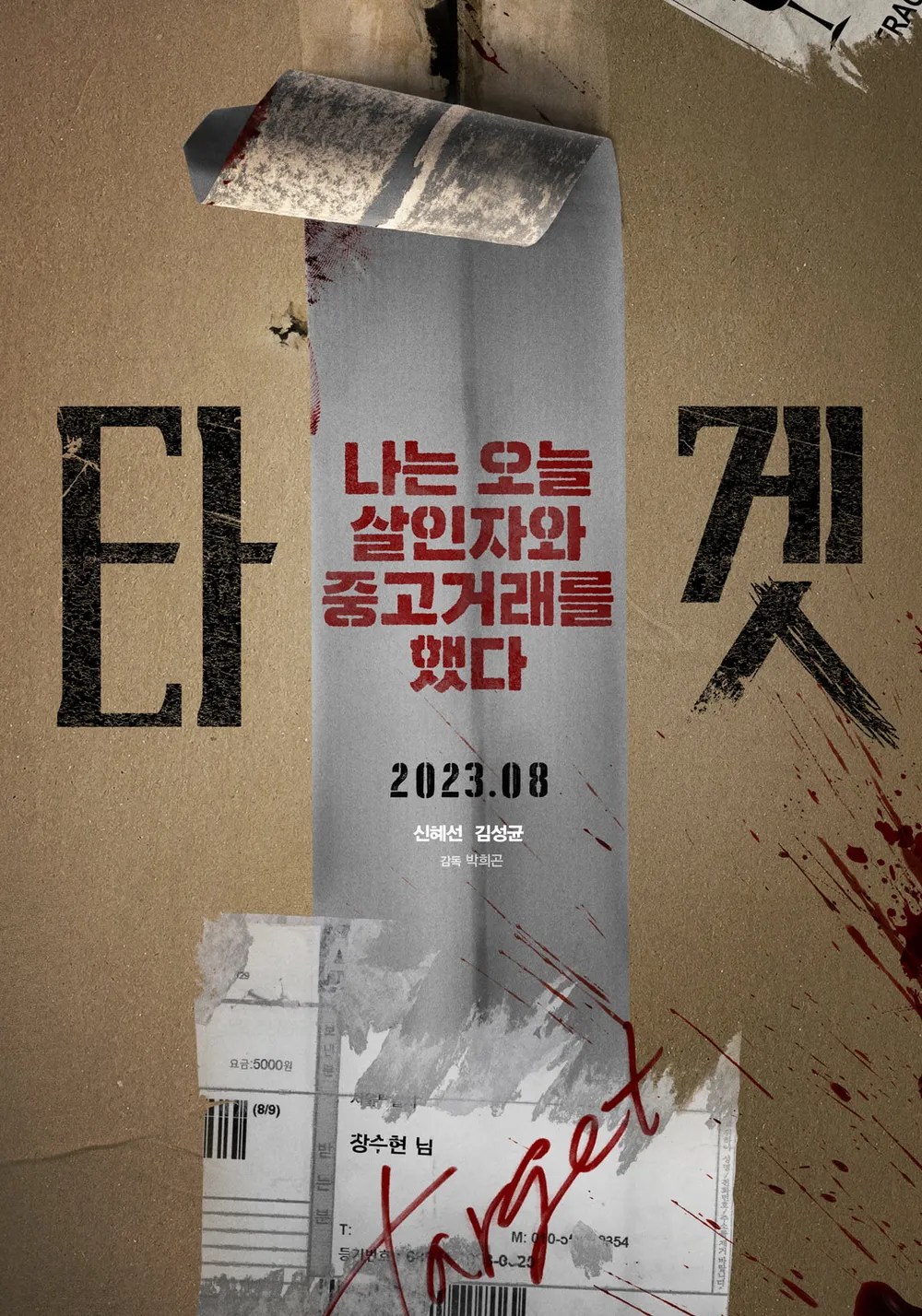
Don’t Buy the Seller (타겟, Park Hee-kon, 2023)

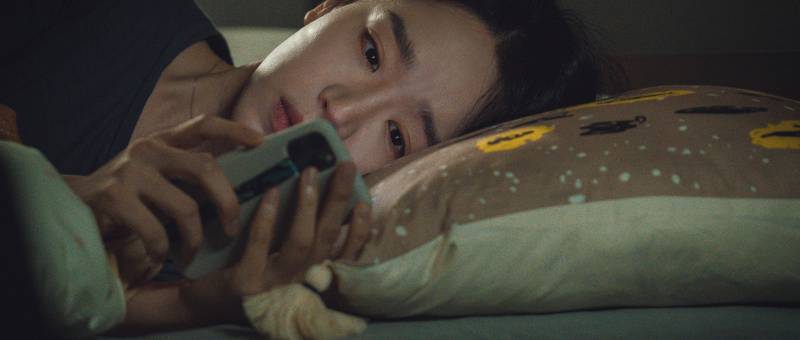
“Why do you always overreact?” a petulant craftsman eventually asks Soo-hyun, though Soo-hyun hasn’t overreacted so much as dared to assert herself in a world that often doesn’t listen to women. The irony at the centre of Park Hee-kon’s cybercrime thriller Don’t Buy the Seller (타겟, Target) is that it seemingly all unfolds because of a faulty washing machine, but like similarly themed films such as Door Lock, it soon becomes clear that Soo-hyun (Shin Hye-sun) isn’t really safe anywhere and there’s nothing this world objects to more than a woman who answers back.

In any case, it’s clear that Soo-hyun is not safe at work as her relentlessly creepy boss (Im Chul-soo) continues to sexually harass her while telling her off for taking things too personally when she finally complains. All he ever seems to do is yell at her for failing to enact his ludicrous demands while the guys at the construction site obviously don’t pay attention to her even though she’s the one managing this project. “Think he wants to work after being yelled at by a young lady?” one of the guys asks when one of the others doesn’t show up for his shift though Soo-hyun hadn’t actually yelled at him so much as asked him to please do his job and follow her instructions rather than ignore her in favour of his own judgement. 

She encounters a similar dismissiveness at the police station where she’s initially fobbed off as just another silly woman despite the younger policeman’s more sympathetic attempts to address her complaints even as his colleague leans over and explains there’s a four month backlog of fraud cases and they won’t even start to look for the guy who scammed her until then. Maybe he has a point, there are lots of victims of crime, but that only means they have lost the ability to enforce the law because the scammers know the police won’t catch them until they’re among the small number of unlucky criminals they do manage to get a lock on. Realising the police won’t help her, Soo-hyun vents her anger by tracking down the scammer on the reselling platform she tried to buy a washing machine from and leaving warnings not to buy on all his listings. Of course, this earns the stalker’s wrath because he too is another man who doesn’t like it when a woman answers back. 

But Soo-hyun has bitten off more than she can chew. This guy is seriously dangerous and into way more than just scamming people online by selling them broken appliances. We can see he has some kind of cyber lair and offers similar services to other men in which he agrees to provide a woman’s phone number, passwords, social media accounts and social security details to any man that wants them, for the right price. If he wants porn or videos posted, that’s extra. But it’s clear that a man with money can ruin a woman who says no with relative ease. Deep into his campaign, the stalker offers Soo-hyun the opportunity to end all this by paying him a large amount of money though as Soo-hyun knows there’s no guarantee he’ll keep his promise. Still after months of terror and constant harassment, she’s on the brink of giving in.

In this way, the stalker becomes an avatar of patriarchal male violence that slaps Soo-hyun right down in her place. She begins to feel insecure in the domestic environment as the stalker sends her nuisance deliveries of fast food at all hours of the day and night along with strange men who’ve been told to visit her for a good time and have evidently been given the code for the door lock. She’d only moved in here a week ago and moving out will incur a financial penalty she’s not well equipped to pay having been scammed in the first place. But the police seemingly can’t do anything while Soo-hyun is plagued by a sense of threat and unease that this person has so much control over her life and could turn up to cause her harm at any moment. Suddenly, she’s not a woman who answers back anymore but a timid and nervous zombie who can barely speak at all. 

Of course, this is exactly what the stalker wanted and what many of the men around Soo-hyun want too. They tell her to stop overreacting or that she brought this on herself by goading the scammer. They imply that she’s made herself an easy target by living alone and that buying goods second hand through apps which involve any kind of personal handover is inherently dangerous, but really they mean that like her friend Dal-ja (Lee Joo-young) she should have got married, chalked up getting scammed to experience, and above all kept quiet about it. Which is to say let her sleazy boss get away with making her feel uncomfortable as a kind of appeasement rather than challenge his behaviour or remind him that he does not have the right to make her feel this way, to abuse his position to interfere with her career, or otherwise oppress her. The message is, you don’t have to buy what they’re selling, faulty goods are after all not worth all this hassle.


International trailer (English subtitles)

12.12: The Day (서울의 봄, Kim Sung-soo, 2023)

Sometimes, the bad guys win. Kim Sung-soo’s long-awaited return after superb underworld drama Asura, 12.12: The Day (서울의 봄, Seoul-ui Bom) explores one of the darkest hours of recent Korean history as all hopes for democracy and freedom are dashed by a 1979 coup by General Chun Doo-hwan whose reign turned out to be far worse than that of his predecessor, Park Chung-hee who had been assassinated by a member of his own security team some months previously.

Yet Kim is less concerned with the coup itself than why so few people tried to stop it. Though everything appears to be going very badly for Chun (Hwang Jung-min), he eventually succeeds in taking Seoul by force while opposed by a solo general who is the lone guardian of justice and righteousness. Lee Tae-shin (Jung Woo-sung) first turns down a promotion to command the Seoul garrison and accepts it only when it’s explained to him that Jeong (Lee Sung-min), the army chief of staff, hopes to use him as a bulwark against Chun whom he fears is indeed preparing for an insurrection. Sure enough, Jeong is eventually abducted by Chun’s minions, who run the security division, on a trumped up charge of being involved with Park’s murder while Chun desperately needs the duly elected president of a democratising Korea to sign his arrest warrant so his blatant power grab will be legitimised rather than branded a “coup”.

Only the president doesn’t play along. He insists on following proper protocol and getting the approval of the defence minister all of which is vexing for Chun who is left humiliatingly standing in his office while the president holds his ground. The defence minister has, as it turns out, fled to the American embassy in his pyjamas where he finds little sympathy while the film subtly implies that the Americans advise him to return and back Chun who is doubtless considered much more useful to them politically.

Though Tae-shin and another officer at HQ try to warn of a brewing coup, their orders are often overruled by superiors either because they do not take the situation seriously or are actively siding with Chun whose “Hanahoe” faction has taken over a significantly large proportion of the military. Kim zooms in on militarism as the fatal flaw in this botched defence system as it seems no one can act without first receiving an order from above nor are they equipped to make critical decisions on a personal level as to whether or not an order should be obeyed. Tae-shin calls on countless devisions for backup but finds them either actively allying with Chun or refusing to get involved believing it is a hopeless battle. Tae-shin asks what the army is for if it refuses to fight at the crucial moment and abandons its responsibility to protect the interests of its citizens in simply allowing Chun to seize power but receives no real answer. 

Chun has already aroused suspicion for his handling of the investigation into Park’s death, reportedly bringing in countless people with no obvious connection to the case and torturing them. The men who support him want to continue Park’s “glorious revolution” which was in itself a repackaging of Colonial-era Japanese militarism, and fiercely resist the idea of “democracy” advocating totalitarian views that the ordinary person longs for a strong hand at the wheel and to be absolved of the responsibility of choice which ironically fits perfectly with hierarchal structure of the Army. The film paints Chun, slight, small, and bald, as a man with a chip on his shoulder apparently resentful of military elites and the wealthy. He craves power because of his own insecurity and a desire to get one over on righteous men like Tae-shin which might be why his line about Chun being unworthy of the uniform of a Korean solider seems to get to him. 

Using the film language of the 1970s such as heavy grain and split screens, Kim keeps the tension on a knife edge even though the conclusion is all too inevitable. Tae-shin cuts a heroic figure, standing alone on a bridge and forcing back the advancing tanks solely with his imperious righteousness but in the end it’s not enough, there are too few like him and too many like Chun whose maniacal laughter is intercut with scenes of Tae-shin in the torture facility which lies beneath the facade of government. Bleak, but also angry, Kim’s extraordinarily controlled political thriller is damning in its condemnations of a militarising culture and the ever present threat which accompanies it.


International trailer (English subtitles)

Hansan: Rising Dragon (한산: 용의 출현, Kim Han-min, 2022)

“A battle of the righteous against the unrighteous” is how Admiral Yi (Park Hae-il) frames his resistance against the Japanese invasion, not a war between nations but an attempt to push back against the authoritarian ruthlessness of Toyotomi Hideyoshi’s desire to conquer most of Asia in a bid to cement his historical legacy as his health continued to fail. Hansan: Rising Dragon (한산: 용의 출현, Hansan: Yongui Chulhyeon) is a kind of prequel to 2014’s The Admiral: Roaring Currents set five years earlier during Hideyoshi’s first campaign and pits the the wise and steadfast Admiral Yi against ambitious yet overconfident Japanese general Wakizaka* (Byun Yo-han). 

Wakizaka’s ruthless cruelty is not in dispute even as the film opens with him dispatching a report stating that he intends to destroy the Korean naval detachment harboured on the southern coast which it seems is all that stands between him and conquest of the peninsula in its capacity to disrupt his supply line. When some of his men return in defeat talking about a “Bokkaisen” with a dragon’s head spouting fire, Wakizaka orders them killed to stop them spreading rumours of supernatural threat among the troops. Retrieving what looks to be a dragon’s tooth from the ruined vessel he begins to realise there might be something their story but still doesn’t take the threat of Admiral Yi’s fleet very seriously. 


Admiral Yi meanwhile, who was wounded in the same battle pitching his bow and arrow against a Japanese rifleman, is plagued by dreams and anxiety while trying to sort out a strategy for dealing with the Japanese invasion. Some of his fellow officers think offence is the best defence and they should try to strike before Wakizaka is able to amass his forces, while others think they should play it safe and continue to defend the coast. He and his chief engineer are working on improvements to their turtle boat which had so spooked the Japanese soldiers at the previous battle but at the same time had its limitations. They don’t call it a turtle boat for nothing, on ramming into the Japanese vessel its dragonhead became lodged in the side locking the two boats in a deathly embrace. Yi suggests removing it, but as it turns out the ability to latch on to the enemy like a snapping turtle can also be an advantage if you know how to use it while figuring out how to get the best out of limited resources, along with managing interpersonal relations, turns out to be Wakizaka’s weakness. 

Ever ambitious, Wakizaka is distracted by petty rivalry with his co-general who disagrees with his strategies and eventually betrays him. A Korean-speaking Japanese retainer sent as a spy later decides to defect precisely because of this ruthless disregard for the lives of one’s fellow soldiers, struck by Yi’s personal presence on the battlefield and willingness to put himself in harm’s way to protect his men. Though he is originally viewed with suspicion by some, Junsa (Kim Sung-kyu) is embraced as a fellow soldier after joining the defence forces at an inland fortress and told that all that is necessary is that he have a “shared righteous spirit” fighting together against the “unrighteous” Japanese invasion. 

In any case, neither Wakizaka or the Japanese care very much about Korea all they’re doing is clearing a path to China. Meanwhile, the nervous king continues to travel North leaving his generals fearful he will defect to the Ming and they will end up losing their sovereignty to China if not to Japan. Wakizaka’s strategy is somewhat hubristic, leaving himself vulnerable in the rear as he pushes forward while using land tactics to fight a war at sea and thereby allowing Yi to set a trap for him perfectly tailored to his vain complacency. Wakizaka may have the numbers, but Yi has superior technology and the respect of his men. Quite fittingly the real Wakizaka was marooned on an island after the battle and had to survive on seaweed while waiting for his chance to escape. With plenty of spy action, double crossings and betrayals, Kim Han-min saves the big guns for the final naval battle which begins in ominous fog before exploding in all out war but still makes clear that the battle is on the side of righteousness and that Yi owes his victory to human solidarity and compassion (leaving aside his torture of suspected spies) and Wakizaka his defeat to hubris and cruelty. 


Hansan: Rising Dragon screened as part of this year’s New York Asian Film Festival and is in US cinemas now courtesy of Well Go USA.

*these subtitles use Wakizaka but his name is sometimes also romanised as Wakisaka.

International trailer (English subtitles)

Images: Courtesy of Well Go USA Entertainment

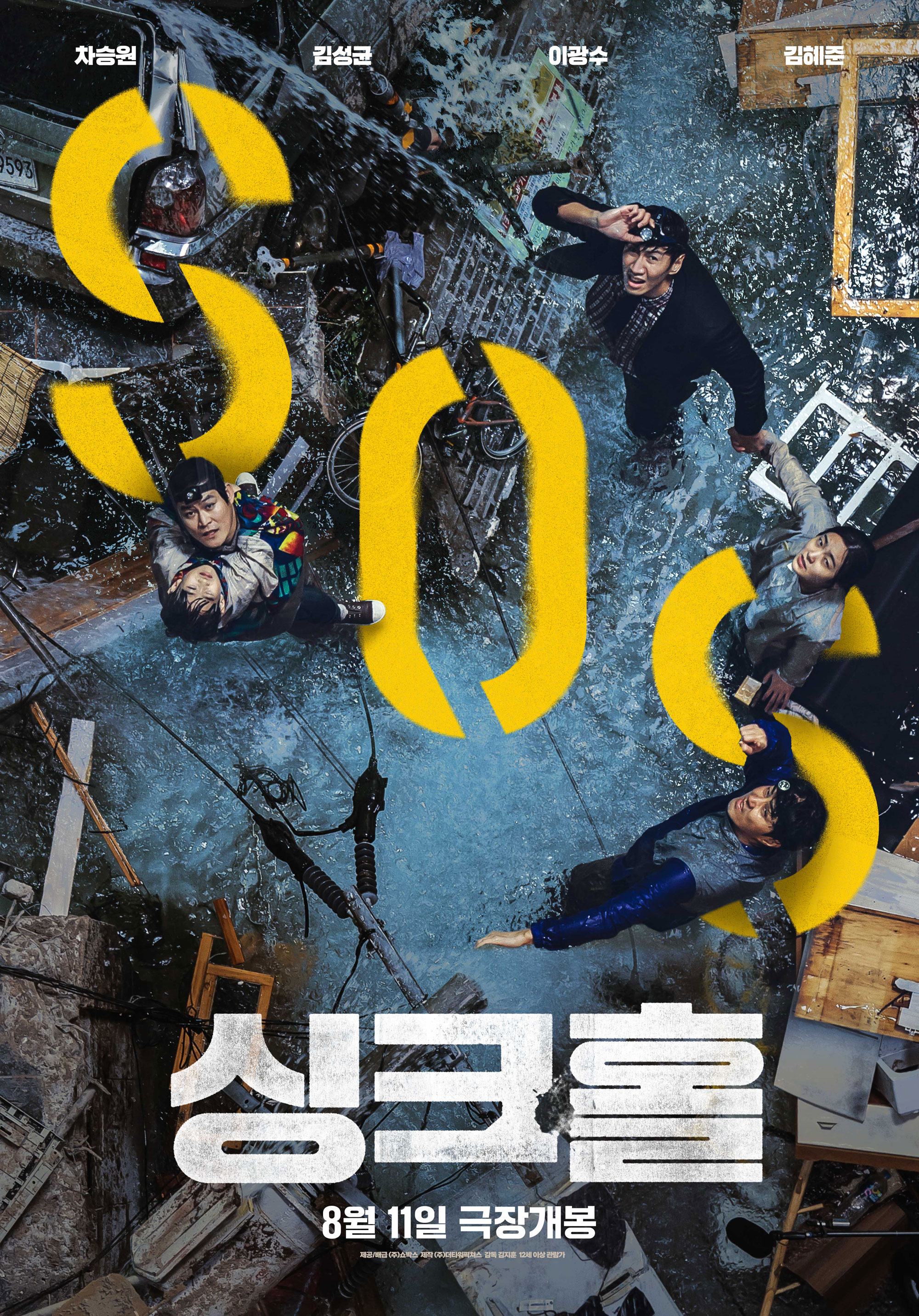
Sinkhole (싱크홀, Kim Ji-hoon, 2021)

Financial security is built on shaky ground in Kim Ji-hoon’s harrowing disaster dramedy Sinkhole (싱크홀) in which one man’s home-owning triumph quite literally crumbles beneath his feet. The latest in a recent series of movies lamenting the sometimes lax safety culture of the Korean construction industry, Sinkhole is also a crushing indictment of a society ruled by house prices in which social status is largely defined by the owning of property while the young in particular struggle to climb out of a deep well of societal despair. 

As the film opens, the Park family is about to move in to their new flat, the first they’ve ever owned albeit with a frighteningly large mortgage, in the middle of a seasonal downpour. Only when they arrive, they discover the movers haven’t even started unloading because their apparently irresponsible neighbour Man-su (Cha Seung-won) has inconsiderately parked his car in front of the entrance and isn’t answering his phone. Patriarch Dong-won (Kim Sung-kyun) ends up in an awkward confrontation with the abrasive apartment dweller which is inconvenient because Man-su apparently works in just about every business in the area which means he continues to run into him just about everywhere he goes. 

Anyway, that’s the the least of his problems because, having made this giant investment, Dong-won can’t help thinking there’s something wrong with his new dream home especially when his adorably polite young son Su-chan points out that his marbles roll across the floor of their own accord. Worried they may have a subsidence problem, Dong-won checks his windows open properly and records evidence of ominous cracks in the pavement outside but struggles to get the other residents to agree to maintenance checks in fear that not getting the answer they want will bring down the value of their property. 

Property prices are apparently everything. Homeownership is an unobtainable dream for many, yet Dong-won already feels insecure in his purchase especially as his colleagues seem relatively unimpressed by the fact his flat is in a recently gentrified area and comparatively modest. Bamboozled into hosting a housewarming, he’s mildly embarrassed to realise the view from his balcony is of nicer, much more expensive luxury flats just across the river which are likely to remain far out of his reach. Nevertheless, his colleague, Seung-hyun (Lee Kwang-soo) declares himself jealous in part because he’s still renting a studio flat and feels that dating let alone marriage is impossible without being in a position to get a multi-room apartment. His colleague Eun-ju (Kim Hye-jun) is in the same predicament but prefers to see it as simply being at a certain stage on the ladder.  

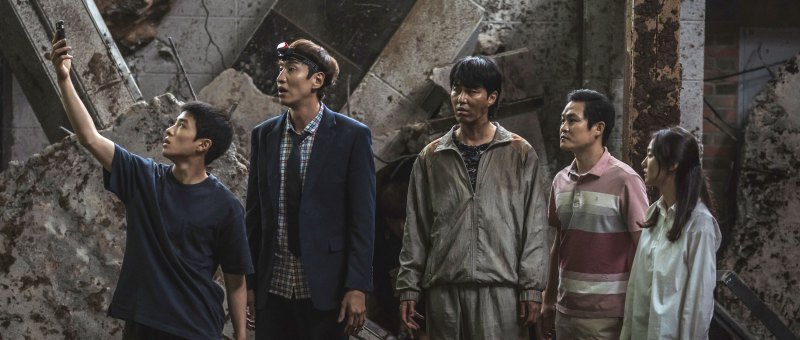
This dream of future security is however quite literally built on shaky ground. There are definitely problems with Dong-won’s new apartment which become increasingly severe from the tilting floors to cracked glass and interruptions with the water supply presumably caused by cost-cutting and shoddy construction practices. When the building collapses into a sinkhole, Dong-won is trapped inside with work colleagues Seung-hyun and Eun-ju along with Man-su and his teenage son Seung-tae (Nam Da-reum). Despite the inherent horror of the situation, Kim keeps the atmosphere light as the small band of survivors attempts to manage as best they can, finding an awkward solidarity while trying to attract the attention of the emergency services and eventually making a daring escape using whatever tools are available to them. 

Even so, as much as the small band of almost strangers bond thanks to their desperate circumstances, there is an uncomfortable conservatism at play especially in the film’s treatment of a working class single mother and her son living in an apartment on the floor below Dong-won’s. That aside, Sinkhole offers a fierce criticism of an increasingly consumerist society in which house prices are all anyone talks about and homeownership is the only badge of social success. 11 years of patient sacrifice is swallowed in an instant, sucked into an abyss of corporate malfeasance, while Dong-won is left to climb out of the hole he’s in on his own. It’s small wonder that some of the survivors decide to drop out of the system altogether, ditching the idea of rooted homeownership for nomadic freedom in buying a small caravan rather than participate in the property market or climb the corporate ladder. “Don’t be happy in 10 years, be happy today!” they enthusiastically chant. The entire society is, it seems, sitting on a sinkhole which might give any minute, what’s the point in investing in a future which could disappear from beneath your feet without reason or warning? 


Sinkhole screened as part of this year’s New York Asian Film Festival.

International trailer (English subtitles)

Fengshui (명당, Park Hee-gon, 2018)

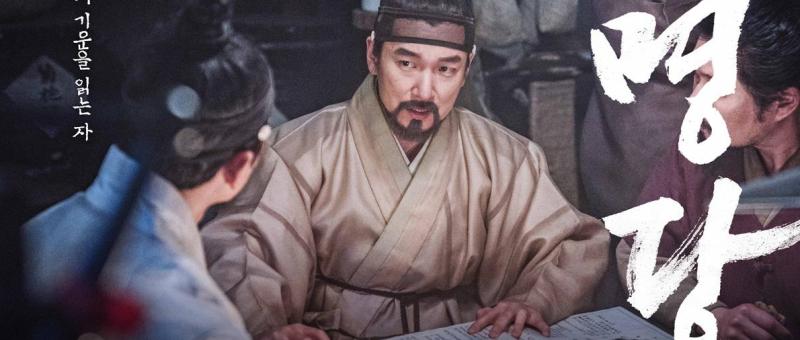
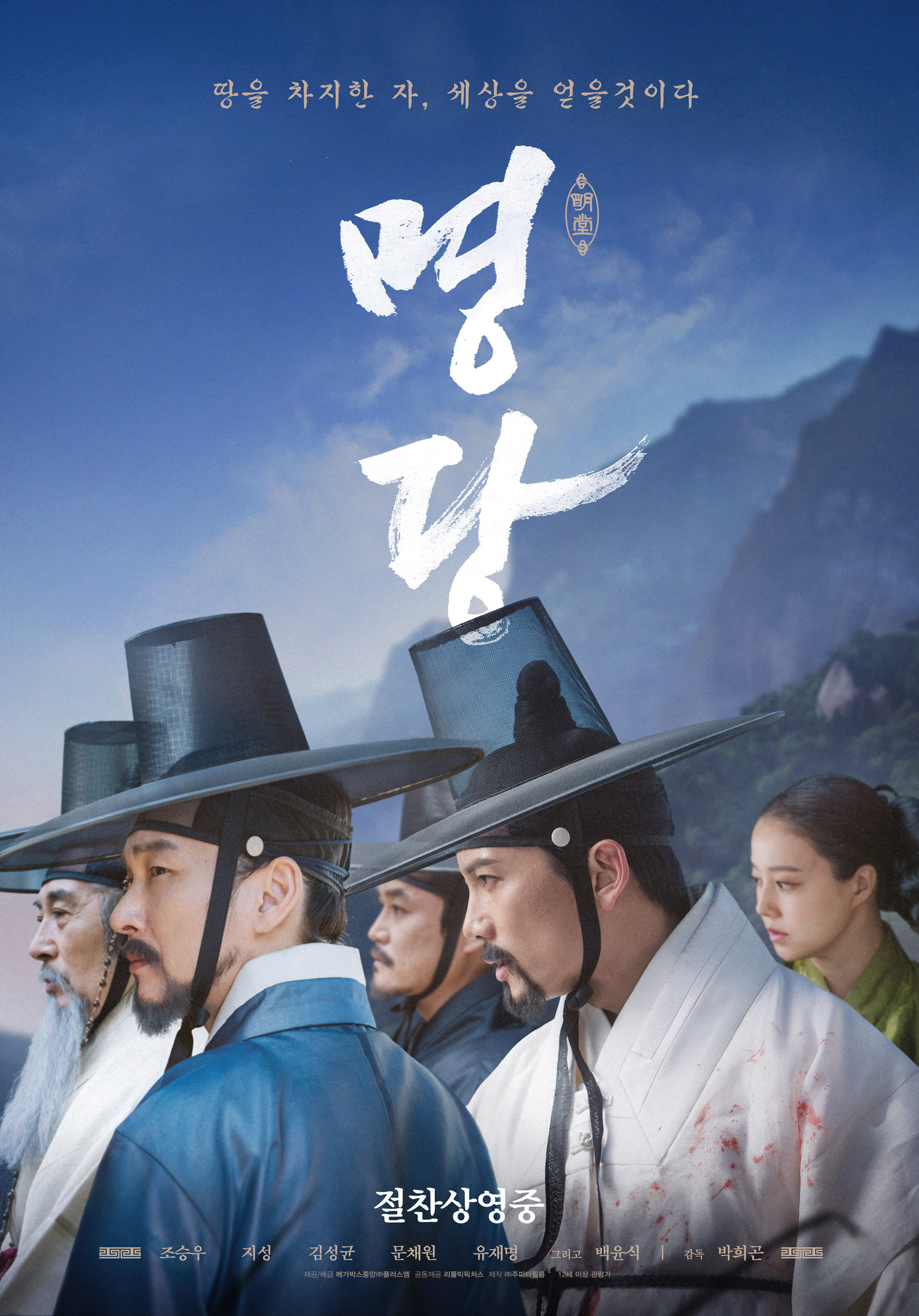
FengShui poster 1A would-be-dynast gets overly involved with a weird spiritualist and almost (?) ruins the nation. Does that sound a little familiar? As metaphors go, it might be a stretch but then so much of Park Hee-gon’s Fengshui (명당, Myeong-dang) is just that. Set in the late 19th century, Park’s film is the third in a loose trilogy themed around Korean fortune telling traditions (following The Face Reader, and The Princess and the Matchmaker), but rather than questioning the efficacy of its art asks a series of questions about its application and the internecine lengths those who lust for power or otherwise feel themselves unfairly oppressed will go to to reclaim their rightful position.

Our hero, unwisely honest fengshui master Jae-sang (Cho Seung-woo), is the only one brave enough to point out that the site chosen for the burial of the late king is cursed, but inevitably he is ignored. He is of course right, which means he must be eliminated which is why a troop of soldiers working for the nefarious Kim clan show up and burn his house down, executing his wife and child by the sword when they manage to escape. 13 years later, he finds his expertise called on again when the weak and inexperienced king begins to suspect the Kim clan is plotting against him and that their shenanigans over his father’s grave may have something to do with it.

Like any typical Korean period drama, Fengshui is chiefly concerned with palace intrigue, only this intrigue is stranger than most in its bizarre obsession with the possibilities of manipulating spiritual power through acquiring “auspicious” land for whichever purpose one might wish from conceiving an heir to making sure your line holds power. The Kims are convinced they can win the throne (if by proxy) through digging up their ancestors and replanting them in more advantageous places only to discover that the grass is (literally) always greener. Still, they will stop at nothing from outright murder to psychological game playing in order to manipulate the teenage king into acting as their puppet.

One might ask themselves what the point is, what’s so great about being king anyway? The actual king might say not much, as he discovers himself a humiliated, hollow figure who wields no real power seeing as his soldiers seem set to side with Kim. Heungseon (Ji Sung), however, his “cheerful” uncle might feel differently after experiencing a lifetime of just the same. Forced to prance about doing party tricks for the Kims, barking and eating scraps from the floor like a mangy dog, he might say that being king is the only way to reclaim your self-respect and ensure you will never be at the mercy of ruthless men ever again.

The real key, however, is presented at the end when Jae-sang and his money loving friend Yong-shik (Yoo Jae-myung) are visited some years later by two men in suits who want to know the best place to start a military school to train Independence fighters. Jae-sang, having vowed to stop looking for places to bury people so he can find one to save them, is only too happy to oblige and even comes up with the name “Shinheung Military Academy” (a real school which is also, quite bizarrely, the subject of a smash hit musical). The point is further brought home with Kim’s descendent standing next to a family grave and lamenting that it can’t have been auspicious enough because they’ve lost all their power since the Japanese arrived. The subtext seems to be that feudal corruption and a subversion of traditional values such as ancestor worship and filial piety contributed to the gradual weakening of the Korean state which was plagued by insecure kings and political finagling until finally “sold” to foreign powers in the early 20th century.

Indeed, the ambitious usurpers eventually burn the soul of Korea in order to ensure their own, or rather their children’s, futures even at the expense of their nation’s. Literally fighting over a grave, the elites waste their time on pointless, internecine dynastic squabbling while ordinary people continue to suffer. Jae-sang, having given up on his own petty quest for revenge, comes to the conclusion that all this looking back is a waste of time when what they should be thinking about is the future – not burying things, but planting them. It is a good lesson, but, Park seems to suggest, perhaps one that has not yet been fully learned.


Screened as the latest teaser for the upcoming London Korean Film Festival. The next teaser screening, Zhang Lu’s Ode to the Goose, takes place on 19th August at Picturehouse Central.

International trailer (English subtitles)
The Witness (목격자, Cho Kyu-jang, 2018)

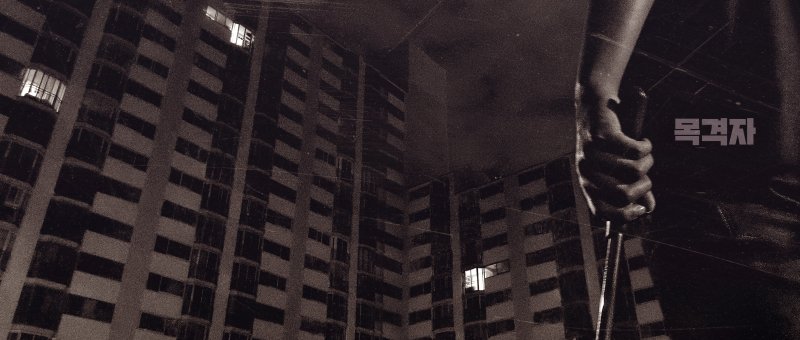
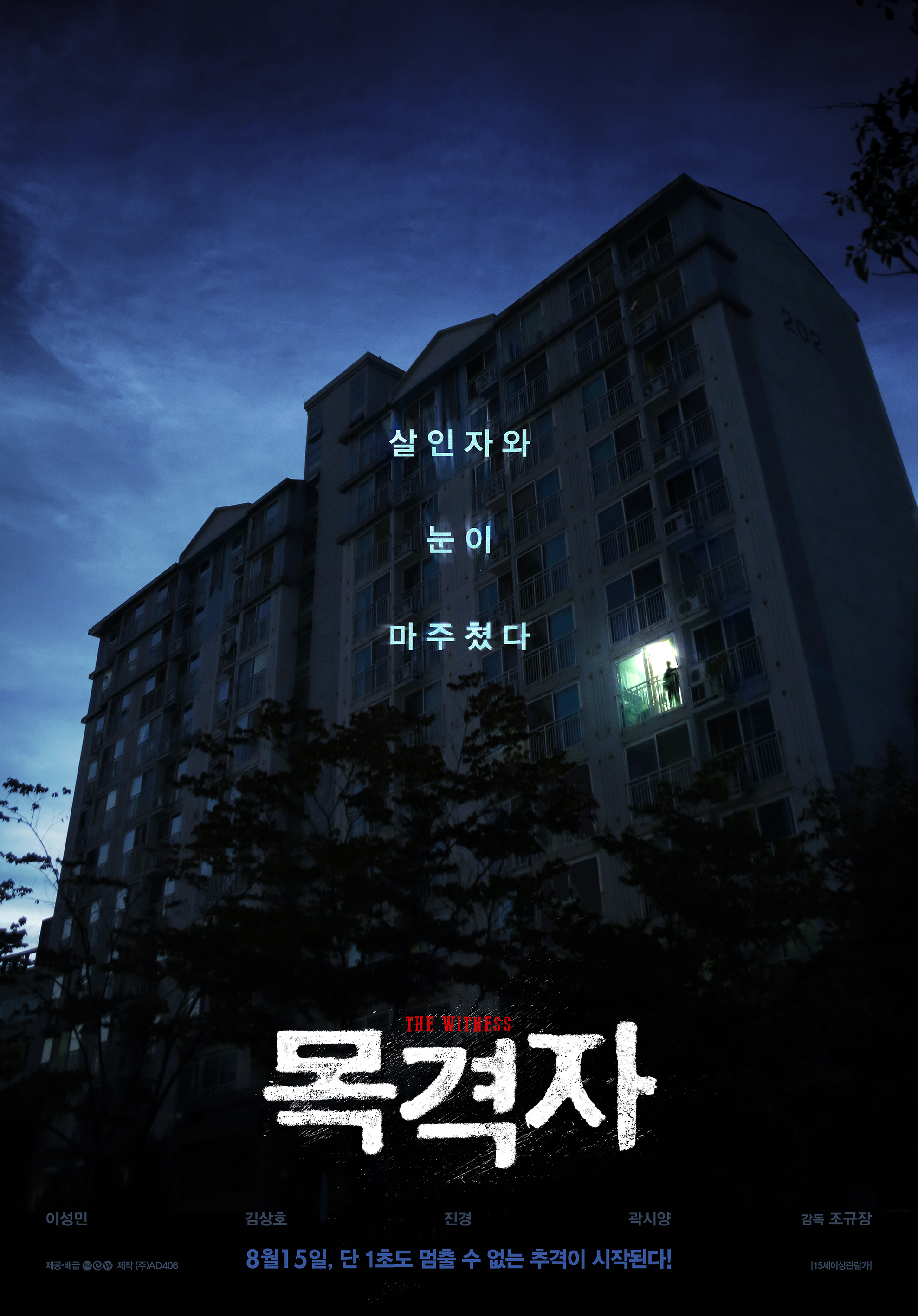
The Witness poster 2The murder of a young woman outside of her New York apartment block in 1964 became a psychology text book standard thanks to the fact no one had raised the alarm or come to help her. Later investigations more or less debunked the so called “bystander effect”, at least in this instance, but it remains broadly true that those who find themselves witnessing a distressing incident fully expect that “someone” will be dealing with it, conveniently forgetting that they too are “someone”. The hero of Cho Kyu-jang’s The Witness (목격자, Mokgyeokja) is only one of many to temporarily distance himself from his community when he fears he has locked eyes with a killer and inadvertently made his family a target for retribution.

Sang-hoon (Lee Sung-min), a middle-class lawyer, is riding high after buying a new apartment (with a hefty mortgage) for his wife and daughter. Rolling home drunk after an evening drinking with colleagues, he opens yet another beer and gazes out over the balcony of his new apartment musing on how great his life is only to be confronted with a screaming woman being chased by a violent man in the courtyard. She falls and the man strikes her. Sang-hoon struggles for his phone but drops it in drunken shock. His wife emerges from the bedroom and alerts the killer to their presence by turning the lights on. Sang-hoon snaps them off and goes back to the balcony where he is convinced the killer has seen him. Paranoid, he forgets all about the poor woman bleeding on the concrete below and spends the night in his hallway clutching a baseball bat just in case.

He doesn’t know it yet, but Sang-hoon has indeed made himself a target for a marauding “random” killer. Afraid and ashamed, he decides to keep quiet. It would be easy enough to read Sang-hoon’s unwillingness to get “involved” in other people’s business as a hangover from an upbringing in an authoritarian regime in which keeping your head down and your nose clean might be essential tools for survival, but it’s also fair to say that his attitude is defined as much by notions of middle-class respectability as it is by cowardice and selfishness. An old busybody in the apartment block is constantly banging on about the house prices, getting the residents to sign a legal waver promising not to cooperate with the police or the media to avoid the name of the community becoming linked with violent crime. Sang-hoon says he wants to protect not only his wife and daughter, but their home too. His hopes and dreams are bound up with conventional homeownership. This is the way he intended to fulfil his male obligations to protect his family, but now it’s being threatened in a way he never expected and he finds himself tested.

Despite himself, Sang-hoon does feel he ought to help those in need. He bristles when his wife wants him to help out a friend whose child was injured in a car accident that the police didn’t bother to investigate properly, because he knows it’s a lost cause and she’s better to settle. He feels sorry for her, but not enough to rock the boat. Being a lawyer he perhaps knows what a risk it can be when the wrong people know where you live, but he’s at constant battle with himself knowing that the killer is still out there and will likely kill again. If he’d only called an ambulance instead of cowering by the front door, the poor woman might have survived – her death is on his hands as much as the killer’s because he chose to do nothing. The body count will only rise all while Sang-hoon tries to hedge his bets, calculating whether he’s better off keeping quiet and hoping the killer appreciates his complicity or surrendering himself to the police in the hope that they can protect him by taking the killer out of the picture.

Sang-hoon’s desire not to get involved has left him very involved indeed. He hoped it would all go away if he turned a blind eye and kept himself out of it, but like it or not he is a member of a community and he has a responsibility which cannot be abnegated. It turns out the best way to protect your family is protecting other people’s, maintaining a herd immunity to the threat of violent crime. There is, however, a reason they tell you to shout “fire” and not “help” – people are selfish and if they hear fire they know they are in danger too so it’s in their interest to come running, if it’s only you in danger they may not put themselves out. Sang-hoon’s brush with the embodiment of random threat does at least release him from the ingrained isolationism of the aspirant middle-classes in which any kind of fellow feeling is distinctly frowned upon, allowing him free rein to embrace his natural tendency towards altruism safe in the knowledge that his desire to help is not a weakness but a strength that will keep his family safe through the interconnectedness of a compassionate community.


The Witness was screened as part of the 2018 London Korean Film Festival.

International trailer (English subtitles)
The Poet and the Boy (시인의 사랑, Kim Yang-hee, 2017)

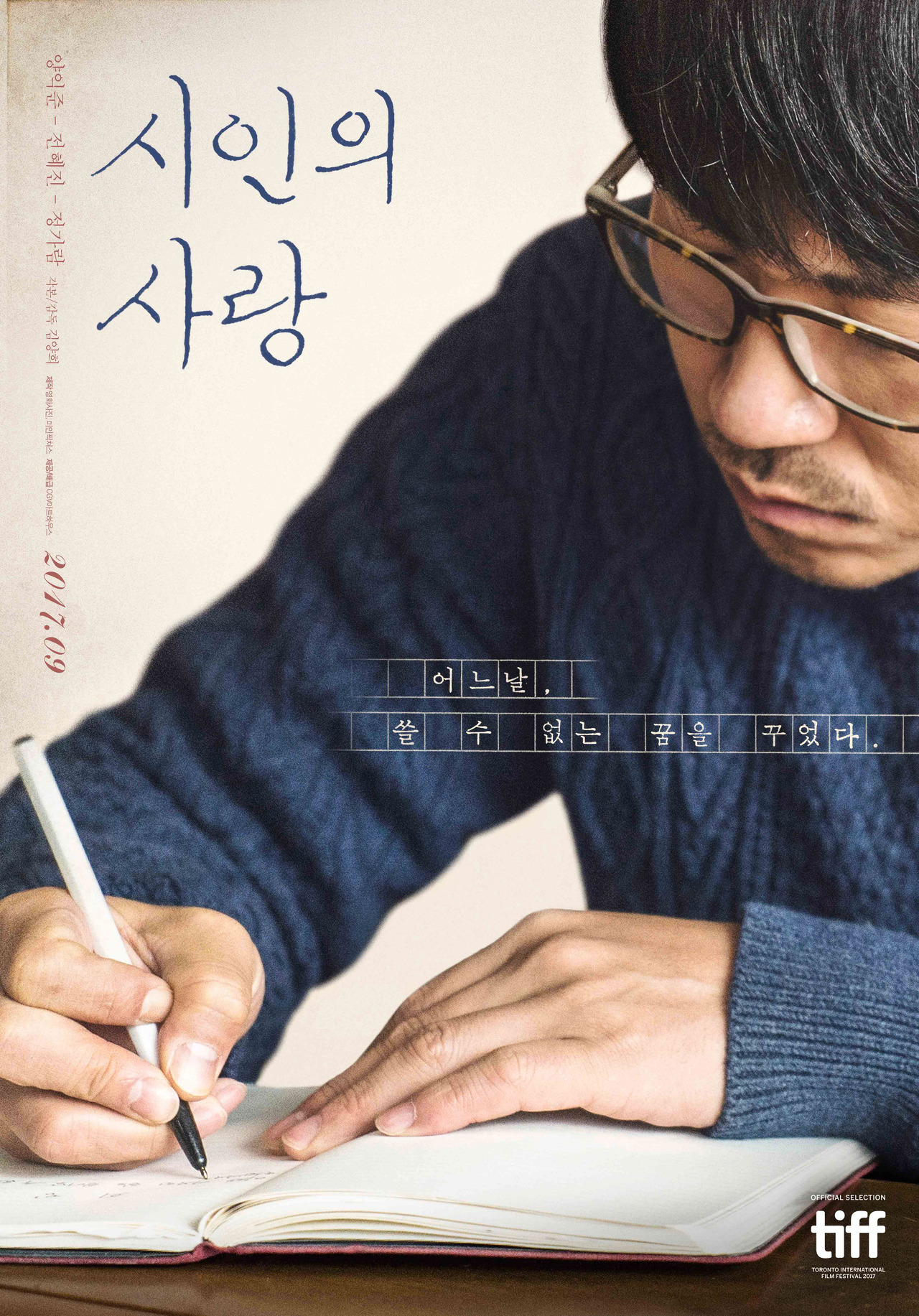
Poet and the Boy posterA poet cries for the sorrow of the world, according to the hero of Kim Yang-hee’s melancholy drama, The Poet and the Boy (시인의 사랑, Sienui Sarang). Unfortunately for him, he lives in his own poet’s world, lonely and disconnected but never knowing the true depth of sadness which would give his verse meaning. Until, that is, he falls in love. Beauty turns out to be a doubled edged sword for a mild mannered yet emotionally brave artist struggling to comprehend his place in the world but discovering that some of it, at least, has already been decided for him.

Hyon Taek-gi (Yang Ik-june) is a 30-something aspiring poet married to a feisty shopkeeper. The couple have been married several years and though they are happy enough together, theirs is a marriage born more of convenience than passion. Having married “late” each has settled in to making the best of things, sure that a greater love will one day blossom between them. Mrs. Hyon (Jeon Hye-jin), feeling an absence in the family home, has been longing for a baby but Taek-gi has never been especially interested in that side of things and isn’t really keen on the idea of becoming a father.

Meanwhile, a brand new donut shop has just opened up in town which is good news for Taek-gi because donuts are one of his favourite things. Unsure whether it’s just his status as a purveyor of sweet goods, Taek-gi develops a fascination with the beautiful boy at the bakery (Jung Ga-ram) which is further inflamed when he accidentally catches sight of him in amorous moment with a female customer. To his mild surprise, Taek-gi finds himself captivated with the male physical form, experiencing feelings and desires he had not even known existed.

As his wife later puts it, a poet’s world is different. Taek-gi stops to appreciate the flowers, watches the children play, and makes a round about detour to a fast food restaurant to observe human life but he doesn’t quite live in the world he inhabits or allow himself to truly experience its beauty. As we first meet him, Taek-gi is writing a poem to open the map of his heart but quickly finds himself lost and wandering, unable to settle on a clear direction and ending up at a disappointingly familiar destination. The poem is interesting but imperfect, somehow hollow and inauthentic.

Taek-gi’s creative block is also an emotional one. What begins with a single moment of captivating beauty expands into something deeper and warmer as the poet gets to know the boy on a more intimate level. Seyun is a troubled young man from an impoverished family caring for his bedridden father while resenting his coldhearted mother. What he sees in Taek-gi is something between friend and father, both wary of and delighting in unsolicited kindness from a virtual stranger. Taek-gi’s wife teases him about his attraction to Seyun, probing him about the nature of their own strange relationship. She wonders if it’s really “love” without intense physical desire – something he has made repeatedly clear that he does not feel for her. Taek-gi insists that it is, citing another romanticised love which remained chaste as further evidence only for his wife to fire back that perhaps all he really wanted was the sadness of unfulfilled longing to complete his poetic world view.

Taek-gi later takes his words back, insisting that what he feels for his wife is not “love” and that their relationship was always doomed to fail. Yet it’s not carnal desire which brings him to this realisation so much a greater motion towards connection. Taek-gi who was always ill-equipped for life and never able to take care of himself, begins to look after the younger man both physically and emotionally asking for nothing in return other than his continued company. Despite his otherworldliness and alienation, there is something uniquely brave in Taek-gi’s willingness to tug on the thread of an unfamiliar feeling, uncertain what it is or might be but determined to find out. Disregarding the conservative values of his society which have led him to embrace conventionality in marrying “late”, supposedly “grateful” that someone allowed him the opportunity to marry at all, Taek-gi moves forward if cautiously, aware that his desires may not be accepted and may present a danger to those around him.

Then again, Taek-gi is a middle-aged man with a series of choices already behind him, many of which entail consequences and responsibilities it would be selfish and irresponsible to break even in the pursuit of individual happiness and fulfilment. Perhaps all he really wants is the grand failed romance that will open the map of his heart through breaking its spine, craving “sadness” to feed his art over “love” to feed his soul. True enough, sorrow does wonders for Taek-gi’s art even if he feels himself trapped by his previous choices and the restrictive social codes of his community but there is also something inescapably poetic in his magnanimity as he prepares to set the thing he loves free in a way he never was and believes he never can be.


The Poet and the Boy was screened as part of the 2018 London Korean Film Festival.

International trailer (English subtitles)
I Have a Date with Spring (나와 봄날의 약속, Baek Seung-bin, 2018) [Fantasia 2018]

I have a date with springIf the world was going to end tomorrow, which of your many anxieties would you most like to ease before you go? I Have a Date with Spring ( 나와 봄날의 약속, Nawa Bomnalui Yaksok) is, as its name suggests, a hopeful tale despite its apocalyptic pretence as its lonely film director hero learns to accept the looming presence of death in order to move beyond his creative block. He may need aliens and the promise of knowledge from beyond our world to do it, but in contemplating the many ways in which modern life is unsatisfactory, he can perhaps begin to envisage a world in which it might not be so bad to live.

Depressed director Lee Gwi-dong (Kang Ha-Neul) hasn’t made a film in 10 years. The last decade has seen him struggling with the same script, an apocalyptic tale of the end of the world in which three unhappy individuals are visited by omniscient aliens to help them celebrate their birthdays which happen to fall on the day before the Earth will be destroyed. Sitting in a forest on his own birthday, reminding us that he came here to work and not to die, Gwi-dong is shocked to receive a visitation from four mysterious campers, one of whom claims to be a fan of his earlier work.

The picture Gwi-dong (and by extension Baek Seung-bin) paints of modern Korean society is one marked by extreme loneliness and existential isolation. The death obsessed director is currently sporting a large cast on his arm apparently a result of an act of self harm committed in frustration regarding his own sense of disconnection and personal failure. The three “heroes” of his tales within a tale are all also shy, lonely, and increasingly withdrawn, no longer interested in finding escape from their personal imprisonment. A dreamy high school girl longs for the destruction of the world while a middle-aged professor laments his missed opportunities for romance and a harried housewife feels both guilt and regret in remembering she was once the leader of a militant feminist movement back in college.

Each of them is, like Gwi-dong, “celebrating” a birthday but due to their specific personal circumstances they are each celebrating alone as those close to them are either absent or have entirely forgotten. The aliens, not revealing the imminent destruction of the planet, promise each of them something special in return for trust and time but the gifts they deliver are perhaps not altogether welcome despite their original appearance. The lonely high school girl bonds with the middle-aged alien over a shared sense of childish glee in monsters and adventure, relieved simply to hear the word “friend” but still unsure whether she should trust him and follow his instructions. Meanwhile the housewife, ignored at home by her noisy child and indifferent husband, is glad to be recognised once again and have the power of her youth literally returned to her in the form of a gun but remains unsure if she should use it. The professor, on the other hand, is corrupted by his original encounter but grateful for his “mother’s” gift and commits himself to living fully and finding love despite the potential risks.

As the mysterious older lady at the campsite tells Gwi-dong, we’re all doomed anyway so we might as well go nicely, beautifully – if we can. Through each of his various stories, Gwi-dong learns to see the presence of death, the end of all things, as not such a bad thing after all. It will come, bidden not, and so there seems little point in worrying about it now. Suddenly his creative world expands. No longer thinking only of death he conjures hundreds of other universes each filled with their own stories, certain that one day “spring will come”. Oddly optimistic for a film about the end of the world, I Have a Date with Spring makes the case for reaching out in a sometimes cold world even if it risks being devoured by strange space crabs or suddenly developing painful boils (tiny bubbles of love?) all over your body. You have to go sometime, so you might just as well sit back and see what happens. The Earth is a beautiful place, enjoy it while it lasts.


I Have a Date With Spring was screened as part of Fantasia International Film Festival 2018.

International trailer (English captions/subtitles)

The Suspect (용의자, Won Shin-yeon, 2013)

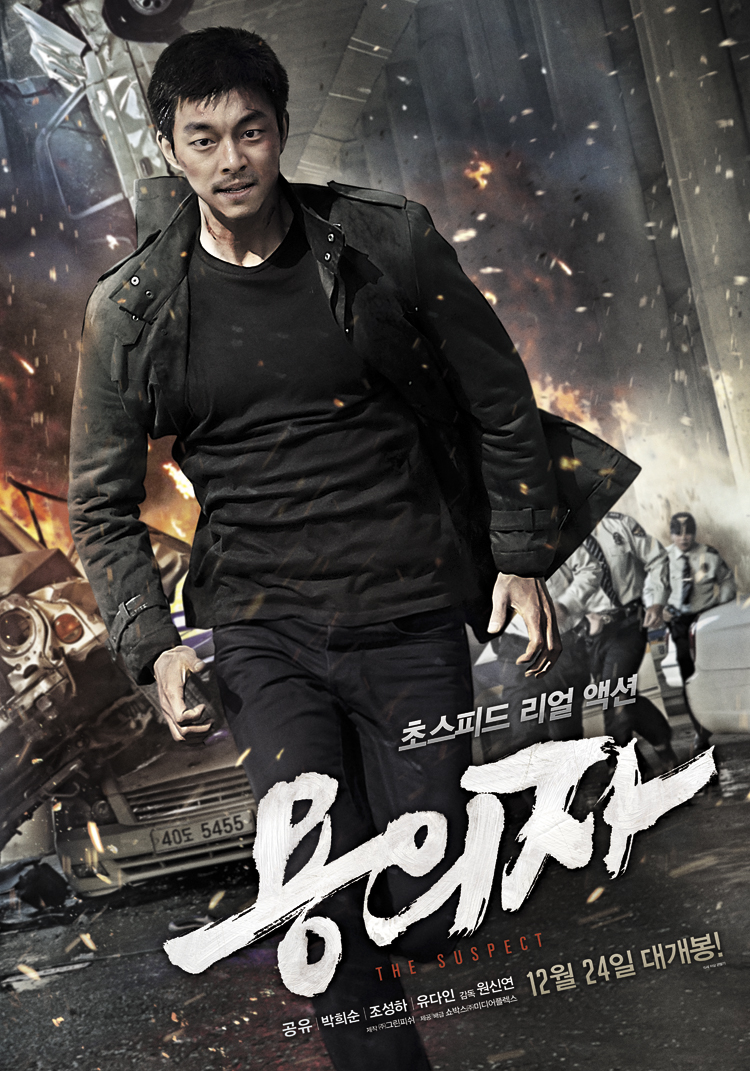
suspect posterNorth Koreans have become the go to bad guys recently, and so North Korean spies have become the instigators of fear and paranoia in many a contemporary political thriller. The Suspect (용의자, Yonguija), however, is quick to point the finger at a larger evil – personal greed, dodgy morals, and the all powerful reach of global corporations. Opting for a high octane action fest rather than a convoluted plot structure, Won’s approach is (mostly) an uncomplicated one as a wronged man pursues his revenge or redemption with no thought for his own future, only to be presented with the unexpected offering of one anyway alongside the equally unexpected bonus of exposing an international conspiracy.

Ji Dong-cheol (Gong Yoo) is former top North Korean asset now defected to the South and working as a driver for an important CEO. His boss thinks he ought to just go home, but Ji has a mission – he’s looking for a former friend, also defected, who was responsible for the deaths of his wife and daughter as part of a wide ranging purge following the accession of Kim Jong-un. Taking pity on him, the CEO eventually gives him the address of his target, adding that he hopes Ji can learn to forgive him (which seems unlikely), but is assassinated by other agents that same night. Arriving at the scene too late, Ji finds himself framed for the killing and charged with taking care of a secret message also in the CEO’s possession at the time of his death. Teaming up with a documentary filmmaker, Ji is now on the run and determined to find his former friend turned mortal enemy before the authorities catch up with him whilst also trying to work out what to do with his boss’ coded message.

Family, debts of honour, and bonds between men are at the centre of this fast paced thriller as Ji attempts to navigate this ever changing conspiracy torn between friends turned enemies and enemies who may become friends. His main adversary is a government agent, Min (Park Hee-Soon), whom he previously encountered during a mission in Hong Kong during which he made the decision to spare Min’s life after catching sight of a photo of his wife and son in his wallet. Min, however, is less than grateful as the failed mission greatly damaged his career prospects and so he has a personal grudge with Ji which he hopes to exorcise through arresting him. On the other side, Ji is also on the hunt for his former training buddy, Lee (Kim Sung-Kyun), whom he believes to have been responsible for the death of his own wife and child though later discovers that perhaps they have all merely been pawns in a much larger game.

The larger game appears to include worldwide arms sales by turns frustrated and conducted by North Korean agents. The conspiracy, however, is very much home grown in terms of its South Korean genesis but makes clear the complicated relationship between the two territories which is very much open to abuse by those who have access to both sides. The big bad turns out not to be the totalitarian regime with its constant purges and rigid enforcement of its political power, but the greedy and venal, power hungry petty officials of the democratic regime working in concert with big business.

Won has obviously drawn inspiration from the first Bourne film, offering several blatant homages including a long car chase referencing The Italian Job by proxy. His shaky cam aesthetic is perhaps overworked, but the fight scenes are undoubtedly impressive, anchored by the astounding performance of unlikely action star Gong Yoo – hitherto known as a sensitive leading man and frequent romantic lead. Having piled on the pounds, Gong is a credible vengeful presence apparently providing many of his own stunts including a strangely overblown sequence which sees him rock climbing bare chested only to emerge panting and glistening next to the flapping North Korean flag. Nevertheless, his near silent performance is a masterclass of physical acting, adding a much needed emotional dimension to the otherwise straightforward script which leaves little time for character development in between its admittedly impressive set pieces. Overlong yet moving at a rip roaring pace, The Suspect is a surprisingly well photographed action fest which manages to add a degree of pathos to its closing scenes even if failing to completely earn it whilst engaging in a series of subtle political allegories.


International trailer (English subtitles)
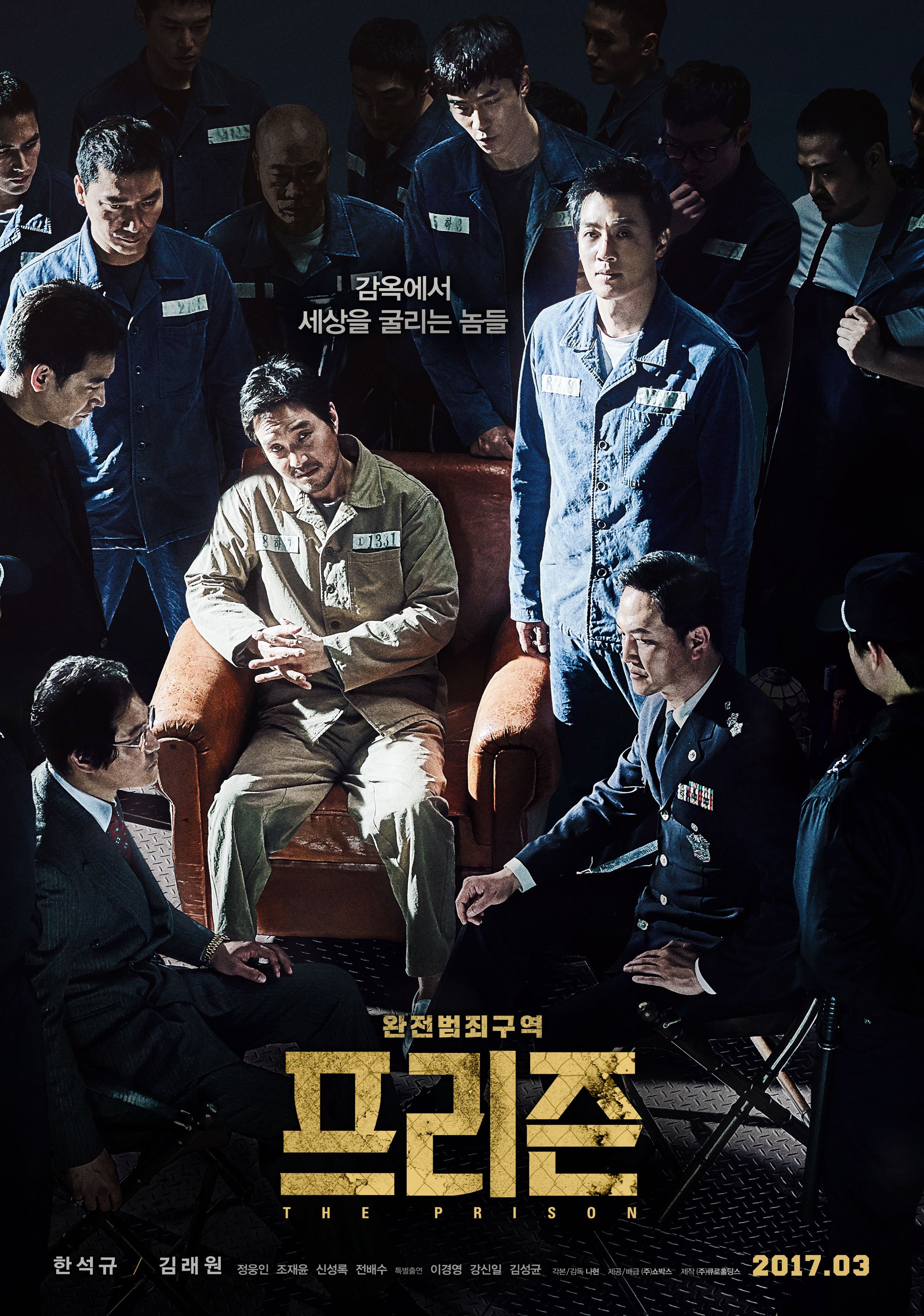
The Prison (프리즌, Na Hyun, 2017)

prison poster bigPrison can be a paradise if you’re doing it right, at least if you’re a top gangster in the movies. Na Hyun’s The Prison (프리즌) paints an interesting picture of incarceration and the way it links into his nation’s infinitely corrupt power structures. When investigators wonder why a crime spree suddenly came to an end, one of the frequently offered explanations is that the perpetrator was most likely arrested for another crime but what if you could turn this obviously solid alibi to your advantage and get those already behind bars to do your dirty work for you?

Disgraced policeman Song Yoo-gun (Kim Rae-Won) has wound up imprisoned alongside several of the men he himself helped put away. Like many cops who suddenly find themselves on the other side of the bars, Yoo-gun’s life is not easy. Badly beaten, tortured, and threatened with amputation Yoo-gun eventually starts fighting back and seizes the most likely path to prison survival – allying himself with the inside’s big guy, Jung Ik-ho (Han Suk-Kyu). Ik-ho, a notorious gangster famous for eating the eyeballs of his enemies, is the one who’s really in charge around here, not least because he’s the one running the gang of prison based hitmen trotted out to take care of the bad guys’ hit list.

What starts out as an intriguing idea quickly descends into predictability as Yoo-gun and Ik-ho face off against each other, finding common ground and camaraderie but ultimately existing on the plains of good and evil. Yoo-gun has his own reasons for landing himself in prison but his policeman’s heart still loves truth and justice even if he’s forced to become a prisoner whilst in prison. While he goes along with Ik-ho’s crimes, joining in the violence and intimidation he practices, he also wants to take Ik-ho down even if it means becoming him in the process.

While the interplay between the two men forms the central axis of the film as they develop an odd kind of grudging friendship which may still end on the point of a knife at any moment, Na tries his best to recreate the world of the grim ‘80s action thriller. Technically speaking, The Prison is set in the ‘90s (not that viewers outside of Korea would notice aside from the external lack of mobile phones, computers, internet etc) but wants to be the kind of tough, bruisy, fight heavy action movie they don’t make any more in which a righteous hero defeats a large-scale conspiracy by jump kicking hoodlums. He almost succeeds in this aim, but never quite manages to anchor the ongoing background conspiracy elements with the intense pugilism of the prison environment.

Yoo-gun and Ik-ho are obviously a special case but aside from their efforts, prison life in Korea is not too bad – the guards are OK, the warden is ineffectual, and the inmates are running the show. Nevertheless the prison is the centre of the conspiracy as elite bad guys take advantage of put upon poor ones who’ve found themselves thrown inside thanks to ongoing social inequality, trading cushy conditions to guys who’re never getting out in return for committing state sponsored crimes. Needless to say, someone is trying to expose the conspiracy which would be very bad news for everyone but rubbing them out might prove counter productive in the extreme.

Na lets the in-house shenanigans drag on far too long, pitching fight after fight but failing to make any of his punches land with the satisfaction they seem to expect. Flirting with the interplay between Yoo-gun and Ik-ho in wondering how far Yoo-gun is prepared to go or whether he is destined to become his criminal mentor rather than destroy him, Na never fully engages with the central idea preferring to focus on the action at the expense of character, psychology, or the corruption which underlines the rest of the film. Nevertheless The Prison does have the requisite levels of high-octane fights and impressive set pieces including the fiery if predictable prison riot finale. Life behind bars isn’t all it’s cracked up to be after all, the corrupt elites of Korea will have to actually pay people to off their enemies. Predictable and poorly paced, The Prison is best when it sticks to throwing punches but might be more fun if it placed them a little better.


The Prison was screened at the 19th Udine Far East Film Festival.

International trailer (English subtitles)