Hotspring SharkAttack (温泉シャーク, Morihito Inoue, 2024)

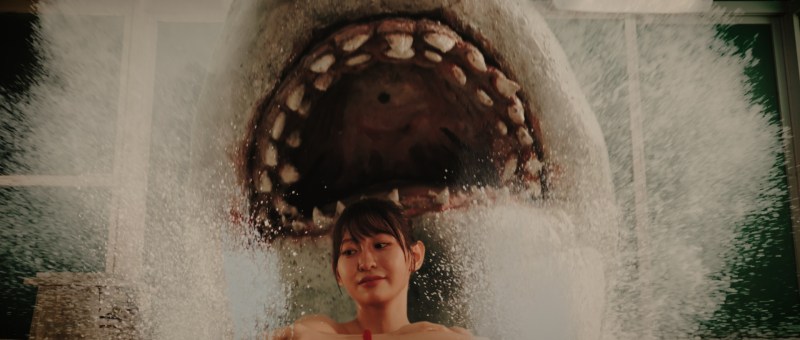
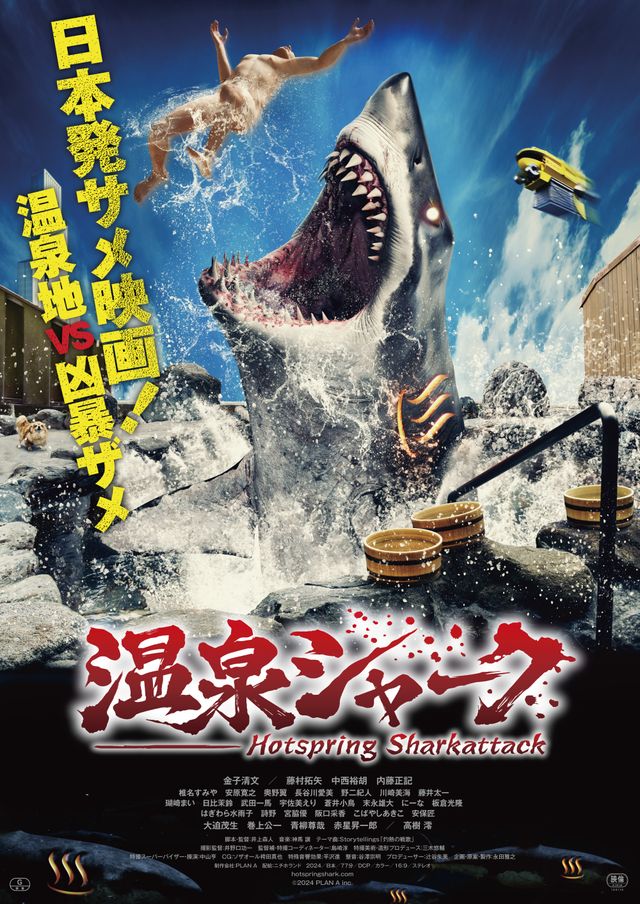
Just when you thought it was safe to go back to the onsen, prehistoric sharks decide it’s time to strike back against unsuspecting bathers. Is it really so wrong to want to relax in some nice, warm water or are we actually invading the sharks’ territory? In any case, Morihito Inoue’s creature feature Hotspring SharkAttack (温泉シャーク, Onsen Shark) is as much about the ravages of capitalism as it is about aquatic terror as the social media-obsessed mayor fixes his sights on saving the town through a massive onsen complex.

Tellingly, many of the local people are against the plan, which will have profound effects on their livelihood, while many of the local politicians are reluctant to close the onsen despite knowing about the shark issue in much the same way the mayor in Jaws refuses to lose the beach because they don’t want to risk damaging the tourist industry. When they do eventually close them, little children cry to their mothers about not being allowed into the baths, which just shows how important hot springs culture is to this area. 

But then it is quite weird, sharks suddenly snatching people from the baths and somehow dragging them back to sea. Modern science has an answer, thanks to top sharkologist Mayumi (Yu Nakanishi), but it’ll take a bit longer to find a way to stop them getting in while Mayumi agonises about her role in the proceedings as a lover of sharks yet essentially responsible for their destruction. A part of her still wants to find a way to coexist peacefully even as the sharks wreak havoc on the town and continue to pose a serious risk to life. Even so, the area ironically becomes a tourist hotspot after all as a swarm of live streamers arrive to try to experience the shark-infested waters for themselves despite the danger. 

Meanwhile, the sharks’ gills light up like the onsen symbol on maps while the mayor is haunted by the spirits of his ancestors and also wears a tie with little onsens on it. He later thinks better of his sleazy capitalist ways and comes to the realisation that it’s his responsibility to save the town even if that means torpedoing his landmark new resort and acknowledging the harm it would do to the local area. It seems that these prehistoric, super squishy sharks only got woken up because of global warming which is why they’re drawn to warmer waters and able to terrorise innocent onsen-goers. 

The same might be said of Maccho, a very buff guardian of onsen culture who can’t remember who he is or why he was born but is committed to defending protecting hot springs everywhere. Everyone in the town is keen to protect them too, and not just because they drive the local economy. The police chief’s about to retire with a vague idea about becoming a novelist but is still determined to clear up the shark problem, while his assistant later fights off a bunch of sharks single-handed to give the others time to do their thing. 

Unable to use guns because these sharks are also full of methane, this particular issue requires a less conventional solution, though the irony is that it lies at the heart of the problem. The weird disease the sharks starts spreading can only be cured by an antidote found within their own fins. The government might be content to simply destroy the town first, hinting at the indifference of the Tokyo elite to small-town disaster, but the local community won’t let that happen and nor will the hot springs guardian. Inoue adds in a fair degree of absurdity in order to make his central conceit work including a series of weird gags about eating a sub on a sub while harnessing the reality of his low budget to add a note of surreality to the town. The sharks themselves have a pleasingly retro design while the practical effects add to the sense of absurdity right down to the cute little submarine the team eventually constructs using the 3D printer that was designed to build the soulless onsen complex with its rooftop pool and ill-advised bungee jumping facilities. If there’s one thing that Hotspring SharkAttack has, it’s genuine heart along with small-town pride and a sense of fun that actively revels in the ridiculousness of its premise.


Hotspring SharkAttack screens 31st May as part of this year’s Nippon Connection.

Trailer (no subtitles)
TOCKA (タスカー, Yoshitaka Kamada, 2023)

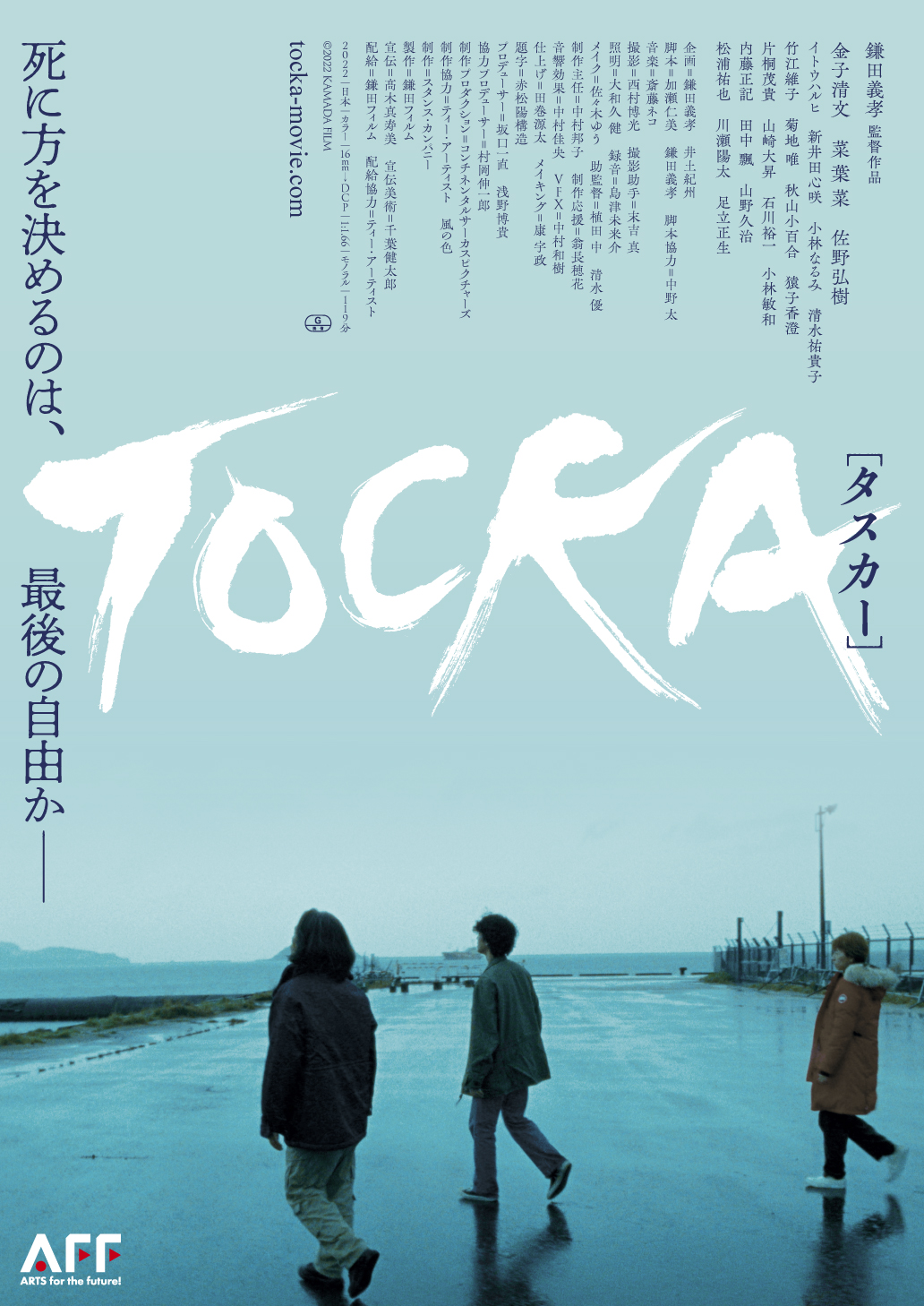
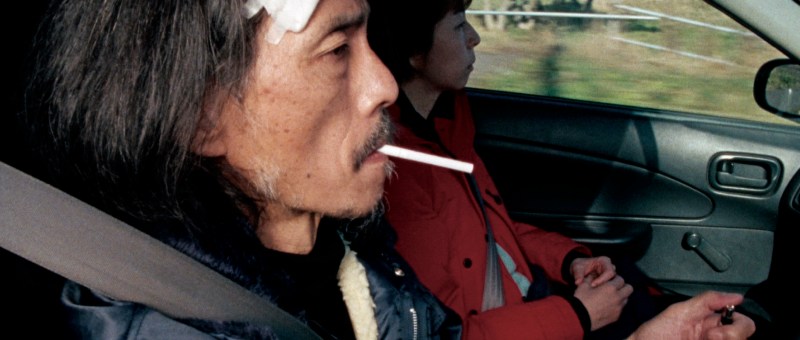
The man at the centre of Yoshitaka Kamada’s bleak social drama Tocka (タスカー) claims that he no longer knows why he’s alive, but as the woman he’s just asked to kill him replies no one else really knows either but even so they continue to live. Set in the northernmost reaches of Hokkaido where you can pick up Russian-language radio and it’s not unusual to spot signage in Cyrillic, the film’s title is taken from a Russian word that describes a quality of spiritual agony that manifests as listless ennui while its sensibility seems to be very much in tune with that of 19th century Russian literature. 

This indeed a cold a barren place almost devoid of signs of life. The heroine, Saki (Nahana), has returned in flight from the implosion of her life in Tokyo but has not told her parents who presumably live not too far away that she’s lost her job or broken up with her fiancé. Instead, she’s living a difficult and dissatisfying life with a part-time job in a local supermarket while contending with massive debts. Unable to see a way forward, she begins to consider taking her own life which is how she ends up meeting Shoji (Kiyobumi Kaneko), a man who wants to die but is unable to kill himself so is looking for someone to help him. 

Perhaps it says something of Saki’s own desperation that she considers his proposal or at least does not necessarily see anything odd about it aside from Shoji’s general vagueness about the reasons he wants to die. Like her, he is living a dissatisfying life but mostly precipitated by the loss of his family and his subsequent descent into alcohol dependency. He used to run a junk shop selling second hand appliances, but his business has also gone bust leaving him with nothing. His only goal is to make sure his daughter receives the payout from his life insurance policy which would be void if it was ruled that his death was a suicide. 

Yukito (Hiroki Sano) also works as a junk man, but scams his clients by pressing them to pay despite advertising a free removals service for unwanted appliances. He also steals petrol to sell illegally on the side and has nothing much going for him in his life while feeling guilty that he has failed to repay the sacrifices his mother made to raise him. Meanwhile, his sister is pregnant and the baby’s father has abandoned them leaving her in much the same position as her own mother but worried she doesn’t have the strength to manage on her own. 

It’s not difficult to understand the reasons why they want to end their lives even if as they sometimes suggest it’s more that they lack reasons to live while those in favour of dying are readily apparent. There doesn’t appear to be much going on in Northern Hokkaido when the businesses seem to be those dedicated to moving around obsolete items, buying junk or selling junk or maybe even stealing junk to sell to people who can’t afford anything better or else for scrap. All three feels themselves already on the scrap heap with nothing more than broken dreams to their names. Saki once wanted to be a singer in Tokyo, but now can’t seem to see a reason to be much of anything at all.

The way she later sees it, it’s alright to want to die and it’s alright to do it too even if you’ll hurt the people you’ll leave behind. None of them are fully able to escape their sense of despair or hopelessness despite the bonds that arise between them as they try to fulfil Shoji’s dying wish. In the end, the firmest expression of friendship is that they will help one another die if and when it’s what they really want though they may never meet again in more pleasant circumstances. In any case, Kamada captures a sense of bleakness in the beauty of the snowbound landscape which remains otherwise barren and defined by emptiness even as those trapped inside it try to find reasons either to live or to die but more often than not find nothing much of anything at all. 


TOCKA screened as part of this year’s Nippon Connection

Original trailer (English subtitles)

Images: ©2022 KAMADA FILM

Midnight Diner 2 (続・深夜食堂, Joji Matsuoka, 2016)

midnight diner 2 posterThe Midnight Diner is open for business once again. Yaro Abe’s eponymous manga was first adapted as a TV drama in 2009 which then ran for three seasons before heading to the big screen and then again to the smaller one with the Netflix original Midnight Diner: Tokyo Stories becoming the de facto season four. Midnight Diner 2 (続・深夜食堂, Zoku Shinya Shokudo) returns with more of the same as Master puts out his sign and opens the shop, welcoming the denizens of Tokyo after dark in search of a little place to call home amid all the chaos and alienation.

To re-cap, the Midnight Diner is a casual eating establishment run by Master which opens only between the hours of midnight and 7am. The restaurant has only a small formal menu but Master’s selling point is that he is prepared to make whatever the customer so desires (assuming the ingredients are available). Regulars and newcomers alike are given a warm welcome and a place to feel at home, free of whatever it was that was bothering them in the outside world.

Like the first film, Midnight Diner 2 is really three TV episodes stitched together. The first begins on an ominous note as each of the regulars arrives in mourning clothes only to be struck by the coincidence that they’ve each been to a different person’s funeral. A woman arrives dressed in black but reveals she hasn’t been bereaved, she simply enjoys dressing like this to destress from the difficult atmosphere at her publishing job. Noriko (Aoba Kawai) is a top editor but often finds herself sidelined – this time by a young author whose book she made a success but has now dumped her owing to all her notes on his second effort. Saddled with an elderly client who doesn’t like taking advice from a woman, Noriko’s fortunes fall still further when she finds him dead. A visit to a real funeral threatens to change her life completely.

Strand two follows the son of a nearby soba shop, Seita (Sosuke Ikematsu), who has fallen in love with a much older woman and wants to marry despite his mother’s reservations. The third segment continues along the familial theme with an old woman travelling all the way from Kyushu to Tokyo after falling victim to an “Ore Ore” scam.

Scams and parental bonds become the central themes tying the episodes together as each of the lovelorn protagonists finds themselves taking advantage of Master’s sturdy shoulders. Noriko and Mrs. Ogawa (Misako Watanabe) fall victim to an obvious conman but do so almost willingly out of their desperate loneliness. Noriko, dissatisfied with her working environment, takes to the streets dressed in black but becomes the target of “funeral fetishists” who are only interested in her “bereaved” state. A chance encounter at a real funeral makes her believe her life can change but she is deceived again when a man she came to care for is unmasked as a serial trickster. Mrs. Ogawa faces a similar problem when she races all the way to Tokyo to pay off a “colleague” of her son’s, so desperate to help that she never suspects that she’s fallen victim to a scam.

Mrs. Ogawa’s deep love for the son she has become estranged from is contrasted with that of the soba noodle seller for the son she can’t let go. Seita cares for nothing other than ping pong, much to his mother’s consternation and has little interest in taking over the family business. A young man, he’s tired of the constraints his lonely widowed mother continues to place on him though his determination to marry an older woman at such a young age bears out his relative maturity.

As usual Master has good advice and a kind word for everyone that helps them get where they need to go, softly nudging them in the right direction through the power of comfort food. By now the cast of familiars is well and truly entrenched but there will always be space at Master’s counter for those in need who will be greeted warmly by those already aware of its charms. True enough, Midnight Diner 2 offers little in the way of innovation (though we do get a little more information about the mysterious Master) but no one comes the Midnight Diner looking to try something new. In here, nostalgia rules and we wouldn’t have it any other way.


Original trailer (no subtitles)

Midnight Diner (深夜食堂, Shinya Shokudo, Joji Matsuoka, 2015)

mainvisualYaro Abe’s manga Midnight Diner (深夜食堂, Shinya Shokudo) was first adapted as 10 episode TV drama back in 2009 with a second series in 2011 and a third in 2014. With a Korean adaptation in between, the series now finds itself back for second helpings in the form of a big screen adaptation.

Midnight Diner is set in a cosy little eatery which only opens between the hours of midnight and 7am. Presided over by the “Master”, a mysterious figure himself with a large unexplained scar running down one side of his face, the restaurant has only one regular dish on its menu but Master is willing to make whatever his customers want provided he has the ingredients. Regulars and newcomers mingle nightly each with their own, sometimes sad, stories while Master offers them a safe place to think things through coupled with his gentle, all knowing advice.

The big screen movie plays just like a series of connected episodes from the television drama yet manages unify its approach into something which feels consistently more cinematic. Keeping the warm, nostalgic tone the film also increases its production values whilst maintaining its trademark style. The movie opens with the same title sequence as its TV version and divides itself neatly into chapters which each carry the title of the key dish that Master will cook for this segment’s star. A little less wilfully melodramatic, Midnight Diner the movie nevertheless offers its gentle commentary on the melancholy elements of modern life and its ordinary moments of sadness.

Fans of the TV drama will be pleased to see their favourite restaurant regulars reappearing if only briefly, but the film also boosts its profile in the form of some big name stars including a manager of another restaurant in town played by Kimiko Yo who seems to have some kind of history with Master as well as a smaller role played by prolific indie star of the moment Kiyohiko Shibukawa and the return of Joe Odagiri whose character seems to have undergone quite a radical change since we last saw him.

The stories this time around feature a serial mistress and her dalliance with another, poorer, client of the diner; a young girl who pulls a dine and dash only to return, apologise and offer to work off her bill; a lovelorn widower who’s come to Tokyo to chase an aid worker who probably just isn’t interested in him; and then there’s strange mystery of a mislaid funerary urn neatly tieing everything together. Just as in the TV series, each character has a special dish that they’ve been longing for and through reconnecting with the past by means of Master’s magic cooking, they manage to unlock their futures too. As usual, Master knows what it is they need long before they do and though he’s a man of few words, always seems to know what to say. One of the charms of the series as a whole which is echoed in the film is that it’s content to let a few mysteries hang while the central tale unfolds naturally almost as if you’re just another customer sitting at the end of Master’s counter.

Shot in more or less the same style as the TV series favouring long, static takes the film still manages to feel cinematic and its slight colour filtering adds to the overall warm and nostalgic tone the series has become known for. Once again offering a series of gentle human stories, Midnight Diner might not be the most groundbreaking of films but it offers its own delicate insights into the human condition and slowly but surely captivates with its intriguing cast of unlikely dining companions.