 It’s tough being young. The Boss’ Son At College (大学の若旦那, Daigaku no Wakadanna) is the first, and only surviving, film in a series which followed the adventures of the well to do son of a soy sauce manufacturer set in the contemporary era. Somewhat autobiographical, Shimizu’s film centres around the titular boss’ son as he struggles with conflicting influences – those of his father and the traditional past and those of his forward looking, hedonistic youth.
Fuji (Mitsugu Fujii) is the star of the university rugby team. In fact his prowess on the rugby field has made him something of a mini celebrity and a big man on campus which Fuji seems to enjoy very much. At home, he’s the son of a successful soy sauce brewer with distinctly conservative attitudes. Fuji’s father has just married off one of his daughters to an employee and is setting about sorting out the second one despite the reluctance of all parties involved. Everyone seems very intent on Fuji also hurrying up with finishing his studies so he can conform to the normal social rules by working hard and getting married.
Fuji, however, spends most of his off the pitch time drinking with geisha, one of whom has unwisely fallen in love with him. Like many teams, Fuji’s rugby buddies have a strict “orderly conduct” rule which Fuji has been breaking thanks to his loose ways. His top player status has kept him safe but also made him enemies and when an embarrassing incident proves too much to overlook he’s finally kicked off the team.
The times may have been changing, but Fuji’s soy sauce shop remains untouched. Gohei (Haruro Takeda), the patriarch, grumpily rules over all with a “father knows best” attitude, refusing to listen to his son’s complaints. In fact, he tries to bypass his son altogether by marrying off another employee to his younger daughter, Miyako. Though Miyako tries to come to the employee’s defence (as well as her own) by informing her father that “this way of treating employees is obsolete”, she is shrugged off by Gohei’s authoritarian attitude. He’s already tried this once by arranging a marriage for his older daughter but his son-in-law spends all his time in geisha houses, often accompanied by Fuji, and the match has produced neither a happy family nor a successful business arrangement.
Fuji is a young man and he wants to enjoy his youth, in part because he knows it will be short and that conformity is all that awaits him. His dalliance with a geisha which contributes to him being kicked off the rugby team is in no way serious on his part (caddish, if not usually so). However, when he befriends an injured teammate and meets his showgirl sister, Fuji falls in love for real. This presents a problem for the friend whose main commitment is to the rugby team who were thinking of reinstating Fuji because they have a big match coming up and need him to have any chance of not disgracing themselves. This poor woman who has apparently been forced onto the stage to pay her brother’s school fees is then physically beaten by him (if in a childishly brotherly way) until she agrees to break things off with Fuji for the good of the rugby team.
Fuji is finally allowed onto the pitch again, in part at the behest of his previously hostile father who thinks rugby training is probably better than spending all night drinking (and keeping his brother-in-law out all night with him). The loss of status Fuji experienced after leaving the team rocked him to the core though his central conflict goes back to his place as his father’s son. At one point, Fuji argues with a friend only for a woman to emerge and inform him that his friend had things he longed to tell him, but he could never say them to “the young master”. Fuji may have embraced his star label, but he doesn’t want this one of inherited burdens and artificial walls. Hard as he tries, he can never be anything other than “the boss’ son”, with all of the pressures and responsibilities that entails but with few of the benefits. Getting back on the team is, ironically, like getting his individual personality back but also requires sacrificing it for the common good.
In contrast with some of Shimizu’s post-war films which praise the importance of working together for a common good but imply that the duty of the individual is oppose the majority if it thinks it’s wrong, here Fuji is made to sacrifice everything in service of the team. At the end of his final match, Fuji remarks to his teammate that this is “the end of their beautiful youth”. After graduation, they’ll find jobs, get married, have children and lose all rights to any kind of individual expression. Fuji is still torn between his “selfish” hedonistic desires and the growing responsibilities of adulthood, but even such vacillation will soon be unavailable to him. Ending on a far less hopeful note than many a Shimizu film with Fuji silently crying whilst his teammates celebrate victory, The Boss’ Son Goes to College is a lament for the necessary death of the self as a young man contemplates his impending graduation into the adult world, but it’s one filled with a rosy kind of humour and an unwilling resignation to the natural order of things.
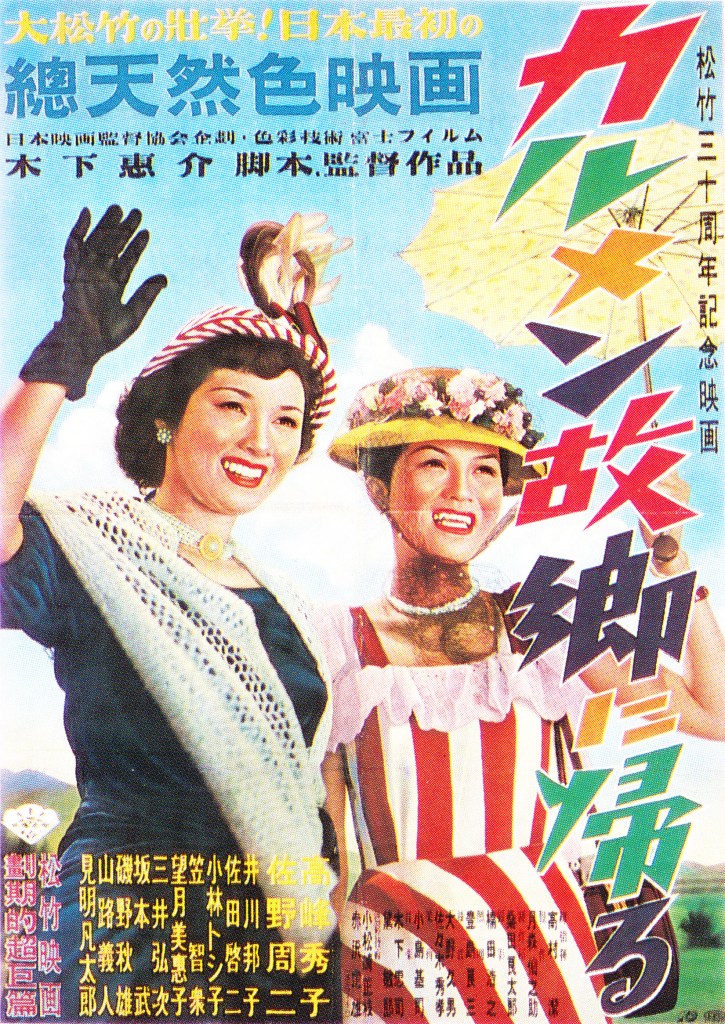 Shochiku was doing pretty well in 1951. Accordingly they could afford to splash out a little in their 30th anniversary year in commissioning the first ever full colour film to be shot in Japan, Carmen Comes Home (カルメン故郷に帰る, Carmen Kokyou ni Kaeru). For this landmark project they chose trusted director Keisuke Kinoshita and opted to use the home grown Fujicolor which has a much more saturated look than the film stocks favoured by overseas studios or those which would become more common in Japan such as Eastman Colour or Agfa. Fujicolour also had a lot of optimum condition requirements including the necessity of shooting outdoors, and so we find ourselves visiting a picturesque mountain village along with a showgirl runaway on her first visit home hoping to show off what a success she’s made for herself in the city.
 Windows on Worlds