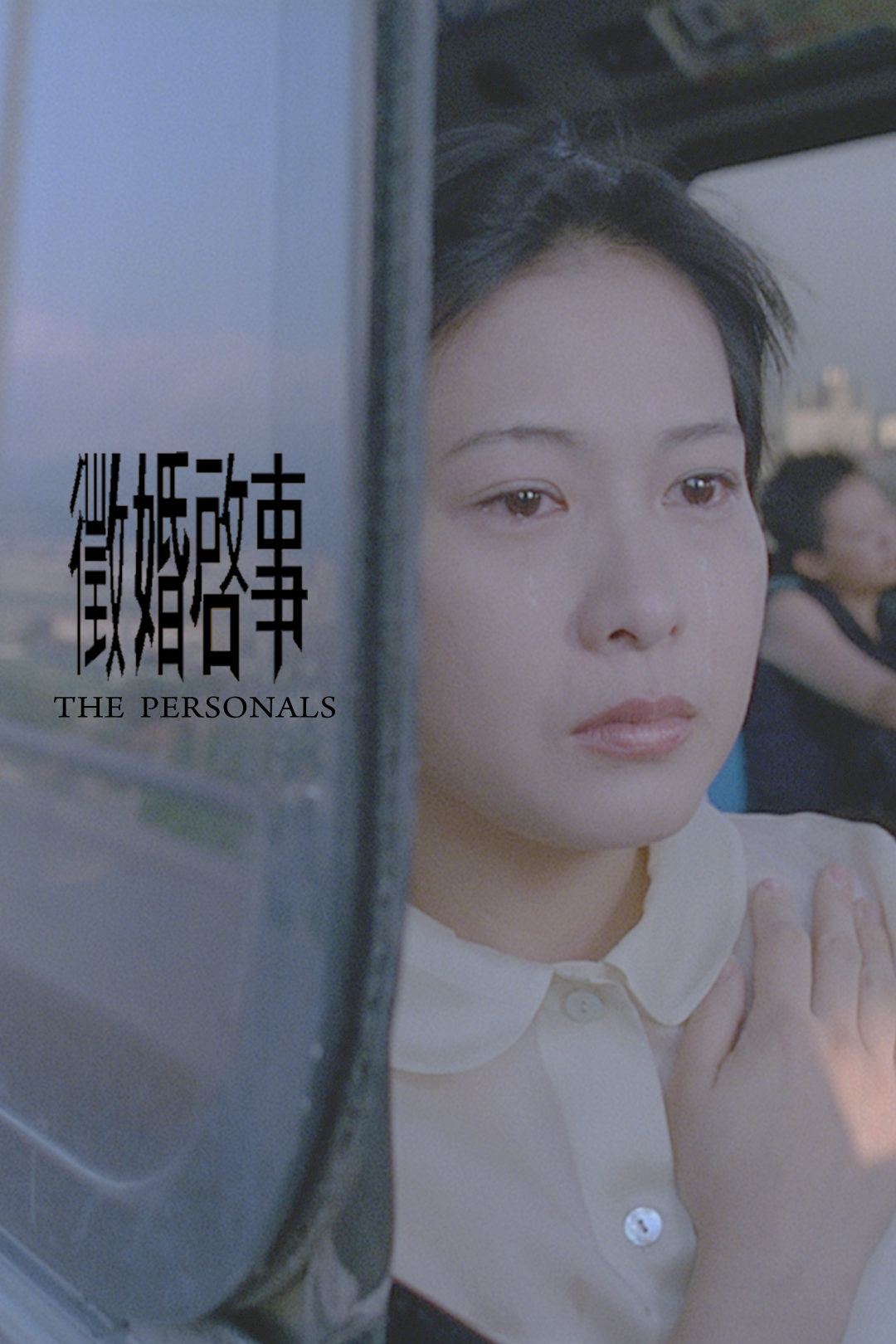
The Personals (徵婚啓事, Chen Kuo-fu, 1998)

Looking for love in all the wrong places, a Taipei career woman suddenly decides to give up her life and place a personal ad stating that she’s looking for a husband, “Who knows, maybe I’ll find happiness” she unconvincingly explains. Chen Kuo-fu’s sophisticated dramedy The Personals (徵婚啓事, Zhēnghūn Qǐ Shì) sends its heroine on a dating odyssey through the contemporary capital but is at heart the story of a woman learning to see herself while grieving a failed relationship and the married ex who won’t return her calls. 

Tu Chia-wen (Rene Liu Ruo-ying) was a successful eye doctor at a Taipei hospital, explaining to a patient that some people lose the ability to produce enough tears after the age of 30, but abruptly quits her job later claiming that she wanted sever connections with her past which is another reason why she’s decided to place an ad rather than asking friends to set her up with eligible bachelors. Implicitly, it also seems that Chia-wen feels her status as a doctor may be intimidating to some men in the still patriarchal society, if also a clue to her true identity which she has otherwise chosen to keep hidden going instead by the name of Miss “Wu” which just happens to be the name of her lover’s wife. 

Of course, it’s illogical to use a false identity if your end goal is finding a life partner, a factor which later feeds in to Chia-wen’s half-hearted conclusion that it isn’t the fault of the men she’s been meeting that they didn’t hit it off but her own in that she’s so far failed to fully “open up” to any of them. Despite newspaper personal ads not featuring photos, Chia-wen receives 100 messages in the three days after her details are posted from a varied cross section of applicants some more suitable than others. One gentleman who unconvincingly claims to be in his 30s reels off his CV as if he were introducing himself at a job interview while wearing a cheerful farmer-style straw hat. A factory worker chews betel nut and smokes tobacco at the same time while exposing an insecurity over his financial situation in complaining that modern women are too materialistic. One suitor is a woman who struggles to explain her gender and sexual identity with the terminology of the time causing Chia-Wen a degree of consternation. Another potential date is a shoe fetishist with a large suitcase intent on some kind of cinderella role-play closely followed by an executive who enthusiastically explains his only hobby outside of drinking is an encyclopaedic knowledge of S&M porn, while a son brings his father as a potential match because his mum’s “gone abroad” and in a heartbreaking moment a worried mother tries to negotiate on behalf of her son who appears to have learning difficulties and might not be sure what’s going on, hoping to find someone to look after him when she’s gone. 

It may be a biased sample, but it doesn’t speak well for the men of Taipei and that’s without even getting into the guy trying to recruit Chia-wen as a high class call girl, the obvious married man after no strings sex, or the salesman trying to peddle women’s self defence equipment with a case full of tasers and pepper spray. Chia-wen pours out her frustrations in daily calls to her ex’s answering machine, leaving long messages she knows he won’t reply to but somehow it makes her feel close to him. Gradually through her monologues we begin to piece together the trauma that she’s struggling to accommodate while a late and unexpected twist keys us in to the cosmic tragedy of her frustrated romance. “Choose what you can endure” she’s advised by a professor friend who confesses to her that he’s chosen to suppress his homosexuality out of a desire for a “normal” life as a husband and father hinting at the still conservative nature of the contemporary society. 

It’s not until she’s caught off guard by a potential match seeing through her ruse that Chia-wen begins to reconsider her experiment, eventually captivated by a sensitive young man who’s not long come out of prison but has an endearingly awkward smile that reminds her of her own. She meets each of the men in the same cafe where she had her first date with her former lover, taking on a slightly different character as she attempts to interview them about their lives, getting to know their hopes and desires often tinged with a note of loneliness or despair. They seldom seem very interested in her, but instantly propose marriage or at least some sort of serious courtship without even finding out about her hopes and aspirations in life. Chia-wen’s often comical encounters from the teenage boys trying their luck to the old men taking their last chance each expose something of contemporary gender dynamics as well as hinting at increasing urban loneliness and romantic desperation but in the end it’s herself Chia-wen must face in learning to let go of past trauma in order to give herself permission to move on in her ever evolving quest for love.


The Personals streams in the UK 25th to 31st October as part of this year’s Taiwan Film Festival Edinburgh.

Trailer (Traditional Chinese / English subtitles)
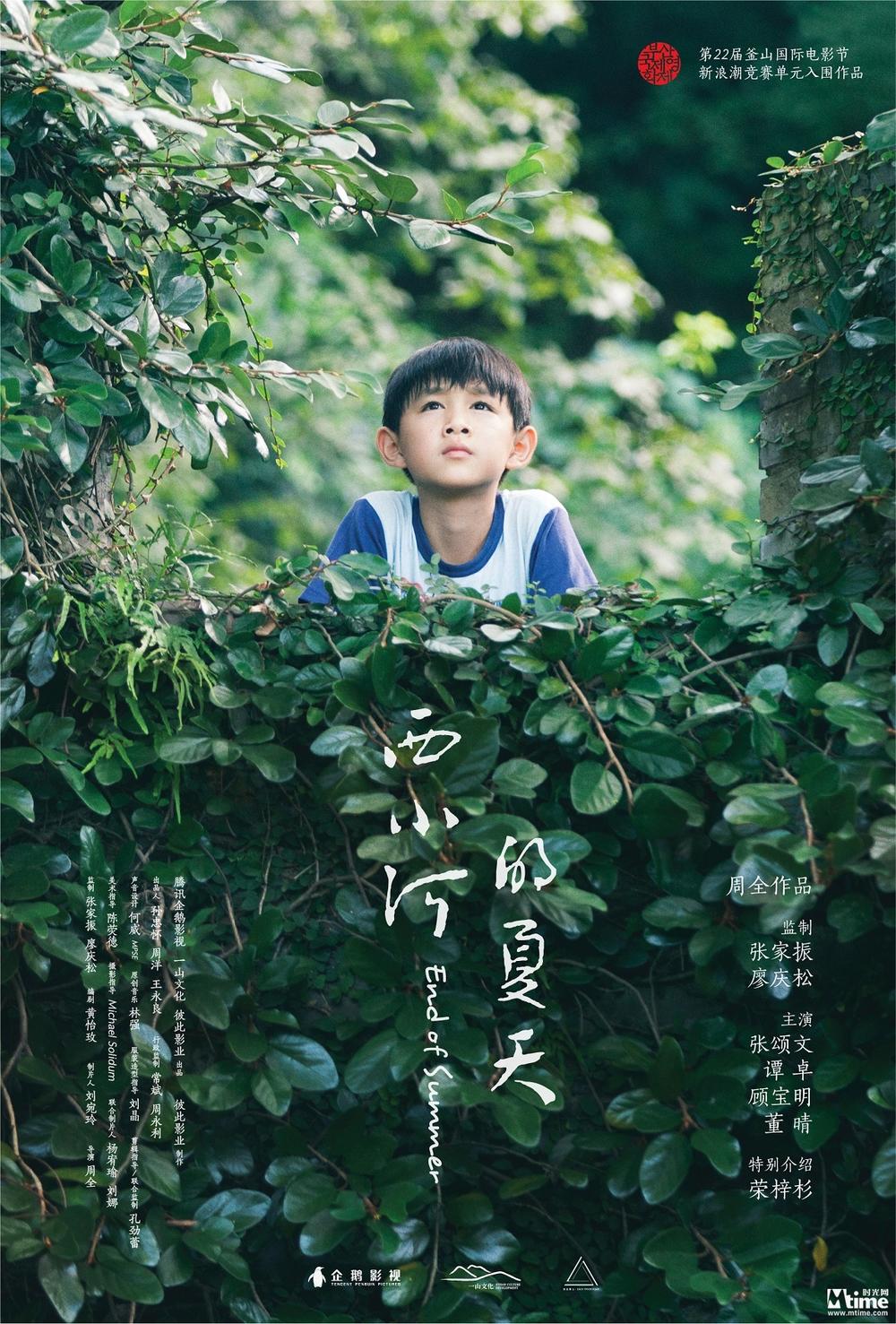
End of Summer (西小河的夏天, Zhou Quan, 2017)

The End of Summer posterMany things were changing in late ‘90s China. For one little boy in the summer of 1998, however, nothing much mattered beyond the World Cup which was being broadcast in its entirety for the very first time. Part nostalgia fest for a more innocent world, Zhou Quan’s End of Summer (西小河的夏天, Xī Xiǎo de Xiàtiān) is, as the title implies, a story of befores as its various protagonists attempt to resolve a series of personal crises that will lead to great changes preceding the autumn of 1998.

Football obsessed little boy Xiaoyang (Rong Zishan) has to keep his love a secret because his dad, Jianhua (Zhang Songwen), thinks all sports are frivolous and has forbidden his son to play with the other children. Jianhua is also a high ranking teacher at Xiaoyang’s school and demands high levels of discipline and commitment from his family, even forcing Xiaoyang to dob one of his friends in under heavy questioning about a playground fight. Bored and lonely at home, Xiaoyang has begun to bond with an older man at their courtyard who also loves football and has promised to help Xiaoyang train for the upcoming school tryouts next term if only he can persuade his dad to sign the consent form.

Meanwhile, there’s trouble brewing on the home front. Xiaoyang’s mother Huifang (Tan Zhuo) is a successful Peking Opera performer whose career is skyrocketing now that she’s been nominated for a prestigious award. Jianhua has also been earmarked for a promotion at work and is covering for a sick colleague, but the arrival of a new teacher threatens to dangerously unbalance the carefully won equilibrium of the Gu family.

Miss Shen (Dong Qing) is indeed a harbinger of social change. The polar opposite of Huifang, Miss Shen is a hippyish free spirit who plays the guitar and sings folk songs in a local cafe with her boyfriend. She teaches the children English through singing songs and playing games, always cheerful and energetic with an adorable smile and easy going personality. Xiaoyang proves himself unusually astute for his years when he misinterprets an innocent scene between Miss Shen and his father, correctly guessing that Jianhua has developed a mild crush on the lovely young woman though perhaps not realising that Miss Shen is merely naive and entirely oblivious to her boss’ ulterior motives.

The camera first catches Xiaoyang caught between two football teams, standing motionless and staring vacantly ahead. He remains caught between two worlds while prompted a little early towards the compromises of adulthood as he experiences the moral outrage of realising his rigid, authoritarian father maybe breaking all the rules of conventional morality by stepping out on his mum. A victim of China’s one child policy, he is often intensely lonely, left alone at home with nothing to do but study while his mother is out rehearsing and his dad increasingly staying out late to offer “guidance” to Miss Shen.

Xiaoyang’s loneliness finds a mirror in the grumpy old man from across the way, Zheng (Ku Pao-Ming), who appears to have fallen out with his family and is missing his own absent grandson, Bao. Zheng picks up the fatherly responsibilities Jianhua has failed to fulfil – supporting Xiaoyang in his football dreams, giving him little bits of life advice, listening intently to his worries regarding his parents’ marital problems without trying to sugarcoat the seriousness of the issues or making a pretence of humouring a perspicuous little boy as they turn detective and catch Jianhua in the act but just miss out on his humiliating defeat and the epiphany which accompanies it as he is forced to confront the fact that he has become a sad old man. Jianhua’s major problems stem from an intense lack of self confidence as his growing son begins to reject his rigid authority and his wife’s increasing success punches a hole through his male pride. Temporarily boosted by the possibility of a promotion, he decides to try rebelling by chasing a younger woman who is very much not his type, little knowing that she sees him only as a venerable teacher and is shocked by his improper interest in her.

Meanwhile change is on the horizon everywhere. The courtyard is earmarked for “redevelopment”, and Mr. Zheng’s family are constantly trying to convince him to come and live with them in the city. By the end of the summer everything will have changed, some things for the better and some perhaps not but there will at least be a shift as each is forced into a reconsideration of their present circumstances. End of Summer is gentler than its title would suggest, a wistful look back one dramatic summer in the childhood of a sensitive little boy, but what it lacks in impact it makes up for with sincerity and a good deal of warmth.


End of Summer was screened as part of the New York Asian Film Festival 2018.

International trailer (English subtitles)

Interview with director Zhou Quan from the 2017 Busan Film Festival.

The Village of No Return (健忘村, Chen Yu-hsun, 2017)

健忘村_畫報風篇_RED_OK_VWouldn’t it be wonderful to just forget all the terrible/embarrassing things that have ever happened to you and live in a paradise of blissful ignorance? To put it bluntly, this is an experiment with historical precedent and one which has never yet worked out for the best. Absurd Taiwanese comedy Village of No Return (健忘村, Jiànwàng Cūn) is both a raucous life in the village comedy and subtle satire on the roots of tyranny, cults of personality, fake news and the evils of the art of forgetting that ultimately turns into a defence of the benevolent dictator.

Somewhere around 1914, the early years of the Chinese Republic, an ambitious warlord (Eric Tsang) has his sights set on capturing Desire Village which, he has been assured by a fortune teller, contains numerous treasures and will make him a king. Unfortunately, his village mole is the unscrupulous Big Pie (Ban Zan) who treks home with carrier pigeons he’s supposed to send back with the message “wait”, “come”, or “don’t come” only Big Pie can’t read. None of that really matters in the end because Big Pie is shortly to die in mysterious circumstances just as a mysterious monk, Fortune Tien (Wang Qianyuan), rocks up with a strange “Worry Ridder” device he claims can permanently ease anxieties.

The main drama revolves around melancholy village girl, Autumn (Shu Qi), who was married off to the ugly and abusive Big Pie against her will. Still pining for the son of the village leader, Dean (Tony Yang), who went off to become an official but has become displaced during the Revolution, Autumn has spent her life literally shackled to the stove and has begun to dwell on death as an antidote to the hopelessness of realising Dean is probably not coming back. Autumn is, however, the last to hold out against the lure of the Worry Ridder, reluctant to give up the memory of Dean no matter how painful it may continue to be.

Fortune Tien is nothing if not persuasive. Little by little he sells the virtues of his machine and quickly has the villagers eating out of his hand. Before long he’s erased the memories of life before he came and installed himself as village chief, presiding over a collection of beatific zombies content to do the literal spade work while Fortune Tien reigns supreme with an easy answer for everything. The parallels are obvious, even if Tien’s case is more extreme. History is rewritten, anyone who remembers differently has a faulty memory or is, perhaps, mad. Only Tien can be relied upon to arbitrate the truth of his false revolution.

The Worry Ridder itself is a fabulously designed piece of anachronistic technology, displaying memories like silent movies with scratchy sound and operated by a modern user interface complete with kitschy animation. Its evils can only be undone with the long lost “Soul Restorer” and its overuse seems to lead to an advanced senility. Though it does indeed erase memories and offer a kind of drugged up serenity, the machine cannot undo the underlying emotions and so those lingering feelings of love or attraction, misplaced or otherwise, remain even without the reasons for their existence. Love is the force which saves the day as Autumn, temporarily saved from her hellish life as the wife of Big Pie after becoming the “First Flower” of Tien’s dictatorial regime, continues to dream of her former love leading her to question Tien’s all powerful grip on the accepted truth.   

Meanwhile outside the village other threats are looming. Prior to their own revolution, the villagers had been excited to learn of the coming railways, mistakenly believing that randomly building an unconnected station (which is like a farm for trains!) would make them rich. The nefarious gangster quickly gets forgotten but he seems evil enough seeing as he’s flying kites made out the skins of his murder victims, though his biggest allies – the Cloud Clan, are led by a portly postmistress (Lin Mei-hsiu) to whom he presents an “iron horse” (i.e. a bicycle) which proves a surprisingly difficult challenge for her to master. The Cloud Clan’s main weapon is their sweet sound, beatboxing a background melody for the surprisingly beautiful voice of the postmistress often heard just before she whips out her giant machete and dispatches her foes with ruthless efficiency. An absurd satire on the ease with which tyranny makes use of human failings, Village of no Return ultimately wonders if blissful mindlessness is really all that bad if all your needs are met and you can count yourself “safe” and “happy”. A good question at the best of times, but one that seems oddly urgent.


Currently streaming on Amazon Prime Video in UK & US.

International trailer (Mandarin with English subtitles)