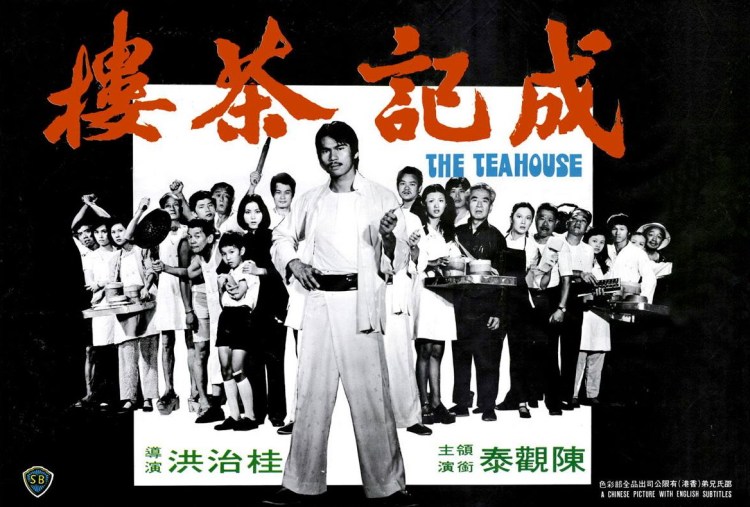
 Where oh where are the put upon citizens of martial arts movies supposed to grab a quiet cup of tea and some dim sum? Definitely not at Boss Cheng’s teahouse as all hell is about to break loose in there when it becomes the centre of a turf war in gloomy director Kuei Chih-Hung’s social minded modern day kung-fu movie The Teahouse (成記茶樓, Cheng Ji Cha Lou).
Wang Cheng runs a small teahouse which prides itself on being the kind of progressive environment where everyone looks after each other as long as they play by the rules. Unfortunately, one of his young guys – Blackie, fresh off the boat from the mainland, has got himself into bad company and into trouble with the law. However, as he’s a minor, he gets off with barely any punishment at all. Cheng tells him he can stay at the teahouse only if he pays properly for his crime leading him to try and get himself arrested all over again so he can go to jail (which actually proves very difficult).
Another unfortunate side effect of Blackie’s adventure is that it brings some unwanted gangster attention and when two young thugs come looking for one of the waitresses, Boss Cheng is not going to stand for any nonsense. However, after his attempts to help the girl have failed, he finds himself in trouble with two different sets of gangsters and also a meddling police inspector who seems intent on using the teahouse to trap the triads.
Boss Cheng is a good and decent man but also someone with his own opinions on justice who is not afraid to take matters into his own hands. His rules for workers at the teahouse emphasise obeying the law and behaving like responsible citizens, but he’s not above carrying out a little corrective action of his own if the need arises.
The biggest theme of the film is the rising inequality and place of migrants from the mainland in contemporary Hong Kong society but the first target Kuei has his sights set on is out of control youth. Because of the lenient laws regarding child criminality, the young men of Hong Kong run rampant, safe in the knowledge that nothing is going to happen to them while they remain under the age of responsibility. The two gangsters accused of raping and attempting to force the teenage waitress at the teahouse into prostitution give their ages as 14 and 15 respectively to the trial judge and are released without charge to go back to their life of crime with impunity and no respect for the law or conventional morality. Sadly, this system just creates another child criminal but one who will receive a jail sentence even if a lighter one to be served in a reform school rather than a prison.
Blackie was seduced into crime by a lack of funds – having managed to make it over from the mainland he has nothing other than his job at the teahouse and the support of Boss Cheng. One day a ragged looking little boy leading his sister by the hand wanders into the teahouse to beg for food. It turns out his small family escaped from the mainland too but his father never made it to Hong Kong and his mother is ill, leaving the children to try and fend for themselves. Boss Cheng takes pity on them and gives the boy a job plus paying for his school fees but he still finds himself beaten up by thugs not much older than himself in the street.
All the while, corrupt fat cats are messing with the system to keep the poor in their place while the rich get richer. Cheng takes great pleasure in playing off a corrupt industrialist who tried to use him as a sacrificial pawn in his own war against the triads (well, the triads he doesn’t like, anyway). Amusingly, one of the triad bosses seems to think Cheng is also a brother forcing him to pretend to know all about triad rituals to attempt to make a truce with them. The teahouse is situated right between the territories of two rival gangs making it a prime spot for conflict. However, the real problem comes when the police start muscling in, giving off the impression that Cheng has turned traitor on the triads. Soon, Cheng becomes the single biggest threat to his own teahouse and the progressive environment he hoped it would foster.
The Teahouse is actually a little ahead of its time concentrating not on kung fu or street fighting but mixing in a little gun play and some bloody knife crime. The shooting style is impressive throughout with a realistic, gritty atmosphere which aims to put the real streets on screen. The film does, however, have a tendency to fall into an episodic rhythm and suffers from its abrupt and slightly odd, downbeat ending which finishes things on an unsatisfying note. That said, The Teahouse is a stylishly shot and socially engaged action extravaganza that makes up for its minor shortcomings with a degree of chutzpah which looks forward to the classic heroic bloodshed movies of the ‘80s.
Seen as part of HOME’s CRIME: Hong Kong Style touring season.
Unsubtitled trailer (Mandarin):
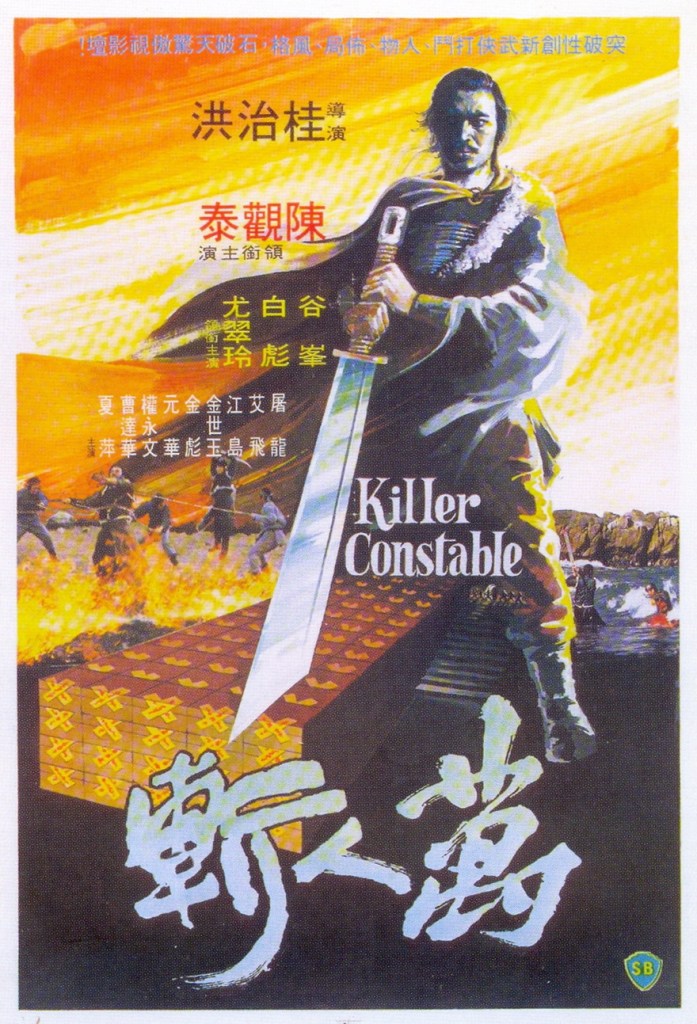 Every sovereign needs that one ultra reliable and supremely talented servant who can be called upon in desperate times. For the Dowager Empress of the Qing Empire, that man is Leng Tien-Ying – otherwise known as the Killer Constable. When a sizeable amount of gold goes missing from the Imperial Vaults, it’s Leng they call to try and get it back. However, what Leng doesn’t know is that there’s far more going on here than he could possibly have imagined and he’s about to wade into a trap so deep that you never even see the bottom.
 Windows on Worlds