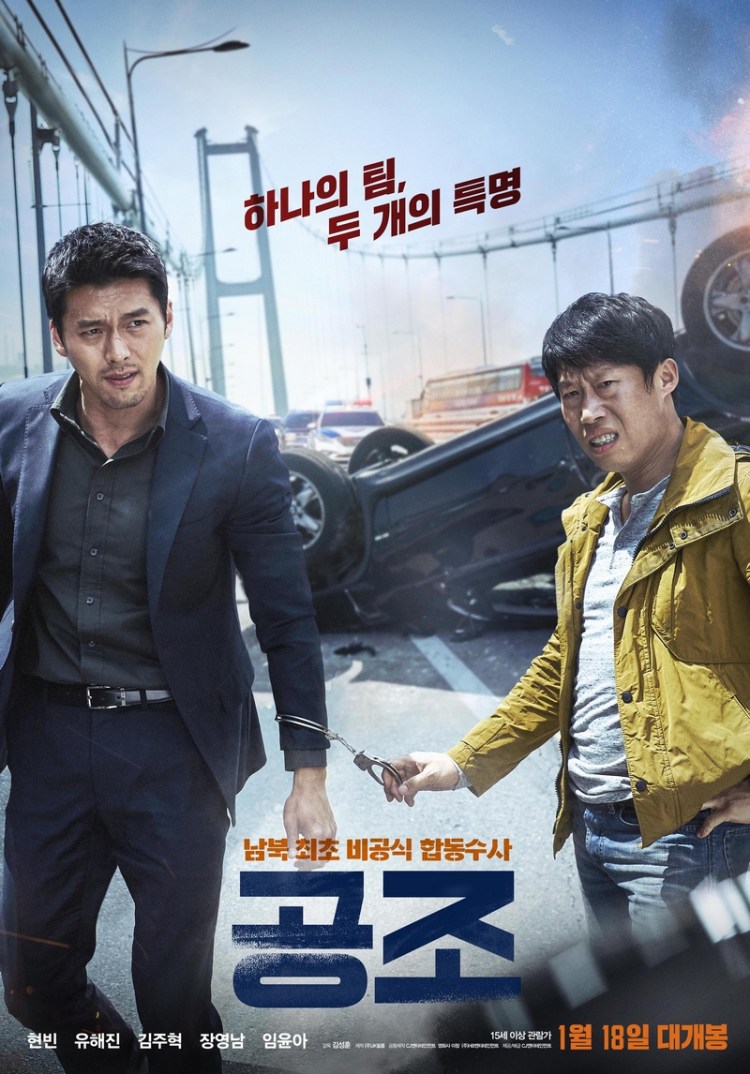
Confidential Assignment (공조, Kim Sung-hoon, 2017)

confidential assignmentSouth Korean cinema has a fairly ambivalent attitude to its policemen. Most often, detectives are a bumbling bunch who couldn’t find the killer even if he danced around in front of them shouting “it was me!” whereas street cops are incompetent, lazy, and cowardly. That’s aside from their tendency towards violence and corruption but rarely has there been a policeman who gets himself into trouble solely for being too nice and too focussed on his family. Confidential Assignment (공조, Gongjo), though very much a mainstream action/buddy cop movie, is somewhat unusual in this respect as it pairs a goofy if skilled and well-meaning South Korean police officer, with an outwardly impassive yet inwardly raging North Korean special forces operative.

In the South, Gang (Yu Hae-jin) is hot on the trail of a suspect he’s been chasing for quite some time but just as he’s finally about to catch him, his phone starts ringing. The cute ringtone featuring a little girl’s voice saying “daddy, pick up – don’t pretend to be working” is impossible to ignore and so Gang answers, chats to his daughter, and lets the suspect get away. In the dog house at work, Gang winds up with all the rubbish jobs before finally being saddled with a “special assignment” – babysitting a North Korean policeman as part of a collaborative detail chasing a possible defector/dangerous criminal the North are keen to drag back home for possibly inhumane treatment.

The Northerner, Lim (Hyun Bin), has his own reasons for chasing the criminal in that he is the only surviving member of a squad wiped out when a superior officer decided to go rogue and run off with a set of plates for printing counterfeit money. The North need the plates back, but Lim’s motives are personal more than merely patriotic and what he wants is vengeance for the death of someone close to him rather than protecting the embarrassing secret of North Korea’s counterfeit currency conspiracy.

For obvious reasons neither of the two men is able to trust the other but the confusion and suspicion is only increased by Gang’s total lack of knowledge about the case. All he knows is that they’re looking for a defector – no more, no less. Lim isn’t happy about having a South Korean cop getting in his way and quickly ditches him as soon as possible only for Gang to turn on his ace detective abilities and eventually end up at the same place through policeman’s instinct. Gradually a sort of grudging camaraderie builds up between the two as they’re forced to spend more time together and their odd couple buddy cop antics become the film’s main draw.

Lim, knowing nothing of life in the South yet suspicious of Gang, goes along with some of Gang’s goofier attempts to rein him in such as extended gag in which he gets him to put on an ankle bracelet by telling him that it’s a secret detective’s badge, reassuring him that his is in the cleaners, only for him to meet another suspicious type out on the road. So that he can keep track of him better, Gang’s superiors order him to take Lim home so he can watch him day and night much to the consternation of his wife but delight of his slightly younger sister-in-law who is instantly smitten by Lim’s chiseled features. Lim reacts to all of this with obvious vigilance but comes to like and respect Gang’s family who eventually welcome him into their home without reservation, even taking pains to try cooking North Korean food when he appears reluctant to join them at mealtimes.

Never quite engaging with the political subtext, Confidential Assignment is less about North/South co-operation than it is about complementary skills and the creation of an unexpectedly complete buddy cop unit. Gang is instantly impressed (and a little scared) by Lim’s obvious physical capabilities as he leaps from high balconies and fights off a whole room of bad guys armed only with soggy toilet roll, but Lim also comes to respect Gang’s bravery, kindness, and dedication to his family. Confidential Assignment might not be the most nuanced cinematic portrayal of North/South relations but its good-natured warmth, silly comedy, and impressively staged action scenes make it one of the most entertaining.


Confidential Assignment was screened as part of the 19th Udine Far East Film Festival.

Original trailer (English subtitles)

The Handmaiden (아가씨, Park Chan-wook, 2016)

handmaiden.jpgPark Chan-wook has something of a track record when it comes to bending literary sources in unexpected ways – who else would have thought of adding vampires to Thérèse Raquin and actually managed to make it work? In The Handmaiden (아가씨, Agasshi), his first return to Korean filmmaking after Stoker’s foray into American Gothic, Park adapts Sarah Waters’ Fingersmith – a Dickensian tale of love and the multilayered con, and relocates it to 1930s Korea under Japanese rule.

Ambivalent attitudes to the Japanese is a key element exploited by a ruthless conman posing as “Count Fujiwara” (Ha Jung-woo) in order to seduce a lonely heiress. To complete his elaborate plan, he needs the help of pickpocket extraordinaire, Sook-hee (Kim Tae-Ri), whom he will install as a maid in the household so she can subtly sell the virtues of the dashing nobleman to the innocent flower trapped in a well of opulence.

On arriving at the curiously constructed mansion which is an elegant architectural mix of Korean, Japanese, and English country estate, Sook-hee is quite literally out of place in the upperclass environment a world away from her home in a den of petty of thieves doubling as a baby farm. Another thing she had not quite banked on was that her new mistress, Hideko (Kim Min-hee), would be quite so pretty. A serious spanner is thrown in the works as a mutual attraction builds up between the two women who, for reasons which become apparent, are being pulled in separate directions by other desires.

Park retains Waters’ tripartite structure even if he jettisons the final plot reveal for a less intricate tale of liberation and escape. Beginning with Sook-hee’s narrative he introduces us to the first layer of the con but also to Sook-hee and her down and dirty home in the criminal underworld. Chosen by the Count for her supposed lack of intellect and innocent naivety, Sook-hee is not quite at home among her family either. Both believing the promise that the babies they collect and sell in Japan will be going on to better lives and lamenting the cruelty of the whole business in wanting to mother the lot of them, Sook-hee is soft presence yet she also wants to prove herself as adept at criminality as her legendary, now deceased, mother.

It’s this essential warmth which eventually attracts Hideko’s attention. The much talked about tooth filing scene in which Sook-hee takes out a thimble to soften a lacerating sharpness in her mistress’ mouth is not just notable for the oddly erotic quality born of the obvious suggestive motion, unavoidable intimacy created by the closeness of bodies, and the growing desire of fleeting, furtive glances, but for its essential kindness. Moving into Hideko’s perspective for the second chapter, more is learned about her damaged past filled with cruelty and abuse. Orphaned and brought to Japan as a small child by her pornography obsessed uncle so that he might train her to entertain him with readings of erotic literature before he eventually marries her to inherit the family fortune, Hideko has never known anything as simple as unguarded goodness.

Caught up in a long con, the choice remains whether to blow cover and declare one’s hand or play the thing through to the end, however painful it may be. Park takes a different route than in the original novel which makes both of its heroines the victims of someone else’s avaricious plot of revenge against the cruelty of an unequal world, eventually reinforcing their bond by a shared rejection of their victimhood, but even when their passions eventually erupt the lovemaking begins as a another “con” where Sook-hee takes on the role of the Count, “educating” the assumedly “innocent” Hideko in the ways of desire.

Trapped within an oppressive gilded cage of a prison, Hideko has become the embodiment of desire for her cruel and eccentric uncle and the groups of men he invites to listen to her read erotic literature as if reciting a classical play. Complete with sideshows of sex dolls and theatrical scenery, Hideko is forced to act out the scenes from the books as an actress on the stage for an audience rapt in silence. Unable to escape alone, Hideko is offered new hope by Sook-hee’s straightforward outrage which allows the pair to destroy or repurpose the instruments of their oppression for their own pleasure. This is, in essence, their form of revenge in which they simply remove themselves from an abusive environment leaving the men behind to wonder at what’s gone wrong and later to destroy themselves without any additional help.

Filled with a gothic sense of impossible desires and uncertain judgements, The Handmaiden is unafraid of the genre’s melodramatic roots but is all the better for it. Beautifully photographed, this opulent world of swishing ball gowns and gloved hands is undercut by the ugliness of quisling collaborator Kouzuki and his basement of horrors. Erotically charged but ultimately driven by love, The Handmaiden is another unconventionally romantic effort from Park albeit one coloured by his characteristic sense of gothic darkness.


Reviewed at 2016 London East Asia Film Festival.

Original trailer (English subtitles)
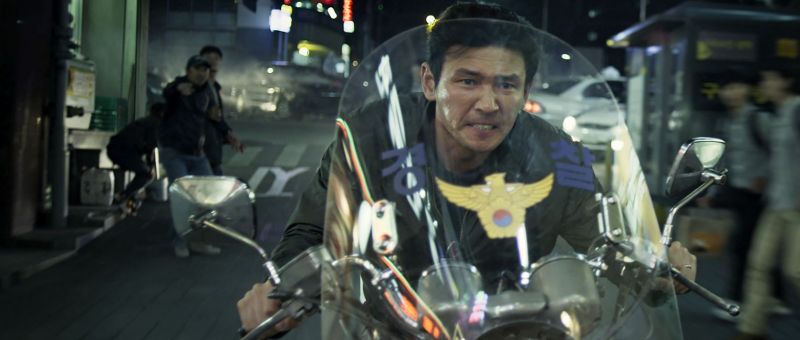
Veteran (베테랑, Ryoo Seung-wan, 2015)

1439210220_베테랑1Review of Ryoo Seung-wan’s Veteran (베테랑) – first published on UK Anime Network.


One of the top Korean box office hits of 2015, Ryoo Seung-wan’s Veteran is a glorious throw back to the uncomplicated days of ‘80s buddy cop crime comedy thrillers. A little less than subtle in its social commentary, Veteran nevertheless takes aim at corrupt corporate culture and the second generation rich kids who inherit daddy’s company but are filled with an apathetic, bored arrogance that is mostly their own.

Seo Do-cheol (Hwang Jung-min) is, as one other officer puts it, the kind of police officer who joined the force just to beat people up. He loves to fight and isn’t afraid of initiating a little “resisting arrest” action just to make things run a little more smoothly. However, when he strikes up a friendship with a put upon truck driver and his cute as a button son only to miss a crucial telephone call that eventually lands said truck driver in the hospital, Do-cheol’s sense of social justice is inflamed. After trying to join a trade union, Bae, the truck driver, is unceremoniously let go from his company. On taking his complaint directly to the head of Sin Jin Trading, play boy rich kid Tae-oh, Bae is subjected to the most cruel and humiliating “interview” of his life before apparently attempting to commit suicide after having realised the utter hopelessness of his situation. Incensed on his new friend’s behalf, Do-cheol is determined to take down these arrogant corporatists what ever the costs may be!

Veteran makes no secret of its retro roots. It even opens with a joyously fun sequence set to Blondie’s 1979 disco hit, Heart of Glass. Like those classic ‘80s movies, Veteran manages to mix in a background level of mischievous comedy which adds to the overall feeling of effortless cool that fills the film even when things look as if they might be about to take a darker turn. The action sequences are each exquisitely choreographed and filled with sight gags as the fight crazy Do-cheol turns just about any random object that appears to be close to hand into an improbable weapon.

Make no mistake about it either, this is a fight heavy film. Though Veteran has a very masculine feeling, it is to some degree evened out by the supreme Miss Bong whose high class high kicks can take out even the toughest opponents and seem to have most of her teammates looking on in awe, and the withering gaze of Do-cheol’s put upon wife who seems determined to remind him that he’s not some delinquent punk anymore but a respectable police officer with a wife and child who could benefit from a little more consideration.

Indeed, Tae-oh and his henchmen aren’t above going after policemen’s wives in an effort to get them to back off. Though this initial overture begins with an attempt at straightforward bribery (brilliantly dealt with by  Mrs. Seo who proves more than a match more the arrogant lackeys), there is a hint of future violence if the situation is not resolved. Tae-oh is a spoiled, psychopathic rich kid who lacks any kind of empathy for any other living thing and actively lives to inflict pain on others in order to breathe his own superiority. Probably he’s got issues galore following in his successful father’s footsteps and essentially having not much else to do but here he’s just an evil bastard who delights in torturing poor folk and thinks he can do whatever he likes just because he has money (and as far as the film would have it he is not wrong in that assumption).

He also loves to fight and finally meets his match in the long form finale sequence in which everything is decided in a no holds barred fist fight between maverick cop and good guy Do-cheol and irredeemable but good looking villain Tae-oh. Veteran never scores any points for subtlety and if it has any drawbacks it’s that its characterisations tend to be on the large side but what it does offer is good, old fashioned (in a good way) action comedy that has you cheering for its team of bumbling yet surprisingly decent cops from the get go. Luckily it seems Veteran already has a couple of sequels in the pipeline and if they’re anywhere near as enjoyable as the first film another new classic franchise may have just been born.


Reviewed at the first London East Asia Film Festival and the London Korean Film Festival.