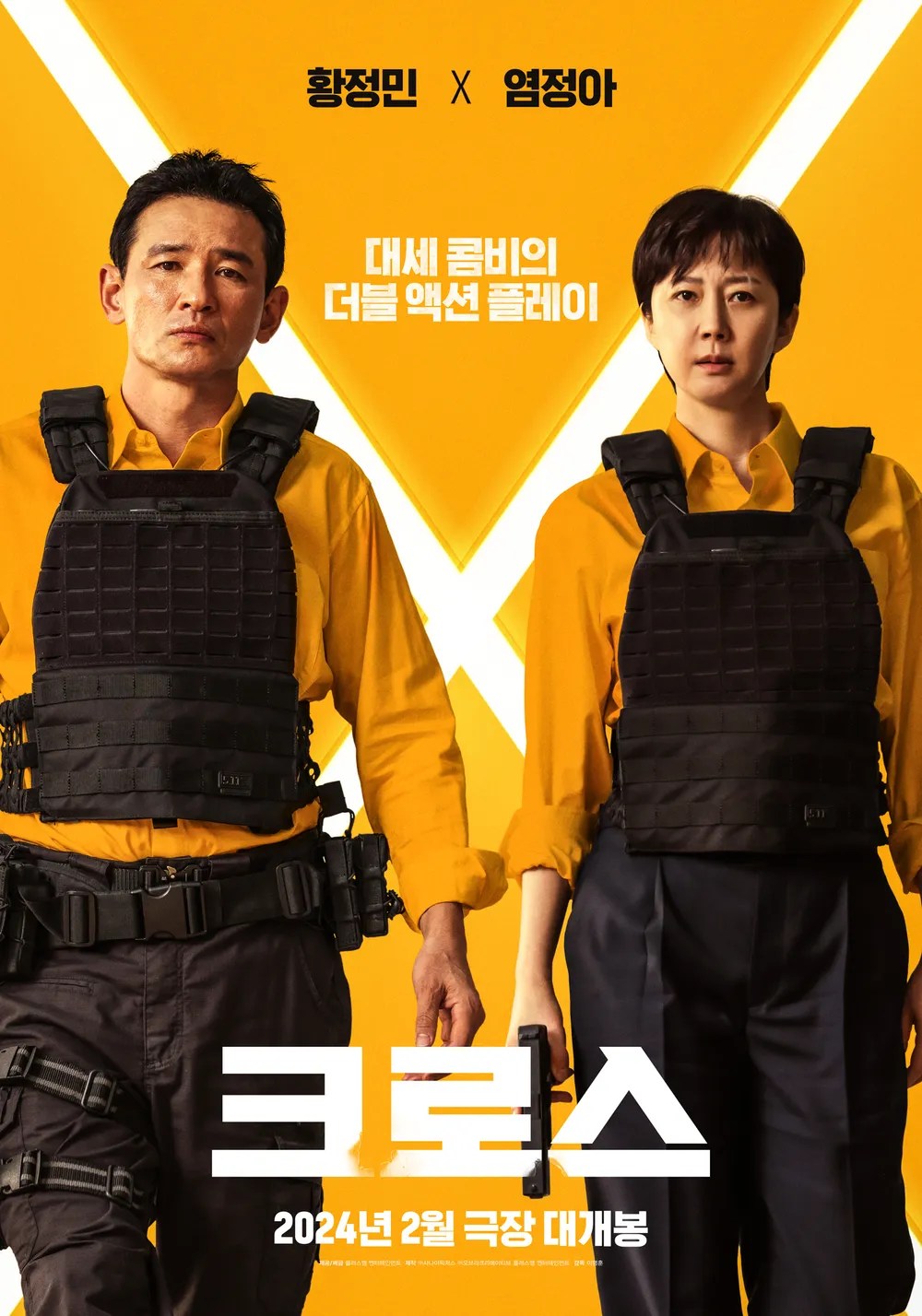
Mission: Cross (크로스, Lee Myung-hoon, 2024)

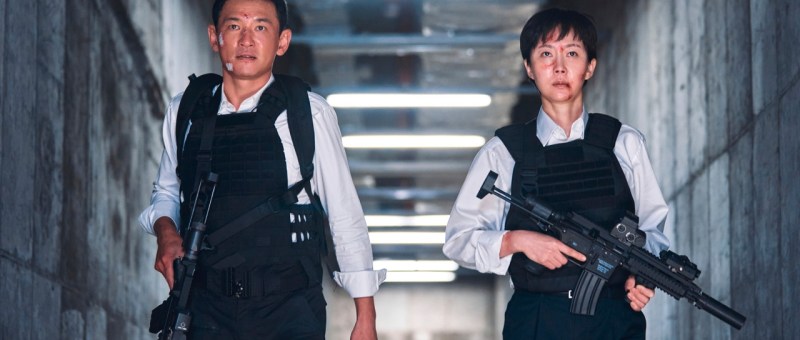
“Justifying each other’s existence, is that what marriage is about?” Asks top cop Mi-seon (Yum Jung-ah) while contemplating her vaguely dissatisfying marriage to househusband Kang-mu (Hwang Jung-min). In the opening sequences of Lee Myung-hoon’s action rom-com Mission: Cross (크로스), Mi-seon describes Kang-mu as a lottery ticket that’s never going win and suggests she only puts up with him because he’s not the worst man in the world and maybe marriage means putting up with each other. Only on discovering his long-buried secret does she begin re-evaluate him along with what marriage means to her.

Part of what puts her off, however, is Kang-mu’s seeming unmanliness. As a househusband, a rarity in South Korea’s patriarchal society, Kang-mu takes good care of care of her but Mi-seon finds it vaguely annoying and is irritated by his tendency to raid her wallet. It’s also Kang-mu that hosts when her colleagues come over for celebrations after solving a case and he’s got labelled Tupperware in his fridge with homemade kimchi for them. Nevertheless, they all jokingly refer to Kang-mu as Mi-seon’s “missus” which is also in part born of their characterisation of Mi-seon as a man because of her no-nonsense nature and the authority she holds over them. When Kang-mu asks Mi-seon’s colleague Sang-un (Jung Man-sik) to give her a wrist brace he bought her but thinks she’s too proud to accept from him, she jokingly asks if he fancies her but he replies that he only likes women. Nevertheless, Sang-un too is positioned as unmanly because his wife cheated on him which led to their divorce. The other two officers, meanwhile, are obsessed with romantic drama and act out their own version of events after spotting Kang-mu with another woman and becoming convinced that he’s having an affair.

Kang-mu, however, has a secret past as an intelligence officer from which he got fired for conducting an unauthorised mission to stop a Russian arms shipment reaching North Korea. While they were on the boat, they discovered that it was actually going to South Korea while one of his men was killed by the Russian Mafia. Six years later, one of his old colleagues has gone missing while trying to expose a procurement fraud scam run by the mysterious General Park through a fake contract to buy a new aerospace weapon from the Russians. Meanwhile, Mi-seon is investigating the attempted murder of a young woman who was shot after delivering a USB stick containing accounting files to a dead drop. 

Obviously, the cases are connected and Mi-seon is about to make a discovery about her husband but not before she experiences the unexpected jealousy of suspecting that he might actually be having an affair. The film actively turns an established trope on its head in that there are countless dramas in which a secret agent thinks he’s married to a regular housewife only to find out she used to be a top assassin, but in its way still ends up conforming to traditional gender roles while essentially subverting them. Mi-seon’s attraction to her husband is reignited when he becomes more stereotypically masculine by charging in with guns and rescuing her. In any case, finding out truth seems to complete the puzzle so that she can reconsider the point of marriage to reflect “Even if the whole world is against you, I’m on your side. That’s what marriage is.” 

Even so, the end result is that they fight crime together rather than Mi-seon having to take a back seat while she also commits to making it work rather than being vaguely irritated with Kang-mu but not making any attempt to improve their marriage. Lee cleverly plays with the tropes of the genre to create a genuinely surprising twist complete with a Bond-style maniacal villain playing off the region’s complicated geopolitics by working with the Russians who are thought to be colluding with North Korea against the South when really just in it for themselves. While the final mid-credits sequence, a reference to Hwang’s Netflix series Narco Saints, is a little uncomfortable in its implications, it’s clear that there’s a lot more milage in this potential franchise built around the unusual dynamics of the central pair’s marriage as well as those of Mi-seon’s equally unusual team of lovelorn romantics.


Trailer (English subtitles)

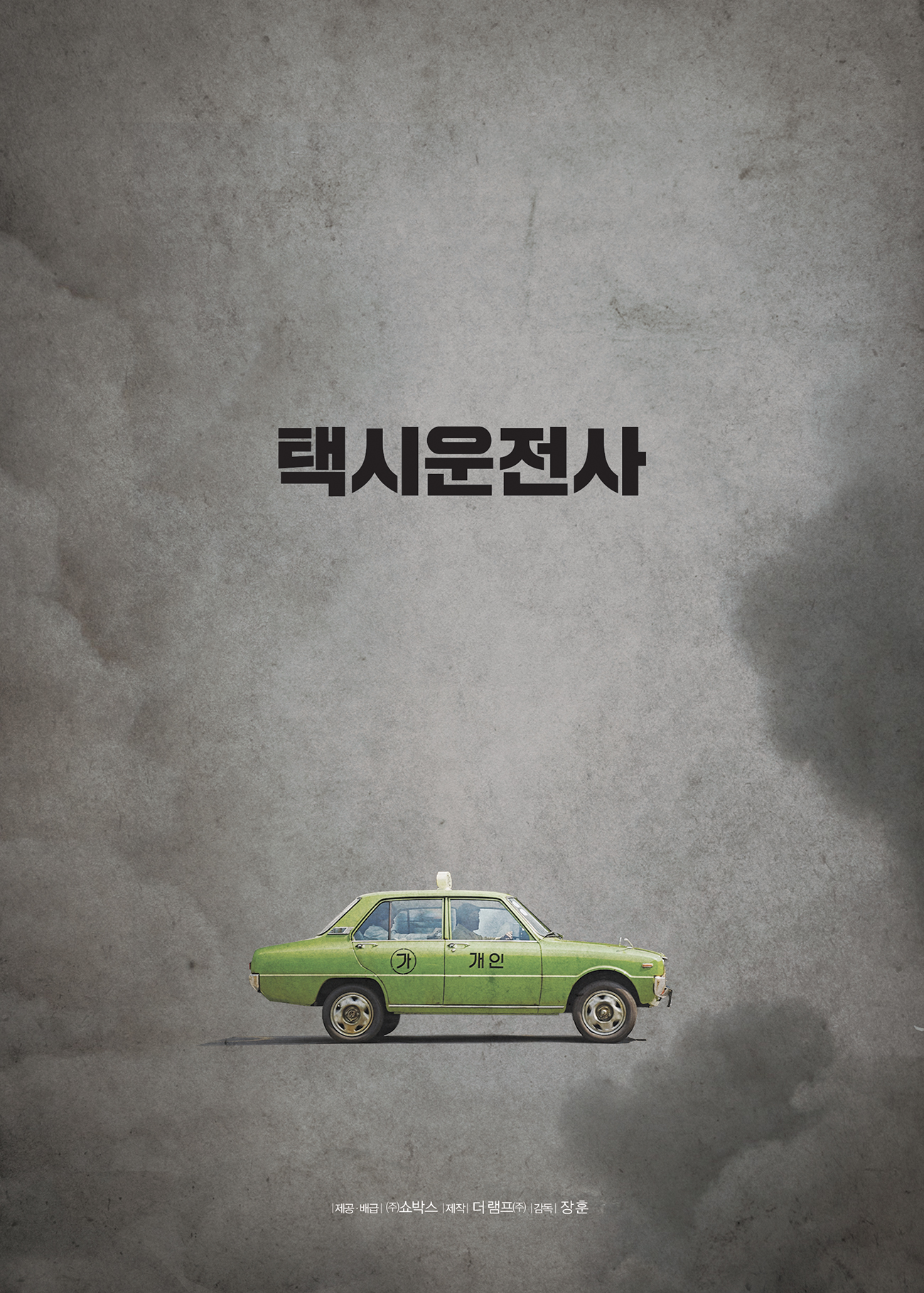
A Taxi Driver (택시 운전사, Jang Hoon, 2017)

A Taxi Driver PosterIn these (generally) well connected days of mass communication when every major event is live broadcast to the world at large, it’s difficult to remember a time when dreadful things might be happening the next town over yet no one knows (or perhaps dares to ask). Until 1979, Korea had been under the control of an oppressive dictatorship which was brought to a sudden and bloody end by the murder of the president, Park Chung-hee, at the hands of one of his aides. Though the democracy movement had been growing, hopes of installing a modern governmental system were dashed with the accession of the de facto president, General Chun Doo-hwan, who reinstated martial law, placing troops on the streets on the pretext of a possible North Korean invasion. In an event known as the Gwanjgu Uprising, a long term peaceful protest led by the area’s large student population was brutally suppressed with large numbers dead or wounded by government soldiers.

Meanwhile, in Seoul, regular Joe taxi driver Kim Man-seob (Song Kang-ho) is trying to go about his everyday business and is finding all of this protesting very irritating, especially when he is forced to swerve to avoid a young man running from riot police and breaks the wing mirror on his otherwise pristine vehicle. Man-seob thinks these kids don’t know they’re born, if they’d spent time abroad like he did in Saudi Arabia, they’d know that few places are quite as nice as Korea. A single father raising his young daughter alone, Man-seob’s major worry is money. He’s four months behind on his rent and his daughter keeps getting into fights with the landlord’s son. Actually, the rent might not be such a pressing problem seeing as Man-seob’s landlord is a close friend and colleague – close enough for him to cheekily ask to borrow the money to “pay” him so his friend’s wife will stop being so mean. When he overhears another driver boasting that he’s picked up an improbably large fare that’s exactly the same amount as the money Man-seob owes, Man-seob bluffs his way into stealing it out from under him. Man-seob, however, has not stopped to consider why a foreigner wants to pay him an insane amount of money to drive from Seoul to provincial Gwangju.

Like many in the Korea of 1980, Man-seob is a man just trying to get by. He has his private sorrows, but largely avoids thinking about the big picture. To him, the Seoul protest movement has become such a normal inconvenience that he keeps cream in his car to help cope with the smell of the smoke bombs. He thinks all of this rancour is just kids out of control and will eventually blow over when order is restored.

Others feel differently. A BBC journalist relocated from Korea to Tokyo describes the situation as “tense” and avows that this time something may be about to break. Tokyo in 1980 is a nice place to live, but extremely boring if you’re an international journalist and so German reporter Peter (Thomas Kretschmann) catches the next flight out with the intention of investigating the rumours of state sponsored violence coming out Gwangju.

Though Man-seob’s original motivation is the money, the events he witnesses in Gwangju have a profound effect on the way he sees his country. Bypassing roadblocks and sneaking into a city under lockdown, Man-seob and Peter witness acts of extreme violence as the army deploys smoke grenades, beatings, and bullets on a peaceful assembly of ordinary people. Prior to the military’s intervention, the atmosphere is joyful and welcoming. The people of Gwangju dance and sing, share meals with each other, and all are excited about the idea of real social change. This juxtaposition of joy and kindness with such brutal and uncompromising cruelty eventually awakens Man-seob’s wider consciousness, forcing him to rethink some early advice he gave to his daughter concerning her difficult relationship with the little boy next-door to the effect that non-reaction is often the best reaction.

Rather than focus on the Uprising itself, Jang presents it at ground level through the eyes of the previously blind Man-seob and the jaded Peter. Inspired by real events though heavily fictionalised (despite a search which continued until his death, Peter was never able to discover the true identity of the taxi driver who had helped him), A Taxi Driver (택시 운전사, Taxi Woonjunsa) is a testament to the everyman’s historical importance which, even if occasionally contrived, speaks with a quiet power in the gradual reawakening of a self-centred man’s sense of honour and personal responsibility.


A Taxi Driver was screened as the sixth teaser for the upcoming London Korean Film Festival 2017. Tickets for the next and final film, The Villainess which screens along with the official programme launch at Regent Street Cinema on 11th September, are on sale now.

Original trailer (English subtitles)