Dream (드림, Lee Byeong-heon, 2023)

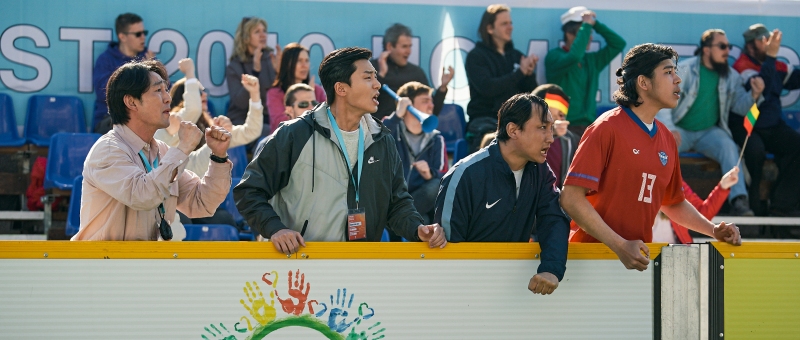
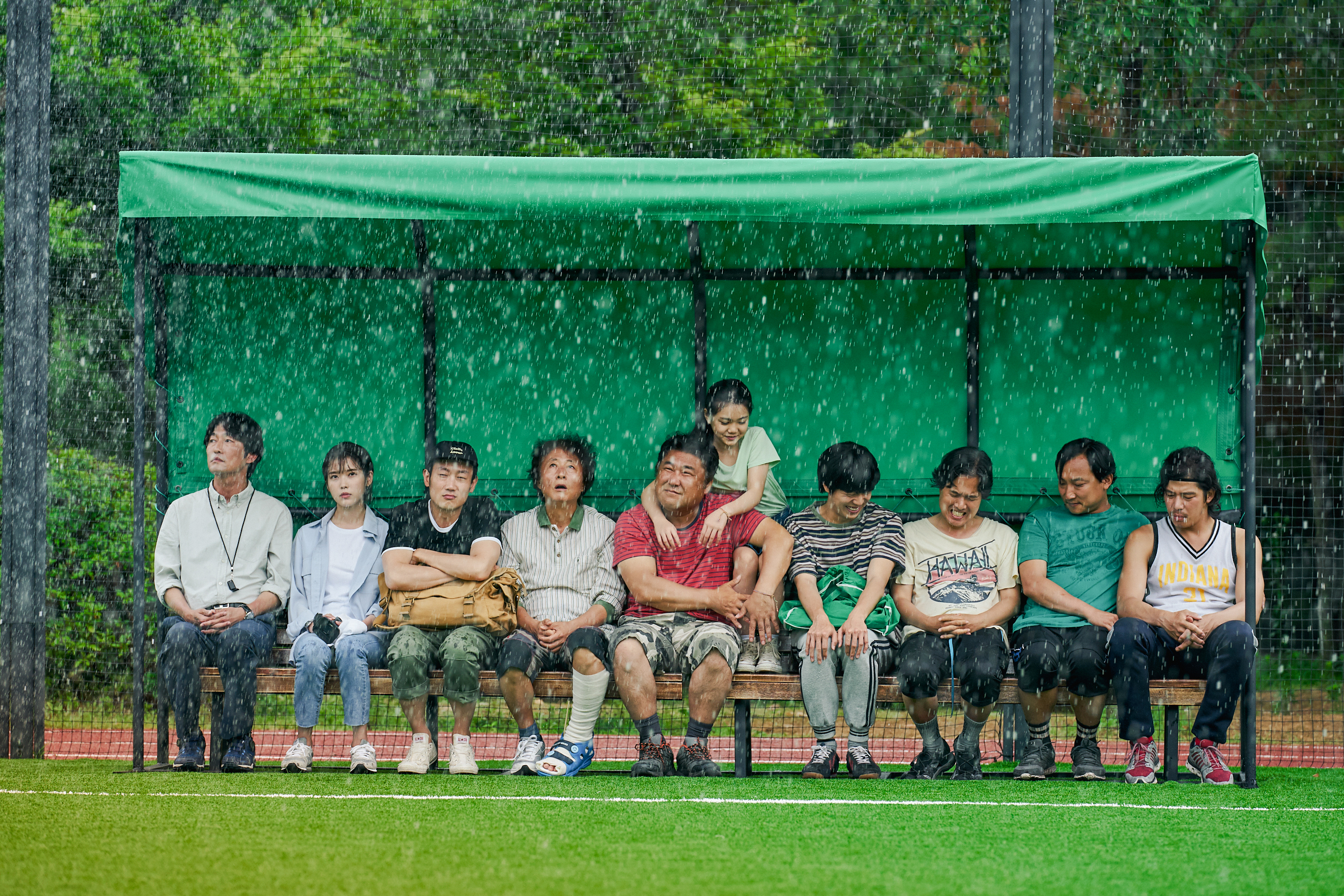
A disgraced football player gets a shot at redemption after agreeing to coach a team hoping to take part in the Homeless Olympics in Lee Byeong-heon’s sporting drama, Dream (드림). The Homeless Olympics was founded in order to advocate for the end of homelessness while combatting discrimination and stigma and takes place annually with teams of homeless people from all over the world taking part. Set in 2010 and inspired by the first Korean delegation to participate, the film is essentially an underdog sports drama in which the act of scoring a single goal is the same as an overall victory.

It is also, meanwhile, heavily critical of celebrity and sensationalist media each of which have a habit of latching onto popular causes in order to further their own careers. Hong-dae (Park Seo-jun) was a popular footballer insecure in his talents, but gained notoriety after poking an obnoxious reporter in the eyes when he repeatedly brought up the topic of his mother who happens to be a fugitive from justice. Deciding to retire from the game, Hong-dae is picked up by a talent agency who want to make him a star and is convinced to become the coach of the homeless football team in order to improve his personal brand while documentarian So-min (Lee Ji-eun) hopes to do something much the same by producing a semi-scripted reality show following the team’s fortunes.

Accordingly, So-min instructs Hong-dae to let her “cast” the key players on the basis of their touching backstories rather than their sporting ability. She comes up with a selection of people who have each for various reasons ended up on the streets but are looking for a way to turn their lives around and repair fractured relationships with family members. One man turned to booze and women while riding high but found himself out of luck when the Asian Financial Crisis ruined his business, while another claims that he’s not really homeless just lying low for a while, and a third was scammed by a friend and saddened by the impending exit of his ex-wife and daughter who will shortly be moving to Australia with her new husband. The film strays into more interesting territory in exploring the story of 44-year-old Beom-su (Jung Seung-gil) who ended up on the streets after a workplace accident left him with a chronic illness he did not have the money to treat, but otherwise falls into the same trap as So-min’s documentary in taking a fairly superficial view of homelessness. By the end of the film many of the players have thankfully moved into stable accommodation but do so largely without explanation aside from having apparently managed to save up for a deposit. 

Positioning their battle for sporting success as a means of reclaiming their self-esteem might also uncomfortably suggest that the reason they’re on the streets is a matter of mental attitude while ignoring other systemic issues that led them there or prevented them from moving on (assuming that they wish to do so). Aligning their struggles with Hong-dae’s and to a lesser extent So-min’s might do something similar while they too are also battling cynicism and self-esteem issues, Hong-dae continuing to blame his mother for his problems complaining that he was born to be second place because she never put him first. As Hong-dae later points out, So-min is also to an extent exploiting the homeless in trying to create an inspirational narrative for her TV show before she like everyone else realises there are other ways to win besides the literal. 

The final message is more one of never giving up as the team finally travel to the Olympics and find themselves out of their depth before deciding to give it everything they have even if it’s very unlikely they will win. There had indeed been discrimination in Korea, a sponsor pulling out describing the homeless as “smelly and disgusting” and expressing a degree of squeamishness about involving them with their brand, but at the Olympics they become the most popular team despite their lack of skill purely because of their charismatic perseverance. One player’s late in the game announcement that he is gay but has now come to accept himself in the knowledge that the problem lies with the world that will not accept him also makes the case for a greater equality if perhaps clumsily conflating two different issues. Nevertheless, IU’s lively performance and the film’s warmhearted tone help to overcome any mild sense of discomfort in its otherwise genial tale of never giving up and regaining your self-esteem even if you feel as if the world has already abandoned you. 


Dream screens July 17 as part of this year’s New York Asian Film Festival.

International trailer (English subtitles)

Images: © 2023 PLUS M ENTERTAINMENT & OCTOBER CINEMA INC. ALL RIGHTS RESERVED.
Broker (브로커, Hirokazu Koreeda, 2022)

Perhaps more than any other contemporary director in Japan, Hirokazu Koreeda has persistently interrogated the concept of the modern family asking what exactly the word has come to mean and how it is or should be defined. In Nobody Knows he showed us a case of parental neglect as abandoned siblings attempted to get by on their own in the absence of maternal care, while the separated brothers of I Wish struggle to define the nature of their relationships in the wake of their parents’ divorce. In Like Father, Like Son, Koreeda asks whether it’s blood relation that defines a family tie or whether it is forged more by mutual affection and shared memories, and in festival hit Shoplifters, he showed us a family who were not related by blood but had found in each other a home and a place to belong. 

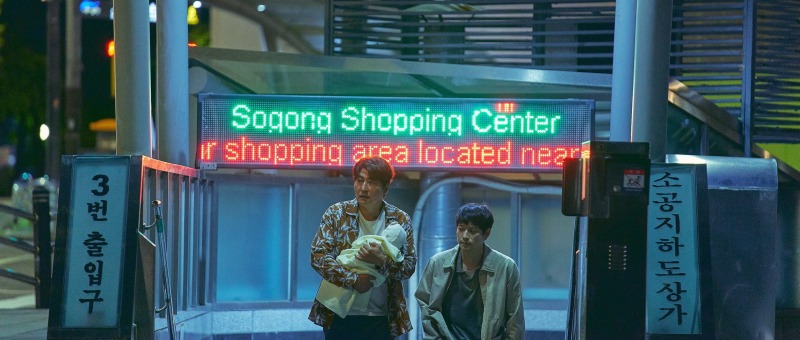
Billed as a kind of companion piece, Broker (브로커) once again features a found family “brokered” by criminal activity but goes a step further, asking once again what the rights and responsibilities are when it comes parenthood and if the choice to abandon a child can ever be justified. Set in Korea where Christian morality has a greater influence, the film opens with a young woman leaving her infant child in front of a church yet abandoning him on the floor rather than placing him inside the “baby box” in the church’s wall. A policewoman staking out the church in the belief that someone is using the baby box to traffic children gently places the infant inside with what looks like maternal care but then we start to wonder, perhaps she only does so in order to see what happens when someone picks up him from the other side. 

Indeed, the policewoman will later concede that perhaps she herself was the one who most wanted the baby, Woo-Sung, to be sold so that she could catch the traffickers redhanded. We might feel a degree of revulsion towards the idea that a baby could be exchanged for money, but then perhaps we don’t stop to wonder who might buy and for what purpose. Sang-hyun (Song Kang-ho), a dry cleaner with gambling debts, and his partner Dong-soo (Gang Dong-won) who himself grew up in an orphanage, later recount selling a baby to two gay men who would otherwise be unable to adopt in the still conservative country suggesting in part that it’s a repressive society that forces people into this morally questionable underground trade in human children. It’s also societal conservatism that necessitates the existence of something like the baby box in that often very young women who bear children but cannot keep them either out of shame or simple economic impossibility have few other options than to abandon their child in the hope that someone will take it in. 

Detective Lee (Bae Doona) nevertheless brands these women as “irresponsible” and blames the baby box for tacitly encouraging their behaviour. An abandoned child himself, Dong-soo also struggles with his attitude towards the mother, So-young (Lee Ji-eun), who against all the odds does come back to reclaim her son after changing her mind. He and Sang-hyun justify their actions that they’re “saving” Woo-sung from being placed into the care system by finding him a loving home with parents who can give him a comfortable life. After taking to the road, the trio arrive at the orphanage where Dong-soo was raised which is less a home for him than a painful reminder of all he’ll never have and will never achieve as someone without a clear idea of a place to belong.

The man running the orphanage even concedes he’s not doing so well after the losing the subsidies for a few of the kids who have left, though few people adopt kids over six and the law makes it more difficult at eight which is a particular problem for football enthusiast Hae-jin (Im Seung-soo) who ends up climbing into Sang-hyun’s van and demanding they take him in. “Blood is thicker than water” the man sighs, explaining that kids are often sent back when it doesn’t work out or even end up suffering abuse despite the supposedly rigorous processes for vetting potential parents which causes some to simply buy a child on the black market instead. 

Despite the image of Dong-soo and Sang-hyun as heartless child traffickers they nevertheless take good care of Woo-sung and are up to a point careful that they should give him to someone responsible, mindful of those who might want a baby for untoward purposes or are intent on selling him on. A visual motif of tangling threads from the cotton on Sang-hyun’s sewing machine to the rope that pulls the busted back door of the van closed hints at the various ways these five dispossessed people are slowly bound together, becoming an accidental family forged through a process of mutual understanding in which Dong-soo is able to re-evaluate his feelings towards his mother through bonding with So-young and realising that in abandoning her child she may only have been trying to protect him and give him the better life that she never had. 

So-young tells Dong-soo that she sometimes has a dream in which the rain washes away her life until now, but on waking she realises it’s raining and nothing’s changed. He tells her perhaps all she needs is an umbrella that’s big enough for two, a metaphor for the protective quality of family he could perhaps have given her. Even she later concedes that had she met them earlier, none of this would have been necessary while Detective Lee’s more sympathetic partner (Baek Hyun-jin) likewise asks why they couldn’t have intervened earlier and done something to help this struggling young woman whose only problem was her aloneness before it came to this. What emerges is an unexpected compassion and the extension of an umbrella from an unexpected source in the acknowledgement that nothing’s ever quite as simple as it might seem. Koreeda leaves us with an outcome that is possibly as happy as it could be in an imperfect world, which might in itself be a little unrealistic but nevertheless in its own way hopeful in having reclaimed a notion of “family” brokered by selflessness and mutual compassion if not quite love for the orphans of an indifferent society.


Broker opens in UK & Irish cinemas on February 24th. For more information head to http://broker.film/

UK release trailer (English subtitles)

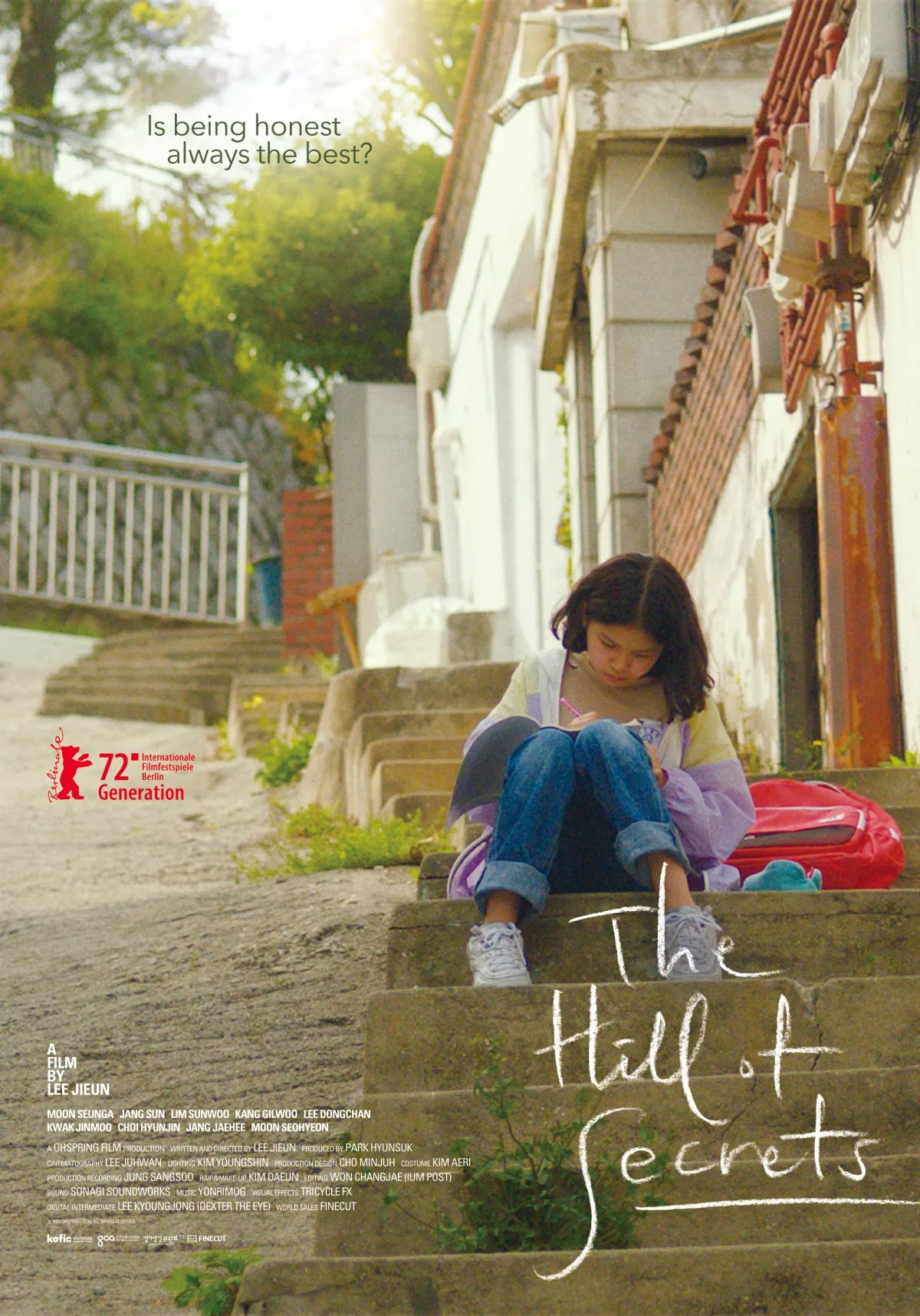
The Hill of Secrets (비밀의 언덕, Lee Ji-eun, 2022)

A little girl contends with the boundaries of social responsibility, the nature of the contemporary family, classism, and a deep desire to be accepted while confronted by the ambivalent “honesty” of adulthood in Lee Ji-eun’s charming coming-of-age tale, The Hill of Secrets (비밀의 언덕, Bimileui Eondeok). Set in 1996 and filled with nostalgia for simpler times, Lee’s tale of the painful lessons of adolescence is in its own way timeless as the heroine begins to reprocess her complicated relationships with her family while simultaneously preparing to step away from it. 

12-year-old Myeung-eun’s (Moon Seung-ah) problem is that she’s a bit of a snob. Surrounded by children from wealthier families at her school, she feels ashamed of her background and looks down on her working class parents whom she brands “terrible people” for their every man for himself philosophy. When her brother asks their father what their family motto is for a homework assignment, he looks confused and answers that they don’t have one, but her mother jumps in with “give nothing, take nothing” having experienced a moment of outrage when Myeung-eun wanted to donate some money to a struggling family on the television. Her father had insisted that the family is only struggling because they’re lazy and aren’t trying hard enough, reminding her that their lives are hard too but they’ve made their way through buckling down and working without complaint. Myung-eun resents his explanation in part because she thinks he’s selfish and unkind, but also finds it hypocritical in that she sees her father as lazy and irresponsible while her mother is a workaholic who only cares about money and is indifferent to the suffering of those around her. 

To demonstrate that she’s different from her family, Myung-eun has developed conservative social values with a strong aspiration to achieve conventional middle class success as symbolised by the incredibly prim dress she’s forever trying to get her mother to buy for her while she opts for something a little less particular that Myung-eun won’t grow out of too quickly. So ashamed of her family is she, that Myung-eun lies at school telling her teacher that her dad’s an office worker and her mum a housewife while making constant excuses as to why they can’t come to parents’ days. Challenged by her rival, rich kid Kyung-soo, she even goes so far as to bamboozle an executive at a nearby company into an “interview” for her “homework” taking a series of fake photographs while getting a friend’s mother to pose as her own as they cheerfully bake cookies together at home. 

Wanting to knock Kyung-soo off her perch Myung-eun runs for class president and pulls off a shock victory but soon becomes drunk on her power and driven further into a narcissistic drive for approval from her harried teacher. She sets up a secret letterbox so her classmates can make anonymous suggestions, but is actually writing them all herself sometimes using her left hand, different coloured pens, and weird handwriting to cover up her crime. When she fears her brother is about to blow her cover, she gets into a physical fight with a friend accusing her of disrespecting the office of class president, and struggles to accept herself at her new status because of her internalised shame over her class background. 

Yet confronted with the incredible cynicism of transfer student Hye-jin who matter of factly answers the teacher’s question about workers making people happy that her mum makes loads of people happy because she runs a brothel which is why Hye-jin has had to change schools so often, Myung-eun begins to reconsider her notions of honesty and deceit. Hye-jin is tired of hiding her background and really doesn’t care what anyone thinks anymore, while Myung-eun is desperate to keep up an image of conventional respectability rather than admit that her parents sell salted fish at the market. As her teacher later tells her, honesty is not necessarily the best policy and sometimes you might have to lie to protect someone’s feelings but that’s really the opposite of what Myung-eun has been doing. Her lies are all about protecting herself and told out of fear of rejection ironically because she feels rejected by her family who appear disinterested in her successes and indifferent to her feelings. 

But then as her brother tried to remind her, her mother works hard to support their family while crafting a sketchbook of the ideal home she’ll probably never be able to afford. Myung-eun decamps to stay with her mother’s step father and brother who are much more stereotypically respectable than her parents, living in a nicer flat which belonged to her grandmother and outwardly religious. But then again her uncle has the same internalised shame as she does, a failed artist working part-time in construction but putting on a suit and carrying a briefcase when he picks her up from school so that people will assume he’s a middle-class office worker. Her grandfather berates her uncle for not having a proper job while he later reveals that Myung-eun’s rmother’s resentment stems from the fact she’s been supporting both families financially even though her mother has passed away and they aren’t related by blood. Myung-eun’s father complains about his domineering wife, but as his friend points out he’d be lost without her. 

An exercise in rigorous honesty confronts Myung-eun with her true feelings surrounding her family but also with the consequences of her actions as she realises an autobiographically-themed prize-winning essay may end up hurting their feelings while she herself would not necessarily come out of it looking very good. Through her friendship with Hye-jin and her sister, Myung-eun comes to a better understanding of emotional authenticity edging away from her snooty social group who as Hye-jin points out enforce hierarchy by taking turns leaving each other out and beginning to accept herself no longer so desperately in need of external approval having understood a little of the way she fits in to her family. A gentle, nostalgic coming-of-age tale, Lee’s charming debut feature is both a mild critique of deeply ingrained classism and an empathetic contemplation of what it is that “family” really means.


The Hill of Secrets screened as part of this year’s London Korean Film Festival.

Clip (English subtitles)

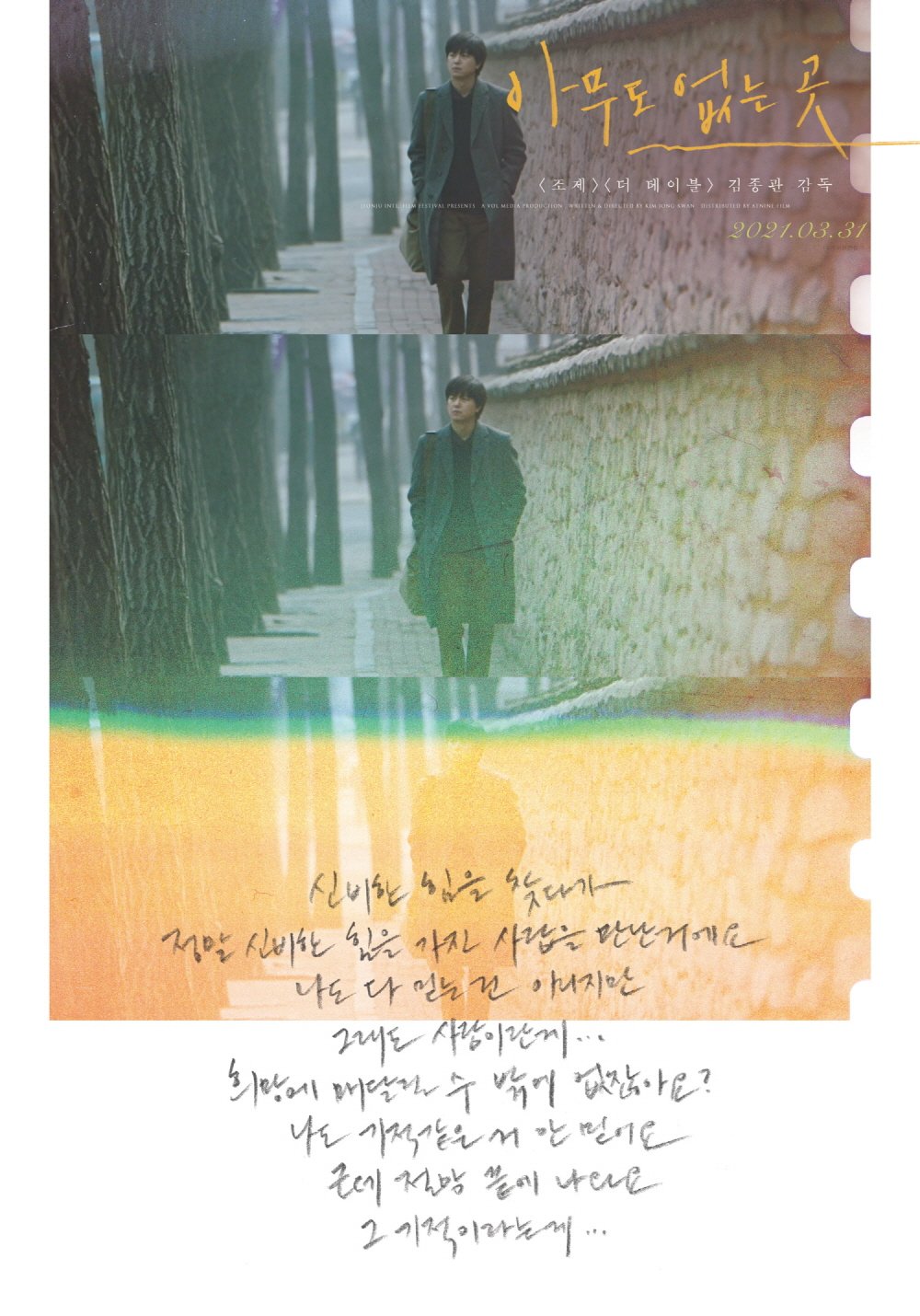
Shades of the Heart (아무도 없는 곳, Kim Jong-kwan, 2021)

“I see hope! Let’s change direction” a distressed woman shouts in a park, “We should follow the wind, let’s hold hands that way you won’t get lost.” Her interjection is perhaps unexpected, in its own way sad, but also a sign offered to the melancholy protagonist of Kim Jong-kwan’s Shades of the Heart (아무도 없는 곳, Amoodo Eobneun Got), a man who has become without quite realising it “someone who waits” yet through encounters serendipitous and otherwise begins to see new paths in front of him, turning a corner into another story.

Novelist Chang-seok (Yeon Woo-Jin) has just returned to Seoul after seven years abroad following the breakdown of his marriage in the UK. He has begun to have strange dreams, seeing an older version of himself and presumably his wife walk away from him and eventually disappear. Yet each of the people he meets is also in someway burdened by a sense of loss or despair, his first meeting with his mother who appears to have some kind of dementia and does not initially recognise him thinking once again she’s on her first date with his father. Her sadness is the loss of past and present but also of future, telling her son on finally recognising him not to smoke so much so he won’t die young like his dad. 

Chang-seok had apparently given up smoking, but is motivated to start again perhaps seeing little point in extending his life, accepting some unusual Indonesian cigarettes from a former colleague now his editor who eventually tells him of her failed love affair with a young exchange student which apparently ended partly because he could not acclimatise himself to the harsh winters of Seoul. The other reason perhaps echoes something in Chang-seok’s own life though also tinged with a different sense of sadness. A serendipitous meeting with a former acquaintance meanwhile takes a turn for the strange, photographer Sung-ha (Kim Sang-Ho) somewhat manic in his ecstasy in having run into Chang-seok explaining that his wife is terminally ill yet a Buddhist monk had told him he’d run into someone he knew who would bring him luck. On the other hand, Sung-ha also shows him a vial of cyanide he’s managed to procure apparently planning to use it to take his own life after his wife dies but now filled with an almost certainly false hope in the strange power of religious mysticism. “I don’t believe in all that, but people.. they need to hang their hope on something” he explains.

Chang-seok may not have much of a sense of hope, but what little he has he’s hung on people or on art. He is forever “waiting” for someone who may or may not arrive or even exist, making notes in his notebook or wandering around the surprisingly lonely streets of Seoul after dark pausing by the now obsolete phone booths filled with the detritus of city life unsure whether or not to make a call. His final conversation is with a woman who tells him that she has no memories of her own, having been robbed of her past, and more, in an accident and now “buys” them off her customers swapping free drinks for personal stories while writing poems about their lives. “No one is coming, but he became someone who waits” she writes of Chang-seok, their meeting oddly mirroring his first in its mixture of fiction and reality along with relationships forged through the exchange of stories true or otherwise. As he’d said, sometimes a made up story can be the more truthful. 

“But they come in the depth of despair, miracles” Sung-ha had added hopefully seconds after saying he didn’t believe in them, each of Chang-seok’s encounters a tiny miracle in itself. Imbued with a deep sense of melancholy and loneliness, Kim’s delicately scripted ethereal drama is an exercise in grief and despair Chang-seok’s sense of fiction and reality beginning to blur even as he begins to find the urge to write again and with it perhaps to live again too. “I see hope!” the woman shouts once more, restored something as she takes her place in a new story, Chang-seok turning the corner and beginning once again to dream. 


Shades of the Heart screens 14th November as part of this year’s London Korean Film Festival.

Original trailer (English subtitles)

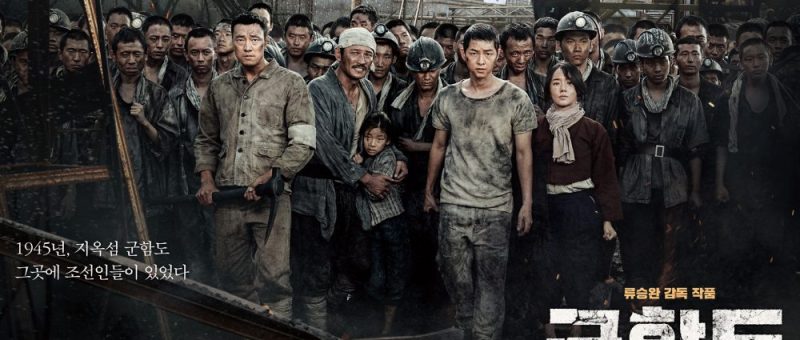
The Battleship Island (군함도, Ryoo Seung-Wan, 2017)

battleship island posterKorean cinema has been in a reflective mood of late. The ongoing series of colonial era dramas have sometimes leaned towards uncomfortable and uncompromising nationalism but among the more recent, there has also been an attempt to ask more serious questions about collaboration and capitulation of ordinary people living under a brutal and often cruel regime. While Age of Shadows dramatised this particular problem through the conflicted figure of a former resistance fighter turned Japanese military police offer, The Battleship Island (군함도, Goonhamdo) goes further in its depiction of those who dedicated themselves entirely to the Japanese Empire and were willing to oppress their fellow Koreans to do so. That is not to ignore the hellish conditions which define the very idea of Hashima as an off shore labour camp where depravity rules, exploitation is hidden, and the camp commander is free to run his ship however he sees fit.

In early 1945 Korea is still under Japanese colonial rule and ordinary Koreans are liable for conscription into the Imperial Japanese army whether they like it or not. Gang-ok (Hwang Jung-min) and his daughter Sohee (Kim Soo-ahn) are members of a popular jazz band but Gang-ok has a habit of getting himself into trouble and so they are tricked into getting on a boat to Japan hoping for a safer, more lucrative life. Where they end up is Hashima – otherwise known as “Battleship Island”. Gang-ok and Sohee are separated with Gang-ok stripped of his musical instruments and Sohee, who is only a child, carted off with the other women destined for the “comfort station”.

Ryoo wastes little time demonstrating the immense evil buried in places like Hashima. A deep seam coal mine in the middle of the sea, the island is a fortress prison from which escape is impossible. Early on, three small boys decide to flee after their friend is killed in a cave-in only for one to be shot and the other two drowned by the lazy soldiers of a Japanese patrol boat who couldn’t be bothered to fish them out of the water. The miners are beaten, starved, tortured and manipulated into submission knowing that capitulation is their best route to survival. Not only are these men the subjects of forced labour, they are also made liable for the “costs” involved in their own enslavement with the bill for their transportation, food, clothes, and tools deducted from their “wages” which are supposed to be paid into their bank accounts for access on release. Those killed whilst working are supposed to receive compensation for their families but as will later be revealed, systematic corruption means their families may not even know their loved ones are dead let alone that they are being denied the money rightfully owed to them.

Things get even worse for little Sohee who is forced into a kimono and smothered with makeup to “entertain” some of the Japanese officers on the island. She manages to buy herself some time when she realises the Korean record the camp commander puts on to “comfort” the “comfort women” is one she is actually singing on. This new discovery earns her and her father a slightly improved status in the camp though she may not be safe for long. Gang-ok has already reverted to his tried and tested methods for getting out of sticky situations, making himself a kind of camp fixer aided by his ability to speak Japanese.

The Korean prisoners are represented by a former resistance leader, Yoon Hak-chul (Lee Kyoung-young), who offers rousing speeches in public but privately is not quite all he seems. Gang-ok gets himself mixed up in a Resistance operation run by an OSS (Song Joong-ki) plant on site to rescue Yoon who eventually uncovers several inconvenient truths which make his mission something of a non-starter. Yoon’s empty rhetoric and self serving grandeur represent the worst of the spiritual crimes discovered on Hashima but there is equal ire for the turncoat Koreans who act as enforcers for the Japanese, issuing beatings and siding with their oppressors in the desperation to escape their oppression. Tragically believing themselves to have switched sides, the turncoats never realise that the Japanese hold them in even lower regard than those they have betrayed.

It is hard to avoid the obvious nationalistic overtones as the Japanese remain a one dimensional evil, smirking away as they run roughshod over human rights, prepare to barter little girls and send boys into dangerous potholes all in the name of industry. At one point Gang-ok cuts an Imperial Japanese flag in half to make the all important ramp which will help the captive Koreans escape the island before being summarily murdered to destroy evidence of Japanese war crimes which is a neat kind of visual symbolism, but also very on the nose. Once again, the message is that Koreans can do impossible things when they work together, as the impressively staged, horrifically bloody finale demonstrates, but as Ryoo also reminds us there no “heroes”, only ordinary people doing the best they can in trying times. 


Currently on limited UK cinema release!

Original trailer (English subtitles)