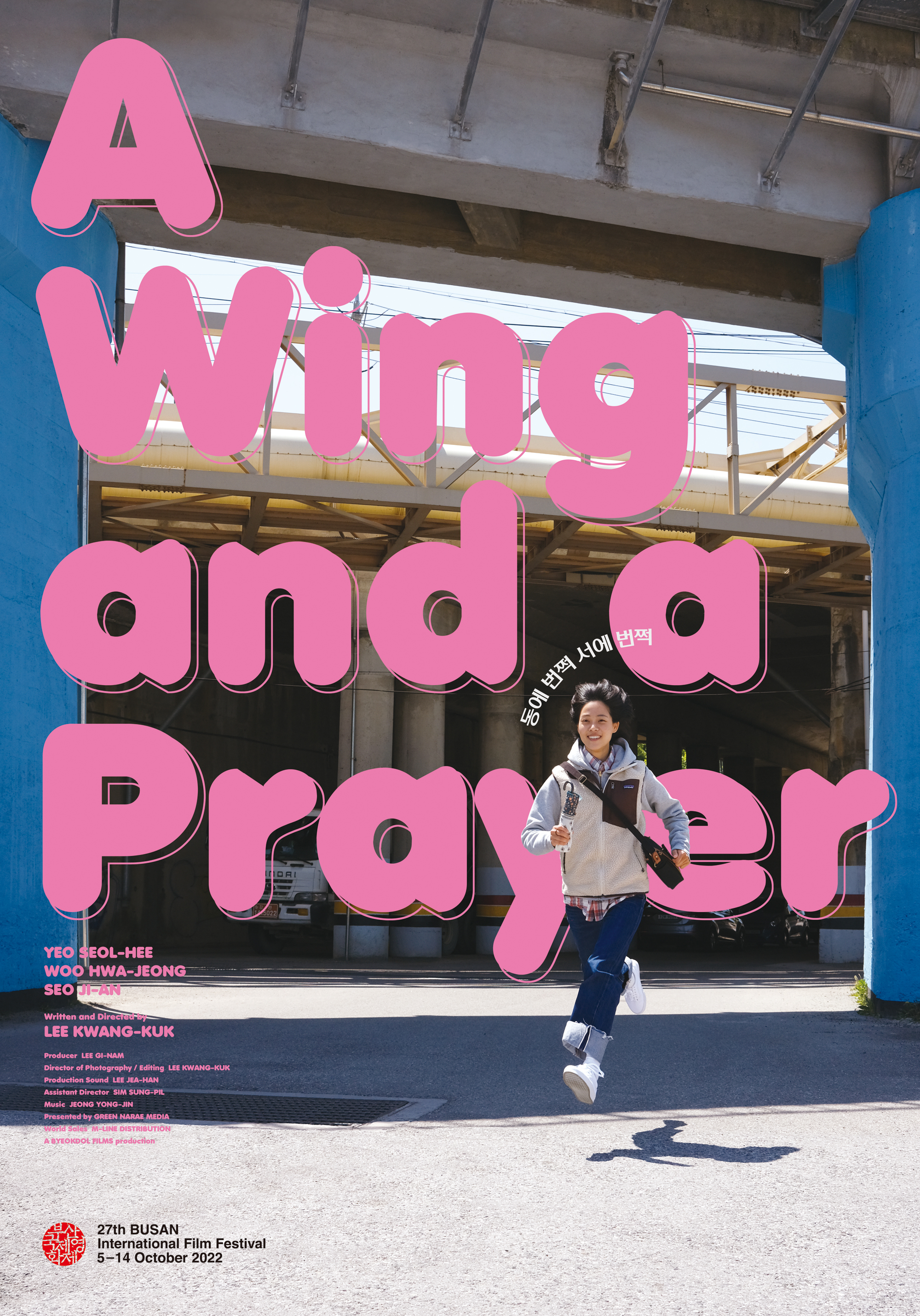
A Wing and a Prayer (동에 번쩍 서에 번쩍, Lee Kwang-kuk, 2022)

A pair of 25 year olds find themselves marooned in adolescence thanks to the precarious socio-economic conditions of contemporary Korea in Lee Kwang-kuk’s indie dramedy A Wing and a Prayer (동에 번쩍 서에 번쩍, Dong-e Beonjjeog Seo-e Beonjjeog). Not quite as quirky as Lee’s previous work, the film nevertheless finds its twin protagonists undergoing parallel journeys while each preoccupied with the progression to adulthood and what that might actually mean in real terms while perhaps guilty of a childish naivety in their vision of what it is to be grown up.

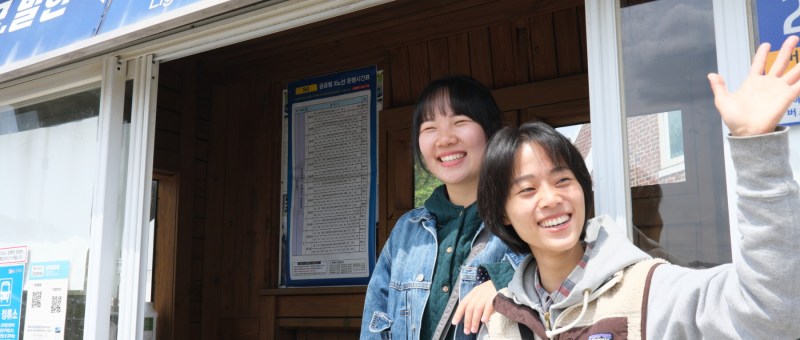
Seol-hee (Yeo Seo-hee) and Hwa-jeong (Woo Hwa-jeong) are best friends and roommates each currently without jobs and feeling lost without clear direction for their future. Seol-hee was on track to be an athlete but was forced to give up following injury. At an interview for a job in a coffee shop she’s asked a series of questions which seem to her somewhat unnecessary. “Do I need a dream in order to work here?” she asks, “Can’t I just make good coffee and try my best at everything?” Predictably, her answer does not go down well with the interviewer and it seems unlikely she’s going to get this job though Seol-hee remains cheerful and upbeat unable to understand why everyone keeps pressing her about her hopes and dreams when she’s just trying to live. By contrast, Hwa-jeong has reached the final stages for a job at a company and feels her interview went well so she’s optimistic that this time it really might work out.

Though in quite different places, the pair decide to take an impromptu trip to the seaside to wish on the sunrise only to fall asleep and completely miss the moment. The mismatch in their circumstances comes to the fore when Hwa-jeong reveals that with their lease about to come to an end she’d like to try living on her own, “like a real adult”. Of course, that’s quite destabilising and hurtful for Seol-hee who has no real expectation of being able to get the kind of job that would let her find an apartment she could rent on her own. After a small argument, the pair end up separated and on parallel adventures as Seol-hee bonds with a slightly older woman, Ji-an (Seo Ji-an), whose life has been ruined by unresolved trauma caused by high school bullying while Hwang-jeong meets a high schooler, also bullied, who is looking for her missing parrot. 

When Hwang-jeong comes to the rescue of the high school girl after she’s lured by bullies who claimed to have info on her parrot, it’s obvious that they immediately recognise her as an “adult” though she holds little sway over them. Hwang-jeong is fond of saying that she isn’t a kid anymore, but it’s also clear that getting a job is central to her definition of adulthood. When the high school girl asks what she does for a living, Hwang-jeong answers pre-emptively that she’s a “respectable company employee” to which the high school girl replies “an adult” but then goes on to ask at exactly what age one becomes one. Hwang-jeong has no answer, because perhaps it’s not an age after all but a state of being. 

She also accuses Seol-hee of behaving like a child as they continue to argue about Hwang-jeong’s plans for solo adulting. Seol-hee meanwhile finds herself trying to help another lost woman who is herself arrested but trying to break of the “jail” she feels she’s been placed in by an overprotective mother she nevertheless feels may be ashamed of her for her own “failure” to progress into a more conventional adulthood. Like the high school girl Seol-hee claims she has no friends and tries to make one of Ji-an only she refuses. On seeing the flyers for the lost parrot, which Seol-hee herself at times resembles, she wonders if recapturing it is the right thing to do or if it wouldn’t be happier flying free rather than trapped within a cage that to Seol-hee represents conventionality and socially accepted ideals of success.

They’re all lonely, wounded, and insecure, afraid of talking to each other about their worries because of the internalised shame of feeling to meet the demands of “adulthood” despite, in all but the case of the high school girl, being well over the age of majority. The high school girl herself may represent Hwang-jeong’s refusal to confront her past while throwing herself into an adulthood she hasn’t quite earned just as the parrot represents both her friendship with Seol-hee and the elusiveness of their future, but it also returns to her the sense of positivity she may have been missing just as Seol-hee’s care of Ji-an also allows her to take care of herself. They might not quite be adults, but then who really is and at least they have a little more clarity about that means and what they want out of life in the realisation that they aren’t alone and not least in their worries.


A Wing and a Prayer screens 10th November as part of this year’s London Korean Film Festival.

Original trailer (English subtitles)
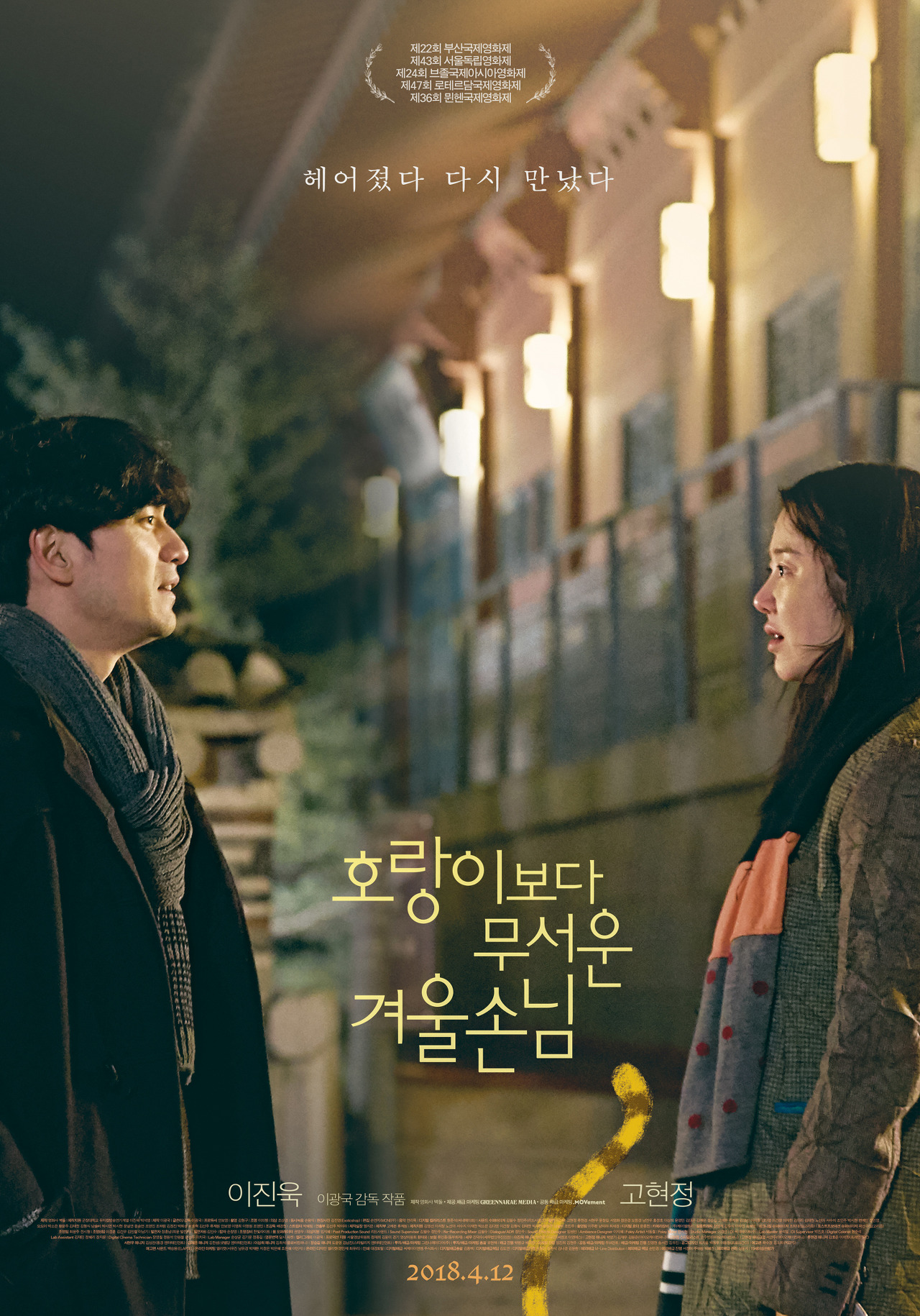
A Tiger in Winter (호랑이보다 무서운 겨울손님, Lee Kwang-kuk, 2018)

Tiger in Winter poster“Life just keeps getting harder” sighs a weary policeman charged with extracting a coherent statement from an accidental hero who only wants to talk about a tiger. Lee Kwang-kuk’s third feature, A Tiger in Winter (호랑이보다 무서운 겨울손님, Horangiboda Museoun Gyeoulsonnim), is in some ways a more conventional exercise in comparison with the time bending reflexivity of his earlier work, but the journey he takes us on is similarly circular as a melancholy young man finds himself chased out of his natural habitat and cast adrift, outside of his comfort zone too resentful to crawl back into a familiar cage but too afraid to embrace his freedom. 

On the day a tiger escapes from the zoo, Gyeong-yu (Lee Jin-wook), a failed writer, “loses” his day job and has to temporarily vacate his apartment because his girlfriend’s parents are coming to visit and she evidently hasn’t told them she is “living in sin”. Gyeong-yu offers to stay and meet them, but bristles when his girlfriend wonders if he’s ready to make a firm a commitment. He packs and leaves, planning to return in a few days’ time when the coast is clear. Decamping to a friend’s place, Gyeong-yu continues his night “job” as a designated driver which brings him into contact with an old girlfriend – Yoo-jung (Ko Hyun-jung), who is also a writer and apparently successful but suffering from an extended bout of writer’s block and has descended into a self destructive spiral of alcohol fuelled existential desperation.

After reconnecting with Gyeong-yu, Yoo-jung pulls down a book he once gave her from her well stocked bookcase – a Korean translation of Hemingway’s The Old Man and the Sea. Hemingway’s hero fights his age as manifested in a powerful marlin and dreams of youth in the lions of Africa. The film’s English title, “A Tiger in Winter”, is perhaps a mild pun on “The Lion in Winter” which again tells of a once proud old man struggling to deal with his bodily decline, only Gyeong-yu is still young even if he feels himself diminished and brought low by life. Unlike the old man, he has stopped fighting and accepted his defeat. He no longer writes and flounders aimlessly, running away from the things that frighten him without aim or purpose. The loosed tiger is a manifestation of the fears Gyeong-yu refuses to fight which render him both physically and artistically impotent.

Writing, or perhaps art of any kind, becomes its own kind of vice – a dangerous addition, a need which must be sated or displaced without which the rest of life remains hollow. Unable to satisfy her need for creation, Yoo-jung has crumbled under the pressure of her own expectations and retreated into the comforting world of the permanently tipsy even whilst knowing that the alcohol itself inhibits her ability to create and forever separates her from that which would make her whole. She wants to stop, throws away her soju, but can’t move past her inability to face herself and resolve her creative doubts. Yoo-jung wants the quick fix, and like any addict, she is past caring about the harm she might do to herself and others in the pursuit of it.

Gyeong-yu, meanwhile, almost wallows in his degradation as he allows himself to be belittled by the customers who call for his services and insist on treating him like a servant. Designated driving doesn’t seem like a particularly safe arrangement for either party – many of Gyeong-yu’s customers are extremely drunk and willingly allowing a man they don’t know to drive them somewhere in their own car while they are barely conscious, while conversely many refuse to pay or accuse Gyeong-yu of damaging the car while berating him for acting in an insufficiently humble manner. Yet it’s not humiliation that knocks Gyeong-yu out of his stupor but trauma and a direct confrontation with someone else’s despair.

Tigers lurk everywhere, though when Gyeong-yu finally learns to look his in the eye it’s a very cute and non-threatening sort of tiger which perhaps makes him feel foolish for having evaded it for so long. Lee may not be playing with time in his usual fashion, but he sends Gyeong-yu retreating into the past all the same in an attempt to hide from his fears only to discover you can’t walk backwards into the future. An exploration of the destructive power of the creative urge, the soul crushing inertia of artistic block, and the continuing rootlessness of a life lived in flight, A Tiger in Winter is another beautifully poetic character drama from Lee whose world weary optimism loses nothing in its seeming simplicity.


A Tiger in Winter was screened as the final teaser for the London Korean Film Festival which will open on 1st November with Microhabitat. The full programme for this year’s event is now available on the official website – tickets on sale soon!

International trailer (English subtitles)

A Matter of Interpretation (꿈보다 해몽, Lee Kwang-kuk, 2015)

matterofinterpretation_keyartFirst published on UK Anime Network – review of Lee Kwang-kuk’s A Matter of Interpretation (꿈보다 해몽, Ggumboda Haemong).


Romance Joe director Lee Kwung-kuk returns to the director’s chair with a another meta take on modern Korean life only this time he’s interested in the nature of dreams vs reality. A Matter of Interpretation is, ironically, a little closer to Lee’s mentor Hong Sang-soo thanks to its repeated dream motifs but always stands at a slightly more abstracted angle than the comparatively more realistic Hong. Building on the promise of Romance Joe, A Matter of Interpretation further marks Lee out as a talent to watch in modern Korean cinema.

The film begins with a group of performers nervously waiting in a rather circus-like theatre before eventually deciding to cancel the performance because no tickets have been sold. Yeon-shin, the star actress, storms out and goes for a smoke in a nearby park. Her boyfriend eventually finds her and they talk about the film project Yeon-shin has just been bumped from in favour of a young pop idol. They break up and we time jump to the same bench some point later as Yeon-shin talks to a policeman who, it turns out, can also interpret dreams. Yeon-Shin has had a dream about attempting to commit suicide in an abandoned car only to find a man (who now has the face of Seo, the policeman) tied up in the car’s boot.

The car itself ends up becoming a recurrent theme in the film, appearing in the dreams of multiple people and eventually in reality (maybe?). The policeman (who frequently pulls out a pocket watch and seems to be late for a very important date) interprets Yeon-shin’s dream as being about regret over rashly ending her relationship with her boyfriend and a mixture of guilt and worry that he quit his theatre job soon after and she hasn’t heard from him since. There are other repeated motifs such as the date 7th February circled on a calendar and, like Romance Joe, a pre-occupation with suicide but A Matter of Interpretation proves an apt title for a film that’s so bound up with playful symbolism.

Also like Romance Joe, A Matter of Interpretation owes a lot to Lee’s mentor Hong Sang-soo. Like Hong, Lee has opted for a concentration of static camera shots with his subjects centrally framed like a conventional landscape photograph albeit with the occasional creeping zoom. However, where Hong can be deliberately repetitious, Lee’s repeated motifs take on a different kind of playfulness – deliberately disorientating us with his mix of dream and reality to the point where we can’t really be sure which of the two is the “real” world. He’s also ported over his love of Alice in Wonderland (or this time Through the Looking Glass) which adds another surrealistic layer of whimsy to the film.

Ultimately, A Matter of Interpretation builds on the promise of Romance Joe to create something that feels much more well thought out as well as much more affecting than Joe’s rather distant atmosphere. Much of this is thanks to Shin Dong-mi’s engaging performance (even more so than her winning turn as the “coffee waitress” prostitute in Romance Joe) as the aging actress Yeon-shin who’s coming to regret some of her previous life choices and wondering how things might have been different. Whimsical is probably the best way to describe the film. It isn’t trying to be deep or profound so much as playfully thoughtful though its complex, interconnecting narrative symbolism is certainly likely to spur post viewing debate. Less contrived and undoubtedly more fun than Romance Joe, A Matter of Interpretation marks a definite step up for director Lee Kwang-kuk and hints at even more meta tales of playful absurdity to come from this promising director.


Reviewed at the London Korean Film Festival 2015.

Romance Joe (로맨스 조, Lee Kwang-kuk, 2011)

romance-joeReview of Lee Kwang-kuk’s Romance Joe (로맨스 조) up at UK Anime Network. First saw this at the LFF a couple of years ago but now it’s back alongside Lee’s latest film A Matter of Interpretation at the London Korean Film Festival.


Lee Kwang-kuk’s meta romantic comedy drama first got a London outing at the BFI film festival back in 2012 but now makes a welcome return visit as part of the 2015 Korean film festival in a strand dedicated to its director. Playing alongside a short film, Hard to Say, which was completed by Lee in-between Romance Joe and his new film A Matter of Interpretation, the film brings Lee’s meta concerns to the fore and offers plenty of Alice in Wonderland inspired absurdity to its otherwise straightforward plot elements.

Romance Joe is a film with many levels. On the first layer, we have an elderly couple arriving in Seoul to look for their son who came to the city to be a director 18 years ago but he’s not been in contact recently so they’re worried. His friend greets them and tells them their son had been feeling depressed lately over the suicide of a well known actress. He then starts to tell them about an idea for a screenplay he’s had about a director with writer’s block who checks into a motel where he’s told another set of stories by a prostitute who delivers coffee as a cover. From here the stories radiate out like cracks in a broken mirror though we never quite get the answers we’ve been looking for.

Lee has worked extensively with Korean auteur Hong Sang-soo and his shadow looms large over the film. From the cutesy title cards to the static camera with occasional creeping zooms and often unbearably awkward situations, there is certainly a lot of Hong in Lee’s film. However, where Hong takes the same situation and replays it with a different outcome, Lee gives you a set of intersecting stories which spring forth from each other. Lee’s interests are more surreal and metaphysical than Hong’s which are, ostensibly, more naturalistic in feeling than Lee’s almost hyperreal world.

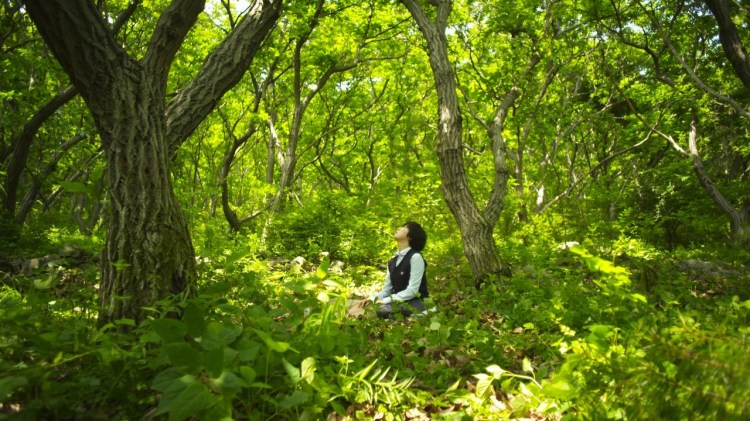
In contrast to Hong’s social comedies, Lee also digs a little darker into the Korean psyche and reveals a strange preoccupation with suicide and abandoned children. The furthest point back in the film deals with the lonely mid forest suicide attempt of a teenage schoolgirl who’s become a figure of fun thanks to a loud mouth “boyfriend”. Her rescuer may (or may not be) the man we later come to know as Romance Joe. Though the two eventually bond, the story is not an altogether happy one as they’re rushed into fairly adult decisions which neither of them is really ready for.

Later, a young boy who may (or may not) be the child of the high school girl arrives at the “cafe” from which the prostitute operates looking for his mother who apparently last wrote to him from that address sometime ago and has since disappeared. Later, the prostitute receives a call from her own son safely in the country being cared for by grandparents while his mother earns the money in the city.

In many ways it’s a series of sad yet inevitable stories leaping out from inside each other each more heart rending than the last, though somehow it never becomes as affecting as you’d like it to be. Romance Joe feels like a deliberate experiment in form or at least a dedication to pushing conventional narrative structures into new and exciting places but it does so in a way that’s self consciously about form rather than content so that it never quite takes hold. It wants to discuss time and memories and stories but ends up mostly talking about itself and, in truth, a little lengthily, still Romance Joe does at least manage to offer an intriguing, beautifully filmed and often enjoyable surrealist tale that will have your mind in knots long after you see it.


Reviewed at the London Korean Film Festival 2015.

http://www.youtube.com/watch?v=gby8x6X-AWI