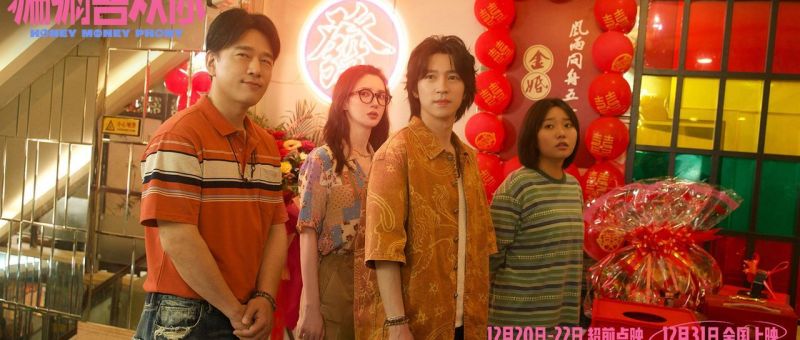

Honey Money Phony (“骗骗”喜欢你, Su Biao, 2024)

Can you really say a scammer who just takes people’s money without messing with their feelings is any better than one who just robs them? That’s a justification put forward by fraudster Ouyang (Sunny Sun) in Su Biao’s remake of Thai rom-com The Con-Heartist, but it’s a difficult one to swallow. After all, even if you just trick someone out of a small amount of cash,the psychological effects can be devastating though the pain may not be quite the same as getting your heart broken in a love scam.

Qinglang (Jin Chen) has indeed had her heart broken by the lothario Zijun (Wang Hao) whom she met at a tennis class she started going to after moving to the fictional city of Aoo Kang. Later it’s revealed that the cause of her move was getting fired from her company for reporting her boss for sexual harassment while she was also in a bit of debt from breaking a non-compete clause by getting another job, something which Zijun apparently sorted out for her. But not long after she took out a loan to give him money supposedly for his university tuition, Zijun ghosted her and she realised she’d been the victim of a romance scam. Now she’s on the hook for that too, working a series of part-time jobs in fast food restaurants and walking dogs as well as an unsuccessful gig as a vlogger in addition to her regular job in insurance. 

Experience is maybe why she suddenly thinks twice after being contacted by someone purporting to be from the vlogging site telling her she’s been suspended and needs to pay a fine. After getting Ouyang’s info from the bank she threatens to expose him but then makes a deal, if he helps her scam Zijun into giving back the money she gave him she won’t take this any further. Of course, there’s no guarantee Ouyang hasn’t just switched to a different con while Qinglang remains quite naive and despite herself trusting him. Then again, he’s the exact opposite of Zijun who took advantage of her despair and offered himself as a source of constant support. His aloofness and apparent honesty about what he is may in their way reassure her. 

There is something that might be comforting in Ouyan’s unflashiness. Though he drives a convertible, it’s not a particularly glamorous sort and has a busted taillight and in any case, he also lives in it. According to him, that’s so he can get away quickly if he needs to, but also suggests that it’s not really all about the money. Zijun, meanwhile, is greedy and materialistic, hopping from one wealthy woman to the next while hoping to join the social elite and live a high life of fast cars and wild parties. A justification for Ouyang’s scamming is given in a tragic backstory which may or may not be true suggesting that he was born out of wedlock and his mother died in childbirth. He was raised by his grandmother and uncle while his birth father entered his life at one point and tried to connect with him but it turned out it was all because his other son from a different relationship needed a bone marrow transplant. As soon as he found out Ouyang wasn’t a match, he disappeared from his life. 

The implication is that Ouyang scams as a kind of revenge because he doesn’t trust people and therefore is unable to live an ordinary, honest, life but through connecting with Qinglan and falling in love he develops the desire to live with more compassion and stability. Qinglang, meanwhile, gains confidence in herself and realises that her low self-esteem left her vulnerable to manipulation. Her friend, Xiaohui (Li Xueqin), who was also in massive debt and ended up posing as a blind person to carry out accident scams, also puts the skills she’s learned to good use to progress her acting career which might all be a very contradictory message even if there’s something satisfying about scamming a scammer and especially one as full of himself as Zijun. Released for Western New Year, the film has a zany wholesomeness despite its bleak subject matter and hints at a sense of despair in contemporary life in China but does indeed suggest that cheaters don’t necessarily need to prosper and you do have a degree of control over your life even if it’s just deciding to choose love and move on rather than wallow in a sense of futility. 


International trailer (English subtitles)

Yolo (热辣滚烫, Jia Ling, 2024)

In the training footage which plays over the closing credits of Jia Ling’s YOLO (热辣滚烫, Rè là gǔntàng), someone asks her why she’s learning to draw and she replies that she’s trying to become a better version of herself. The same is very much true of the movie’s heroine who trying to rediscover her will to keep fighting in a world that seems to have beaten her down and destroyed her spirit. Inspired by Masaharu Take’s 2014 boxing drama 100 Yen Love, Jia’s film is kinder and less cynical in tone while also taking on a meta quality in documenting the actress’ own transformation.

Then again, the film opens with a sequence laying bare the petty prejudices that surround Leying (Jia Ling) as a woman in her 30s unemployed and still living with her parents. It’s never revealed what exactly caused her to leave the job she got after college though she explains that she was unable to get another because she finds it difficult to talk to people. What seems apparent is that she is likely living with a heavy depression that is all too often dismissed as mere laziness by those around her and most particularly her mean and judgmental older sister (Zhang Xiaofei). The crunch time comes when her cousin Doudou (Yang Zi) who works for a TV company producing a reality programme about finding jobs for people who for various reasons struggle to get one, tries to bamboozle her into appearing on the show by turning up with a camera for an impromptu family intervention before even asking her if she wanted to take part.

In the attitudes of her family and most particularly the TV show which is ironically called “Find Yourself”, there is a degree of fat shaming in which Leying is treated in certain ways just because of her weight which is assumed be the outward manifestation of her problems. Doudou’s previous guest on the show had been a man who was obese and had mobility issues so they got him a job posing as Buddha for photos. It’s tempting to read Leying’s transformation as complicity with culturally defined notions of feminine beauty and ideal body shape, but the point really is that Leying is unhappy and as a people pleaser with low self-esteem unable to care for herself until she discovers boxing and literally learns to fight back. It is therefore also a little bit awkward that her first steps towards self-care are taken in order to look after a man, insecure boxer Hao Kun (Lei Jiayin), as she tries to help him achieve his dream while allowing him to mooch off her even though he treats her poorly.

Nevertheless, it’s seeing him give up without at fight that eventually spurs her on to start fighting back by taking up boxing herself and surprising those around her with her seriousness and determination. Asked why she’s doing it, she says that she just wants to win for once and eventually comes around to the idea of winning in her own way which doesn’t necessarily mean being named as the champion or beating someone else but holding her own and staying in the fight. What she regains is self-confidence and self-respect, no longer a willing doormat accepting whatever humiliation comes her way to avoid upsetting someone else but standing up for herself and gaining the courage to say no to things she doesn’t want to do. 

There is something quite moving in witnessing the actual transformation of actress Jia Ling throughout the credits sequence and most particularly when she comes to film the scene in which she walks parallel with her old self and has to turn back because it’s too much for her on a personal level. Jia shows us just how unhappy and hopeless Leying had become because of the way the world treated her, but also how singleminded pursuit of her goal gave her a new sense of purpose and a means of fighting back that showed her she could win in her own way when it came to life as well as in the ring. Swapping the grimness of Take’s original for something more broadly inspirational, Jia nevertheless hints at the prejudices of the contemporary society and its money-loving superficiality while simultaneously allowing her heroine to find and occupy her own space born of her own individual happiness rather than the acquisition of things other people think she should want but actually does not.


Original trailer (English subtitles)