Kung Fu Soccer (功夫女足, Stephen Chow, 2026)

Seven years on from New King of Comedy, Stephen Chow returns with another reimagining of a past hit in Kung Fu Soccer (功夫女足, gōngfu nǚzú), a new take on the 2001 global sensation Shaolin Soccer. Throughout the ‘90s, Chow had been one of Hong Kong cinema’s most bankable talents with a series of mo lei tau or “nonsense” comedies. There’s no getting away from the fact that the Cantonese language is intrinsic to the genre which heavily relies on zany puns and wordplay in addition to slapstick humour, though the later phase of Chow’s career has largely been in Mainland-friendly Mandarin as is Kung Fu Soccer.

As such, the film struggles to achieve the kind of comedic rhythm that made Chow’s earlier work so popular while its nonsense gags such as a man burning his leg in order to get rid of unwanted hair after mistakenly thinking someone talking on the phone about cooking pork was talking to him play out less successfully. As in Shaolin Soccer, Chow turns subpar CGI into a kitsch feature, leaning in to the unreality of virtual stadia and the uncanniness of a CGI ball being knocked around the pitch to create a cartoon world where the normal rules of physics do not apply.

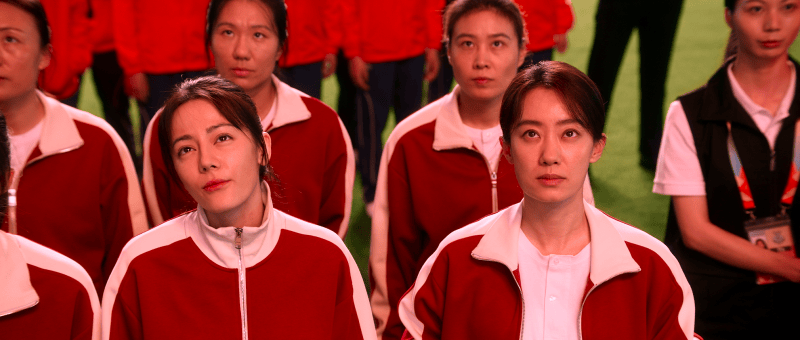
This time around, the action follows the Emei women’s football team who face ageism and sexism after making a belated bid to win an Asian championship. Headstrong captain Shuang (Zhang Xiaofei) and her childhood friend Jade (Dilraba Dilmurat) are struggling to overcome a falling-out over Jade’s decision to leave the sport and get married only to return following her divorce, while Shuang has dedicated her life to football and kung fu but now at almost 40 is beginning to realise that she may have missed out on other life experiences and has no plans for the future. Shuang is an orphan who found a place within the team and fears abandonment, whereas Jade is a wealthy heiress whose devil-may-care attitude is informed by her financial security.

As expected, part of the path for the team’s success is getting the pair to patch things up, which they eventually do after a little manipulation by “Grand Uncle” Xu Feng (Lay Zhang), another childhood friend with a longstanding crush on Shuang she in fact returns but is unable to act on due to being arrested emotionally having done nothing but sport and kung fu since she was a child. The conclusion that Shuang is gradually guided towards is that she’s too intense and has lost her love of playing the game. She has a lack of empathy for her teammates and an autocratic management style that alienates those around her, a criticism that has been levelled at Chow himself in the past. It’s this internalised pressure that makes it difficult for the players to perform. If they chilled out a bit and rediscovered the joy of it, they might be better placed to face their opponents who also have their own particular quirks.

The film has also come in for criticism for the ways that it depicts the other Asian nations in the competition, most particularly the South Koreans who are shown to be obsessed with beauty and play in underhanded ways while the Korean spoken in the film is delivered unconvincingly. The team from India similarly have some kind of super-stretchy ability and the Australians are defined by aggression and tactlessness. The Japanese team, coached by Takeru Satoh in a cameo appearance, are mainly just violent while the decision to make their goalie a figure of fun for not being considered conventionally attractive seems very outdated and undercuts the film’s other messages of female power and solidarity. The Emei team face questions of ageism and are forced to constantly prove themselves, but eventually come out on top after learning to trust each other, pool their respective strengths, and just have fun playing the game. Backed by Carina Lau’s mahjong-obsessed grandmaster, they have perhaps learned to integrate their martial arts abilities and love of sport to overcome not only the prejudice held against them, but their own internalised anxieties.


Kung Fu Soccer is in North American, UK, & Ireland cinemas from 23rd October.

Trailer (Simplified Chinese / English subtitles)

Yolo (热辣滚烫, Jia Ling, 2024)

In the training footage which plays over the closing credits of Jia Ling’s YOLO (热辣滚烫, Rè là gǔntàng), someone asks her why she’s learning to draw and she replies that she’s trying to become a better version of herself. The same is very much true of the movie’s heroine who trying to rediscover her will to keep fighting in a world that seems to have beaten her down and destroyed her spirit. Inspired by Masaharu Take’s 2014 boxing drama 100 Yen Love, Jia’s film is kinder and less cynical in tone while also taking on a meta quality in documenting the actress’ own transformation.

Then again, the film opens with a sequence laying bare the petty prejudices that surround Leying (Jia Ling) as a woman in her 30s unemployed and still living with her parents. It’s never revealed what exactly caused her to leave the job she got after college though she explains that she was unable to get another because she finds it difficult to talk to people. What seems apparent is that she is likely living with a heavy depression that is all too often dismissed as mere laziness by those around her and most particularly her mean and judgmental older sister (Zhang Xiaofei). The crunch time comes when her cousin Doudou (Yang Zi) who works for a TV company producing a reality programme about finding jobs for people who for various reasons struggle to get one, tries to bamboozle her into appearing on the show by turning up with a camera for an impromptu family intervention before even asking her if she wanted to take part.

In the attitudes of her family and most particularly the TV show which is ironically called “Find Yourself”, there is a degree of fat shaming in which Leying is treated in certain ways just because of her weight which is assumed be the outward manifestation of her problems. Doudou’s previous guest on the show had been a man who was obese and had mobility issues so they got him a job posing as Buddha for photos. It’s tempting to read Leying’s transformation as complicity with culturally defined notions of feminine beauty and ideal body shape, but the point really is that Leying is unhappy and as a people pleaser with low self-esteem unable to care for herself until she discovers boxing and literally learns to fight back. It is therefore also a little bit awkward that her first steps towards self-care are taken in order to look after a man, insecure boxer Hao Kun (Lei Jiayin), as she tries to help him achieve his dream while allowing him to mooch off her even though he treats her poorly.

Nevertheless, it’s seeing him give up without at fight that eventually spurs her on to start fighting back by taking up boxing herself and surprising those around her with her seriousness and determination. Asked why she’s doing it, she says that she just wants to win for once and eventually comes around to the idea of winning in her own way which doesn’t necessarily mean being named as the champion or beating someone else but holding her own and staying in the fight. What she regains is self-confidence and self-respect, no longer a willing doormat accepting whatever humiliation comes her way to avoid upsetting someone else but standing up for herself and gaining the courage to say no to things she doesn’t want to do. 

There is something quite moving in witnessing the actual transformation of actress Jia Ling throughout the credits sequence and most particularly when she comes to film the scene in which she walks parallel with her old self and has to turn back because it’s too much for her on a personal level. Jia shows us just how unhappy and hopeless Leying had become because of the way the world treated her, but also how singleminded pursuit of her goal gave her a new sense of purpose and a means of fighting back that showed her she could win in her own way when it came to life as well as in the ring. Swapping the grimness of Take’s original for something more broadly inspirational, Jia nevertheless hints at the prejudices of the contemporary society and its money-loving superficiality while simultaneously allowing her heroine to find and occupy her own space born of her own individual happiness rather than the acquisition of things other people think she should want but actually does not.


Original trailer (English subtitles)