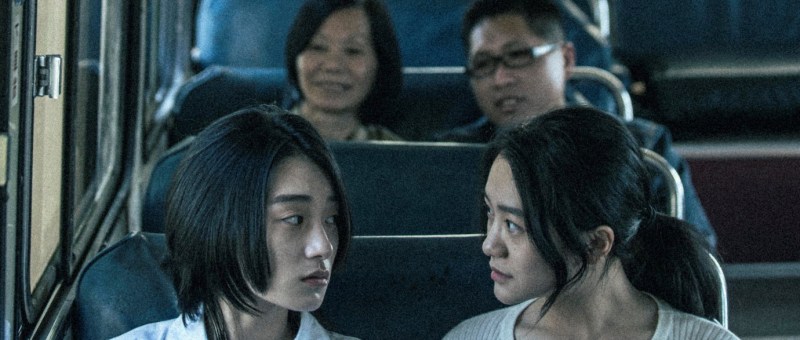
Who’ll Stop the Rain (青春並不溫柔, Su I-Hsuan, 2023)

What does “freedom” actually mean? Su I-Hsuan’s post-martial law drama Who’ll Stop the Rain? (青春並不溫柔) sees a younger generation struggle to shake off the authoritarian yoke meanwhile it seems clear that freedom has its limits and has not been granted equally to or by all. Set in 1994 it takes place against the longest student strike in the nation’s history and ultimately pits the forces of protest and complicity against each other in the constant struggle for individual freedom. 

Free-spirited Chi-wei (Lily Lee) might be something of an outlier in this age, later expressing confusion to the comparatively repressed Ching that she doesn’t understand why they’re fighting for freedom when freedom was something they had always possessed. Yet at the university she finds herself constrained in what is supposed to be an artist’s school, denied creative freedom by stuffy professors who mark their students not by the quality of their work but their obedience and willingness to accept the lessons the professors see fit to give them. Chi-wei’s professor gives her telling off because he says her hair’s too messy, then humiliates her in front of the class by throwing her work on the floor and telling her to start again. Chi-wei, however, remains defiant and continues to work her own way regardless of what the teachers may say. 

It’s after a chance encounter with Ching (Yeh Hsiao-Fei) that she’s drawn into the student movement which opposes the authoritarian rule of the professors and demands greater creative freedoms for the students and society at large as this generation who came of age after martial law considers the kind of future they envision for themselves. But like any student movement, there are innate tensions within the group with some suggesting that its leader, Kuang (Roy Chang), is merely trying to relive the White Lily movement and is in fact less committed to the cause than he seems as evidenced by his willingness to enter dialogue with the staff against the wishes of his girlfriend, Ching. 

Unlike the others, Ching is a law student and not and artist. She’s also the daughter of a prominent, conservative and patriarchal politician and the group is somewhat ironically often dependent on her familial wealth. Her background perhaps makes it harder for her to emerge into a new, ostensibly freer age as bound by a set of ideas otherwise alien to Chi-wei who is at any rate absolutely herself and unafraid to be so. Ching tells her that she longs to be part of a group, which is presumably why she’s joined the artists in their protest even if others accuse her of simply rebelling against her privilege, which is something Chi-wei has little need for as she has already discovered the power of freeing her mind. 

It’s these forces that generate the push and pull between the two women as Chi-wei is eventually awakened to her sexuality by Ching only to experience her pulling away in her deeply internalised shame. Even so, she takes an approach that largely avoids direct confrontation but allows her to stay by Ching’s side, patient yet confused in attempting to create a safe space that Ching can accept as her own. Both women are also constrained by forces of traditional patriarchy with even Kuang stating that perhaps women shouldn’t be too independent after all or else they wouldn’t need him in an ironic moment foreshadowing his total redundancy. Meanwhile, Chi-wei is aggressively pursued by a fellow student who won’t be deterred by her frequent rejections and general lack of interest in men while ironically trying to convince her she’s been “brainwashed” by the strikers and is really a good girl, like him willing to bend to the authoritarian yoke. 

Perhaps it’s telling that it’s only once the strike is over and following a confrontation with her authoritarian father that Ching is able to overcome the barriers that prevent her from embracing her true desires and authentic self. In her opening voiceover, Chi-wei reflects that back then they still believed a tiny flame could burn down the forest implying at least that she was mistaken but even if a wider revolution ends if not exactly in failure than in compromise, disappointment, and rancour, it is true enough that the spark between these women was enough to burn through the forces that kept them apart to find a more individual kind of freedom that exists outside of oppressive superstructures even if as Ching says protest never ends.


Who’ll Stop the Rain screened as part of this year’s BFI Flare.

Trailer (English subtitles)
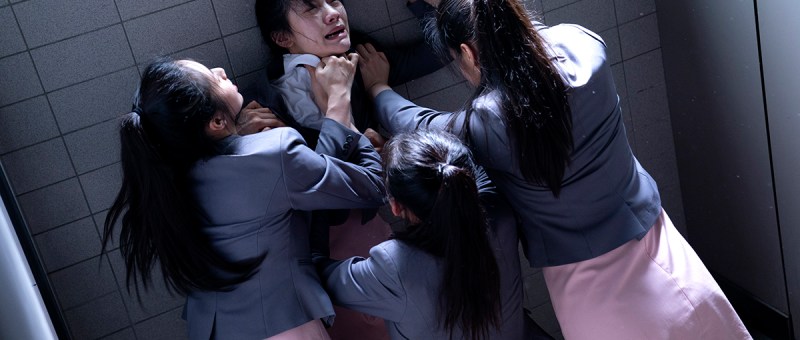
Born to be Human (生而為人, Lily Ni, 2021)

Taiwan is often regarded as among the more liberal of Asian nations, but it is certainly not free of outdated ideas of gender and sexuality as Lily Ni’s powerful sci-fi-inflected drama Born to Be Human (生而為人, Shēng ér Wèirén) makes clear. Like the similarly themed Metamorphosis from the Philippines which also made much of butterfly imagery, Born to Be Human finds a teenager’s ordinary existence upended by the sudden discovery that they are intersex along with the realisation that they have almost no agency over their medical decisions, but is ultimately more concerned with undermining the fallacy of the gender binary along with the sometimes duplicitous actions of the medical profession than with exploring the intersex identity. 

Unpopular at school 14-year-old Shi-nan (Lily Lee) is a regular teenage boy who secretly buys porn mags from the old man on the corner and enjoys playing online video games. Still embarrassed about his body, he is deeply worried on noticing blood in his urine after experiencing painful stomach cramps and half-convinces himself he has bladder cancer while too anxious to tell his parents or seek medical help. When his parents eventually find out they take him straight to the hospital but are fobbed off by an overworked doctor who diagnoses him with a urinary tract infection caused by an infected foreskin, something which they assume can be fixed by circumcision. Returning to school after some time off to recover, however, the problem recurs with Shi-nan collapsing during a sports lesson his shorts stained with blood. A more comprehensive medical exam reveals that Shi-nan is in fact intersex and has a functioning womb directly connected to external male genitalia. 

This unfortunately brings Shi-nan into the orbit of Dr. Lee (Yin Jau-Der), apparently a specialist in urology with an improbably futuristic office, who immediately latches on to Shi-nan’s case as a means of advancing his own career. He recommends to Shi-nan’s parents that they “correct” his physical body according to his chromosomal makeup, explaining that he may be at increased risk of cancer maintaining both sets of sex characteristics. On discovering the analysis has come back female, Shi-nan’s father’s first question is how he can carry on the family name if his son is now a daughter while his mother and the doctor fixate on Shi-nan’s viable womb and the all important ability to procreate. Feeling he will not understand, the parents decide not to share his medical diagnosis with Shi-nan even while he continues to believe that he is dying from bladder cancer, telling him only that he will undergo circumcision signing the consent forms for his gender confirmation surgery without ever consulting him. 

Already 14 years old and having lived all his life as a boy, this forced gender transition provokes a secondary sense of dysphoria as Shi-nan becomes Shi-lan and moves to the capital to attend an elite school presumably offered some kind of financial incentive from Dr. Lee who continues to monitor her progress. Removed from her previous environment, Shi-lan is plunged into hyper femininity as if the entirety of her previous personality had been erased. On her birthday she is given a pink cake with frills and a selection of dolls, while her bedroom is similarly pink and frilly, apparently part of Dr. Lee’s treatment programme to acclimatise Shi-lan to her new identity. Even her mother laments that she’s behind on her feminine education, unable to cook or do chores which she fears will interfere with her ability to get married. Shi-lan says she doesn’t intend to marry, but her refusal is met only with confusion as if a woman’s entire purpose lies in marriage and childbirth. Of course, the secondary issue is that Shi-lan is sexually attracted to women, upset and embarrassed to receive a love letter from a boy at school while pining for her sympathetic deskmate who later becomes her first friend. 

Meanwhile, she is forced to adopt a female personality more or less against her will, later explaining an old photo of herself as one of a younger brother who has unfortunately passed away but will remain always in her heart. Having been bullied at her last school, Shi-lan fears discovery but is subject to a secondary prejudice after a nosy girl goes through her bag and finds a bottle of pills she identifies as being for the treatment of depression later getting her parents to complain to the school that they shouldn’t be forced to share a class with a “mental patient”. 

In fact, Shi-lan has been lied to again, the pills aren’t for depression and she is in fact being tricked to take them against her will as part of her forced transition. She describes herself as a “monster”, neither male nor female, and is acutely compelled to feel that those are her only two options. Her new friend, Tian Qi (Bonnie Liang Ru-Xuan), takes her to a Taiwanese opera performance starring her mother in which a female scholar poses as a man in order to get her education only to fall for a classmate making it clear that an idea of gender fluidity has cultural currency yet Shi-lan has been denied the right to define her own identity, told that what she is is wrong or incomplete, and ultimately reduced to a subject for experimentation by an unethical doctor. Confronting him to be told he has turned her into a “normal person”, she later insists that she can ruin his work just as he has ruined her life, walking through a market witnessing flesh being butchered and fish gutted, before buying a bouquet of sunflowers echoing those on the doctor’s jigsaw puzzle. Whatever her intentions, Shi-lan perhaps comes into herself even if with a dark purpose in mind, actively claiming an identity that is defiantly her own in rebellion against a conservative society that refuses to accept her for all that she is.


Born to be Human screened as part of the 2021 Osaka Asian Film Festival

Original trailer (dialogue free)