
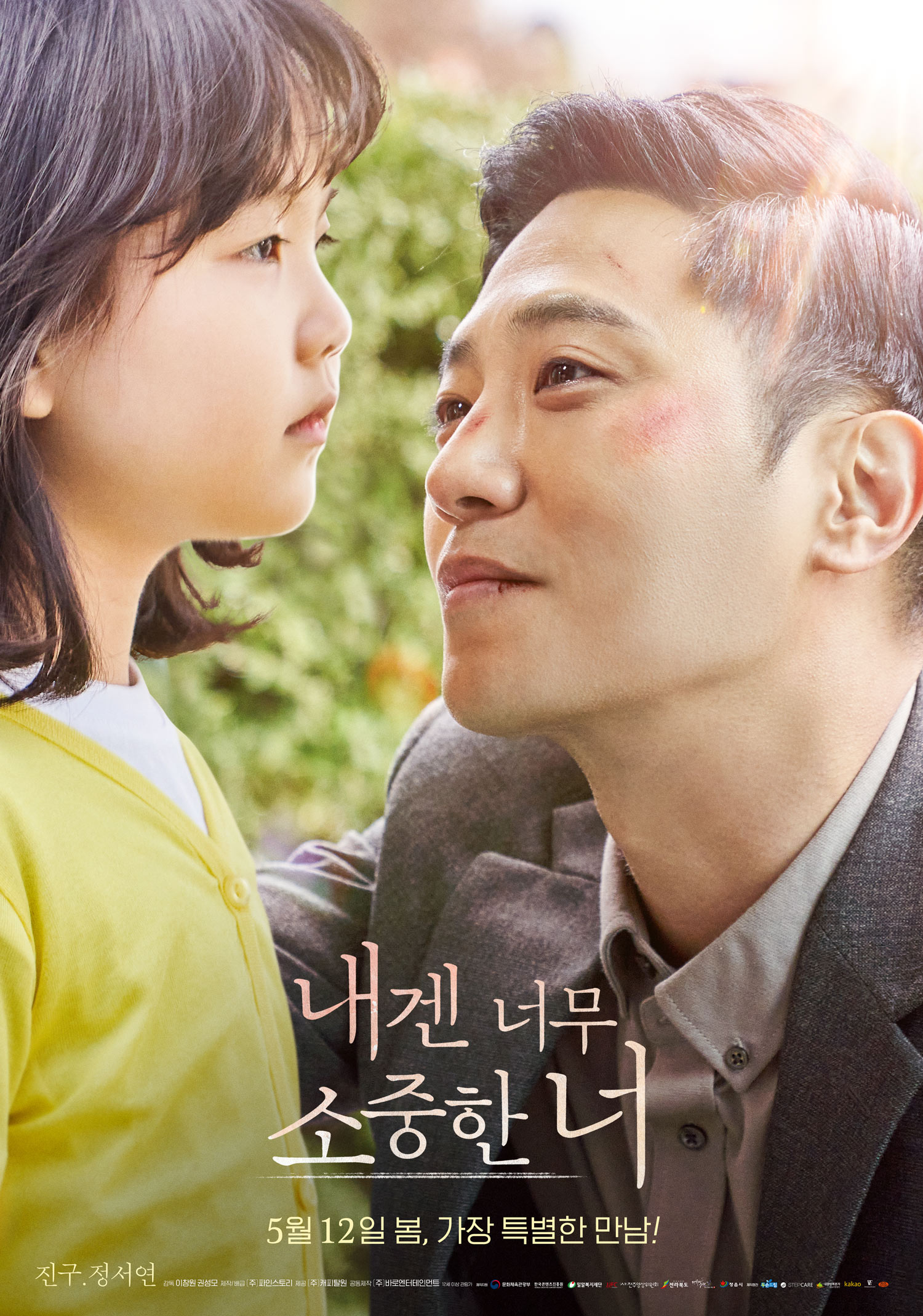
“You’ve got to be brutal to survive in this world,” according to a coldhearted gangster remonstrating with down on his luck chancer Jae-sik (Jin Goo) for his seeming inability to be as bad as the world around him in Lee Chang-won & Kwon Sung-mo’s touching drama My Lovely Angel (내겐 너무 소중한 너, Naegen Neomu Sojunghan Neo), “You won’t get anywhere the way you handle stuff.” He might have a point, Jae-sik doesn’t really have the heart to be a heartless gangster but for the moment at least has been driven into cynicism by the futility of his life.
When one of the women in the small troupe of performers at promotional events he drives round in his van doesn’t turn up for work, Jae-sik is irritated and not really all that remorseful on realising that the reason Ji-young hasn’t arrived is that she died in a freak accident. Like most of the other women, he doesn’t know much about her personal life hearing from the police that her family record only lists a seven-year-old daughter. Investigating her apartment he makes two important discoveries. Firstly, Ji-young’s lease is about to expire and there’s a 70,000 won deposit looking for a new owner. Secondly, Ji-young’s daughter Eun-hae (Jung Seo-Yeon) is still in the apartment though she behaves as if she doesn’t know he’s there and seems to survive on packets of bread her mother had left on the kitchen table.
It takes Jae-sik quite a while to realise that Eun-hae is deafblind, but in any case he ends up moving into the apartment and superficially looking after her in the hope of claiming that he’s Ji-young’s common law spouse and entitled to the deposit money and anything else Ji-young might have to bequeath. But as he discovers, deafblind people find themselves trapped in an awkward limbo of the contemporary welfare system which recognises only deaf or blind people, leaving those who are unable to see or hear without any kind of support. Jae-sik tries to take Eun-hae to school, but she’s put in a class for blind children which is taught through spoken language that she is obviously unable to hear. Jae-sik complains that the classes are no good for her while she becomes obviously bored and frustrated by them, but the teacher’s only suggestion is that she also take the classes for deaf children which are taught in visual media she obviously can’t see.
Of course, to begin with Jae-sik only accepts Eun-hae as a means of getting the money, otherwise little interested in what will happen to her now. He tries to ring her estranged birth father, but he rejects all responsibility for her presumably having walked out on the relationship because of his reluctance to care for a child with special needs. Jae-sik tells the landlady, who thinks he’s Eun-hae’s dad, that he’s looking for a nanny because he wouldn’t be able to care for her on his own while working only for the landlady to point out that Ji-young was managing it alright hinting at the patriarchal double standards which still see childcare as an inherently female domain.
Still despite himself, Jae-sik begins to bond with Eun-hae who is after all completely dependent on him. He begins to communicate with her through teaching her words written in hangul by tracing them on her palm, while she seems to blossom in a new world of sensation when the pair embark on a road trip to the country. Though his past chases him, the further Jae-sik travels from the city the less cynical he seems to become no longer interested solely in money but beginning to care about those around him, not just Eun-hae but those he meets along his journey many of whom are also dealing with their own problems which sometimes echo his own as in a single-mother’s attempts to care for her ageing father as his dementia worsens. Lee & Kwon lend a golden glow to the expanses of the rural farmland where Jae-sik and Eun-hae find themselves taking refuge, Eun-hae in thrall to the natural world cheerfully dancing in the rain, smelling the flowers, and befriending animals even as the city snaps at their heels. Avoiding obvious sentimentality, the film nevertheless tells a poignant story of paternal redemption and the blossoming of a little girl finally finding a means to express herself.
My Lovely Angel screened as part of this year’s London Korean Film Festival.
Original trailer (English subtitles)




 Windows on Worlds