A Normal Family (보통의 가족, Hur Jin-ho, 2023)

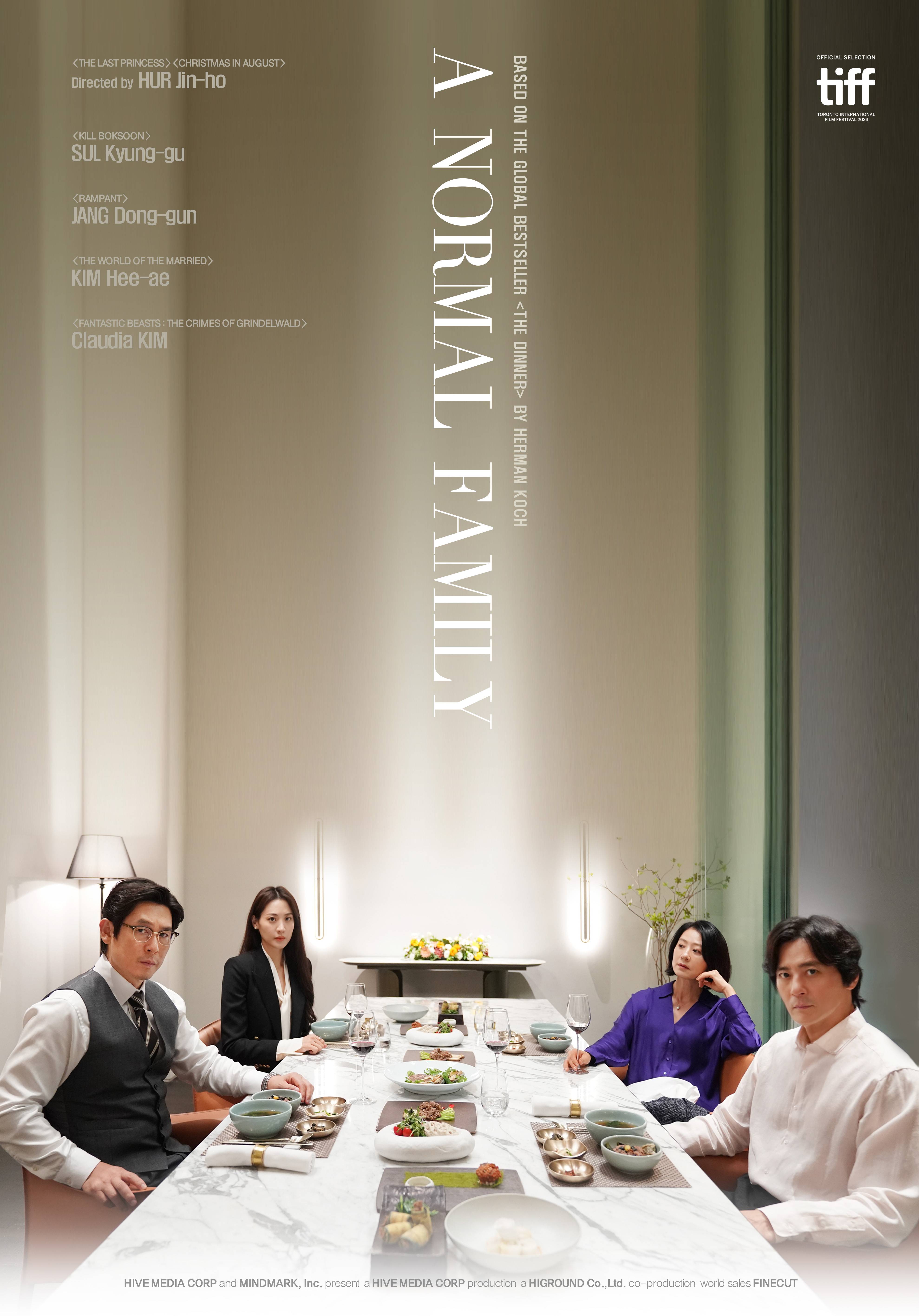
“Parents are weak before their children” according to an apparently doting dad in Hur Jin-ho’s A Normal Family (보통의 가족, Botong-ui Gajok), yet later he will have to ask himself what it means to be a father and what exactly it is that he’s raising his daughter to be. Based on the Dutch novel The Dinner and a departure for Hur who is best known for romantic melodrama, the film nevertheless takes aim at the chaebol culture of the contemporary Korean society in which consequences are only for those without means. 

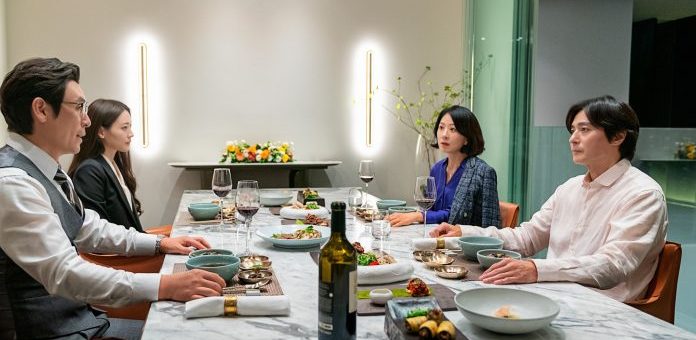
Twin cases further exacerbate the rift between two brothers, cynical lawyer Jae-won (Sol Kyung-gu), and earnest doctor Jae-gyu (Jang Dong-gun) as one finds himself defending the feckless son of a wealthy industrialist, and the other doing his best to save the life of a child seriously injured when a case of road rage resulted in the death of her father. Meanwhile, the brothers’ respective children, Jae-won’s daughter Hye-yoon (Hong Ye-ji), and Jae-gyu’s son Si-ho are later the subject of a viral video which appears to show two teens beating a homeless man half to death. 

Jae-gyu had resented his brother and rejected the idea of Si-ho doing an internship at his hospital on the grounds that he wants him to grow up to be a person with “integrity” rather than one who’d unfairly use his privilege and connections to get ahead. Yet as time moves on we begin to wonder if it isn’t also a little because he’s ashamed of his son who is socially awkward and apparently struggling academically. His wife Yeon-kyung (Kim Hee-ae), meanwhile, is a classic helicopter parent who spends an evening out repeatedly calling Si-ho’s phone and irritated when he doesn’t pick up. The implication is that they’re so hellbent on getting Si-ho into a good university to fulfil their own sense of esteem as parents that they’ve raised a child to conventional success that they’ve lost sight of what might actually be best for him as a whole individual.

On realising Si-ho maybe the violent teen in the video, Jae-gyu’s first instinct is to go to the police but he soon loses his moral authority on failing to follow through. Once again, the question is whether they choose to protect Jae-gyu from the consequences of his actions because they fear for him or because they fear the embarrassment his criminal status would bring to them. On the surface, Jae-woo has no such qualms, immediately torching the dress Hye-yoon was wearing that night while going into damage limitation mode trying to keep the teens’ identities secret. Yet he must also reckon with the fact that he’s brought her up in a world without consequences in which conventional morality no longer really applies to her because she is wealthy and has an elite lawyer for a father. 

In any case, just as Jae-gyu’s morality began to crumble so Jae-won begins to wake up to the idea that perhaps it’s a problem that his teenage daughter and her cousin beat a man half to death and then went back to their lives without batting an eyelid. Hye-yoon shows no remorse, cheekily asking her father for a car he promised her if she passed her exams while later expressing the view that as the man was homeless, a person who in her eyes had failed to achieve personhood through attaining markers of conventional success such as a degree and steady job, his life was of no consequence. Yeon-kyung later says something similar, not understanding why they’re making a fuss over “someone like that” whose life is worth nothing in comparison to her son’s future. 

Yeon-kyung is also relentlessly rude to Jae-won’s second wife, Ji-su (Claudia Kim), who is from a much more ordinary background and does everything she can to try and get along with her. Ji-su presents a much more conventional moral compass in considering what kind of mother she wants to be not only to her own newborn child but to Hye-yoon who like Yeon-kyung mainly treats her with contempt. It’s she who begins to wonder if covering this up is really the right thing for Hye-yoon and Si-ho or if failing to show them that actions have consequences will only encourage them to behave in ways otherwise offensive to a commonly held sense of humanity. 

The brothers switch sides, but the truth is that each of them has been teaching their children the wrong lessons in creating a world in which money settles everything and consequences are only for those who can’t pay. Yeon-kyung tries to justify herself that as she’s done a lot of good deeds it somehow balances out, Si-ho too echoing her on suggesting going to church as if you could buy your right to behave badly by saving up goodness points which is also another way of saying that consequences don’t apply. The children think that as long as they fulfil the role they’re expected to play, get good grades and become successful members of society, then nothing else really matters. Darkly comic, Hur’s steely drama suggests that the inequalities of the contemporary society, the elitism and anxiety have slowly eroded not only the most essential of relationships but the soul of the nation’s children who know nothing other than those with money need not pay for their crimes.


A Normal Family screened as part of this year’s London Korean Film Festival.

Original trailer (English subtitles)
A Wild Roomer (괴인, Lee Jeong-hong, 2022)

“Separation and connection” is apparently the architectural theme of the well-appointed home where not completely qualified carpenter Gi-hong (Park Gil-hong) takes up residence in Lee Jeong-hong’s quirky drama, A Wild Roomer (괴인, Goein). It’s not quite clear if Gi-hong is the strange person of the Korean title or if it refers to the young woman he subsequently encounters, to all of us, or someone else entirely but what does seem to be true is that Gi-hong lives a kind of separated life from those around him.

Ironically enough, Gi-hong’s job is as a joiner though as a conversation with a friend he’s hoping to recruit for his moribund business makes clear he may not actually have finished his apprenticeship and has jumped the gun setting up on his own. The way he tells it, people these days don’t hire interior design firms for small jobs but entrust them to a carpenter, such as himself, who can subcontract the other services involved. But it seems Gi-hong is not a particularly considerate boss, looking down on his employees while complaining that labourers are money grubbers and it’s alright for him to be rude to them because that’s how working men talk to each other. He criticises an elderly electrician who asked about his pay because he has medical expenses for not having planned better for his old age but appears to be doing little to plan for his own while keen to give everyone the impression that his struggling business is actually doing big numbers. He also doesn’t appear to care very much about finesse either, using the cheapest materials possible and doing a slapdash job that even loyal colleague Kyoung-jun (Choi Kyung-june) thinks is not really up to scratch. 

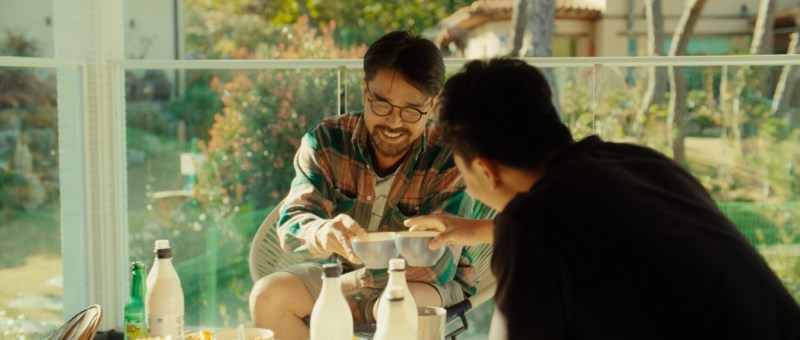
What’s also clear is that Gi-hong has an inappropriate crush on the piano teacher whose studio he’s refitting and a lack of understanding about personal boundaries. At several points he encounters doors that don’t open for him, while ironically his landlord doesn’t seem to believe in them. Though he rents the annex which has a separate entrance, Jung-hwan is keen for Gi-hong to treat the main house as his own entering and exiting through the front door which is all very well but also means that Jung-hwan (Ahn Ju-min) could presumably also wander into Gi-hong’s space whenever he feels like it. Jung-hwan is also living a “separate but connected” life with his enigmatic wife Hyun-jun (Jeon Gil) who he says doesn’t actually like him and never has. For reasons not entirely explained, Jung-hwan is home all day and seemingly lonely hoping he can adopt Gi-hong, who is also home a lot because there’s no work coming in, as a kind of surrogate little brother. 

Yet for all that Gi-hong seems, as his friend describes him, “irresponsible” and self-interested, there’s childlike vulnerability in him that finds an outlet when he unexpectedly encounters a young woman he assumes is responsible for the sizeable dent in the roof of his van. Skittish in nature, Hana (Lee So-jung) is in someways earnest and others helpless. She has no home or family and is in that sense separate and in search of connection while Gi-hong seems to feel guilty about asking her to take responsibility for what happened to his van considering she has no means to do so though is doing her best. She assumes that Gi-hong, Jun-hwan, and Hyun-jun must be “family” considering that they share the same space and seems to want to join them in a separate but connected existence. 

The mechanic they contact about fixing the van goes off on a minor rant about the younger generation, or more accurately those now approaching middle age in their 30s or early 40s, who he claims have been given false expectations because of Korea’s unexpected success in the 2002 world cup which has led them to assume that dreams come true on their own and things will just work out without the need to really do anything to make them. The irony is that he’s pretty much describing Gi-hong who seems to have an insecurity and baseless hope that his business will pick up while terrified it won’t. But then everyone seems to be living a life of quiet separation, privately anxious and dependent upon the loose connections that have replaced the certainties of a blood family. Gi-hong, whose attempts to construct pleasant spaces for others are often imperfect, may have found himself a home of separate connection. “It feels so weird” a woman exclaims on looking at a precariously balanced rock, but like so many things in Lee’s strange world it seems to work even if you think it shouldn’t.


A Wild Roomer screens 11th November as part of this year’s London Korean Film Festival.

Origina trailer (English subtitles)

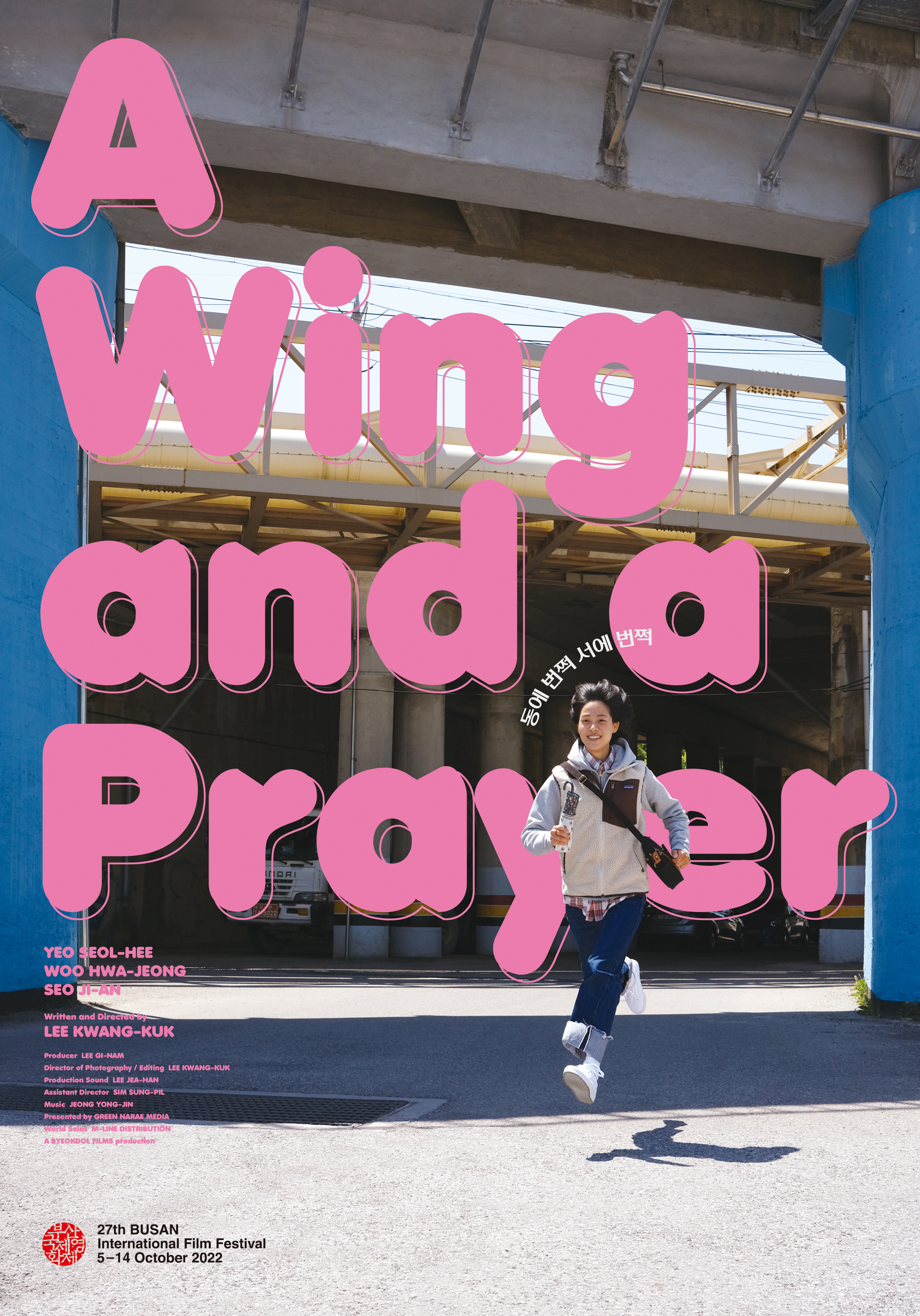
A Wing and a Prayer (동에 번쩍 서에 번쩍, Lee Kwang-kuk, 2022)

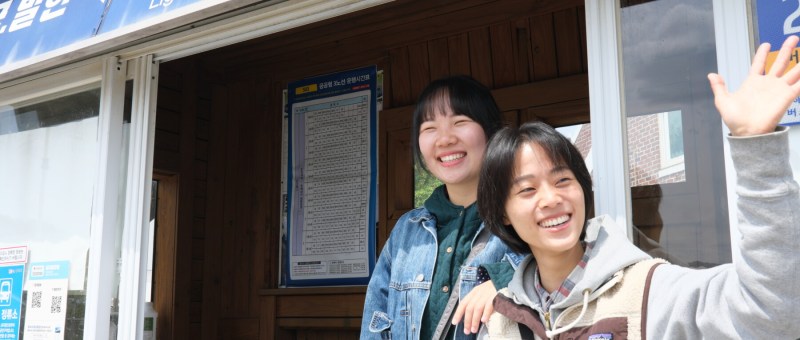
A pair of 25 year olds find themselves marooned in adolescence thanks to the precarious socio-economic conditions of contemporary Korea in Lee Kwang-kuk’s indie dramedy A Wing and a Prayer (동에 번쩍 서에 번쩍, Dong-e Beonjjeog Seo-e Beonjjeog). Not quite as quirky as Lee’s previous work, the film nevertheless finds its twin protagonists undergoing parallel journeys while each preoccupied with the progression to adulthood and what that might actually mean in real terms while perhaps guilty of a childish naivety in their vision of what it is to be grown up.

Seol-hee (Yeo Seo-hee) and Hwa-jeong (Woo Hwa-jeong) are best friends and roommates each currently without jobs and feeling lost without clear direction for their future. Seol-hee was on track to be an athlete but was forced to give up following injury. At an interview for a job in a coffee shop she’s asked a series of questions which seem to her somewhat unnecessary. “Do I need a dream in order to work here?” she asks, “Can’t I just make good coffee and try my best at everything?” Predictably, her answer does not go down well with the interviewer and it seems unlikely she’s going to get this job though Seol-hee remains cheerful and upbeat unable to understand why everyone keeps pressing her about her hopes and dreams when she’s just trying to live. By contrast, Hwa-jeong has reached the final stages for a job at a company and feels her interview went well so she’s optimistic that this time it really might work out.

Though in quite different places, the pair decide to take an impromptu trip to the seaside to wish on the sunrise only to fall asleep and completely miss the moment. The mismatch in their circumstances comes to the fore when Hwa-jeong reveals that with their lease about to come to an end she’d like to try living on her own, “like a real adult”. Of course, that’s quite destabilising and hurtful for Seol-hee who has no real expectation of being able to get the kind of job that would let her find an apartment she could rent on her own. After a small argument, the pair end up separated and on parallel adventures as Seol-hee bonds with a slightly older woman, Ji-an (Seo Ji-an), whose life has been ruined by unresolved trauma caused by high school bullying while Hwang-jeong meets a high schooler, also bullied, who is looking for her missing parrot. 

When Hwang-jeong comes to the rescue of the high school girl after she’s lured by bullies who claimed to have info on her parrot, it’s obvious that they immediately recognise her as an “adult” though she holds little sway over them. Hwang-jeong is fond of saying that she isn’t a kid anymore, but it’s also clear that getting a job is central to her definition of adulthood. When the high school girl asks what she does for a living, Hwang-jeong answers pre-emptively that she’s a “respectable company employee” to which the high school girl replies “an adult” but then goes on to ask at exactly what age one becomes one. Hwang-jeong has no answer, because perhaps it’s not an age after all but a state of being. 

She also accuses Seol-hee of behaving like a child as they continue to argue about Hwang-jeong’s plans for solo adulting. Seol-hee meanwhile finds herself trying to help another lost woman who is herself arrested but trying to break of the “jail” she feels she’s been placed in by an overprotective mother she nevertheless feels may be ashamed of her for her own “failure” to progress into a more conventional adulthood. Like the high school girl Seol-hee claims she has no friends and tries to make one of Ji-an only she refuses. On seeing the flyers for the lost parrot, which Seol-hee herself at times resembles, she wonders if recapturing it is the right thing to do or if it wouldn’t be happier flying free rather than trapped within a cage that to Seol-hee represents conventionality and socially accepted ideals of success.

They’re all lonely, wounded, and insecure, afraid of talking to each other about their worries because of the internalised shame of feeling to meet the demands of “adulthood” despite, in all but the case of the high school girl, being well over the age of majority. The high school girl herself may represent Hwang-jeong’s refusal to confront her past while throwing herself into an adulthood she hasn’t quite earned just as the parrot represents both her friendship with Seol-hee and the elusiveness of their future, but it also returns to her the sense of positivity she may have been missing just as Seol-hee’s care of Ji-an also allows her to take care of herself. They might not quite be adults, but then who really is and at least they have a little more clarity about that means and what they want out of life in the realisation that they aren’t alone and not least in their worries.


A Wing and a Prayer screens 10th November as part of this year’s London Korean Film Festival.

Original trailer (English subtitles)

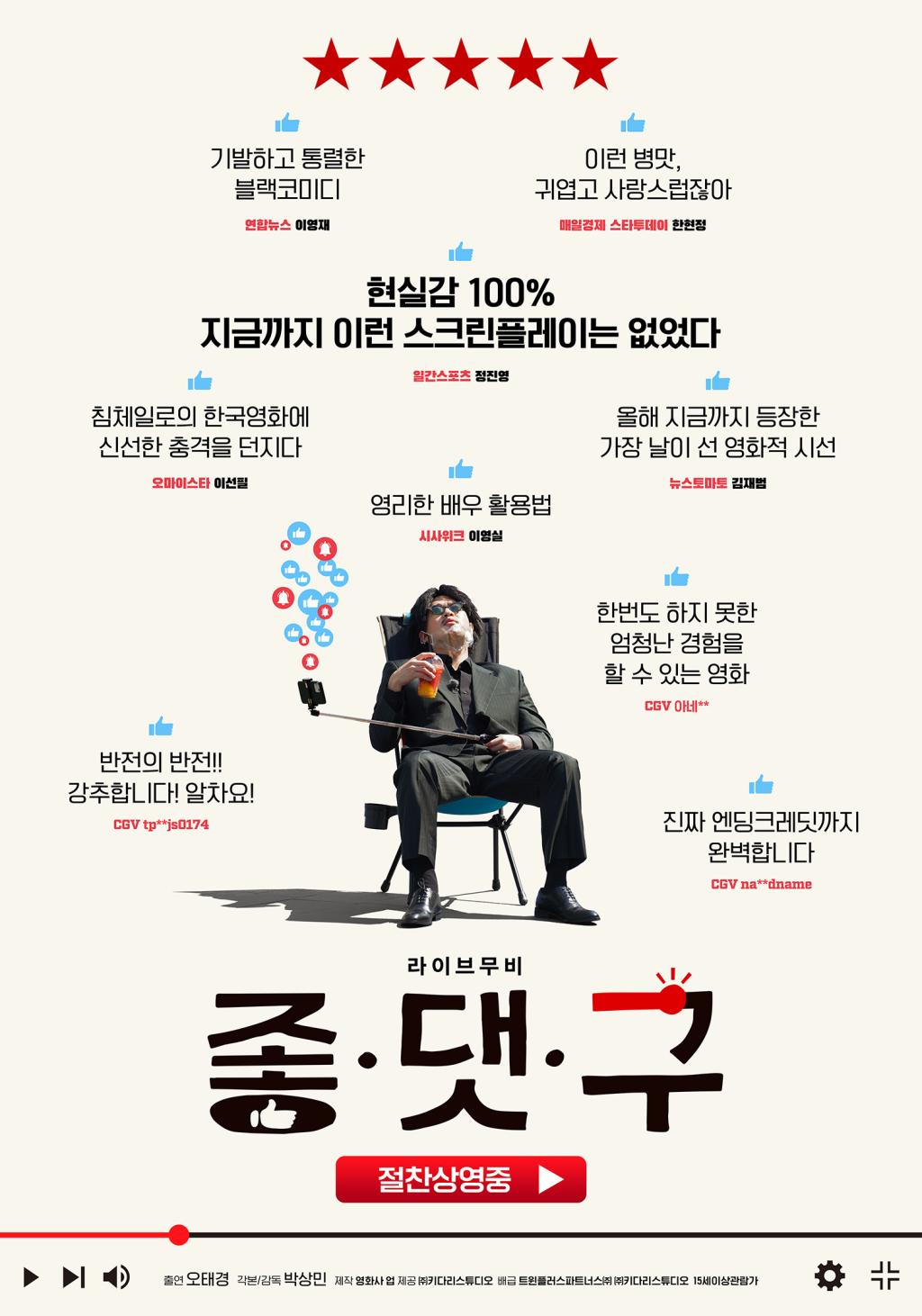
I Haven’t Done Anything (좋.댓.구, Park Sang-min, 2022)

The central irony of Park Sang-min’s meta comedy I Haven’t Done Anything (좋.댓.구, Joh.Daes.Gu) is that a man who remains defiantly silent generates much more interest than the one desperately chasing YouTube success. Adopting a “screen life” aesthetic in which much of the action is told through social media and video screens, the film asks a series of questions about our petty obsessions, online authenticity, media manipulation, and the impossibility of escaping a predetermined image as its embattled hero strives to reinvent himself by his inhabiting most famous role.

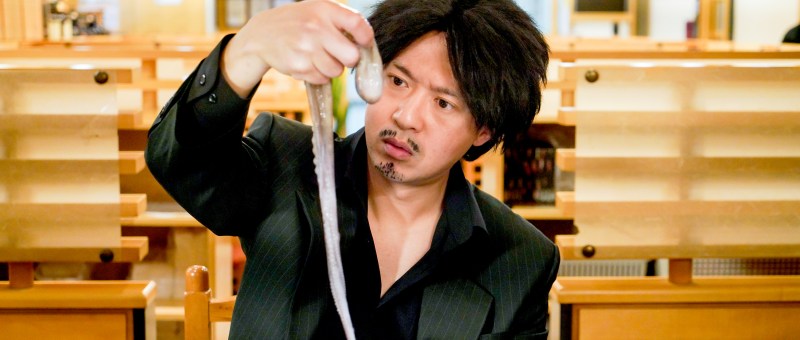
Actor Oh Tae-kyung plays a version of himself who is struggling to maintain his career as an actor having begun as a child star with his most high profile roles including that of the younger Oh Dae-su in Park Chan-wook’s Oldboy. With work thin on the ground, he turns to YouTube but fails to make an impact with content that commenters describe as old hat such as “mukbang” eating videos and unboxings. It’s then that he comes up with the idea of rebranding as “Li’l Oh Dae-su”, dressing up as the protagonist of Old Boy and accepting viewers’ challenges which at one point include him taking revenge on a gang of class bullies by hitting them on the head with a plastic mallet while mimicking the famous corridor fight scene from the landmark drama.

But then, someone else has already shared their screen with us. Going under the name “Bulldog”, a viewer asks Tae-Kyung to solve the mystery behind a man who’s been standing silently in the square with a large sign reading “I Haven’t Done Anything”. Tae-kyung reasonably wonders why Bulldog didn’t just ask the guy himself, but as he explains “Picket Man” refused to answer him. Given the large amount of money Bulldog has pledged for this seemingly simple request, Tae-kyung accepts the challenge but Picket Man continues to ignore him no matter the silly stunts he pulls an attempt to break his concentration. 

Bulldog’s apparently strong desire to know the truth, willing to offer up vast sums of money just to satisfy his curiosity, hints at our own petty obsessions. After all, the cryptic quality of the sign is intriguing. What exactly is Picket Man trying to say, what didn’t he do and who says he did it? Of course, in another way, Tae-kyung also feels he hasn’t done “anything” with his life and stuck in a career morass unable to shed the image of himself as a child actor and young Dae-su in particular. Every time someone offers him another role, he worries that the baggage of his early career follows him and he’s simply not credible as a hardened gangster, for example, if everyone only sees him as the eldest of six siblings in a much loved TV drama or the little boy who grow up to become the schlubby captive Oh Dae-su. 

When the skit becomes an accidental viral hit, Tae-kyung begins to worry that perhaps he’s doing Picket Man a disservice and this kind of publicity isn’t really what he was after though it’s puzzling that he himself refuses to speak about what it is he hasn’t done. What he realises is that Picket Man is much like himself and he’s done to him what others have done to Tae-kyung in reducing him to a single image. How will anyone ever see this otherwise anonymous person as anything other than “Picket Man” now? Tae-kyung has unwittingly exploited him for his own ends and possibly ruined his life in the same way that anyone who becomes a meme is robbed of an identity. 

Then again, in this very meta tale not everything is as we think it is and we ourselves, like the YouTube commenters, are being manipulated by unseen forces. As Picket Man becomes the latest social media phenomenon, other content creators start arbitrarily jumping on the hashtag, randomly mentioning Picket Man to boost their own views while unscrupulous forces also exploit the meme potential to run scams featuring Picket Man’s image. Park carries the meta quality through to interrupting the film with fake YouTube ads and product placement from sponsors that remind us we are being sold something whether we realise it or not and that we might not even realise what the product is or who’s selling to us as the final reveal implies. Nevertheless, there’s a sense of triumph in the success of this heist that’s been pulled on us in the winning self-deprecation of dejected former child star Tae-kyung and his great master plan to shed himself of an otherwise inescapable image. 


I Haven’t Done Anything screens 5th November as part of this year’s London Korean Film Festival.

Original trailer (English subtitles)

Rainbow Trout (송어, Park Chong-won, 1999)

The hypocrisies of contemporary civility pass under the microscope in Park Chong-won’s creepingly intense drama, Rainbow Trout (송어, Song-o). As a collection of urbanites pile into a car and journey far into the mountains to rescue an old friend who’s dropped out and returned to the land as a fish farmer, they find themselves stepping into a world entirely contrary to their understanding but eventually expose themselves as petty, jealous, resentful and shockingly violent even in their disdain towards the “backwards” woodsmen they feel are harassing them.

The film both begins and ends with a tollbooth as the car carrying the urbanites first leaves and then returns to the “safety” of Seoul. Ominous signs pepper their journey, one of the men wondering if the pits on a mirror at a dangerous curve are bullet holes while his friend insists they’re more like pockmarks from small rocks swept up in a storm. Swept up in a storm might be one way to describe what later happens to the city dwellers, but it’s fair enough to say that they are fairly puffed up on the superiority of their urban civility over the earthy lives of the rural hunters. None of them can understand why their friend has made the choice to leave Seoul behind and live a primitive existence in a cabin in the woods. 

Chang (Hwang In-sung) even remarks that his fish sometimes commit suicide, Min (Yu In-chon) suggesting that being cooped up in a small space makes them feel anxious. The urbanites are not in a small space, they’re in the wide open countryside, but to them it is claustrophobic in its unfamiliarity. Though the trip starts off well enough as they reminisce with Chang and enjoy a night round the camp fire, the two men, bank clerk Min and his bbq restaurant owner friend Byung (Kim Se-dong), soon fall foul of a local hunter who doesn’t like where they’ve parked their car or possibly that they’ve parked it at all. Byung is forever performing his masculinity, making a show of chopping wood and lifting weights outside the cabin, but like Min otherwise unable to challenge the hunters and entering a mini vendetta of pettiness with them that is destined to end badly. Min meanwhile is preoccupied in knowing that his wife, Jun-hwa (Kang Soo-yeon), is still in love with Chang while Chang’s decision to leave the city seems in part to have been provoked by their marriage. Byung’s wife, on the other hand, ironically submits to her carnal desires after being caught stealing a rabbit from a trap by a lecherous hunter who later shows up with a gift of yet more meat which seems somehow like even more of a betrayal given that her husband runs a barbecue meat restaurant but is obviously not quite red-blooded enough for her. 

It’s the presence of Jun-hwa’s younger sister Se-hwa (Lee Eun-ju), however, that provokes further tensions in the group not least as she develops a fondness for Chang while local dog breeder Tae-joo (Kim In-kwon) develops a fascination for her. Tae-joo peeps on Se-hwa in the outhouse and creepily lurks around the cabin though he is perhaps just awkward if a little strange more than actively dangerous. Nevertheless he becomes the target for the husbands’ frustrated masculinity as they decide to exorcise some of their frustration on a mountain boy who is ill-equipped to resist them, unleashing uncivilised violence and barbarity that would bring them to the point of homicide. They assume Chang is like them, that he will side with the city, but Chang is now a mountain man and has shades of barbarity the husbands’ little suspect. As the crisis intensifies, the urbanites shift the blame and turn on each other, uncomfortably blaming Se-hwa as if it were her fault that the boy took a liking to her or that the men took it in the direction that they did. Se-hwa also finds herself a victim of male violence from an unexpected source but is again blamed for it less for her naivety than the simple fact of her existence as a young woman in this incredibly primal environment. 

The urbanites thought the hunters to be savage, but in reality were savage themselves only to convince themselves that they had done nothing wrong pleading with Chang to cover up their violence because Tae-joo is only a mountain boy while they are civilised people from the cities who could not have acted in anything other than a civilised way. They are in a sense like the rainbow trout, raised within a narrow frame and little understanding how to live outside of it, driven out of their minds by the removal of the guardrails of civility. On returning to the city they may convince themselves that the dark shadows within have disappeared but the fragility of their sophistication has already been exposed rendering them at least less honest than the huntsmen who made no pretence of their carnality. 


Rainbow Trout screened as part of this year’s London Korean Film Festival.

The Surrogate Woman (씨받이, Im Kwon-taek, 1986)

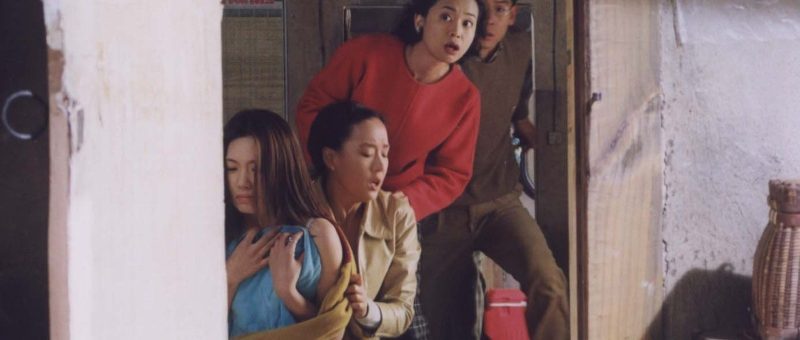
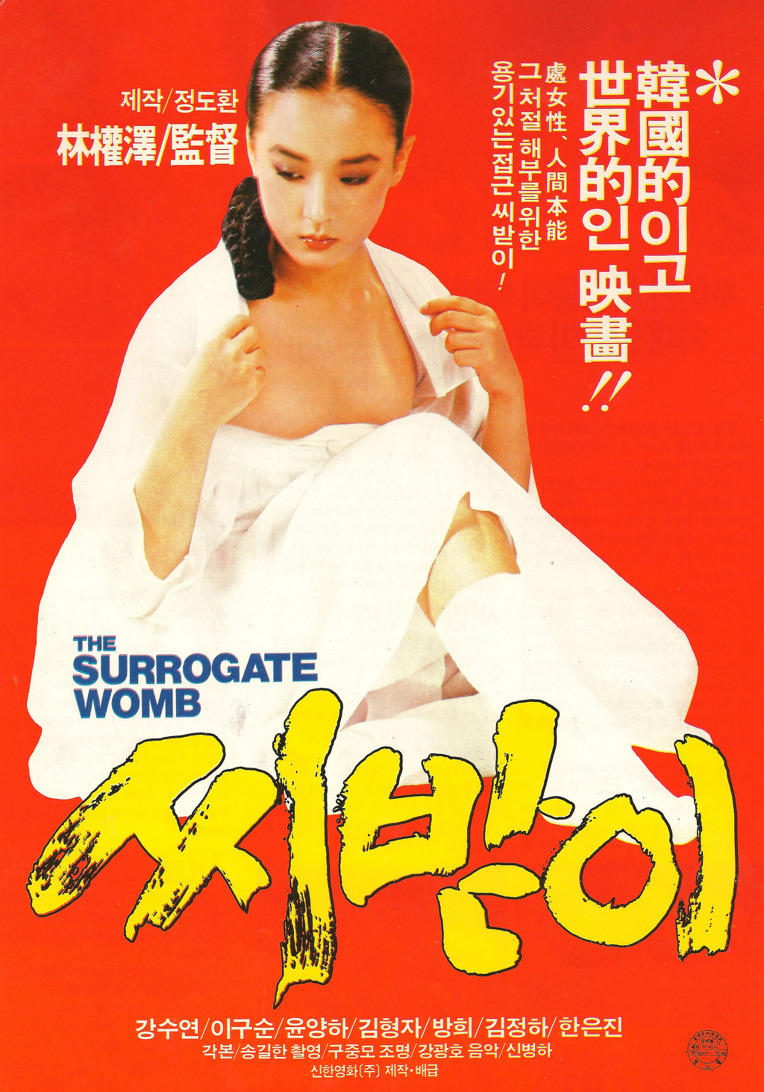
“They seem to live for honouring the dead” the bemused heroine of Im Kwon-taek’s Surrogate Woman (씨받이, Ssibaji) explains to her visiting mother of the noble society she has been unwittingly plunged into but still struggles to understand. A condemnation both of a society which continues to value sons over daughters and of the absurdity of ancestral rites along with the hierarchies of the feudal order, Kwon’s impassioned historical drama speaks directly to the contemporary era in which in many ways nothing has changed.

In any case, Ok-nyeo (Kang Soo-yeon) is fated to become a surrogate woman. As the woman who seems to be in charge in a small community ensconced in a valley which from a certain vantage point seems to resemble female genitalia explains, surrogate mothers who bear daughters are expected to raise them themselves but the children are considered undesirable for marriage and generally end up becoming surrogate mothers themselves. Ok-nyeo’s mother had not wanted such a fate for her daughter, but is in the end powerless to prevent it especially given the allure of the generous payment promised on the birth of a male child. Ok-nyeo thinks she can endure anything for the promise of a comfortable life afterwards but is simply too young and naive to understand the emotional consequences of her decision, that her child will be removed from her seconds after birth and handed to another woman to raise. 

The situation is not much better for the wife who is made to feel as if she has failed in not having conceived a child during her 12 years of marriage. Both she and the grandmother who is so insistent on ensuring the existence of a male heir now that her husband has died and their only son is childless, express anxiety about Ok-nyeo’s youth, as did the women in the village, fearing that at 17 she is not yet physically or emotionally mature enough to bear a healthy child. The man they sent to select her seems to have done so out of personal preference, explaining that of all the women he picked a virgin though this raises several practical issues given the nature of surrogacy. Even so there is something quite perverse in the fact that it is the grandmother, the wife of a noble family of Confucianist scholars, who is actively participating in this system that renders women little more than wandering wombs now that she has the only real power that she will ever experience in her life as a widow turned head of household. 

On the other hand, it’s clear that this isn’t an ideal arrangement for the man either. The husband, Sang-kyu, is reluctant. He thinks it’s morally wrong and against his Confucianist philosophy while he is also attached to his wife and has no desire to sleep with other women. Nevertheless, he becomes attached to Ok-nyeo to a degree that is regarded as inappropriate by his family members and advisors, sneaking out to sleep with her for reasons other than conceiving an heir. When Ok-nyeo becomes pregnant they send him away to a temple in an attempt to sever their emotional connection, though he immediately sleeps with her again on his return despite the fact that she is already pregnant. For this transgression, Ok-nyeo’s mother is beaten while Ok-nyeo herself had earlier been punished for seducing him though she is completely confined to a single room for the entirety of her stay at the house lest anyone find out the embarrassing secret that the family have hired a surrogate. 

While Ok-nyeo and Sang-kyu make love in the bushes, drunken men from the party he’d been attending have a dull conversation about the nature of ancestral rites which is in its own way transgressive as they ask themselves where these ancestral spirits actually are, trying to make sense of what the rituals are for and what they mean but emerging with only confusion for they are largely meaningless. They praise women for rescuing the ancestral tablets at the expense of their children and constantly incur vast expense sacrificing food for those who can no longer eat. As someone remarks, the dead dislike their world and long to stay in ours but the living hardly live at all and spend all their time in service of those who are no longer here. All of it, this vast system that traps women like Ok-nyeo along with men like Sang-kyu the Confucian scholar, stems from this desire to placate departed souls at the expense of those still breathing. 

Yet Ok-nyeo is almost like a ghost herself, an invisible presence locked up in a backroom concealed as a dirty secret. Her mother reminds her that Sang-kyu is an aristocrat and she is not, they do not really regard her as human and what she is is stabled like a horse brought for mating to be taken home once the foal is born. They snuck her in by night and will insist that she leaves in darkness mere hours after her son’s birth. Meanwhile, she will be tortured by her captors who burn her stomach and force her to drink strange potions in the name of having a son. Sang-kyu too is forced to drink deer blood to improve his manliness while Ok-nyeo is advised to stare at the moon to the point of dizziness. She perhaps falls for Sang-kyu because he is her only real human contact though it appears they never actually speak to each other, while he discovers a kind of liberation in the permission to dispense with the sublimation of his sexual desire normally demanded by his Confucianist teachings. 

But few of them acknowledge the cruelty with which Ok-nyeo and the surrogate women are treated, the pain and despair her mother had tried to warn her of. Ok-nyeo had said anything was worth the price of 10 fields, but soon cries out that she’d give them all up for her son unable to accept that the boy will never be hers for to be a surrogate woman is to be denied one’s own existence. Caught in the night, she can only stare back through the fog as the carriage departs forever separating her from her child and the man she had unwisely come to love. As the closing titles explain, returning to the funereal scenes with which the film had opened, Ok-nyeo has become a victim of a society that prizes sons over daughters as have so many women like her even centuries later in which enlightenment has brought little freedom for those oppressed by class and patriarchy.


The Surrogate Woman screened as part of this year’s London Korean Film Festival.

Trailer (no subtitles)

The Anchor (앵커, Jeong Ji-yeon, 2022)

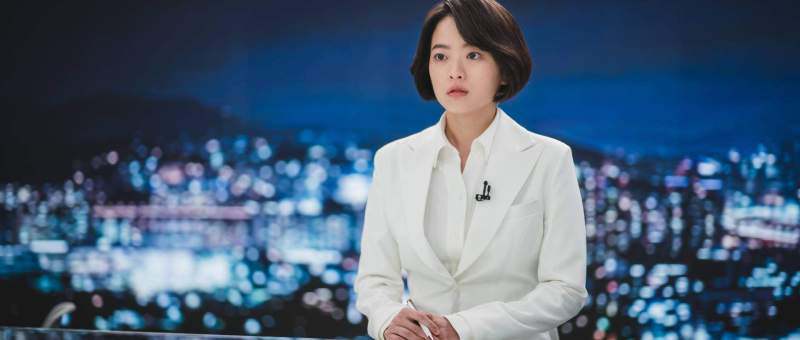
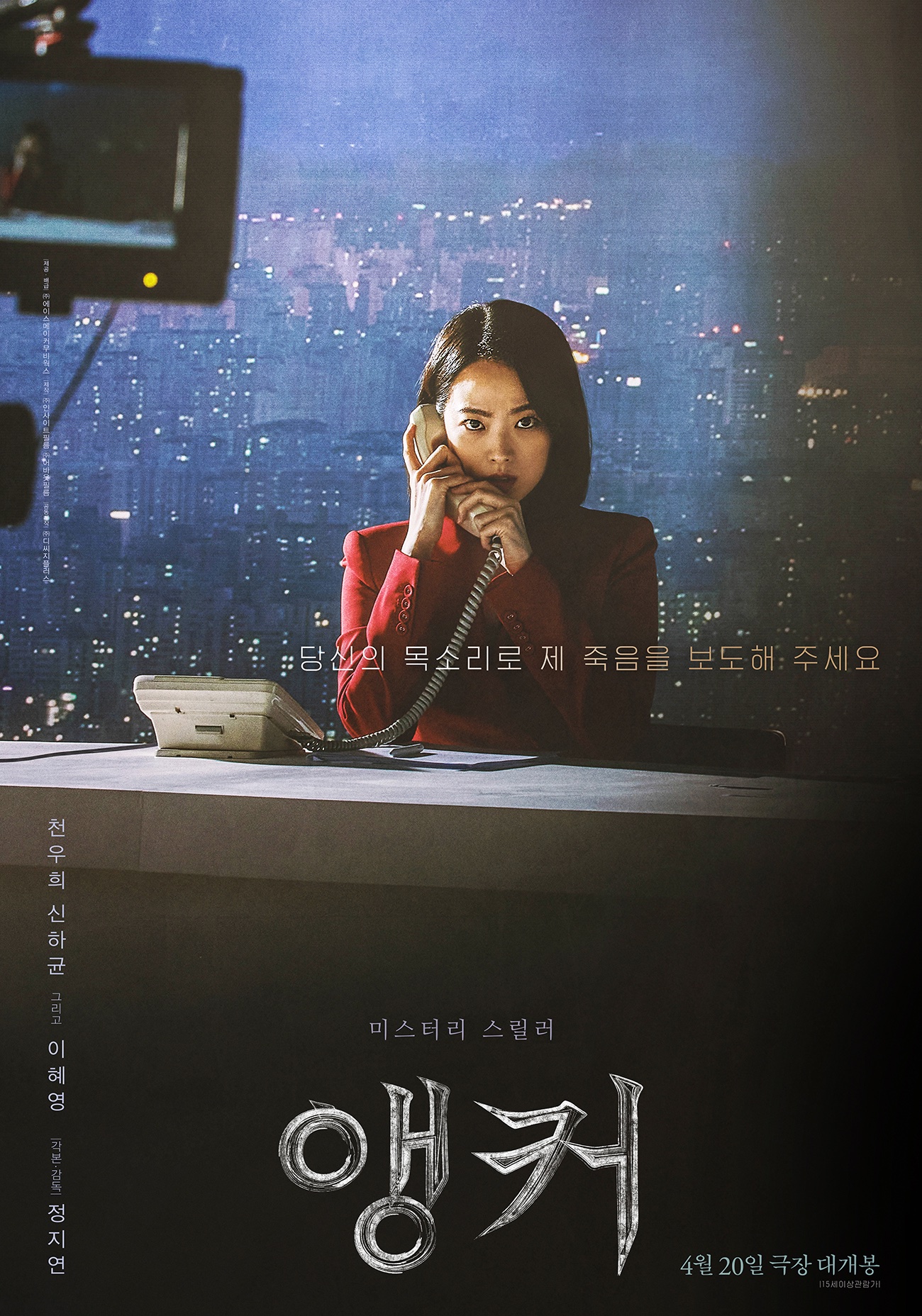
A successful newsreader’s sense of reality begins to fracture when she ends up becoming part of the story in Jeong Ji-yeon’s twisty B-movie psychological thriller, The Anchor (앵커, Anchor). As much about mothers and maternal anxiety as it is about a patriarchal and conservative society, Jeong’s eerie journey through the psyche of a traumatised woman is also a quest for identity and a search for the self as the heroine rails against her role as a mere conduit for the thoughts and will of others. 

In her mid-30s, Sera (Chun Woo-hee) is a popular anchor helming the most important news report of the day. Yet she’s facing a challenge from a younger rival who is not a trained presenter but a respected reporter who can bring a degree of editorial authority to the desk which her polished delivery cannot. As one of her bosses puts it, it’s the way that things are going which Sera seems to know seeing as he also remarks that she’s been trying to gain experience as a reporter so that she can be a “real anchor”. As it stands, her job is mostly to look presentable and support the male lead reading out words other people have written presented to her by autocue. Her mother (Lee Hye-young) is always needling her, insisting that she can’t afford to let her guard down even for a moment if she wants to keep her spot while further fuelling her sense of futility in suggesting that even becoming a news anchor may not have been her decision in the first place so much as in service to her mother’s desire for vicarious success. 

When a strange woman, Mi-so (Park Se-hyeo), calls in to the station one day insisting on speaking with Sera directly it seems like the perfect opportunity to prove her credentials as an investigative reporter but her male colleague immediately shuts the conversation down writing off the woman’s claims that she’s being harassed by an unknown aggressor as a prank call from a crazed fan. Sera follows his lead and in any case has to read the news, but something about the woman’s story disturbed her so she decides to check out her address and is shocked to discover the woman’s daughter dead in the bath and the woman herself hanging in her closet with her phone still in her hand. Perhaps echoing her own fragile mental state, Sera is haunted by the image of the woman hanging but does not seem to feel particularly guilty or responsible for her death in not following up immediately in case she and her daughter could have been saved so much as determined to turn the case into her personal crusade to decrease the likelihood of them kicking her off the desk.

The desire to investigate the case herself is in part a desire to assert her own identity as distinct from that projected onto her by her overbearing mother and chauvinistic husband who insists that her mother is controlling her but in reality just wants to control her himself. Min (Cha Rae-hyung) keeps badgering her about starting family but seems oblivious to her wishes though the couple appear to have been separated for some time only keeping up appearances to avoid the possible fallout from the scandal of divorce. Becoming a mother is in a way to lose one’s own identity especially in a society such as a Korea’s in which women who bear children stop hearing their own name, addressed only as so and so’s mum rather in their own right. It may partly be this sense of erasure which drives the resentment which exists between mother and child along with a persistent social stigma against women raising children alone especially if born out of wedlock. The idea of a woman seeking fulfilment outside of the home is still to some taboo with a strong social pressure for women to abandon their own hopes and desires and devote themselves entirely to the role of “mother”. 

On trying to decide how to frame the case, the editorial board is torn between viewing Mi-so as a victim of unjust societal pressures and condemning her as an evil woman who murdered her daughter and then herself, the police having decided that there was no third party involved despite Mi-so’s claims of an intruder. Even with a more compassionate framing, the message is pity rather than a drive for social change in which women like Mi-so who appears to be incredibly young, little more than a child herself, could get the help they need. Sera becomes convinced that a creepy psychiatrist (Shin Ha-kyun) specialising in hypnotism is somehow responsible though he frames the mysterious intruder as a kind of phantom, a manifestation of buried trauma ratting the doors trying to get in or else a convenient “entity” that allows the hauntee to deny their responsibility or reality. In any case, Sera’s investigations take her to a dark place but eventually arrive in a kind of psychological wombscape in which she must finally kill the image of the mother in herself in order to escape her mother’s house in a symbolic vision of birthing a new self having reclaimed her individual identity. Elegantly lensed and filled with visions of refracting mirrors reflecting Sera’s identity crisis Jeong’s eerie psychodrama eventually allows its heroine to find her own way out of unresolved trauma if only ironically.


The Anchor screened as part of this year’s London Korean Film Festival.

Original trailer (English subtitles)
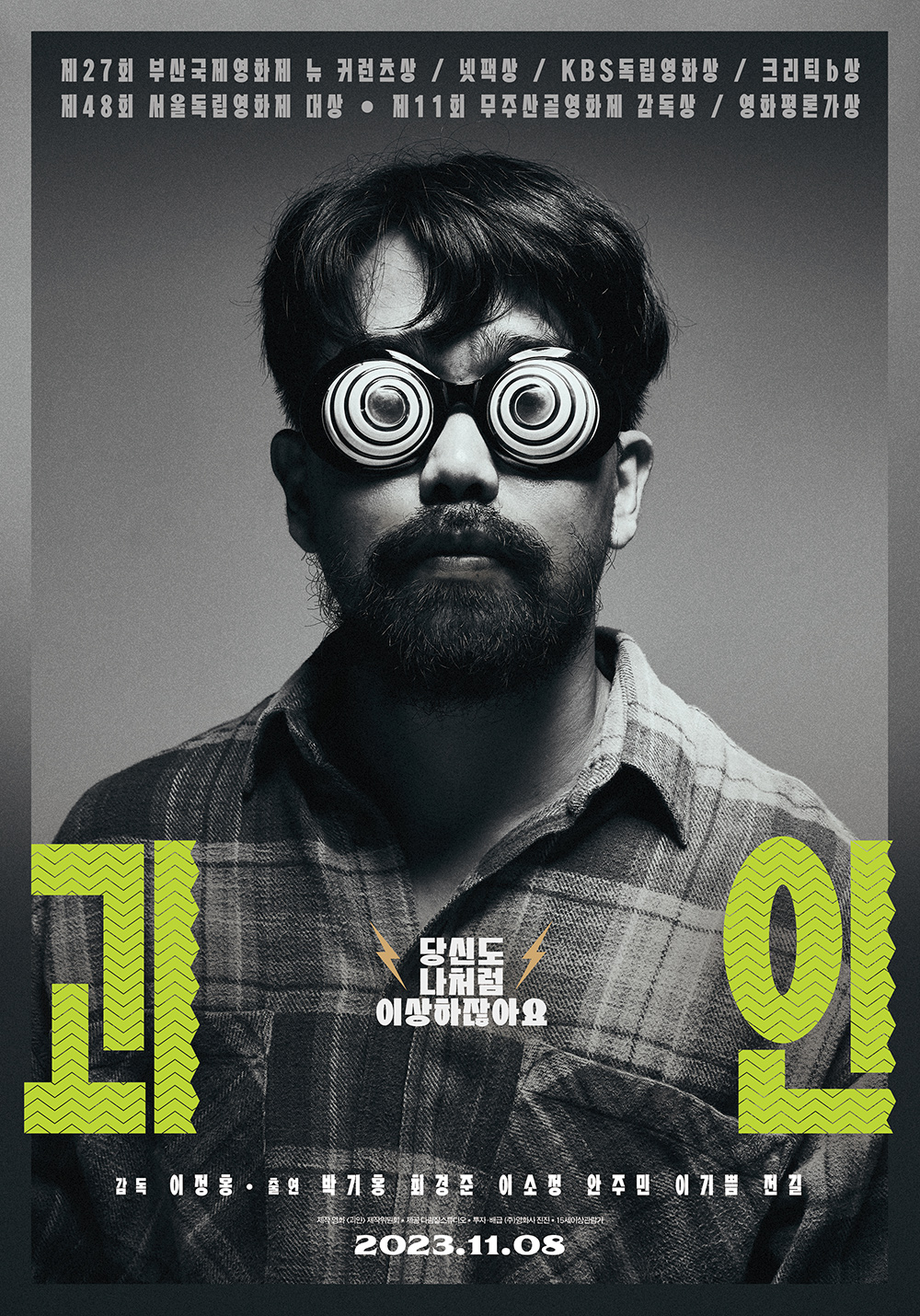
Through My Midwinter (그 겨울, 나는, Oh Seong-ho, 2021)

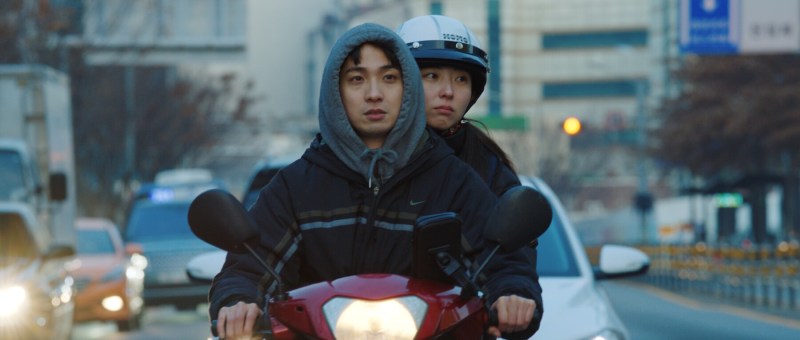
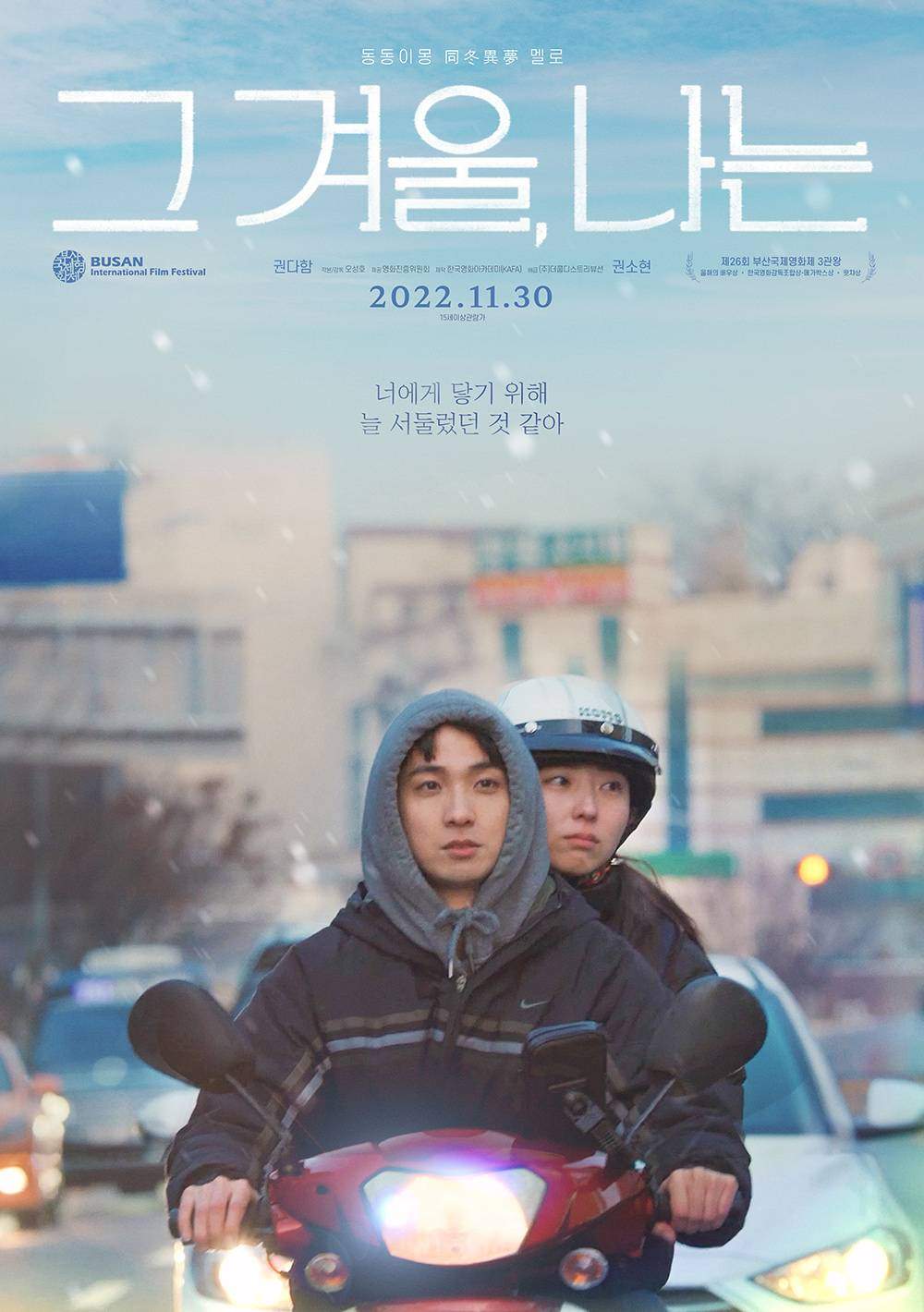
The previously close relationship between a young couple hoping to win steady government jobs is gradually eroded by the strain of living in a hyper-capitalist society in Oh Seong-ho’s empathetic indie drama Through My Midwinter (그 겨울, 나는, Geu Gyeoul, Naneun). Another in a series of recent films exploring the pitfalls of living on the margins of an otherwise prosperous society, Oh’s debut feature explores the ways in which money, employment, security, and the changing natures of classism and patriarchy continue to disrupt human relationships in the simple desire to live in relative comfort or else just survive in one of the wealthiest cities in the world. 

Both approaching 30, Kyung-hak (Kwon Da-ham) and his girlfriend Hye-jin (Kwon So-hyun) are each studying for civil service exams he in the police force and she hoping for a job at the tourist board though it seems like even that wasn’t her first choice. Though they are each worried that their time is running out and they’ve left it too late to get settled, they appear to have a good relationship and are happy muddling through together. The crisis comes when Kyung-hak receives a call from a bank and discovers his mother has taken out a sizeable loan in his name on which she has defaulted and apparently disappeared leaving him liable for the entire amount plus interest. As a student it is not an expense he can afford, leaving him with no other option than to look for part-time work which disrupts his ability to study and further decreases the chances of his passing the upcoming police force exam.

Kyung-hak’s naivety is obvious when it’s clear he’s being ripped off by a friend who sells him a motorcycle for cheap claiming that he recently had it serviced though it sounds and looks like it’s seen better days. Accepting a job as a delivery driver he is resigned to taking the jobs no one else wants as the rookie new recruit, but is quickly frustrated by the way in which he is treated by his customers. The guard at one swanky building won’t let him use the lift in case the take away he’s carrying leaves a smell, forcing him to walk up 19 floors and possibly incur a customer complaint when the food is cold or damaged from its journey up the stairs. He is encouraged to be reckless in order to earn more money, putting his life and those of others in danger while his lack of sleep also makes him irritable and difficult to be around especially with Hye-jin who is experiencing problems of her own after deciding to give up on the government exam and take a job at a tech company. 

Mirroring the final scenes of Kyung-hak operating a machine at a factory, the work Hye-jin is originally assigned is on a production line assembling USB sticks which is most likely not the kind of job she envisioned for herself as someone with a post-graduate degree. A further strain is placed on their relationship by the obvious disapproval of Hye-jin’s mother who thinks Hye-jin is wasting her time with a man like Kyung-hak who is “just” a delivery driver at age 30 and most likely is never going to pass the police exam. “Who marries for love these days” she exclaims in exasperation, simultaneously admitting that it was different for her generation who could make a lot of money together while young and save for the future, and resenting her daughter for not being smart and looking to hook up with someone “on her level”. Hye-jin appears to resent this, but deep down perhaps feels something similar, drawn to her boss at her new job who seems nice enough and like her speaks Japanese having spent some time living in Kyoto. When her new coworkers ask about her boyfriend she’s evasive, finally conceding that he’s studying for the police exam but clearly uncomfortable when they ask if they’ll be getting married once he finally passes.

The cracks may have already been there, Hye-jin accusing Kyung-hak of only using her for sex rather than committing to the relationship, while he is increasingly sullen and uncommunicative unwilling to accept help financial or otherwise humiliated in having his masculinity undermined by not being able to support himself independently. Eventually he’s forced to compromise himself morally, behaving like the colleague he resented in picking up the better jobs first and then resorting to criminality in agreeing to drive sex workers around for the money to fix his bike after an accident. When he realises the girl he’s driving is probably underage he tries to do something about it, but she needs the money as much as he does and asks him what “responsibility” he’s going to take. Will he give her the money so she can go home tonight? Even if he does, what about tomorrow and all the nights after that? She’s just as powerless as he is and at even more risk.  

The film’s English-language tagline presumably referring to Hye-jin as “a woman who falls prey to money” may have its share of misogyny in suggesting that Hye-jin has somehow sold out in choosing to pursue a more middle-class life at the expense of her relationship with Kyung-hak, as if Kyung-hak has not also fallen prey to money in that it is the force which has destroyed his life and hopes for the future as it has for pretty much everyone. When he almost loses a hand at his factory job, his boss just asks if the machine’s alright not really caring that it’s Kyung-hak who might be broken by the inhumanity of rampant capitalism. It’s difficult to tell if the closing scenes are intended as hopeful or otherwise as Kyung-hak once again studies for the police exam hoping to escape his life of crushing poverty but also perhaps complying with the system that sent him there and may never grant him the right the better life he dreams of. Oftentimes bleak, depicting a society in which all relationships are transactional and friendship or romance luxuries most are unable to afford, Oh does at least suggest that this is only an extended midwinter and spring will eventually come for Kyung-hak even if he has to wait until he’s 49.


Through My Midwinter screened as part of this year’s London Korean Film Festival.

Original trailer (Korean subtitles only)

Kingmaker (킹메이커, Byun Sung-hyun, 2022)

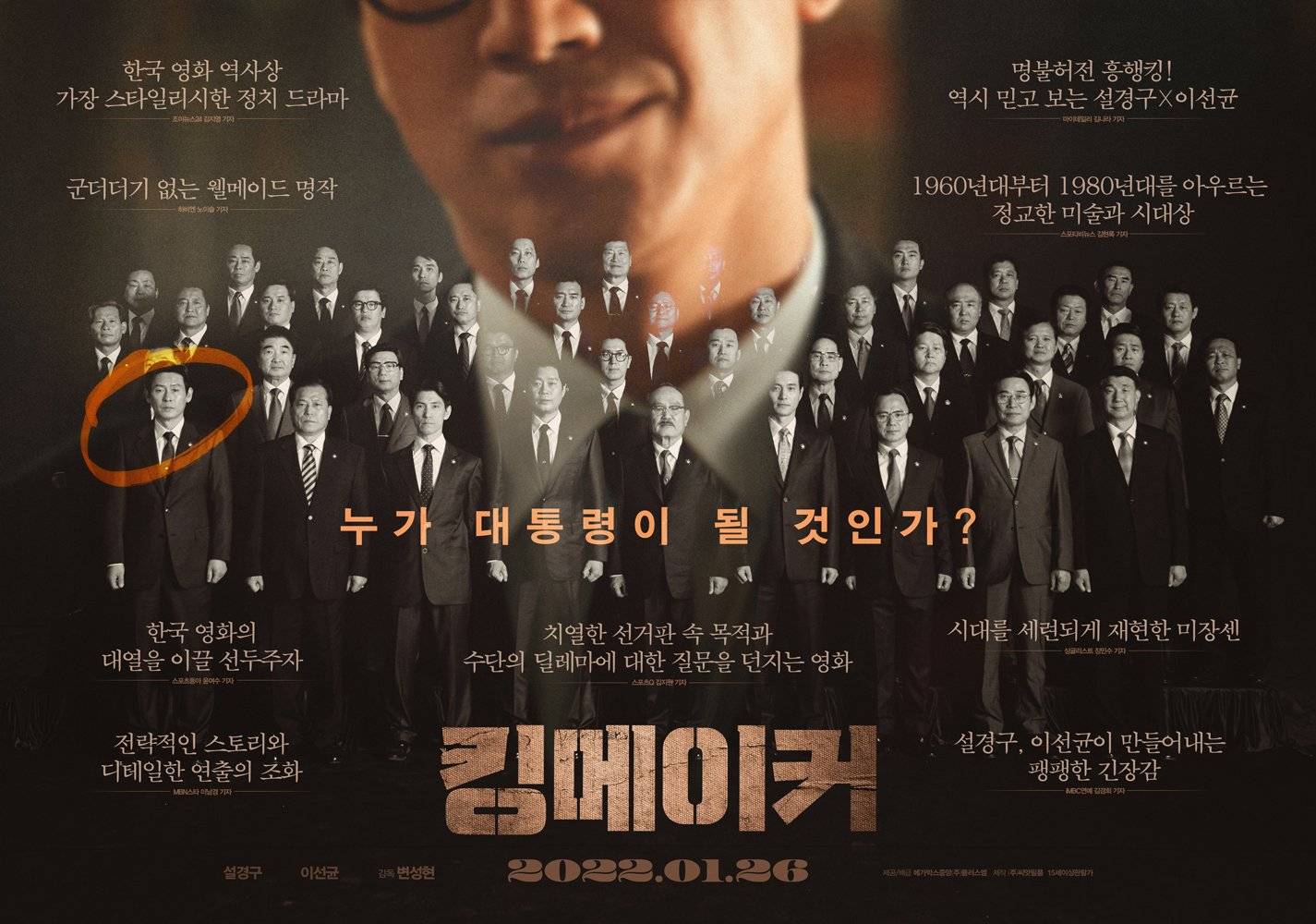
It’s the political paradox. You can’t do anything without getting elected but to get elected you might have to abandon whatever it was you wanted to do in the first place. Loosely based on the real life figures of Kim Dae-jung and his political strategist Eom Chang-rok, the heroes of Byun Sung-hyun’s Kingmaker (킹메이커) are obsessed with the question of whether the ends justify the means and if it’s possible to maintain integrity in politics when the game itself is crooked while the film suggests that in the end you will have to live with your choices and your compromises either way and if it’s a better world you want to build perhaps you can’t get there by cheating your way to paradise.

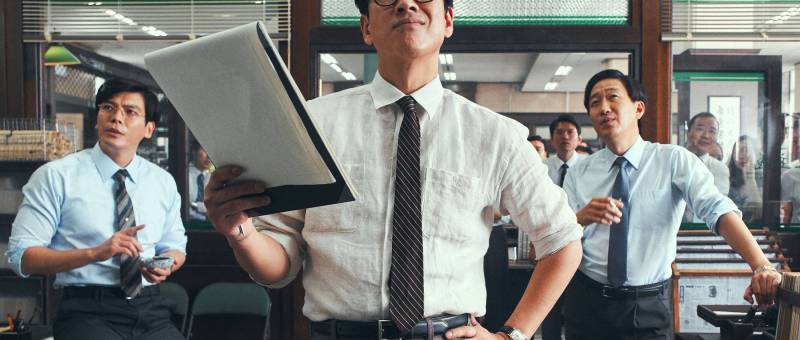
The son of a North Korean migrant, Seo Chang-dae (Lee Sun-kyun) is an embittered and frustrated pharmacist with a talent for spin. When his friend complains about a neighbour stealing his eggs from his chicken coop and denying all knowledge because he’s well connected and knows he can get away with it, Chang-dae’s advice is to plant one of his own chickens in the other guy’s coop and catch him red handed. Impressed by the impassioned political speechmaking of labour activist Kim Woon-bum (Sol Kyung-gu), he writes him a letter offering his services and then marches down to his office to convince him that he is the guy to break his losing streak and finally get him elected so they can “change the damned world”. 

The problem is that all of Chang-dae’s ideas are like the chicken scam, built on the manipulation of the truth, but you can’t deny that they work. He plays the other side, the increasingly authoritarian regime of Park Chung-hee, at their own game, getting some of their guys to dress up as the opposing party and then set about offending a bunch of farmers by being generally condescending and entitled. They stage fights and perform thuggish violence to leave the impression that Park’s guys are oppressive fascists while asking for the “gifts” the Park regime had given out to curry favour back to further infuriate potential voters. Later some of their own guys turn up with the same gifts to send the message that they’re making up for all Park’s mistakes. At one point, Chang-dae even suggests staging an attack on Woon-bum’s person to gain voter sympathy, an idea which is met with total disdain by Woon-bum and his team many of whom are at least conflicted with Chang-dae’s underhanded tactics. 

But then as he points out, if they want to create a better, freer Korea in which people can speak their minds without fear then they have to get elected first. It may be naive to assume that you can behave like this and then give it all up when finally in office, but Chang-dae at least is committed to the idea that the ends justify the means. Woon-bum meanwhile is worried that Chang-dae has lost sight of what the ends are and is solely focussed on winning at any cost. He has an opposing number in slimy intelligence agent Lee (Jo Woo-Jin) who serves Park in much the same way Chang-dae serves Woon-bum, but Chang-dae fatally misunderstands him, failing to appreciate that for Lee Park’s “revolution” is also a just cause for which he is fighting just as Chang-dae is fighting for freedom and democracy. In an uncomfortable touch, Lee seems to be coded as gay with his slightly effeminate manner and tendency towards intimate physical contact adding an additional layer to his gradual seduction of Chang-dae whose friendship with Woon-bum also has its homoerotoic qualities in its quiet intensity. 

The final dilemma lies in asking whether or not Woon-bum could have won the pivotal election of 1971, preventing Park from further altering the constitution to cement his dictatorship and eventually declaring himself president for life, if he had not parted ways with Chang-dae and tried to win more “honestly”. If so, would they have set Korea on a path towards the better world they envisaged or would they have proved little different, their integrity already compromised by everything they did to get there poisoning their vision for the future? The fact that history repeats itself, Woon-bum and his former rival Young-ho (Yoo Jae-myung) splitting the vote during the first “democratic” presidential election and allowing Chun Doo-hwan’s chosen successor to win, perhaps suggests the latter. In any case, it’s Chang-dae who has to live with his choices in having betrayed himself, as Woon-bum had feared too obsessed with winning to remember why he was playing in the first place. “All my ideas about justice were brought down by my own hand” he’s forced to admit, left only with self-loathing defeat in his supposed victory. Some things don’t change, there is intrigue in the court, but “putting ambition before integrity will get you nowhere” as Chang-dae learns to his cost. 


Kingmaker screened as part of this year’s London Korean Film Festival.

International trailer (English subtitles)
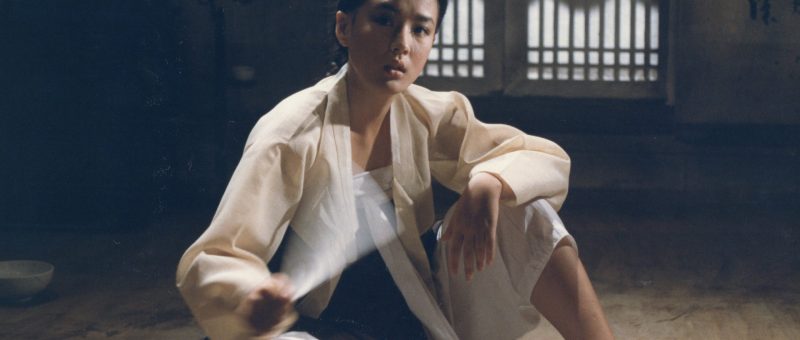
The Hill of Secrets (비밀의 언덕, Lee Ji-eun, 2022)

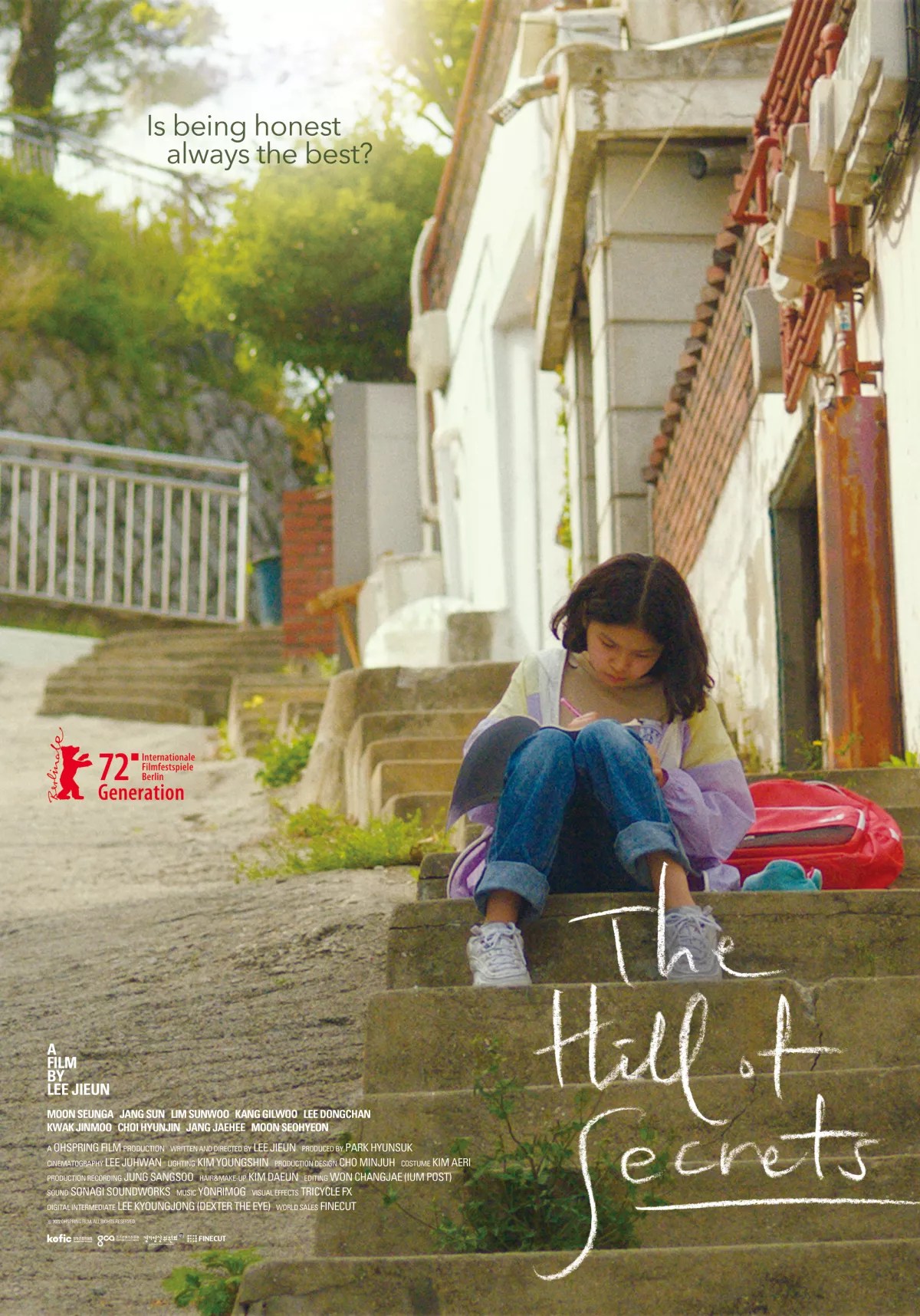
A little girl contends with the boundaries of social responsibility, the nature of the contemporary family, classism, and a deep desire to be accepted while confronted by the ambivalent “honesty” of adulthood in Lee Ji-eun’s charming coming-of-age tale, The Hill of Secrets (비밀의 언덕, Bimileui Eondeok). Set in 1996 and filled with nostalgia for simpler times, Lee’s tale of the painful lessons of adolescence is in its own way timeless as the heroine begins to reprocess her complicated relationships with her family while simultaneously preparing to step away from it. 

12-year-old Myeung-eun’s (Moon Seung-ah) problem is that she’s a bit of a snob. Surrounded by children from wealthier families at her school, she feels ashamed of her background and looks down on her working class parents whom she brands “terrible people” for their every man for himself philosophy. When her brother asks their father what their family motto is for a homework assignment, he looks confused and answers that they don’t have one, but her mother jumps in with “give nothing, take nothing” having experienced a moment of outrage when Myeung-eun wanted to donate some money to a struggling family on the television. Her father had insisted that the family is only struggling because they’re lazy and aren’t trying hard enough, reminding her that their lives are hard too but they’ve made their way through buckling down and working without complaint. Myung-eun resents his explanation in part because she thinks he’s selfish and unkind, but also finds it hypocritical in that she sees her father as lazy and irresponsible while her mother is a workaholic who only cares about money and is indifferent to the suffering of those around her. 

To demonstrate that she’s different from her family, Myung-eun has developed conservative social values with a strong aspiration to achieve conventional middle class success as symbolised by the incredibly prim dress she’s forever trying to get her mother to buy for her while she opts for something a little less particular that Myung-eun won’t grow out of too quickly. So ashamed of her family is she, that Myung-eun lies at school telling her teacher that her dad’s an office worker and her mum a housewife while making constant excuses as to why they can’t come to parents’ days. Challenged by her rival, rich kid Kyung-soo, she even goes so far as to bamboozle an executive at a nearby company into an “interview” for her “homework” taking a series of fake photographs while getting a friend’s mother to pose as her own as they cheerfully bake cookies together at home. 

Wanting to knock Kyung-soo off her perch Myung-eun runs for class president and pulls off a shock victory but soon becomes drunk on her power and driven further into a narcissistic drive for approval from her harried teacher. She sets up a secret letterbox so her classmates can make anonymous suggestions, but is actually writing them all herself sometimes using her left hand, different coloured pens, and weird handwriting to cover up her crime. When she fears her brother is about to blow her cover, she gets into a physical fight with a friend accusing her of disrespecting the office of class president, and struggles to accept herself at her new status because of her internalised shame over her class background. 

Yet confronted with the incredible cynicism of transfer student Hye-jin who matter of factly answers the teacher’s question about workers making people happy that her mum makes loads of people happy because she runs a brothel which is why Hye-jin has had to change schools so often, Myung-eun begins to reconsider her notions of honesty and deceit. Hye-jin is tired of hiding her background and really doesn’t care what anyone thinks anymore, while Myung-eun is desperate to keep up an image of conventional respectability rather than admit that her parents sell salted fish at the market. As her teacher later tells her, honesty is not necessarily the best policy and sometimes you might have to lie to protect someone’s feelings but that’s really the opposite of what Myung-eun has been doing. Her lies are all about protecting herself and told out of fear of rejection ironically because she feels rejected by her family who appear disinterested in her successes and indifferent to her feelings. 

But then as her brother tried to remind her, her mother works hard to support their family while crafting a sketchbook of the ideal home she’ll probably never be able to afford. Myung-eun decamps to stay with her mother’s step father and brother who are much more stereotypically respectable than her parents, living in a nicer flat which belonged to her grandmother and outwardly religious. But then again her uncle has the same internalised shame as she does, a failed artist working part-time in construction but putting on a suit and carrying a briefcase when he picks her up from school so that people will assume he’s a middle-class office worker. Her grandfather berates her uncle for not having a proper job while he later reveals that Myung-eun’s rmother’s resentment stems from the fact she’s been supporting both families financially even though her mother has passed away and they aren’t related by blood. Myung-eun’s father complains about his domineering wife, but as his friend points out he’d be lost without her. 

An exercise in rigorous honesty confronts Myung-eun with her true feelings surrounding her family but also with the consequences of her actions as she realises an autobiographically-themed prize-winning essay may end up hurting their feelings while she herself would not necessarily come out of it looking very good. Through her friendship with Hye-jin and her sister, Myung-eun comes to a better understanding of emotional authenticity edging away from her snooty social group who as Hye-jin points out enforce hierarchy by taking turns leaving each other out and beginning to accept herself no longer so desperately in need of external approval having understood a little of the way she fits in to her family. A gentle, nostalgic coming-of-age tale, Lee’s charming debut feature is both a mild critique of deeply ingrained classism and an empathetic contemplation of what it is that “family” really means.


The Hill of Secrets screened as part of this year’s London Korean Film Festival.

Clip (English subtitles)