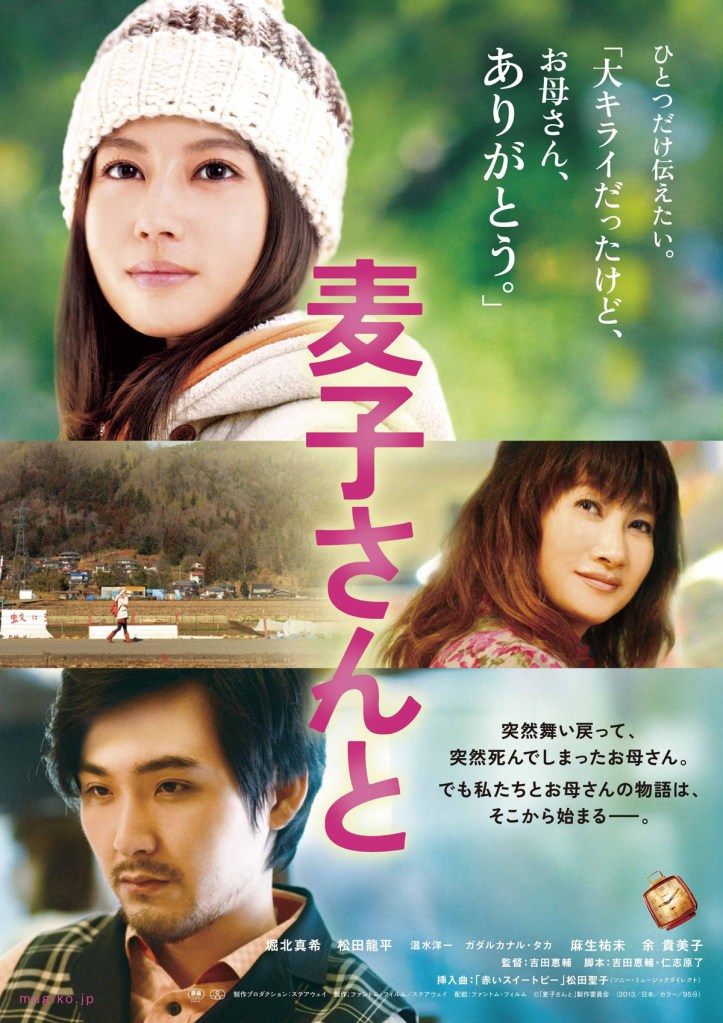
 How many times were you told as a child, someday you will understand this? There are so many things you don’t see until it’s too late, and children being as they are, are almost programmed to see things from a self directed tunnel vision. Such is the case for Mugiko – a young woman with dreams of becoming an anime voice actress who is suddenly reunited with her estranged mother of whom she has almost no memory.
Mugiko (Maki Horikita) has a part time job in a manga store and is saving money to go to voice actress school. Raised by her father who has since passed on, she lives in a small flat with her older brother Norio (Ryuhei Matsuda) who also has a low wage job in a pachinko parlour. The pair’s lives change entirely when their long absent mother, Saiko (Kimiko Yo), arrives on their doorstep one day and begs to live in with them. Norio is dead against it but eventually Mugiko is persuaded and Saiko moves in. However, right after, Norio moves out to live with his girlfriend leaving Mugiko alone with the virtual stranger who is also her mother. Mugiko has a difficult time adjusting to living with a maternal figure and harsh words follow frequent misunderstandings until Saiko suddenly dies. Mugiko then travels back to Saiko’s hometown to inter her ashes and begins to forge a connection with the mother she barely knew.
The “haha mono” or “mother movie” is a subset of Japanese melodrama which focuses on the pain and heartbreak inherent in being a mother. Making countless sacrifices, the often saintly mothers do everything they can to ensure the best for their children even if their efforts cause nothing but suffering for themselves. My Little Sweet Pea (麦子さんと, Mugiko-san to) turns the genre on its side to look at things from the point of view of one of the “ungrateful” children, Mugiko, who is filled with resentment over having been “abandoned” only to have her mother suddenly return as if expecting to forget all the years of absence with one home cooked meal.
On journeying back to her mother’s remote rural town, Mugiko begins realise they weren’t so different from each other after all. Everyone in the village is stunned by Mugiko’s appearance which turns out to be the spitting image of her mother at around the same age. Saiko had also been something of a local celebrity thanks to her beauty, charm and popular presence. She left the town for the city with dreams of becoming a famous singer just like Seiko Matsuda and her rendition of the singer’s famous song Akai Sweet Pea is fondly remembered by the older generation.
Saiko’s dreams of hitting it big in the music business were never fulfilled though we know almost nothing about what happened to her between the end of her marriage and reappearance in her children’s lives save that she obviously had enough financial security to be able to send them money every month. Through meeting her mother’s old friends (and more than a few admirers), Mugiko comes to see something of herself in the distant figure of her mother as a young woman. Even if she couldn’t be there for reasons which are never fully explained, it wasn’t because she didn’t want to be or because she’d forgotten about or rejected her children, she suffered everyday thinking of and missing them and was tragically unable to rebuild that connection even at the very end.
Mugiko has been a little unsettled in her life, floating from one dream to the next and who really knows if voice acting is really the thing that she was meant to do. Saiko may have been more certain in her objective but whatever happened later it seems she found fulfilment in being a mother even if her dream of becoming a singer didn’t work out. Having been able to meet her mother even if vicariously, Mugiko is able to understand something about herself and perhaps repair a relationship that never quite took place. Striding out boldly with her mother in spirit beside her, Mugiko is finally able to step into the adult world and everything that is waiting out there for her with a new found confidence that comes with embracing the beauty of a distant scar.
Trailer (with English subtitles)
and here is the hit song from Seiko Matsuda – Akai Sweet Pea (1982)
 It’s often posited that Japan rarely produces “science fiction” literature or movies and some say that’s because, well, they already live there. However, this isn’t quite true, there are just as many science fiction themed projects to be found in Japan as elsewhere you just have to look a little harder to find them. Depending on your point view, if you succeed in tracking down a copy of Cosmic Rescue -The moonlight generations- (コスミック・レスキュー ザ・ムーンライト・ジェネレーションズ), you may feel the quest was not entirely worth the effort.
 Windows on Worlds