 Koji Wakamtasu had a long and somewhat strange career, untimely ended by his death in a road traffic accident at the age of 76 with projects still in the pipeline destined never to be finished. 2008’s United Red Army (実録・連合赤軍 あさま山荘への道程, Jitsuroku Rengosekigun Asama-Sanso e no Michi) was far from his final film either in conception or actuality, but it does serve as a fitting epitaph for his oeuvre in its unflinching determination to tell the sad story of Japan’s leftist protest movement. Having been a member of the movement himself (though the extent to which he participated directly is unclear), Wakamatsu was perfectly placed to offer a subjective view of the scene, why and how it developed as it did and took the route it went on to take. This is not a story of revolution frustrated by the inevitability of defeat, there is no romance here – only the tragedy of young lives cut short by a war every bit as pointless as the one which they claimed to be in protest of. Young men and women who only wanted to create a better, fairer world found themselves indoctrinated into a fundamentalist political cult, misused by power hungry ideologues whose sole aims amounted to a war on their own souls, and finally martyred in an ongoing campaign of senseless death and violence.
Dividing the narrative into three distinct acts, Wakamatsu begins with a lengthy history lesson starting right back in 1960 with the birth of the student movement and the first casualty of the unborn revolution as a young woman loses her life protesting the rise of tuition fees. Despite the lack of success, the student movement intensifies during the turbulent 1960s with the renewal of the ANPO treaties and the perceived complicity of the Japanese government with America’s anti-communist warfare in Asia. Mixing archive footage with reconstructions and on screen text detailing timelines, names and affiliations these early segments are hard to follow but bear out the complexity and chaos which contributed to the inefficacy of the student movement. Soon, each of the leaders we have been introduced to has been removed from the scene leaving the older but inexperienced Tsuneo Mori (Go Jibiki) in charge of what was then the Red Army Faction.
Mori had only recently rejoined the movement after leaving in disgrace at fleeing a protest and thereby evading arrest. The Red Army Faction then merges with another sect, the Revolutionary Left Wing (RLF), to form the United Red Army. Led by Mori and a female commander, Nagata (Akie Namiki), the United Red Army holes up in a cabin in the woods in order to undergo military training for the upcoming armed insurrection. Prior to this, there had been a series of purges and executions in the city producing an atmosphere of terror and paranoia which only intensifies in the incestuous and claustrophobic environment of the ascetic mountain retreat.
Out of his depth and eager to prove himself, Mori’s revolutionary consciousness developes into a dangerous cult of personality in which his iron rule is more akin to fundamentalist religion than a serious political movement intended to change the world for the better. Wakamatsu’s depiction of these events is as terrifying as it is absurd. Maoist doctrine becomes a holy scripture as each of these would be revolutionaries is forced to undergo self criticism in order to devote themselves fully to the revolution and become a “true communist”. Brainwashed and naive, the cadre comply seeming not to realise that no self criticism they can offer will ever be good enough for Mori’s constant need for identity erasure and that each fault they offer will only be used to form the basis of the next charge levelled against them. What begins as questioning develops into screaming before descending into bloody violence and eventually murder.
If Mori’s fault is a kind of madness born of fear and insecurity, it is Nagata whose mania takes on an almost gleeful quality. A plain woman with unremarkable features and a sharp personality, Nagata, as she’s portrayed in the film, displays extreme issues relating to femininity. When an idealistic young woman arrives dressed in typical city fashions necessary to blend in with the capitalist bourgeoisie, Nagata wastes no time in berating her for her stylish clothes and makeup. Threatened both by the woman’s conventional beauty and high ranking position in another faction, Nagata takes especial care to make sure she herself remains on top. Despite being in a relationship with one cadre member and later leaving him for Mori (because it’s “right from the communist perspective”), Nagata cannot bear any hint of sexual activity and it is an ill judged kiss which ends up leading to the first set of mercilessly violent self criticism sessions eventually resulting in death as both parties are beaten and then tied up in the freezing mountain air where death by exposure is all but inevitable.
Mori declares that “leadership means beating” but when this is no longer enough the death sentences come thick and fast. Eventually, some members manage to escape and the mountain hideout is discovered. Splitting up and heading on the run, Mori and Nagata are captured while a group of five break into a mountain lodge where they take the caretaker’s wife hostage and remain under siege for nine days until the police eventually break in, arrest the terrorists and rescue the woman all of which became the first such event to be live broadcast on Japanese TV. The Asama-Sanso incident, as it came to be known, sealed the fate of the left wing protest movement in Japan as the terrorist violence of the renegade protestors forever coloured public perception.
Wakamatsu does not end his story here – returning to the captions which opened the film, he reveals to us the legacy of the failed student protest movement in the overseas activities of the Japanese Red Army, most notably in North Korea and the Middle East. The protest movement in Japan resulted in abject failure – the ANPO treaty survives, the Sanrizuka villages were destroyed and an airport built, the capitalist future arrived at speed heading into the bubble economy where the only revolution was consumerism. The glorious future of which these young people dreamed, free of class, gender, and social inequality, would not materialise as their idealism devolved into introspective dogmatic rhetoric, violence and murder. Trapped inside a fundamentalist cult, the true tragedy is that this was a children’s revolution – the vast majority of its victims under 25 years old, one just 16 and forced to participate in the death of his own brother. How much good could each of these socially conscious young people have gone on to do if only they’d found a less destructive cause? Would anyone want to live in the world born of this revolution? Contrasting the joyous camaraderie of the peaceful protests with the escalating, internecine violence of the URA, Wakamatsu’s vision of the movement he was once a part of is a necessarily bleak one but resolute in its gaze. Ugly, cold and unforgiving United Red Army is a warning from history which has only sympathy for those caught up in its terrible machinations.
Original trailer (English subtitles)
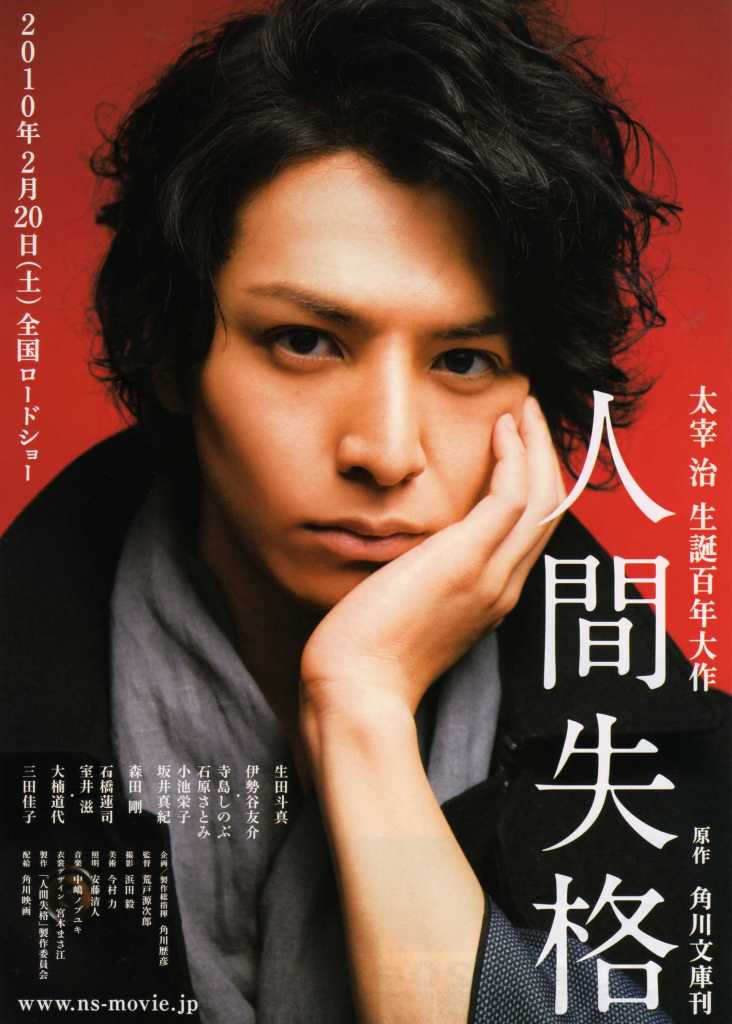 The Fallen Angel (人間失格, Ningen Shikkaku), based on one of the best known works of Japanese literary giant Osamu Dazai – No Longer Human, was the last in a series of commemorative film projects marking the 100th anniversary of the author’s birth in 2009. Like much of Dazai’s work, No Longer Human is semi-autobiographical, fixated on the idea of suicide, and charts the course of its protagonist as he becomes hopelessly lost in a life of dissipation, alcohol, drugs, and overwhelming depression.
 Those golden last few summers of high school have provided ample material for countless nostalgia filled Japanese comedies and 700 Days of Battle: Us vs. the Police (ぼくたちと駐在さんの700日戦争, Bokutachi to Chuzai-san no 700 Nichi Senso) is no exception. Set in a small rural town in 1979, this is an innocent story of bored teenagers letting off steam in an age before mass communications ruined everyone’s fun.
 Windows on Worlds