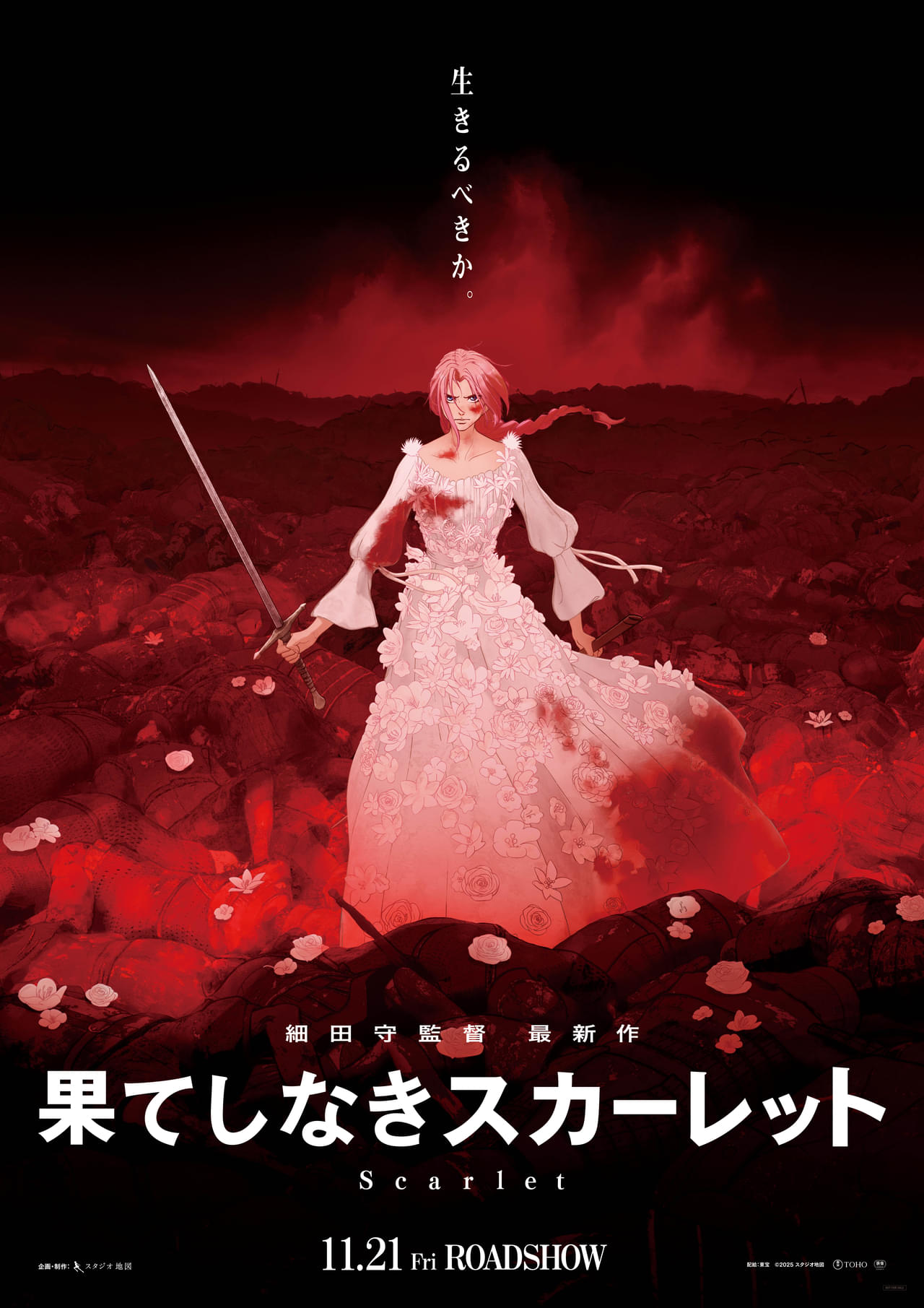
A gender-flipped take on Hamlet, Mamoru Hosoda’s latest feature animation Scarlet (果てしなきスカーレット, Hateshinaki Scarlet) seems to be a rebuttal of contemporary isolationist politics and authoritarian governments. His Otherworld is peopled by those from all places and times who, for the main part, co-exist peacefully aside from the odd marauding bandit. Even if there’s suspicion and division, people are also kind and try to help others. The recent arrivals from the world of Elsinore, however, are not really like that and are seeking to bring their particular brand of fascistic, war-wondering authoritarianism all the way to heaven itself.
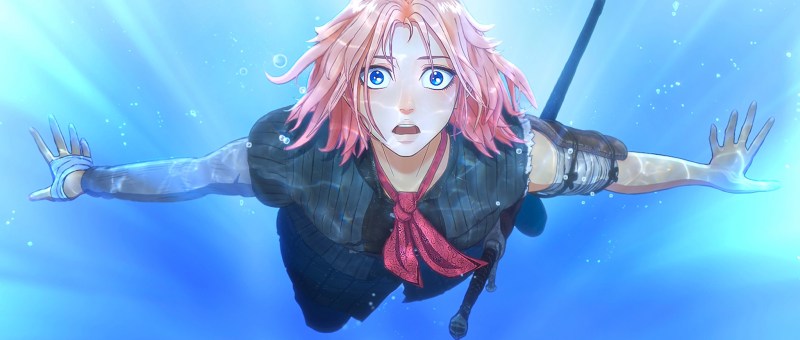
In this version of the tale, Scarlet (voiced by Mana Ashida) unwittingly takes the cursed drink while dithering over killing her uncle, Claudius (Koji Yakusho), who has usurped the throne and married her uncaring mother Gertrude (Yuki Saito) who has a little of Lady Macbeth about her and switches allegiance to Amleth’s brother because she only cares about power. Amleth (Masachika Ichimura) had wanted to stop a potential war and build better relationships with neighbouring nations, while Claudius is hellbent on conquest and domination. Amleth is well aware that it’s the people who will suffer, and his subjects are very much not on Claudius’ side, protesting loudly at Amleth’s public execution. Having failed in her revenge and been resurrected in the Otherworld, Scarlet eventually discovers her father’s final word was “forgive,” only she doesn’t quite know what he meant by that and is conflicted in her quest for revenge while certain that she cannot let Claudius get away with his authoritarian coup.
On her travels, she meets a man from contemporary Japan. Hijiri (Masaki Okada) is a paramedic who insists he’s not really dead and must be here by mistake. He represents human kindness as a healer, though his ability to ride a horse and proficiency with bows and arrows is rather surprising. Coming from a world that’s not at peace, but not quite as unsettled as 16th-century Elsinore either, he begins to convince Scarlet that another world might be possible. If only she had inherited the throne, she might have proved most royal and created a better environment where her subjects were free to live happily without the threat of war or oppression, where those from other nations were thought of as friends rather than as enemies. Hosoda is clearly targeting a Japan which has slid to the right, becoming increasingly intolerant of residents from other parts of the world while far-right parties with fringe views make worrying gains in elections.
Nevertheless, he paints contemporary Japan in softer tones that the Otherworld. Though Hijiri may have become a victim of the latent violence in society while trying to protect others, it’s this world that becomes Scarlet’s benchmark for what a better society could be as she watches another version of herself dance joyfully at a street party with Hijiri. She begins to wonder what sort of person she could be if she weren’t so obsessed with revenge. While contemporary Japan is animated in a style familiar from Hosoda’s previous work, the hyperrealistic backgrounds of the Otherworld lend it a stark and frightening quality that simultaneously recalls the painted matte backdrops of classic anime. Whenever violence is about to occur, a giant dragon appears in the sky and roars, raining lightning on the world below as if issuing divine punishment for this basic moral transgression and turning the sky a blood-red scarlet.
In any case, Scarlet later reaches the conclusion that what her father intended was that she forgive herself, give up on revenge, and live her own life to its fullest. She may not be able to find it within herself to forgive Claudius, or her mother who never joins him in the Otherworld as he assumed she would, but it’s no longer her concern because her duty is to protect her people, so the only thing that matters is deposing him. Claudius and his goons had tried to block off the path to the Infinite Land so that only they, well really just Claudius and Getrude, could enter heaven leaving the ordinary people starving and miserable below. This is really Scarlet’s revenge. Creating a world without war where her subjects are able to lead happy, peaceful lives with no need to fear those from outside nor their own governments.
Trailer (English subtitles)

 Windows on Worlds