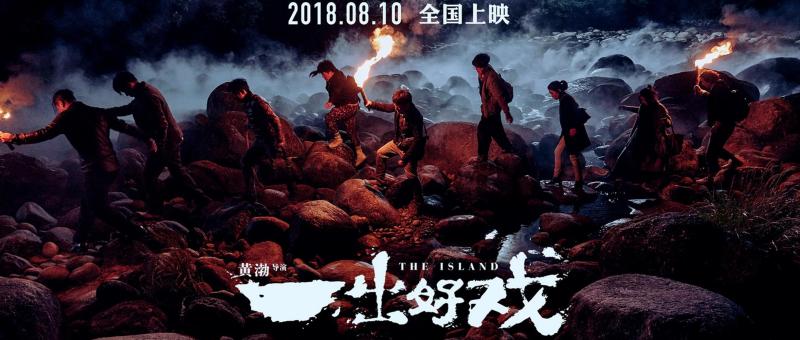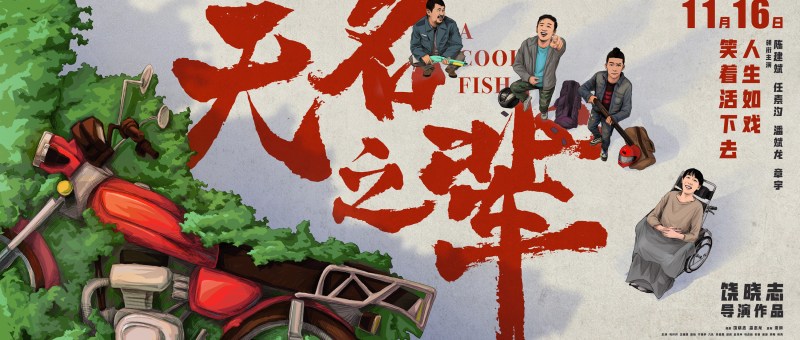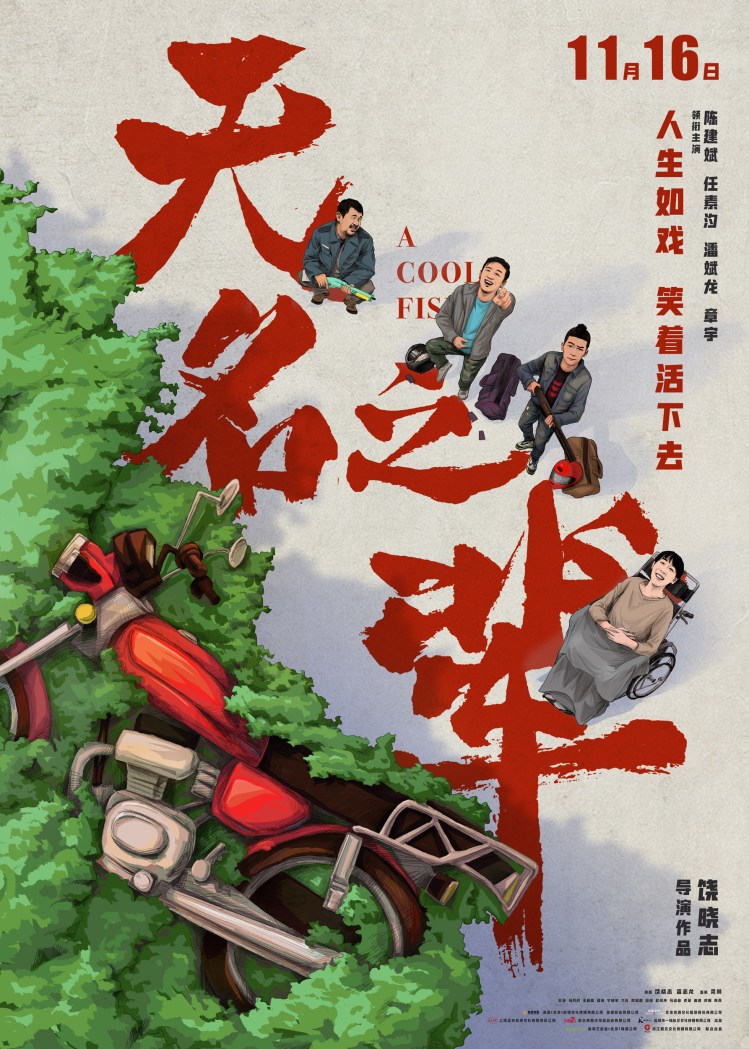
A Cool Fish (无名之辈, Rao Xiaozhi, 2018)

A Cool Fish posterThe genial loser is fast becoming a staple of contemporary Chinese cinema. Rao Xiaozhi’s second feature A Cool Fish (无名之辈, Wúmíng zhī Bèi) is the latest in a long line of comedies to make the “diaosi” world its home as a collection of disappointed and increasingly desperate failures become embroiled in a complex web of cosmological coincidence. China’s famously draconian censorship regulations ensure that the ending of this caper will be bittersweet at best, but even so a brief brush with violent crime does at least allow a bouncing back if only through hitting rock bottom and emerging with greater clarity.

Small town hicks “Bra” (Zhang Yu), short for “Cobra”, and Big Head (Pan Binlong) have talked themselves into a gangland future, planning a big city heist after getting their hands on a stolen gun and motorbike. Unfortunately, not everything goes to plan and they end up robbing a mobile phone shop next door to the bank rather than the bank itself because the security guard was too intimidating. Not only that, they manage to send their getaway bike into a tree while trying to escape by muddling the clutch with the accelerator meaning they have to escape on foot. Crawling in through an open window, they find themselves in the home of the spiky Jiaqi (Ren Suxi) who is paralysed from the neck down and completely unafraid to make use of her one remaining weapon – an extremely loud and imperious voice. Jiaqi is also the sister of widowed security guard Ma Xianyong (Chen Jianbin) who was once an auxiliary police officer and harbours a desire to get back on the force which he feels he could fulfil through investigating the robbery and retrieving the gun on his own initiative. Meanwhile, Xianyong’s boss, financially troubled property developer with a complicated family set up Gao Ming (Wang Yanhui), is on the run from gangsters to whom he has massive debts.

Like the cool fish of the title, Bra and Big Head are young men with impossible futures who find themselves cast out from mainstream society with no real way back in. No education, no connections, no job prospects or family – their futures look bleak. Bra sees himself as a gang boss in waiting even if Big Head is his only henchman, but the guys are no master criminals and despite their claims of working their way up in the crime world it’s clear they aren’t cut out for such cutthroat antics. Xianyong, by contrast, had opportunities but squandered them and then lost everything in a tragic turn of events for which he must bear some of the responsibility. Despised by his teenage daughter, humiliated by the gangsters chasing Gao Ming, and burdened by the guilt of having caused the accident that ruined his sister’s life, all Xianyong wants is to hit back and prove himself a someone, which means he’s coming for another pair of losers not so different from himself.

Rao Xiaozhi rolls the familial in with the political through rooting all of Xianyong’s various problems in his very male failures as a compromised father figure. Having lost his wife in a tragedy of his own making, Xianyong is resented by his daughter who has reverted to her mother’s maiden name out of shame while he engages in underhanded scams to bolster his fragile sense of self worth. Meanwhile, all Big Head dreams of is a small house in his hometown and to marry his childhood sweetheart, Xia (Ma Yinyin), who has come to the city in search of money. Big Head thinks she doesn’t want to marry him because he isn’t rich, but Xia’s reluctance turns out to be misplaced shame in having engaged in sex work and no longer seeing herself as good enough for the small town wholesomeness of a man like Big Head, never guessing he might go to such extreme lengths just to prove himself worthy of her.

Trapped by the crushing impossibility of life in a rapidly developing, relentlessly unfair, patriarchal, and conservative society each of our heroes takes desperate measures to enact their escape but quickly discovers that escape is a spiritual more than material matter and cannot be bought through transgression. This being China, crime cannot pay and so our guys cannot hope to emerge heroically from their less than heroic foray into gun toting criminality but even so you’d have to admit that their futures are brighter for having hit rock bottom and woken up with a better sense of self and a degree of forward motion. Rao’s ramshackle world of lovelorn little guys daring to dream of a (modestly) brighter future perfectly captures the bleak romanticism of the “diaosi” phenomenon and proves strangely difficult to resist save for its crushingly “necessary” finale.


Currently on limited release in UK Cinemas courtesy of China Lion.

International trailer (English subtitles)

Dead Souls (死靈魂, Wang Bing, 2018)

Dead Souls posterFor his eight hour exploration of China’s painful past, Wang Bing borrows a title from Gogol’s famous 19th century Russian novel which aimed to poke fun at the various flaws in contemporary cultural norms. “Dead Souls” (死靈魂, Sǐ Línghún), in Gogol’s case, referred to serfs which had passed on but were still included in a landlord’s register of property and therefore liable for taxation (the novel’s protagonist, a corrupt former civil servant, is keen to “buy” these “virtual” serfs as part of a mysterious money making scam). Wang Bing’s aims are about as far from comic as it’s possible to be, but he too is intent on unmasking national hypocrisy in ensuring the testimonies of the hundreds of men and women who survived Mao’s “Anti-Rightest Movement” of the late 1950s are finally heard. The alleged rightists became “dead souls” in more ways than one – having lost their party affiliation they no longer quite existed in the intensely conformist post-revolutionary world where they found themselves betrayed and abandoned by an increasingly oppressive regime that eventually robbed them of their humanity.

In 1956, the Communist Party had announced the Hundred Flowers campaign in which ordinary people were encouraged to voice their innermost thoughts about the state of the revolution. After a short lived period of liberalism, the Hundred Flowers campaign was exposed as a ruse to root out so called reactionary elements. The Anti-Rightist Movement which began in 1957 rounded up those who had offered up constructive criticism of the party as well as capitalists, intellectuals, and just about anyone with a vaguely questionable history, and packed them off for “re-education” at various labour camps throughout China.

Mostly offered through lengthy direct to camera monologues, Wang presents a first hand account of the Jiabiangou Labor Camp from those who managed to survive (around 500 of 3200 internees) after famine and disease took hold. Many of the alleged “rightists”, most “rehabilitated” after the Cultural Revolution and subsequent economic reforms, affirm that they have no idea what it is they did “wrong” but are convinced that it was petty jealousies and personal resentments that landed them in hot water rather than a political dispute. Many found themselves at the mercy of an official they’d already reported for incompetence or corruption, disappeared for reasons of expediency or convenience. Others were told that their re-education was for the public good and they’d be back in a matter of months in their old job with their old salary, or else their family could come live with them on the utopian farm that would arise from their efforts in the camp.

Of course, the reality was very different and the harrowing stories recounted by the now elderly men with a mix of retrospective black humour and deeply held resentment speak of death on a mass scale, starvation, walking corpses, and rampant disease. With famine intensified by the failure of the Great Leap Forward, food supplies grew increasingly short while numbers of “rightists” in need of re-education only increased thanks to a kind of quota system. Those most likely to survive were the ones who made themselves the most useful – the physically strong, the tenders of horses, and the kitchen staff who could survive by pinching food when no one was looking. One strangely gleeful old man calmly recounts how he finagled his way into the kitchen and then set about pilfering the best of the supplies for himself with the help of the other cooks (seemingly without remorse), while another man recounts spotting a similar practice and taking the greedy to task by reminding them that the food they were scoffing came out of someone else’s mouth. Those who survived did so either because their families were able to smuggle in food for them, or else they were lucky.

Breaking away from the rigorous, sometimes oppressive interviews, Wang wanders the grounds of the former camps now levelled in an attempt to erase their existence but still painfully visible in the arid, scarred landscape. Bones litter surface as if squeezed out of the earth while human skulls rest eerily in the middle of barren land. A group of survivors attempts to identify remains through stones placed atop the bodies of those who died when those left behind still had the strength to bury them, but fail to read the faded names while their attempt to erect a monument to those who lost their lives to a malicious failure of government ends with only more destruction. What they were not permitted to do Wang accomplishes if intangibly in creating an indelible monument to human suffering through the first hand testimony of a persecuted generation finally able to break the long decades of silence and give voice to a truth still so painfully hidden.


Short clip from the beginning of the film (English subtitles)

Bitter Money (苦钱, Wang Bing, 2016)

Bitter money poster“Bitter Money” (苦钱, Kǔ Qián), according to director Wang Bing, is a phrase on the rise. It may be that money is rarely sweet, but this kind is particularly hard to swallow. Not only is the youth of China thrown out of its villages towards the inferno of city industry, living alone and away from home, but finds nothing more than exploitation, drudgery and false promise when it gets there. Wang’s trademark immersive detachment captures the frustrating inertia of the young men and women of the modern China who find themselves very definitely at the bottom of a heap and consistently betrayed by a failed ideology.

Wang opens in the country with a trio of hopeful youngsters about to leave everything behind for the bright promise of a better life for themselves and their families bought with city money. They board a bus, and then a train, and then interminable hours later arrive in Huzhou, the centre of the modern garment trade. The girls find work in a small workshop which, all things considered, might not seem so bad save that it provides only extremely low pay and offers no guarantees.

Shifting away from the recent arrivals, Wang’s camera locks onto the melancholy figure of 25-year-old Ling Ling who wants to borrow it as ally in confronting her coldhearted husband who threw her out after she complained about his beatings and is now so resentful that she’s stayed away too long that he refuses to talk to her. Ling Ling’s attitude to her unhappy marriage speaks volumes about the oppressive, patriarchal world of Huzhou where physical strength and dexterity are the only real currencies.

Lamenting her fate to coworker, Ling Ling affirms that domestic violence is just a part of life and believes that women have a duty to “submit” to their husbands’ rages – after all, “no woman can beat a man”. Her husband, Erzi, is proud and insecure. He views his wife’s behaviour as a slight against him and is resolved to be rid of her, loudly threatening her life in front of half the neighbourhood guys each of whom gets up and abandons their mahjong game after sensing that something is about to kick off. Despite the disdain with which the other men treat his overt violence towards his wife, Erzi is convinced his “manly” behaviour is impressive and thinks nothing of grabbing his wife by the throat in full view of Wang’s camera which remains a purely passive presence despite this ongoing threat.

Ling Ling, however, has few real choices left to her. She can’t survive alone in this environment and has nowhere else to go. In a pattern repeated across the nation, Ling Ling’s son is being raised in the country while she and her husband try to make a go of things in the city. Her major argument with Erzi is that he kicked her out with no money and won’t even give her anything for their son. Yet a later scene shows them together again, seemingly “happier” even whilst they to continue to bicker about money if in a less obviously destructive way.

Most of the other workers are not quite as trapped as Ling Ling, but are caught by a feeling of threat and desperation which encourages them to push themselves beyond the limits of human endurance while their bosses reap the profits. One minute the garment workshop is in the hole because they backed a product which isn’t selling, and the next it’s doing so well that the “slow” workers are being laid off in favour of the more “efficient”. It goes without saying that work in these small workshops is almost entirely unregulated with very few enforceable labour rights which means the boss is free to hire and fire as he sees fit. Some consider “investing” in pyramid schemes despite an awareness of their risks in the belief that they could beat the system if they get out fast enough while others resolve to give up and go home to the comparative comforts of the country.

One worker retreats into drink, only for his boss to tell him he’s holding back his wages for his own good which seems like a dubious claim at best. The workers regard the “big factories” with fear and awe, enemies of their current establishments but perhaps also offering better opportunities if also requiring a further fall into the industrial inferno. With little else on offer, “bitter money” is all there seems to be but its rewards are scant and its toll heavy. The teenage girl we first meet full of excitement and enthusiasm is eventually worn down, realising she’s worked all these months and earned barely anything. Wang’s detachment mirrors that of his protagonists who find themselves at the mercy of a cruel and indifferent social system the ongoing violence of which it proves almost impossible to escape.


Grain in Ear (芒种 / 망종, Zhang Lu, 2005)

Grain in Ear posterChinese-Korean director Zhang Lu has made a career of exploring the lives of those living on the margins of modern China and most particularly those of the ethnic Korean minority. 2005’s Grain in Ear (芒种, Máng zhòng, 망종, Mang Jong) brings this theme to the fore through the struggles of its stoic heroine who bears all her troubles with quiet fortitude until the weight of her despair threatens an already fragile sense of civility, consistently eroded by multiple betrayals, misuses, and an unforgettable othering. Yet she is not entirely alone in her outsider status even if there is precious little value in solidarity among the powerless in a world of circular oppressions.

32-year-old Cui Shun-ji (Liu Lianji) has moved to a small town with her young son Chang-ho (Jin Bo) following her husband’s conviction of a violent crime. Unable to find work, she ekes out a living illegally selling kimchi from a cart without a permit while Chang-ho busies himself playing with the neighbourhood kids in the rundown industrial town. Isolated not only as a newcomer but as a member of the ethnic Korean minority, Shun-ji keeps herself to herself but can’t help attracting the attentions of the locals some of whom are merely curious about her spicy side dishes while others are intent on helping themselves to things which aren’t actually on sale.

There is something peculiarly perverse about Shun-Ji’s decision to make her living selling kimchi. It is both an act of frustrated patriotism and a kind of commodification of her ethnicity though she seems to have intense pride in her ability to produce her national dish even if there is not often as much calling for it as she would like. Meanwhile, at home, Shun-ji virtually tortures little Chang-ho into trying to learn the Korean alphabet as a way of fastening him closely to his heritage and community, but Chang-ho is a Chinese boy to all intents and purposes. He may understand Korean, but he doesn’t want or need to speak it and resents his mother’s attempts to reinforce his Koreanness.

Meanwhile, despite her aloofness, Shun-ji eventually forms a kind of relationship with a lonely Korean-Chinese man, Mr. Kim (Zhu Guangxuan), who visits her cart. Brought together by a shared sense of loneliness and a connection born only of a mutual ethnicity, the pair drift into an affair but Shun-ji’s dreams of romantic rescue will be short lived. Her lover is a weak willed man married to a feisty Chinese woman who will stop at nothing to recapture her henpecked husband. Cornered, Kim tells his wife it’s not “an affair” because money changed hands, branding Shun-ji a prostitute and getting her arrested by the police to prove his point.

To be fair, Shun-ji’s married lover is another oppressed minority afraid of the consequences of non-compliance, but he’s also just one of the terrible men that Shun-ji will encounter in her quest towards independence and self sufficiency. Her husband killed a man for money and left his family to fend for themselves when he went to prison for it. Her lover called her a whore and left her at the mercy of the police. A man who offered to help with a lucrative kimchi contract turned out to be after another kind of spice, and the kindly policeman who stopped by her cart with tales of his impending marriage turned out not to be so nice after all.

In this fiercely patriarchal world, women like Shun-ji have no one to rely upon but each other. Marginalised by poverty, ethnicity, and unfamiliarity, Shun-ji and Chang-ho live in a small shack behind the railway next to the local sex workers. Chang-ho, too small to understand why everyone calls the women next-door “chickens”, treats them all like big sisters while a kind of solidarity emerges between Shun-ji and the melancholy youngsters from far away towns who’ve travelled to this remote place to ply their trade out of desperation, too ashamed to stay any closer to home. One of the sex workers tries to warn Shun-ji about Kim – men who buy their services are not especially good romantic material, but it’s advice that falls on deaf ears. Shun-ji wants to believe better of her compatriot, but her faith is not repaid.

Zhang, in a familiar motif, foregrounds Li Bai’s famous ode to homesickness, giving it additional weight in the mouth of little Chang-ho whose longing is for another kind of home in contrast to his mother’s continued need to believe in the solidarity of her community. Yet even she eventually loses faith, tearing up Chang-ho’s Hangul cards and finally allowing him to give up on his Koreanness. Having endured so much, Shun-Li’s broken spirit eventually leads her towards an inevitable explosion and a grim, strangely poetic revenge against the society which has so badly wronged her. Only in this final moment of transgression does Shun-ji begin to harvest her own freedom, but escape is still a long way off and her final act of defiance may only further condemn her in world of constant oppressions.


Grain in Ear was screened as part of the 2018 London Korean Film Festival.

Original trailer (Mandarin and Korean with Korean subtitles only)

The Great Buddha+ (大佛普拉斯, Huang Hsin-yao, 2017)

Great Buddha + posterFor some, the good life always seems a little out of reach, as if they showed up late to the great buffet of life and now all that’s left is a few soggy pastries and the salad someone’s aunt brings every year that no one really likes. Still, even if you know this is all there is, it doesn’t have to be so bad so long as you have good friends and something to do every day. The “heroes” of documentarian Huang Hsin-yao’s fiction feature debut The Great Buddha+ (大佛普拉斯, Dà fó pǔ lā sī) are exactly this sort – men in late middle age who’ve never quite grown up but have eased into a perpetual boyhood safe in the knowledge that there’s nowhere left for them to grow up to.

“Pickle” (Cres Chuang) is something of a holy fool. His major preoccupation in life is his elderly mother whose increasing medical bills he is continually worrying about paying. He’s taken to banging a drum in a local marching band with a big line in funerals for extra money at which he is terrible but seeing as there’s no one else his job is probably safe for the minute. His “occupation” is nightwatchman at a factory owned by “Kevin” (Leon Dai) – a renowned sculptor working on a giant Buddha statue. Nothing ever happens at the factory at night so no one is very bothered what Pickle does there, which is mostly being “entertained” by his “best friend” Belly Button (Bamboo Chen). Belly Button doesn’t really have a job but earns money through collecting recyclables and selling them on. Looking for a new source of vicarious fun, Belly Button talks Pickle into stealing the SD card from the dash cam on Kevin’s fancy car so they can enjoy riding along with him in their very own private sim. This turns out to be more fun than expected because Kevin is also a womaniser with a thing for car sex even if the cam only captures the audio of his exploits. Nevertheless, the guys inevitably end up seeing something they shouldn’t.

Huang shoots in black and white but switches to vibrant colour for the dash cam footage, somehow implying that nothing is quite so real to guys like Pickle and Belly Button as a fantasy vision of someone else’s glamorous life. After all, if it’s not online it didn’t really happen. Trapped in the gutter of small town life, both men have either failed to move on from or wilfully regressed into a perpetual adolescence in which they waste their days idly on pointless pursuits – leafing through ancient porn mags, gossiping, and eating half frozen curries from half-filled Tupperware boxes. A mild mannered man, Pickle is so innocent that he never quite understands Belly Button’s lewd jokes while Belly Button, who is picked on and belittled by everyone else in town, takes delight in being able to boss him around.

Together the pair of them can only marvel at a man like Kevin with his wealth and talent which allows him to gain the thing they want the most – female company. Kevin, however, is not quite as marvellous as they might assume him to be even if they remain in awe of his caddish treatment of women while perhaps feeling sorry for those unfortunate enough to fall in love with him. In tight with the local bigwigs, Kevin is simply one link in a long chain of bureaucratic corruption in which business is done in the bathhouse surrounded by floozies. Kevin never explicitly lets on whether he knows that Pickle and Belly Button have stumbled on his secret, but their lives begin to change all the same. Their easy nights in the security cabin have gone for good and they feel themselves under threat in a chilling reminder of how easily a little guy can disappear or fall victim to an accident after asking too many questions about a vain and powerful man with money.

Meanwhile, Pickle is left worrying what’ll happen to his mum if he falls out with Kevin. Even if he wanted to speak out about a great injustice, he’d be putting his mother in the firing line. Then again, after a brief visit to Belly Button’s home in which he cocoons himself inside a mini UFO filled with the prizes he’s won from UFO grabber games (he says it’s like “therapy”), Pickle is forced to wonder how well he even knew him – his only friend. As Huang puts it in his melancholy voice over, we might have put men on the moon, but we’ll never be able to explore the universe of other peoples’ hearts.

Huang’s deadpan commentary is among the film’s strongest assets with its New Wave associations and determination to wring wry humour out of the increasingly hopeless world inhabited by Pickle, Belly Button, and their similarly disenfranchised friends. Filled with meta humour and a deep sadness masked by resignation to the futility of life, The Great Buddha+ is a beautifully lensed lament for the little guy just trying to survive in a land of hollow Buddhas and venial charlatans.


Screened as part of the 2018 London East Asia Film Festival.

Original trailer (English subtitles)

Father to Son (范保德, Hsiao Ya-Chuan, 2018)

Father to Son posterEvery son kills his father, but echoes of the past prove hard to escape in Hsiao Ya-Chuan’s Father to Son (范保德, Van Pao-te). Legacies national and personal conspire to frustrate the dreams of the young while the old are left with nothing more than enduring mystery after a lifetime of disappointment. Faint notions of mortality send an old man on a quest to understand himself by making peace with his long absent father and taking his own son along for the ride, but perhaps there really are no answers to the questions you most want to ask, or to put it another way perhaps it’s better to answer them yourself.

60-year-old Van Pao-te (Michael Jq Huang) is feeling his age. He’s taking longer in the bathroom and he’s no longer as agile as he was. A handyman with a hardware store, Van is also something of an “inventor” and has several patents in his name but cannot escape the feeling of being unfulfilled, as if something in his life has always been missing. A twinge fixing a pipe for a doctor friend provokes a fuller examination as a result of which Van is told he may have a serious pancreatic illness and is advised to see a specialist in Taipei, but Van hates doctors and so he puts the decision off. Meanwhile, he goes to the city on other business. Honoured for his contribution to Taiwan’s intellectual economy thanks to his inventions, Van is also presented with an unexpected opportunity to do business with a Japanese company. Rather than deal with his medical problem, Van visits an old friend for an address he was first offered 30 years ago and decides to look for his long lost father who abandoned the family when Van was 10 in order to try his luck in the burgeoning Japanese post-war economy.

History repeats itself eerily. Van dreams of the night his father left in anger and resolves never to become the kind of man that he was but finds himself falling into his father’s footsteps. His own son, Ta-Chi (Fu Meng-Po), is a man much like him – which is to say, he is torn between duty to family and a desire to follow his dreams. Ta-Chi works in the hardware store, but his talent is for coding and he’s already a mildly successful app builder. Van thinks he should go to the city and make something of himself, but is worried that he won’t because he can’t leave his ageing parents behind alone.

Meanwhile, trouble is brewing because the beautiful niece of the woman who runs the dry cleaners has just blown in from Taipei to cover the shop while her aunt goes to the city for cancer treatment. A splash of excitement in this tiny town, she has created quite a stir among Ta-Chi and his friends which is exactly the same thing that happened thirty year’s previously when the current hotel owner first arrived in town. At select moments we also get voice over narration from Kuo Yu-Chin (Aria Wang) who, as she tells a friend, caused some “trouble” back in 1987 only to leave and then return again later. She and Van seem to share a painful history and mutual resentment over a future that never was. Yu-Chin wonders if the stories of the past that you want to hear are hidden in the future or if it’s the other way round, but if their background music choices are to be believed there seems to be a part of them always stuck in 1987 and waiting for an excuse to leave.

Like his father, Van considered leaving his family to chase a dream but he couldn’t do it. As Ta-Chi later puts it, he wasn’t “heartless” enough. Van learns enough about his father’s later life to confirm what he suspected, that his dad was no good and best forgotten, but that only leaves him with a lingering sense of resentment and inferiority in wondering if he wasted his life sticking around his hometown to make a point about a man who never gave him a second thought. He doesn’t want the same thing for his son, but hasn’t figured out the best way to push him out of the nest without breaking his heart.

While Van is caught in a web of existential confusion attempting to break free once and for all from the destructive memory of his father, Taiwan too finds itself pulled between conflicting colonial echoes while striving to embrace an identity all of its own. Hsiao paints a melancholy picture of inescapable tragedies and generational miscommunications, eventually advancing that a father’s love for his son is often buried in silent sacrifice, but does so with warmth and sympathy, resigned to the cruel ironies of time.


Screened as part of the 2018 London East Asia Film Festival.

International trailer (English subtitles)

Walking Past the Future (路過未來, Li Ruijun, 2017)

Walking Past the Future poster 1Communism is a labour movement. It’s supposed to look after the workers, ensure fairness and equality through prosperity born of common endeavour. “Socialism with Chinese characteristics” was how the ruling powers tried to justify their headlong slide into globalised capitalism but thirty years on the modern China has left many behind while the rich get richer off the backs of the poor. The poetically titled Walking Past the Future (路過未來, Lùguò Wèilái) follows two such unlucky youngsters from Gansu who find themselves out of options in China’s shrinking industrial heartlands.

Our heroine Yaoting (Yang Zishan) has a job in an electronics factory assembling circuit boards. She lives with her parents – peasants from rural Gansu who came to Shenzhen 25 years previously in search of a better life, and a younger sister who is the family’s bright hope. Trouble is on horizon when Yaoting’s dad is taken ill and needs hospital treatment only to be unceremoniously “made redundant” when he tries to go back to work. On the very same day, Yaoting’s mother also announces she has been let go from her factory job leaving Yaoting as the family’s only earner. The day after Yaoting’s dad gets fired, his factory literally collapses and many workers are killed. You could say he’s had a lucky escape, but there are still few options for a man in his 60s with poor health and the family needs money. He decides they have no other option than to move back to Gansu and go back to farming, but when they get there, he discovers someone else has taken over his land (legally) and won’t give it back.

Meanwhile, Yingtao desperately wants to buy an apartment but with sending money back to her struggling parents her factory job is barely enough to live on. Her best friend Li Qian (Wang Ting), unburdened by a family, is addicted to plastic surgery and is saving to go to Korea for the best there is. On a hospital visit during which she is temporarily blinded, Li Qian runs into the roguish Xinmin (Yin Fang) who has a sideline recruiting desperate people to take part in potentially dangerous medical trials. Unbeknownst to either of them, Xinmin is also the “Desert Ship” to Yingtao’s “Misty Landscape”. They’ve become online best friends but have never met. Increasingly desperate to get the money for her dream apartment, Yingtao agrees to participate in a series of drug trials even though she has previously had a liver transplant and has a history of poor health.

Despite the supposed benefits of a movement led by workers, Yingtao and her family are victims of the modern era in which jobs are no longer for life, there is no community or fellow feeling between “boss” and “employee”, and those at the bottom of the ladder enjoy few rights. Yingtao’s father gets laid off when they find out he’s been ill with only a goodwill gesture of severance pay (which presumably goes up in smoke with the factory), while the same thing later happens to Yingtao when her liver condition resurfaces. When the electronics factory hits a rough patch, Yingtao is laid off for an entire week with no pay – so much for solidarity and a full belly for all.

Yingtao’s only pleasures are her constant conversations with “Desert Ship” who keeps needling her to officially accept his friendship request, but she won’t because moving their friendship to a more official level would prevent her from talking to him quite so freely. Neither Xinmin nor Yingtao is aware of the other’s identity, or that they are in fact texting each other while quietly miserable in the same room. A young orphan just trying to survive, Xinmin has a cynical and exploitative streak perfectly symptomatic of the world in which he lives but he is not completely heartless even if he is somewhat hypocritical in advising his online friend against the medical trials he has unwittingly persuaded her to undertake back in the real world. 

Pushed lower and lower, forced to undertake difficult and physically dangerous work with little protection and only the warning that their decisions are on their own heads, Yingtao and Xinmin find little to be hopeful about despite the eventual warmth of the connection between them and the innocent desire to see the snow back in the simpler world of rural Gansu. The future has indeed passed them by, marooning them in a miserable present yet, like the song the pair keep singing, they continue to dream of finding a “welcoming window” no matter how far off it seems to be.


Walking Past the Future screens in Chicago on Oct. 24 as part of the Seventh Season of Asian Pop-Up Cinema where director Lee Ruijun and producer Zhang Min will be present for an introduction and Q&A.

Original trailer (English subtitles)

A Family Tour (自由行, Ying Liang, 2018)

A Family Tour posterMaking films in China is far from easy, especially if you’re intent on exposing the misconduct of your own government. Director Ying Liang found this out the hard way after his third film When Night Falls fell foul of the censors and subsequently saw him exiled from Mainland China. Distancing himself slightly from his material, Ying draws inspiration from his own life in following an exiled female filmmaker’s uncover mission to surreptitiously meet up with her mother by “coincidentally” bumping into her at various tourist spots around Taiwan while she pretends to be taking part in a specially organised package tour.

Ying’s stand-in, Yang Shu (Gong Zhe), has been living in Hong Kong for the last five years after her last film, which features the same plot as Ying’s offending feature in following the mother of a man facing the death penalty for a notorious violent crime whose case may not have been properly handled, was banned. Married to a Hong Kong film programmer, Cheung Ka-Ming (Pete Teo), Yang has a young son and a teaching position but has been unable to pursue filmmaking thanks to the demands of living in exile. When a Taiwanese festival decides to screen her controversial film and invites her over to talk about it, it seems like too good an opportunity to miss. Together with her compassionate husband, Yang hatches a plot to bring her mother, Chen Xiaolin (Nai An), to the “neutral” territory of Taiwan as part of a tightly organised package tour of Mainland tourists. However, as it might cause problems for Xiaolin on her return if they are spotted together, the family will have to take care to ensure that their meetings seem coincidental – no mean feat when Xiaolin is holidaying with a crowd of sociable coach travellers who will no doubt be wondering why she keeps wandering off on her own.

The ironies of exile abound. Yang is constantly asked difficult questions of identity, whether she considers herself to be a Hong Konger or a Mainlander with pressure on all sides to give the correct response. Meanwhile, she’s confronted with the creeping authoritarianism of Beijing even in Hong Kong as a celebrity doctor who’s said the wrong thing is forced on TV to make the obligatory public self criticism in which he avows his loyalty to the “One China”. Despite being married to a Hong Kong national and mother to a son born on the island, Yang doesn’t quite feel as if she’s truly supposed to be there. As she later almost puts it in an ill-advised social media post her husband is quick to talk her out of, Yang “wants to go home” and being unable to means she can’t really settle anywhere else.

Meanwhile, she’s “free” to travel to Taiwan while her mother can only get there by bribing an official tour guide to get her on a tightly regimented bus trip which requires jumping through a lot of bureaucratic hoops to prove you will definitely be coming back. China famously doesn’t recognise the autonomy of Taiwan which has its own troubled history of colonisation and oppression. One of Xiaolin’s fellow passengers who eventually stumbles on her secret is an elderly man whose father came to Taiwan with the nationalists in 1949 shortly before he was born and was executed there, never to meet his son. The old man has come to Taiwan to see where his dad lived and died while he still has time. Politics has been destroying families since time immemorial  but never quite so insidiously as when it decides to use the natural bonds of parents and children as a tool to ensure total compliance within a cruel and uncompromising regime.

Despite having made all this effort, Yang’s interactions with her mother are strange and strained. She’s angry, resentful, guilt ridden and conflicted, unable to meet her mother on an emotional level and unwilling to accept this will probably be the last time she ever sees her. Xiaolin knows her daughter well but her country better, she’s learned to live within its oppressive confines by keeping her head down but Yang seethes with anger towards her mother’s tendency towards compliance. When Yang’s film was blacklisted, it was Xiaolin’s house the men in suits barged into, insisting she force her daughter to re-edit her film, bringing up unpleasant memories of her husband’s time in the re-education camps and making mildly threatening insinuations while Xiaolin holds her ground and refuses to cooperate. Yang’s activism has very real consequences not only for herself but for her family. Ironically enough, Ka-Ming is free to travel back and forth to the mainland, occasionally visiting Xiaolin but too afraid to take his son there in case the authorities try to snatch him.

Restrained as always, Xiaolin poignantly and without irony talks of what she terms the “Chinese way of love” – that you might have to sever connection with those closest to you in order to keep them safe. Familial love, or any kind of love at all, is a liability and a burden that puts both parties in danger from those that would seek to use their feelings against them. Like the rather brusque tour leader who has taken a significant risk in facilitating this odd reunion puts it, “what can ordinary people do?”. Ying cannot find much of an answer. Ironically enough, the Chinese title translates as “free travel” – the very opposite of a package tour in which one has the right and the opportunity to go wherever one wants whenever one wants to, unencumbered by the desires of the collective. A meditation on the inertia of exile, the pain of separation, and the cruelty of the uncompromising systems which abuse real feeling in the name of control, A Family Tour (自由行, Zìyóuxíng) is a heartbreaking exercise in futility in which the only way forward lies in melancholy resignation.


Screened as part of the 2018 BFI London Film Festival.

Trailer (English subtitles)

Shadow (影, Zhang Yimou, 2018)

Shadow poster 1Zhang Yimou waxes Shakespearean in a tale of palace intrigue and a world out of balance in his latest return to the age of wuxia, Shadow (影, Yǐng). Drawing inspiration from classic ink paintings, Zhang’s monochromatic world has a chilling beauty even in its intense layers of oppression which make prisoners of king and subjects alike. Like the yin yang diagram on which the climatic battle takes place, Shadow is a tale of dualities and oppositions as its hollowed out hero begins to wonder who exactly he might be without the mirror.

Long ago in feudal China, the Kingdom of Pei has been living in peace thanks to an “alliance” with the Yang who are technically occupying the former Pei city of Jing. Many in the Kingdom of Pei are unhappy with this arrangement, regarding the loss of Jing as a humiliation and the king’s refusal to retake it more cowardice than pragmatism. Despite the king’s instruction that the truce must be maintained and war avoided at all costs, his trusted commander has undertaken a secret meeting with Yang in which he has agreed to a personal duel for the honour of Pei. The king is very unhappy. A lesser man might have lost his head, but the king needs his commander. What he doesn’t know, however, is that the commander is not all he seems. Nobleman Yu (Deng Chao) was badly injured during a previous fight with Yang and has retreated to the catacombs while his double, Jing (also Deng Chao), has been playing his part in court.

Jing, “saved” from poverty as a young child brought to the palace as a double for Yu, is grateful and loyal. He respects his masters and has trained hard to learn the skills needed to pass as a nobleman and more particularly as Yu. As such he has no “identity”. Even his name was given to him by his master and is simply that of the town where he was found which happens to be the disputed city itself. Jing does everything right – his instincts are good, he is clever and quick-witted with a talent for intrigue, all of which makes him both a danger and a shield for Yu. Yu, meanwhile, trapped in the same underground cell which used to house Jing, has become warped and embittered. Nursing a mortal wound, he plots and schemes against the king, scuttling goblin-like as he rails against his fate.

Yu promises Jing a release from his mental imprisonment if he agrees to take part in the duel with Yang. Jing knows that Yu’s promise is hollow and that he is not intended to survive, but submits himself to his fate anyway. He does this, partly, in hope but also because of his longstanding but unspeakable love for Madam (Sun Li) – Yu’s wife, who is one of the few people ever to express pity for his miserable circumstances. As the film opens, Madam and the king’s sister are reading proverbs together including one which insists that men are meant to rule. The king, however, is weak – he is effete and prefers the art of the brush to that of the sword, while his sister is “wild” – a bold and impetuous young woman seemingly more suited to the throne than her foppish brother.

As if to complete the theme, it’s Madam who eventually reveals the technique to beat Yang to her increasingly crazed husband. In order to defeat his hyper masculine enemy who fights with a giant sabre, Yu resolves to fight like a girl armed with one of Pei’s iconic parasols reconfigured in sharpened iron. Only by creating balance can they hope to win, meeting the weight of Yang’s blunt force with a lightness of touch and feminine elegance. 

The world of Shadow is one defined by its dualities – male/female, lowborn and high, betrayal and loyalty, arrogance and supplication. Jing’s existence is defined by that of the “true” commander – a shadow cannot exist without a form to cast it, or so it had always been thought. Offered the possibility of escape, Jing’s original identity begins to resurface. Yet his victory over his “other self” is also a defeat which infects him with the dubious moralities of the court, allowing him to become more than himself alone and leaving the world once again dangerously unbalanced. As the opening narration told us, however, it is not Jing, or Yu, or the king who hold the fate of Pei in their hands but Madam whose final decision will dictate the course of history. Set in a world of oppressive greys broken only by the driving rain and shocking redness of blood, Shadow may not return Zhang to the balletic heights of the poetic Hero, but does its best to add Shakespearean grandeur to its tragic tale of fractured identities and conflicting desires.


Screened as part of the 2018 BFI London Film Festival.

International trailer (English subtitles)

Dead Pigs (海上浮城, Cathy Yan, 2018)

Dead Pigs posterPigs – they have the best life, according to pig farmer Old Wang (Yang Haoyu). All they do is sleep and eat while hard working folks like him go out of their way to keep them comfortable. To Old Wang, it doesn’t seem fair but, ironically enough, he seems to have forgotten the heavy price a prize pig pays for its short life of “luxury”. Nevertheless, all his hard work is about to go down the drain in the debut film from Cathy Yan, Dead Pigs (海上浮城, Hǎi Chàng Fú Chéng). Loosely inspired by the infamous Huangpu River incident, Dead Pigs is a decidedly cheerful satire of modern China’s capitalist revolution and the many changes, good and bad, it has wrought.

When all the pigs in China suddenly start dropping dead, it presents a series of problems for your average pig farmer like Old Wang. With everyone on high alert and no clear indication of what is causing the strange phenomenon, no one is buying pork and getting rid of the carcasses in the “official” way is costly, bothersome, and will alert the attention of the authorities. Therefore, pretty much everyone starts tipping their dead pigs in the river which, besides being unsightly, is also a significant risk to public health.

Old Wang, however, has other problems. When we first meet him, he’s become obsessed with the cutting edge art of VR technology because it feels just like the real thing, delighting in pretending to go swimming when he could actually just go swimming outside if only he hadn’t been polluting the river with pig carcasses. Not content with virtual delusions, he’s also got himself into debt by “investing” in a scheme which turned out to be a scam and lost him all his savings. In debt to loan sharks, Old Wang decides to ask his sister, Candy (Vivian Wu) – a beautician with an upbeat, inspirational marketing campaign, for help. Candy, however, is in the middle of a nasty dispute with a local property developer which has bought up all the other properties in the area to build a brand new housing complex bizarrely inspired by classic Spanish cathedral Sagrada Família and designed by American architect Sean (David Rysdahl) who has ended up in China in flight from failure at home. Old Wang considers asking his son, Zhen (Mason Lee), whom he thinks has a good job in the city, for the money to pay the gangsters, but Zhen is just a waiter (in an upscale bar/restaurant specialising in pork) and is too ashamed to tell his dad he can’t help. Meanwhile, Zhen has also fallen for disillusioned rich girl Xia Xia (Li Meng) who is currently rethinking her elitist lifestyle.

Snapping at the property developers, Candy laments that it’s all “money, money, money” and resents that they can’t see the various practical and sentimental reasons she might not want to move, assuming she’s just an old battle-axe out for more money. In the world of rich kids like Xia Xia, money is indeed all that matters – having the flashiest outfits, jewellery, cars and accessories while being seen at the trendiest bars and restaurants on the arm of the handsomest companions the elite has to offer. No one seems to care very much about how they treat others because every offence can be paid for. Xia Xia, though she perhaps suspected it before, learns the hard way when she winds up in hospital and none of her many “friends” bother to visit her, preferring to send expensive gifts instead.

Meanwhile, Wang Zhen and his dad are two guys left behind by rapid modernisation. Too ashamed to tell his father he couldn’t cut it in the city, Zhen eventually takes to deliberately crashing into oncoming vehicles with his bicycle in the hope of extracting compensation – willingly submitting himself to a system in which money has become a license to do wrong for those who can afford it. American architect Sean feels much the same as he makes plain in an impassioned speech to Old Wang in which he insists that no one has the right to call him stupid or to make out he isn’t good enough for the brave new world they are making. Sean, having ended up in China in an attempt to escape these same feelings of inadequacy and failure in his home country, finds a new niche for himself, uncomfortable as it is, as a professional Westerner for hire in series of bizarre publicity stunts managed by a talent agency specialising in such rarefied fare. 

Yet more than the greed, selfishness, and inhumanity the cruelty of capitalism has engendered, it’s the loss of community that seems to really sting. Candy wants to hold on to her childhood home as a physical expression of a long lost neighbourhood and now absent family. Tellingly, the song she’s always singing, which is later reprised as a community wide karaoke number, is a classic track by Teresa Teng known as “I Only Care About You” in its Mandarin version but originally released in Japanese as “Toki no Nagare ni Mi wo Makase” which literally means “surrender yourself to the flow of time”. You can’t stop progress – perhaps it’s a mistake to cling on to the tangible in a world constantly in flux when what really matters has always been close at hand. The message seems to be, salvage what you can but get out of the way of the bulldozer before it buries you too. Sparkling with whimsy and filled with impromptu song and dance, Dead Pigs is a delightfully surreal examination of a changing nation in which goodness and empathy eventually win out (to a point at least) against the overwhelming forces of rampant capitalist expansion.


Screened at the 2018 BFI London Film Festival.

Original trailer (English subtitles)
Teresa Teng’s I Only Care About You

Original Japanese version (Toki no Nagare ni Mi wo Makase)