The Return of Sister Street Fighter (帰って来た女必殺拳, Kazuhiko Yamaguchi, 1975)

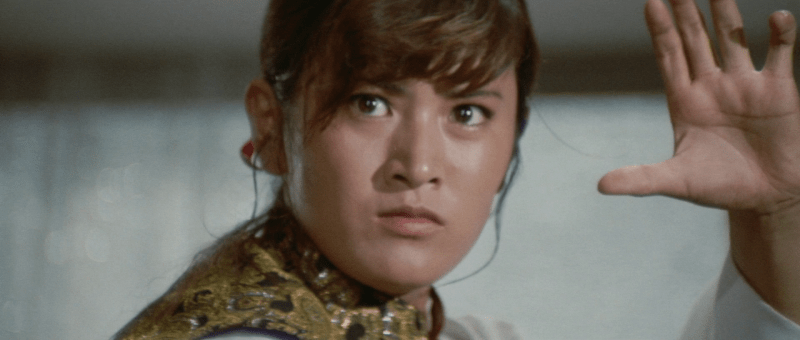
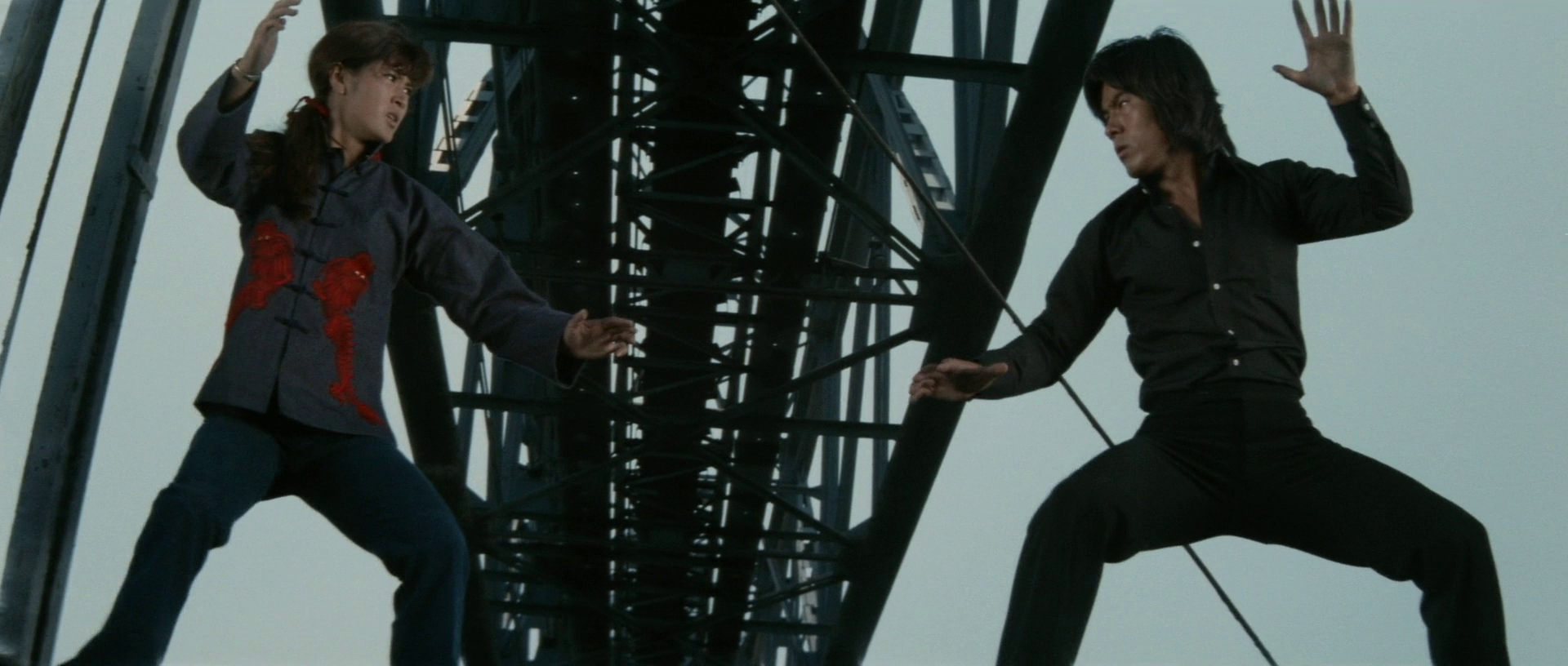
First it was drugs, then diamonds. This time, it’s gold. Even by this third and final, in the official trilogy at least, instalment in the Sister Street Fighter series, Return of the Sister Street Fighter (帰って来た女必殺拳, Kaette kita onna hissatsu ken) the gangsters still haven’t come up with a good way of smuggling. These ones have hit on the bright idea of dissolving gold in acid and importing it as if it were Chinese liquor. 

In any case, following the same pattern as the other two films, Return begins in Hong Kong with a friend of Koryu’s (Etsuko Shihomi) being murdered by thugs right after asking her to go to Japan and look for her cousin Shurei (Akane Kawasaki) who has gone missing leaving her little girl Rika (Chieko Onuki) behind. Hoping to track down her sister Reika in Yokohama, Koryu once again heads to Japan with Rika in tow only to discover that Shurei has been forced to become the mistress of the shadow boss of the Yokohama China Town, Oh Ryumei (Rinichi Yamamoto). 

Though the film maybe following a pattern, it’s also, in a sense, diverging in that it, perhaps uncomfortably, attempts shift Koryu into a more maternal space in essentially leaving her responsible for Rika because of all of her other relatives are for one reason or another unavailable. This is, after all, the implication of the closing scenes, that Koryu will be giving up her life of martial arts and fighting crime to look Rika. Even so, as we’ve seen throughout the trilogy, Koryu is not much good at protecting those around her. All of her friends and relatives generally end up dead, leaving the screenwriters having to make up more for the next instalment. Family is a liability for the sisters too, as Shuri and Reika try to save each other from the clutches of Oh, who once again tries to control them with drugs and familial bonds, but ultimately fail.

But then Oh is on a different level even to the admittedly eccentric villains of the first two films. He appears to use a wheelchair and dresses in a stereotypically Chinese outfit (as does Koryu, to be fair). Even his name is obviously Chinese even if uses the Japanese readings of the kanji which literally mean “King Dragon Bright”. Yet when he’s eventually unmasked, it seems that he was actually a member of the Kempeitai, or military police, in Manchuria during the war, where he committed atrocities against the Chinese people and finally stole bunch of gold bullion which has fuelled his post-war Chinatown empire. It’s likely also what sparked his obsession with all things gold. Even his prosthetic hand turns out to be made of it, ironically moulded into a grasping motion. 

Oh behaves like some kind of Roman Emperor, sitting on his Dias and holding gladiatorial contests to find new henchmen. He declares he that neither capitalism nor communism can beat gold and he’s hedging his bets on both in an ultimate bid for behind-the-scenes power. Embodying the toxic legacy of militarism, he mistakenly underestimates Koryu declaring that that’s what happens to people who depend too much on their physical abilities, thinking her to be dead. His weird henchmen include a man with a lewd-looking and infinitely symbolic snaking sword, but, of course, they’re no match for Koryu who once again discovers an unexpected ally at a critical moment. 

Even so, the film’s approach to it’s Chinese themes is very much of its time. Once again, it uses some offensively stereotypical music to introduce the Hong Kong setting, and the friend who went to Japan with Shurei is actually called “Suzie Wong”, as in “The World of”. The world surrounding Oh ought to be quite dark what with the constant presence of acid, the people trafficking, and the weird henchmen but somehow the film maintains its cheerful tone, no doubt bolstered by Koryu’s ability to take the gangsters down, even if her way of doing it isn’t all that efficient and more often than not gets all her friends killed. Nevertheless, this time around it seems she’s fighting for the sisterhood against the evil gangsters who control and abuse women, but even so, her final transition to mother-in-waiting feels a little like a rebuke, as if even little dragons have to cool their fire one day just as her brother in the first instalment had wanted her to settle down and live a “normal life” doing typically feminine things rather than mastering martial arts and shutting down the warped and amoral gangsters currently smuggling their greed and weirdness into a changing Japan.


Trailer (English subtitles)

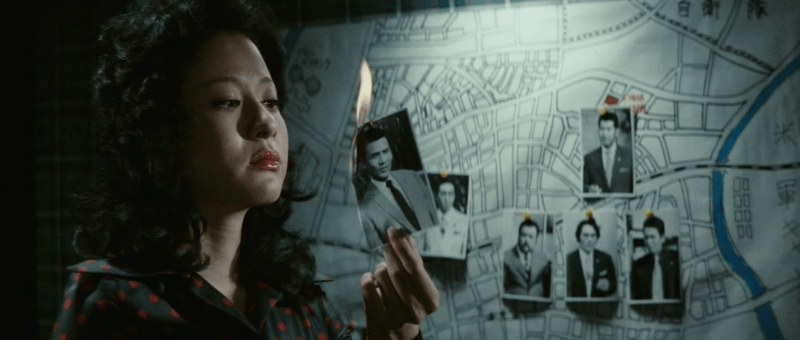
New Female Prisoner Scorpion (新・女囚さそり 701号, Yutaka Kohira, 1976)

After the fourth film in the Female Prisoner Scorpion series, star Meiko Kaji decided to move on but Toei had other ideas and opted for a reboot as signalled by the addition “shin” or “new” to the otherwise identical title to the very first film. New Female Prisoner Scorpion #701 (新・女囚さそり 701号, Shin Joshu Sasori: 701-go) moves in a slightly different direction spinning a tale of a less straightforward revenge coloured by conspiracy cinema and a series of real life high-profile corruption cases including the Lockheed Scandal, itself name checked in the film. Just a few months earlier, Roman Porno actor and fervent nationalist Mitsuyasu Maeno had lost his life in a suicide attack on the home of underworld figure and right-wing fixer Yoshio Kodama who had been instrumental in “convincing” Japanese airlines to buy Lockheed planes over McDonnell Douglas.

In any case, this Nami Matsushima (Yumi Takigawa) is an ordinary young woman who becomes concerned about her sister Taeko (Bunjaku Han) when she uncharacteristically drops out of contact after behaving strangely. Taeko is a political secretary to assemblyman Miura (Ichiro Nakatani) who is currently the vice-minister for justice and at the centre of a burgeoning corruption scandal. After Nami and her fiancée Toshihiko (Yusuke Natsu) manage to meet up with Taeko, she is suddenly kidnapped from the hotel car park while the man who was with her, Sugino (Nenji Kobayashi), is gunned down. Sugino is found to be carrying his passport and two airline tickets to Paris which, along with Taeko’s strange behaviour, imply they were planning to flee the country together. Looking more closely at the wedding presents her sister had given her, Nami realises she’s left her a cassette tape with the instruction to leak its contents to the press should anything untoward happen to her. 

Nami uses the tape as leverage with Miura to try and rescue her sister but ends up learning some unpleasant truths before being framed for Taeko’s murder and sentenced to 15 years in prison. Toshihiko, who had originally been supportive, betrays her, testifying at her trial that she may have been resentful that Taeko was against their marriage only to later marry Miura’s daughter and go into politics apparently siding with the bad guys. Toshihiko may have seemed like a nice guy, but it’s also true that he tried to pressure her into premarital sex that she didn’t want by insisting that he couldn’t wait for marriage, suggesting they blow off her sister and go to a hot springs in Hakone instead. Most of the men in the film are equally spineless and duplicitous not least the guards who with the exception of one are all corrupt and/or abusing the inmates. 

Not content with sending her to prison, Miura tries to have Nami offed with the assistance of the warden who puts her in a cell with the prison’s most notorious offender. Fusae (Mitsuyo Asaka) orders her minions to beat and torture Nami, at one point gang raping her while the only way she can think of to save her life is by claiming there’s another tape so if they kill her they’ll never know where it is and run the risk of the contents leaking. 

Meanwhile, she’s approached by a group of anarchists who tell her they need a leader which seems a little contradictory but nevertheless enables a jailbreak even as Nami develops a rivalry with the feisty prisoner number 804. Though she obviously didn’t commit the murder for which she was imprisoned, Nami is no pushover and in fact burns one of her tormentors alive not to mention stabbing another in the eye with a pencil and cunningly splitting a pair of scissors to gain twin knives. Rather than the classic scorpion look, she appears almost batlike, spreading her arms in her cape as she prepares to make her final act of revenge right outside the Diet building itself as if she were making a point about cleaning up politics aside from avenging her sister’s death and her own mistreatment. Director Kohira lends her a supernatural quality in her eerie silhouette as if she’s already become something else, a force of nature transformed by her righteous anger towards a corrupt society largely ruled by venal men willing to kill and use women for their own benefit or pleasure. Even Nami is forced to admit her complicity having learned her sister may have paid for her education through allowing herself to be traded by Miura as a political bargaining chip. She is not, however, willing to let it stand, resisting a controlling a patriarchal society with all of the resources available to her.


Criminal Woman: Killing Melody (前科おんな殺し節, Atsushi Mihori, 1973)

“Five women like us could take on the whole world!” a woman exclaims after a very successful mission of revenge in which they didn’t have to do very much at all except play on male pride and yakuza honour. Criminal Woman: Killing Melody (前科おんな殺し節, Zenka onna: Koroshi-bushi) stars the two main players of Toei’s pinky violence line, Reiko Ike and Miki Sugimoto, and plays with their star rivalry by casting them as a pair of women eventually divided by the conflicting loyalties presented by the heroine’s desire for revenge. 

Ike stars as Maki, an intense young woman first seen hiding behind a door in the classic club scene that opens the film. Eventually she darts inside and slashes some yakuza with a knife, but her assassination attempt is very unsuccessful landing her in prison for a number of years where she largely spends her time glaring at the bars and plotting her revenge. Nevertheless, it’s the solidarity she finds with her cellmates that eventually allows her to carry out her plan. On her arrival, she first clashes with cell boss Masayo (Miki Sugimoto), a former yakuza moll inside for slashing some guys with a razor after they caught her cheating at hanafuda, but eventually wins her respect after a prison test of strength in which each woman is armed with a glass shard and grips a rope between their teeth until the loser gives in and lets go. Maki is not a skilled fighter and easily wounded by Masayo but refuses to surrender, getting right back up again every time Masayo knocks her down until Masayo finally concedes defeat.

The early prison fight is repeated at the end of the film only without the rope and with real knives, drugs replacing the white chalk that clouded around them as they fought in the prison yard. This time they are more evenly matched. Maki is no good with a knife, but more than able to hold her own and the fight is more about settling a score than it is about revenge so neither really wants to harm the other anyway. Though they found themselves temporarily on opposing sides, inevitably it turns out that Masayo is the woman of the yakuza Maki is trying to bring down, the sense of solidarity between them as women eventually wins out and though Masayo is unable to betray Oba (Ryoji Hayama) she cannot betray Maki either and ends up helping in her in quest for revenge if in a round about way.

It’s this sense of solidarity that brings the other cell mates back to the prison when Maki is released already having decided to help her get her revenge on the yakuza who forced her father to traffic drugs and then had him killed. Maki first refuses their help, as she had the opportunity of getting legal justice by telling the police everything that had happened including her own gang rape at the hands of the same yakuza, because it’s important that she’s the one who takes down Oba but later accepts their gesture and forms a tightly knit gang of her own fronted out of former sex worker Kaoru’s (Yumiko Katayama) bar. To fund the mission, Maki goes on a two week sex work spree mostly bedding American servicemen with whom she later makes a deal to buy a large number of guns and grenades she eventually sells to hotheaded yakuza son Tetsu (Takeo Chii) who is already resentful towards Oba for having stolen his father’s turf.

All Maki has to do to is light the touch paper on a simmering gang war between old school yakuza and the amoral corporatising Oba. She antagonises him by expertly offing one of his guys in a rain drenched assassination scene and getting one of the other girls to strongly hint it was Tetsu’s doing, then pretending to come to Tetsu’s rescue with the guns only to further provoke Oba. The girls even joke they’re doing a public service by cleaning up the town in taking out the corrupt politician who was propping up Oba for his own financial gain. It’s all expertly planned by Maki who appears in a series of quite stunning power suits and sporting giant hair, battling yakuza with killer style and an expert understanding of the way their brains work. But the reason the plan succeeds is the shared sense of solidarity between the women, Masayo included, as they strike back together against an oppressive and patriarchal society.


The Desperate (どろ犬, Takaharu Saeki, 1964)

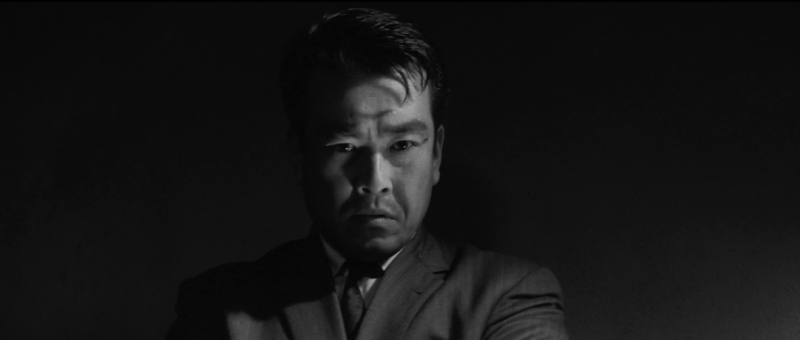
A bruiser cop railing against the system is pulled towards the dark side in Takaharu Saeki’s icy noir, The Desperate (どろ犬, Doro Inu). Adapted from a novel by Shoji Yuki, the film is one of only two Saeki directed in an otherwise lengthy career mainly spent in television and captures an eerie sense of existential dread as its detective hero sinks to even greater depths in a quest for self preservation while kicking back against the hypocrisies of the post-war society. 

As one officer puts it, Sugai (Minoru Oki) is one of many veteran officers who can’t adjust to new codes of justice in the democratic era. In the film’s opening sequence, he’s pulled aside and warned about using excessive force on a suspect only to counter that he knows the guy’s guilty so he doesn’t see what the problem is. Sugai had been particularly motivated about this case as the victim was an 18-year-old girl raped after accepting a lift from a stranger. She was so traumatised that she could hardly speak but did remember the registration plate of the car. She’d only been working because her father lost his factory job though he appears to have begun drinking and is abusive towards his daughter for her silence, later coming to the station to drop the charges after being paid off by the suspect’s lawyer. The legal definition of rape in this era is founded not on an idea of consent but whether violence was involved and the victim can be proved to have resisted physically. The guilty party, Tomita (Hideo Murota) claims that nothing illegal transpired in his car and then walks away with a smirk when his lawyer gets him off the hook. It’s all too much for Sugai to bear, resentful that the rich and powerful are now effectively above the law thanks to legislation he feels ties his hands as a police officer. 

It’s at this point he runs into petty yakuza Yamaguchi (Ko Nishimura) whom he’s been trying to turn as an informant, unwisely mouthing off about his dissatisfaction with contemporary law enforcement only for Yamaguchi to turn the tables and effectively blackmail him having discovered that Sugai has begun a relationship with the estranged wife of an imprisoned gangster. In an act of petty revenge and desperation, Sugai leaks info on “guilty” suspects who weren’t charged to Yamaguchi who exacts financial justice by extorting them for money while threatening to expose their immorality. 

Disappointed in him, the gangster’s wife, Chiyo (Chisako Hara), exclaims that Sugai’s no different from her husband and in truth he isn’t. Part of Sugai’s resentment lies in the fact his wife left him for another man while he was on a stakeout, frightened by his violence and insisting that she hated detectives. His old-fashioned police tactics include taking suspects to the dojo where beats the living daylights out of them. Later he tells another, more earnest officer, he reminds him of himself when he was younger implying that he has become corrupted by the times and the impossibility of justice, particularly for young women whom he feels an urge to protect, in a world ruled by money and status. He may feel some pangs of guilt for a rookie who is unfairly fingered as the mole on the grounds that he and Yamaguchi were originally from the same area and had a past acquaintance, but in the end is happy enough to scapegoat him for his wrongdoing while he continues trying to dig himself out a hole but falling still further into the abyss. 

Sugai is merely trying to save his own skin, but those around him are desperate too. His opposite number, Toku (Hisashi Igawa) is desperate to clear his name, while Chiyo is desperate for what she describes as a proper marriage to a proper man while seemingly kept captive in the apartment Sugai rents for her on his meagre police salary but does not live in himself. She wants to work and has an innocent desire to buy him some better shoes that he otherwise resents in its implied challenge to his masculinity that he evidently cannot afford all this additional expense coupled with the strain of keeping his problematic relationship with a gangster’s wife secret from his employers. In the end he claims that the problem was he couldn’t escape from being a detective, pushed into desperate acts of destruction as a man now exiled from his times unable to move on from post-war chaos into a newly democratic, consumerist Japan. Saeki ends his fatalistic vision with an image of a train reeling backwards, echoing the degree to which Sugai has lost control of his life and himself no longer a detective but only a man without a moral compass whose path can only lead in one direction. 


The Bullet Train (新幹線大爆破, Junya Sato, 1975)

bullet train posterFor one reason or another, the 1970s gave rise to a wave of disaster movies as Earthquakes devastated cities, high rise buildings caught fire, and ocean liners capsized. Japan wanted in on the action and so set about constructing its own culturally specific crisis movie. The central idea behind The Bullet Train (新幹線大爆破, Shinkansen Daibakuha) may well sound familiar as it was reappropriated for the 1994 smash hit and ongoing pop culture phenomenon Speed, but even if de Bont’s finely tuned rollercoaster was not exactly devoid of subversive political commentary The Bullet Train takes things one step further.

A bomb threat has been issued for bullet train Hikari 109. This is not a unique occurrence – it happens often enough for there to be a procedure to be followed, but this time is different. So that the authorities don’t simply stop the train to find the device as normal, it’s been attached to a speedometer which will trigger the bomb if the train slows below 80mph. A second bomb has been placed on a freight train to encourage the authorities to believe the bullet train device is real and when it does indeed go off, no one quite knows what to do.

The immediate response to this kind of crisis is placation – the train company does not have the money to pay a ransom, but assures the bomber that they will try and get the money from the government. Somewhat unusually, the bomber is played by the film’s biggest star, Ken Takakura, and is a broadly sympathetic figure despite the heinous crime which he is in the middle of perpetrating.

The bullet train is not just a super fast method of mass transportation but a concise symbol of post-war Japan’s path to economic prosperity. fetching up in the 1960s as the nation began to cast off the lingering traces of its wartime defeat and return to the world stage as the host of the 1964 olympics, the bullet train network allowed Japan to ride its own rails into the future. All of this economic prosperity, however, was not evenly distributed. Where large corporations expanded, the small businessman was squeezed, manufacturing suffered, and the little guy felt himself left out of the paradise promised by a seeming economic miracle.

Thus our three bombers are all members of this disenfranchised class, disillusioned with a cruel society and taking aim squarely at the symbol of their oppression. Takakura’s Okita is not so much a mad bomber as a man pushed past breaking point by repeated betrayals as his factory went under leading him to drink and thereby to the breakdown of his marriage. He recruits two helpers – a young boy who came to the city from the countryside as one of the many young men promised good employment building the modern Tokyo but found only lies and exploitation, and the other an embittered former student protestor, angry and disillusioned with his fellow revolutionaries and the eventual subversion of their failed revolution.

Their aim is not to destroy the bullet train for any political reason, but force the government to compensate them for failing to redistribute the economic boon to all areas of society. Okita seems to have little regard for the train’s passengers, perhaps considering them merely collateral damage or willing accomplices in his oppression. Figuring out that something is wrong with the train due to its slower speed and failure to stop at the first station the passengers become restless giving rise to hilarious scenes of salarymen panicking about missed meetings and offering vast bribes to try and push their way to the front of the onboard phone queue, but when a heavily pregnant woman becomes distressed the consequences are far more severe.

Left alone to manage the situation by himself, the put upon controller does his best to keep everyone calm but becomes increasingly frustrated by the inhumane actions of the authorities from his bosses at the train company to the police and government. Always with one eye on the media, the train company is more preoccupied with being seen to have passenger safety at heart rather than actually safeguarding it. The irony is that the automatic breaking system poses a serious threat now that speed is of the essence but when the decision is made to simply ignore a second bomb threat it’s easy to see where the priorities lie for those at the top of the corporate ladder.

Okita and his gang are underdog everymen striking back against increasing economic inequality but given that their plan endangers the lives of 1500 people, casting them as heroes is extremely uncomfortable. Sato keeps the tension high despite switching between the three different plot strands as Okita plots his next move while the train company and police plot theirs even if he can’t sustain the mammoth 2.5hr running time. A strange mix of genres from the original disaster movie to broad satire and angry revolt against corrupt authority, The Bullet Train is an oddly rich experience even if it never quite reaches its final destination.


Original trailer (no subtitles)

The Girl in the Glass (ガラスの中の少女, Masanobu Deme, 1988)

The popularity of idol movies had started to wane by the late ‘80s and if this 1988 effort from Masanobu Deme is anything to go by, some of their youthful innocence had also started to depart. Starring Kumiko Goto, only 14 at the time, The Girl in the Glass (ガラスの中の少女, Glass no Naka no Shojo) is an adaptation of a novel by Yorichika Arima which had previously been filmed all the way back in 1960 starring another idol starlet – Sayuri Yoshinaga. Given a new, modern twist for the very different mid-bubble era, the 1988 edition of the familiar rich girl falls for poor boy narrative is no less tragic than it ever was. Gone is the cheerful, carefree invincibility of youth – The Girl in the Glass is a painful lesson in loss of innocence in which the forces of authority will always betray you but in the end you will betray yourself.

Middle schooler Yasuko (Kumiko Goto) has a very busy life. Accordingly, she maintains a coin locker at the station in which she keeps all the equipment she needs for her after school clubs which range from fencing to piano and cram school. Fiddling with the key one day she finds herself chatting with a rough young man who abruptly gives her something wrapped up in newspaper to stash in her locker with the instruction to meet him back there at nine to return it. Yasuko’s step-mother is a very strict woman who demands absolute punctuality and so Yasuko leaves a note to the effect that she’s taken the boy’s package home and will return it another time.

This is a big problem for the boy, Yoichi (Eisaku Yoshida), because the package contains a gun that some criminal types are quite keen to get back. After their factory closed, Yoichi and his Filipino friend have been forced into the fringes of the criminal underworld to make ends meet. Crafting pistols or adapting toy guns to fire real bullets, the boys are engaged in some shady stuff. Regretting his decision to get a random schoolgirl involved in all of this, Yoichi needs to get his gun back but also finds himself growing closer to Yasuko, particularly as he accompanies her on a personal journey to discover a few painful family truths.

Made the same year as Memories of You, The Girl in the Glass once again casts Goto as a spiky though eventually tragic heroine, unable to withstand the forces of time and society to fulfil her true love dream. The daughter of a prominent politician who is often absent for long stretches of time, Yasuko is devoted to her father though suspicious and hostile towards her noticeably cold step-mother. Her life is a tightly ordered one of swanky private school days followed by a series of clubs befitting an upper class girl, after which she is to return straight home lest she incur the wrath of her step-mother.

Yasuko, however, is getting to the age where doing what she’s told without question is no longer appealing. Yoichi’s appearance is then not an altogether unexpected development, but this very ordinary pull away from her overbearing family environment also coincides with its implosion as a chance telephone call tips Yasuko off to a long buried family secret. Yasuko’s father, so apparently doting on his pretty daughter, is forever the politician – cold, calculating and willing to sacrifice anything and everything for his political career.

Spouting nonsense about family values from the top of a bus with the resentful Yasuko made to stand beside him, Yasuko’s father is perhaps the symbol of a growing threat of a profligate and self centred authority whose selfishness and coldhearted austerity is already wreaking havoc on those who are excluded from Japan’s new found prosperity. Yoichi, fatherless, lives a typical working class life with his mother and younger sister. He’s left school but the factory where he worked has closed down and there are few other jobs for a high school graduate in these fast moving times. The family have taken in a Filipino friend, Jose, who also worked at the factory but is technically in the country illegally as his visa has expired. Yoichi has pulled Jose into the gun making business as a way to make ends meet, but even if the two are essentially nice kids making bad decisions, their accidental criminality will come back to haunt them.

About halfway through The Girl in the Glass, Yasuko and Yoichi end up on the run together. Holed up in Yasuko’s family summerhouse the pair enjoy a taste of domesticity as Yoichi cooks breakfast for an upperclass girl whose only culinary experiences have been in home-ec class, but their romantic dream is short lived. A stupid, pointless and tragic end, Deme dares to include the bizarrely silly outcome to a mad dash declaration of love which every viewer fears yet never believes will occur. The abrupt transition from romance to tragedy is not altogether successful as Yasuko’s coming of age takes on all of its painful, unforgivable wounds. Leaving on a note of total bitterness, there is no hope left for Yasuko, romantic love fails and familial love betrays. Strangely unforgiving, The Girl in the Glass lets no one off the hook from the corrupt politician, to the poor boy with empty pockets and a head full dreams, and the hardworking foreigner who finds himself caught up in someone else’s drama, but least of all Yasuko who is left with nothing more than the knowledge that she herself has been a prime motivator in all her suffering.