Fly Me To The Saitama -FROM BIWA LAKE WITH LOVE- (翔んで埼玉 ~琵琶湖より愛をこめて~, Hideki Takeuchi, 2023)

The Saitamafication of Japan continues in the long-awaited sequel to the hit 2019 comedy Fly Me to the Saitama. Though the visa system has been abolished and the citizens of Saitama are new free to enter the capital, that does not mean to say everyone is on the same page and the prefecture still faces internal divisions and increasing factionalism. Revolutionary Rei (Gackt) proposes a solution which involves connecting the series of train lines to make it easier to get around and building a beach resort to lesson their sense of inferiority over having no access to the sea.

Once again it has to be said that humour is very local and largely built around regional stereotypes, though it is perhaps curious that the ordinary citizens are often seen in clothing reminiscent of the 1930s something which is also echoed in scenes of trains arriving at stations greeted by crowds of well-wishers seeing soldiers off to war. This may in a sense echo the film’s central theme in the encroachment of Osaka imperialism in which Japan’s second city has launched a not so secret campaign to Osakify the rest of the nation, if not the world, using white powder manifesting as sand from Koshien Baseball Stadium which is a holy place to many as it is where the high school baseball championship takes place. 

They have a visa system in Osaka too, or more strictly the Kansai area, with Kyoto and Kobe apparently in on the plot and intent on looking down on suburban areas such as Wakayama and Shiga which is where Rei was planning on getting his sand. Shiga is set up as a the Saitama of the south west, a pleasant if dull sort of place with a lake its only claim to fame. Like Saitama it has a liberation front, led by Kikyo (Anne Watanabe) who known as the Oscar of Shiga because she went to France to study revolutions and is is dressed like Oscar from the Rose of Versailles. 

The citizens of Kyoto come in for a bit of a kicking for their stereotypically snobbish attitude, the natural politeness of the local dialect undone by a social gadget that reveals what they’re “really” thinking which is that their definition of Kyoite is very narrow. The stereotypical view of Osaka, as voiced towards the end of the film, is that the people are cheerful and warmhearted. The city is associated with comedy and particularly manzai double acts like the one which appears during the opening credits, which perhaps adds to the sense of despair and confusion that the normally nice Osakans could suddenly be hellbent on world domination aided by the already strong love for takoyaki throughout the nation.

As before, we also have a “real world” subplot in which members of a family listen to the radio broadcast outing the urban legend of Rei and his BL love story with Momomi, the Tokyo-raised governor of Saitama. These regional rivalries are tearing up the real world too with a tug of war match that threats to go incredibly wrong if the two areas with an existing beef are allowed to face each other in the final. In contrast, the fantasy world is a riot of zany 18th-century influenced design that sees Rei set off on a pirate ship to get his sand for the fake beach though the mayor of Kobe turns up dressed like Audrey Hepburn in Breakfast at Tiffany’s, and the Kyoto-ite has Taisho-esque straw hat. When the gang are caught by the fascisitic Osakans they’re relegated to a dungeon under Koshien Stadium and enslaved because of Saitama’s low ranking amid the other prefectures of Japan.

It’s all very silly, and somewhat impenetrable to non-Japanese speakers who can’t pick up on the dialect switching or zany wordplay while a certain degree of familiarity with regional stereotypes is certainly helpful. In any case, while the Osakafication of Japan undoubtedly sounded quite bad, the same cannot be said for its Saitamaification and Rei’s desire to create a land without discrimination free of the oppression and inequality born of pointless regional snobbery where everyone is free to go wherever they please without let or hinderance. 


Fly Me To The Saitama -FROM BIWA LAKE WITH LOVE- screened as part of this year’s Nippon Connection

Original trailer (English subtitles)
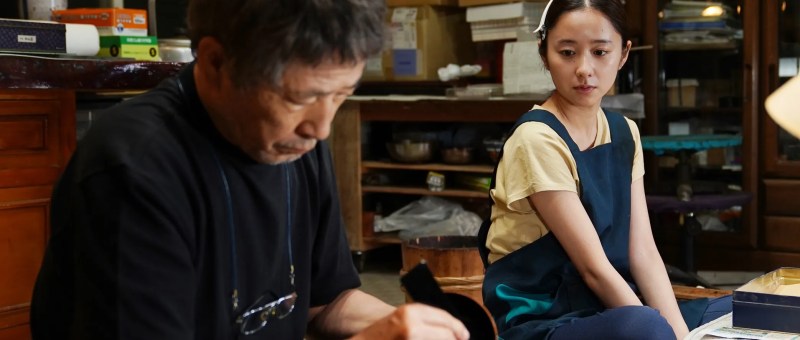
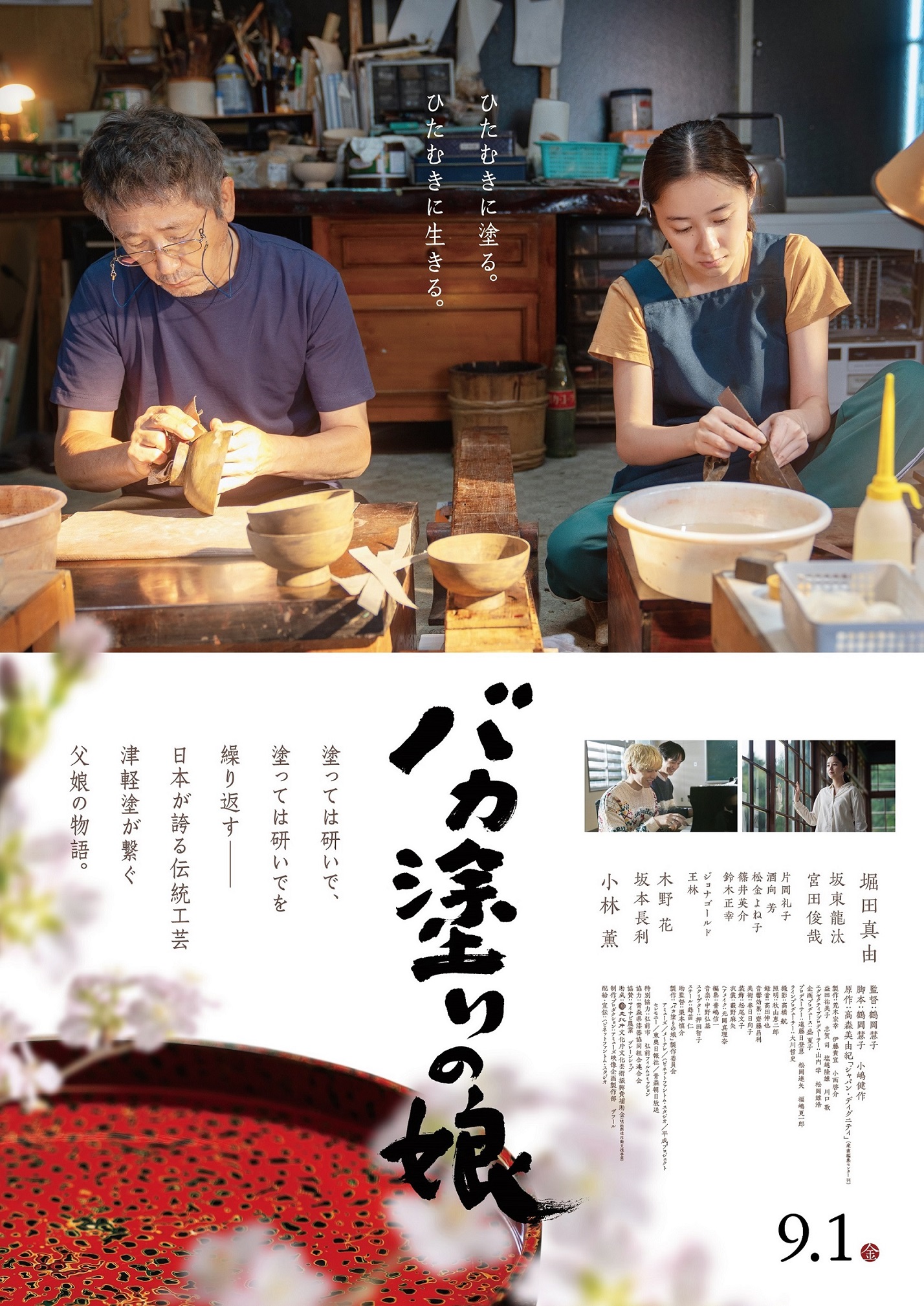
Tsugaru Lacquer Girl (バカ塗りの娘, Keiko Tsuruoka, 2023)

Which traditions should we keep and which should we lose? A young woman finds herself frustrated by outdated gender norms in her desire to take over the family lacquerware business in Keiko Tsuruoka’s gentle rural drama, Tsugaru Lacquer Girl (バカ塗りの娘, Bakanuri no Musume). While her family, save older brother Yu (Ryota Bando) who has already rejected lacquerware, do nothing but run her down and claim she’ll never be a success at anything all she wants to do is devote her life to a traditional craft her father no longer believes has any kind of future. 

Even so, Seishiro (Kaoru Kobayashi) is dead set on Yu taking over the business to the point that they have become semi-estranged. He calls Miyako (Mayu Hotta) “clumsy” and complains that she has no aptitude for anything unlike Yu who was always good at anything he tried. Miyako too later suggests that she was her brother’s opposite, while he was cheerful and outgoing she is shy and melancholy but then perhaps it’s hard to be cheerful when everyone’s always telling you you’re useless and doing everything wrong. In an interesting parallel, Yu is also trapped by outdated social codes in that he is gay and he and his partner have decided to move to London where they can legally get married and live their life out and proud in a way they feel they cannot do in contemporary Japan. 

Lacking other direction in her life, Miyako has been working a part-time job in a local supermarket which she hates while her father occasionally allows her to help him finish big orders though it’s clear her salary is now their main source of financial support. A local inn keeper who is a good customer of theirs explains to some of his guests that craftsmen rarely construct large pieces such as tables because they are no longer cost effective while fewer young people are willing to take up apprenticeships leaving the traditional art in danger of dying out despite the frequent remarks that everything tastes better out of a lacquerware bowl which is after all in the modern parlance “sustainable” in that it will last for many decades and can easily be repaired if damaged. 

Seishiro doesn’t seem to have a reason for rejecting the idea that Miyako might take over aside from basic sexism in preferring to hand the business over to his first born son. It might be tempting to think that he dissuades her because he thinks there isn’t a future in lacquerware, but if that were the case he could simply retire. Her mother (Reiko Kataoka), who left the family some years ago in part it seems because of her own animosity towards lacquerware and its lack of financial promise, seems to feel much the same comparing Miyako to a more successful cousin who has kids and a high powered job at an international trading firm, telling her that she should be settling down and getting married suggesting that she is simply incapable of becoming a successful lacquerware artist and should at best keep it as a hobby. 

Her mother had also shut down her desire to learn piano as a child by telling her there was no point because she’d never be good at it. Miyako’s decision to prove herself by re-laquering an abandoned piano in her disused school is then an act of rebellion against both parents showing them what she can and will achieve along with the direction she has chosen for her life. Not everyone respects it even if her father begins to come around but really it doesn’t matter because the decision is hers alone whatever anyone else might have said. Far from being insular, the embrace of traditional culture gives Miyako new opportunities and allows her to grow in confidence until she’s finally ready to set off along her own path. Even so, it seems there are some traditions she thinks it would be better to lose, such as her father’s sexism and the homophobia that has forced her brother to emigrate in order to live a happy life just as he is. They call it “fools lacquer” because no one but a fool would go to all this trouble to make a bowl but in many ways that’s the point. Miyako pours all of herself in to the lacquer, piling layer on layer dotted by handfuls of thrown rice that give it its pattern much as she herself is slowly tempered by the world around her.


Tsugaru Lacquer Girl screened as part of this year’s Camera Japan.

Original trailer (English subtitles)

108: Revenge and Adventure of Goro Kaiba (108 海馬五郎の復讐と冒険, Suzuki Matsuo, 2019)

In Buddhism, there are said to be 108 earthly desires, 108 lies, and 108 human delusions. As he points out however, all that is merely coincidence to Goro Kaiba, his petty revenge is founded entirely on the fact that a Facebook status in which his wife, using a pseudonym, detailed an affair with a lithe young contemporary dancer, garnered 108 Likes. Waxing self-referential, Suzuki Matsuo’s surreal sex comedy 108: Revenge and Adventure of Goro Kaiba (108 海馬五郎の復讐と冒険, 108: Kaiba Goro no Fukushu to Boken) in which he also stars, finds a middle-aged screenwriter somehow still trapped in adolescent insecurity, intensely self-involved as he pursues a “revenge” which is also a strange kind of ironic self harm intended to prove his manhood but accidentally exposing the love’s sordid underbelly in the vacuousness of its inversion. 

As the film opens, successful screenwriter Goro Kaiba (Suzuki Matsuo) is overseeing auditions for the musical adaptation of his greatest hit, Dancing in the Mental Ward. He tells us that he’s bored with his work and somewhat disrespectfully is actually writing a column due in a couple of hours’ time, barely paying attention to the actress as she valiantly perseveres with the less than stellar material before rudely dismissing her performance and suggesting she dump the boyfriend who helped her come up with it. Goro claims that he carries on in a job he hates for three reasons: he loves money, his wife’s a spendthrift, and he loves her. It’s something of a shock therefore when a young actress comes up to him after the auditions to ask for a private chat which turns out to be about something slightly different than he’d assumed. She shows him a Facebook profile she believes belongs to his wife, Ayako (Miho Nakayama), in which she claims to have fallen in love with a “contemporary dancer” named “Dr. Snake”. 

Confronted, Ayako admits “everything”, but explains that the Facebook profile is nothing more than wish fulfilment, a romantic fantasy to distract from the emptiness of her married life. Predictably, Goro fails to pick up on the fact there are obviously problems in their marriage, fixating on the extent of Ayako’s relations with Dr. Snake of whom she now has a large tattoo on her shoulder, something which he hasn’t noticed because they have not been intimate in some time. Ayako assures Goro that she means to stay with him forever, but will be fantasising about Dr. Snake when they make love, further hinting at another problem undermining their relationship. Goro, however, is not convinced and starts talking to his friends about divorce only to be reminded Ayako will be entitled to half his savings if he splits up with her. Consumed by pettiness, he decides to spend all the money so she’ll be left with nothing by sleeping with 108 women as “revenge” for her infidelity. 

Of course, the problem is less Ayako than his wounded male pride and emotional immaturity. Perhaps he’s doing this because he can’t admit to himself how much he really does love his wife and how hurt he is by her “betrayal”, but in any case he makes it all about him, refusing to engage with the problems in his marriage or reflect on the fact Ayako is obviously unhappy and unfulfilled. He tries giving some of the money away to his ex-wife and 20-year-old son Michio (Louis Kurihara) from whom he has apparently been withholding alimony and child support, put out that his ex won’t take it because she has no need of him, a man who abandoned her. Not abandoned, he points out to his son, simply “ran away”. In an awkward conversation, he goes so far as to blame Michio for his family’s collapse, claiming that he left essentially because Michio didn’t love him enough while complaining that no one seems to appreciate him. 

Meanwhile, we also realise Goro has been hypocritically carrying on a casual affair with an old friend, Mitsuko (Natsuko Akiyama), perennially unlucky in love but planning to put an end to their “arrangement” to marry a much younger man she is fully aware is only after her money. As part of his sexploits, Goro hires a high class call girl, Azusa (Shiori Doi), but she is also romantically challenged in that despite being the number one herself, she’s only really doing this to make her host club boyfriend top dog at his establishment. In love, it seems there is always some kind of transaction, a misplaced desire. Edging deeper into his pointless and petty quest to bed 108 women, it’s not until late in the game as he’s overseeing a pool full of glistening, gyrating bodies that he perhaps begins to realise how vacuous and meaningless it all really is, sordid in its emptiness. By then, however, he’s gone too far to turn back. 

Better to him than he deserves, Ayako eventually confesses that she was “fighting the inevitability of ageing”, both facing and refusing to face the fears which informed the choice she made to retire from acting and become his wife, but Goro remains petulant and immature, indulging in a romanticisation of their early romance but unwilling to confront himself, his fears, and the real reason he’s embarked on this pointless and silly quest to vindicate himself through aggressive masculinity. Worryingly indulging in fantasies of sexualised violence against his wife which admittedly have an unexpected pay off, Goro struggles to identify what it is he’s really reeling from while pursuing not so much pleasure but misdirected pain in flight from adult vulnerability. In his usual style, Matsuo has ironic fun with Goro’s flights of fancy, suddenly breaking into song like one of his shows while simultaneously mocking them and undercutting Goro’s thinly veiled misogyny by having the leading actress abruptly walk out in protest against his childishly smutty song about the joys of sex. Nevertheless, we leave Goro exactly where we found him, all at sea torn between the risky rewards of honest romantic connection and the dubious pleasures of hedonistic conquest. 


108: Revenge and Adventure of Goro Kaiba screened as part of Camera Japan 2020.

Original trailer (no subtitles)

Organ (あの日のオルガン, Emiko Hiramatsu, 2019)

Emiko Hiramatsu is best known as a regular collaborator to the endlessly prolific Yoji Yamada. Though his repertoire is more varied than some give him credit for, Yamada is one of several veteran directors to have begun looking backwards with a sometimes uncomfortable nostalgia for the wartime era in tales of maternal suffering such as Kabei and Nagasaki: Memories of my Son, or its legacy of unfulfilled desire in the more complex The Little House, all of which were co-written by Hiramatsu. It’s to the war she returns in her second directorial feature Organ (あの日のオルガン, Ano Hi no Organ), once again chronicling female fortitude as an idealistic nursery school teacher defies governmental advice to evacuate the children in her care to the relative safety of a disused temple outside of the city. 

“Angry girl” Kaede Itakura (Erika Toda) is outraged by the news that the schools will soon be closed, not least because of it’s impracticality seeing as the parents of the children in her care have all been mobilised for the war effort and will not be able to look after them. Worried about the intensification of aerial bombardment, she’s considering taking the children somewhere safer but is struggling to convince others that she is right to reject the governmental line. Her greatest challenge is not, however, the authorities, but the children’s parents, many of whom have been quite thoroughly brainwashed and have no idea how badly the war is going. They find Kaede’s suggestion defeatist and are certain that they are in no real danger. Of course, no one wants to be separated from their children, but some begin to wonder if they aren’t being selfish in wanting to keep them close if they’ll be safer elsewhere. Experiencing a serious air raid, most parents ultimately decide that perhaps evacuation is for the best. 

The kids, though obviously distressed to be taken away from their parents, perhaps think of it as an extended school trip. The locals, however, are not universally pleased to see them. A farmer beefed up by militarist credentials, loudly complains about being forced to feed and shelter “unproductive” refugees. He’s only talked round when the sole male teacher explains to him that the children are important because they too are children of the emperor who will someday grow up to become fine soldiers fighting for imperial glory. 

Kaede bristles, but finally cannot argue. A neat mirror of macho male militarist ideology, her philosophy also has its patriotic quality in her constant insistence that they must save their “cultural identity” by teaching the children traditional arts such as flower arranging and folk songs which, while admired by the militarists for their essential Japaneseness, are also regarded as frivolous. She tries to maintain distance between herself and the children, clear that this a school and not a home, but is forced to accept a degree of maternity when it becomes clear that lack of human warmth is causing them to suffer. 

The teachers at the school, all of whom are necessarily unmarried and most of them young, are doubted by others precisely because they have no children of their own even if they are ultimately respected as educators. Caring for the children is also their way of serving, allowing their parents to devote themselves entirely to the war effort in the knowledge that their kids are safe. The country is, however, much more conservative than the city. Also viewed with suspicion is a man who’s come home from the war injured and now finds himself out of place, “unproductive”, and to a degree feminised. When he dares to talk cheerfully to one of the teachers after helping her fix her bicycle, the ultra militarist doesn’t like it, accusing the teachers of being a bunch of loose women in the habit of taking advantage of “vulnerable” men who are apparently both emasculated and infantilised by their inability to serve. The militarist’s complaint gets the teacher sent home, back to the city, and straight into the heart of danger where she may die simply for smiling at a lonely young man. 

Kaede once again doesn’t approve, but is powerless to resist. She is forced to compromise her principles for the greater good to keep the children safe. Her “angry girl” fortitude is directly contrasted with the ethereality of the bumbling Mitsue (Sakurako Ohara) who has a knack with the children but is not exactly a responsible adult. Yet Mitsue too is “serving”, if only as a morale booster, her cheerful attitude helping to carry others through tough times. It’s her organ from which the film takes its title, gathering the children to sing wholesome folk songs including the classic “furusato” with all its evocations of nostalgia for an idyllic pastoral innocence.

Meanwhile, Kaede wonders if she’s done the right thing in separating families, darkly worried that the parents might have preferred to die with their children rather than be glad they sent them away to safety. Many of the children in her care are orphaned, losing homes and family members in the fire bombing, and finally not even rural Saitama is safe, but she has at least saved something in her determination to carve out a space for peaceful innocence far away from the unfeeling chaos of militarist folly.


Screened as part of the Japan Foundation Touring Film Programme 2020.

International trailer (English subtitles)