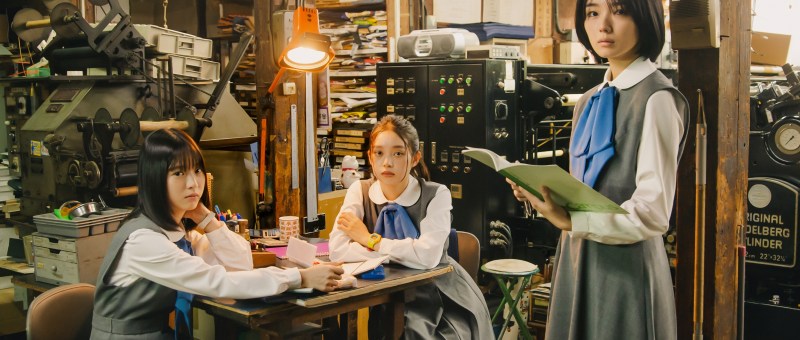
The Scoop! (新米記者トロッ子 私がやらねば誰がやる!, Keiichi Kobayashi, 2024)

The print media industry in Japan has often come in for criticism because of its perceived toothlessness in which it is often afraid of speaking truth to power lest it lose its access. Of course, as we’ve seen all too well just recently, that’s not a problem limited to Japan, but it’s something that’s preoccupied the students at the centre of Keiichi Kobayashi’s teen drama The Scoop! (新米記者トロッ子 私がやらねば誰がやる!, Shinmai Kisha Torokko: Watashi ga Yaraneba Dareka ga Yaru) whose unofficial newspaper club is threatened by the school because of its tendency to expose scandal and oppose the elitism which has otherwise taken over the institution.

Yui (Karin Fujiyoshi) only enrolled here because of the famous literature club and the possibility of meeting her idol, Konoha Midorimachi, the winner of a prestigious student writing competition. But as she quickly finds out, the Literature Club is pretty high up in the school hierarchy and only really open to those in the “advanced” class. All of its members wear red scarves to distinguish them from the other students who wear blue. You have to take a test to get in, but Yui’s dreams end before they’ve even started when she’s hit by a rogue drone and knocked out. They won’t let her retake the test because they say it would be unfair to the other students, but the club president, Mari (Rinka Kumada), has another proposition for her. It turns out that Konoha Midorimachi isn’t a member after all but a mysterious person using a pen name. Mari wants to know who it is too so she suggests they team up to find out. Following a lead to the unofficial Newspaper Club, Mari advises Yui to sign up there and win their trust to find out Konoha’s true identity on the promise of being admitted to the Literature Club once she’s solved the mystery.

Yui isn’t really happy with this plan in part because the Newspaper Club has a bad reputation for being a bunch of cranks and nerds. The Newspaper Club isn’t really all that keen on talking about Konoha either but is glad to have Yui on board while she also begins to embrace the opportunity to hone a different side to her writing skills. While there, she’s confused by the tactics employed the editor, Kasane (Akari Takaishi), whom she describes as more like a con-artist than a journalist as she employs some unorthodox methods to get to the truth, but also wakes up to the myriad problems at the school and comes to understand that the newspaper is necessary for exposing them. 

This does not, however, endear them to the headmaster, Numahara (Masahiro Takashima), who is a fascistic elitist intent on ruling the school with an iron fist. Backed into a corner, he agrees to make the Newspaper Club “official” with funding from the school but only as a gambit to control it. If Kasane accepts his offer, they will have to abide by his rules which means puff pieces and propaganda only. “Submit to me,” he snarls, inappropriately pinning the teenage Kasane to a wall while making her an ultimatum to join his side or get the hell out. “Women should be compliant,” he advises shortly before Kasane socks him on the jaw. What happens after that is a neutering of the paper while Numahara strengthens the elitism of the school by deepening the privileges held by the so-called “advanced” class represented by the Literature Club. 

The Japanese title of the film is the more evocative “Rookie Reporter “Trolley”: If I don’t do it, who will?” As Kasane had said to Numahara, silence changes nothing. Kasane later claims that she started the Newspaper Club because she lost faith in the power of fiction, but also wanted to bring about real change and expose Numahara’s corruption. Though their paper is suppressed, they do eventually manage to bring about something like a more egalitarian revolution and expose Numahara for what he really is by using the same tactics he used against them. In some ways, it’s an allegory for the wider society and an advocation for the power of journalism to bring about real change by refusing to shrink from the truth or be cowed by those in power, as much it is a coming-of-age tale in which the heroine learns that things aren’t always what they seem and a club that’s founded on the principle of excluding others isn’t one you want to join.


The Scoop! screens as part of this year’s Japan Foundation Touring Film Programme.

Trailer (English subtitles)
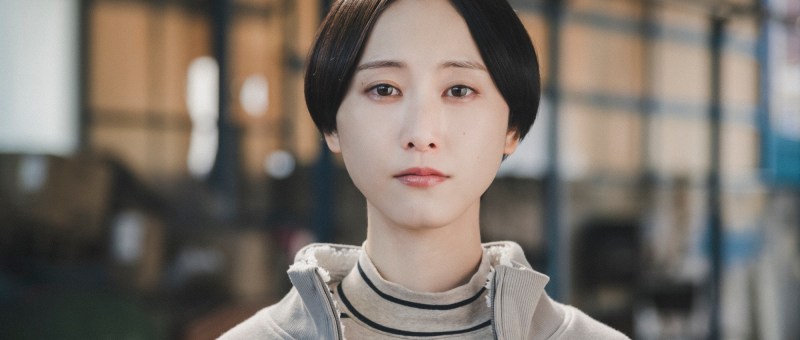
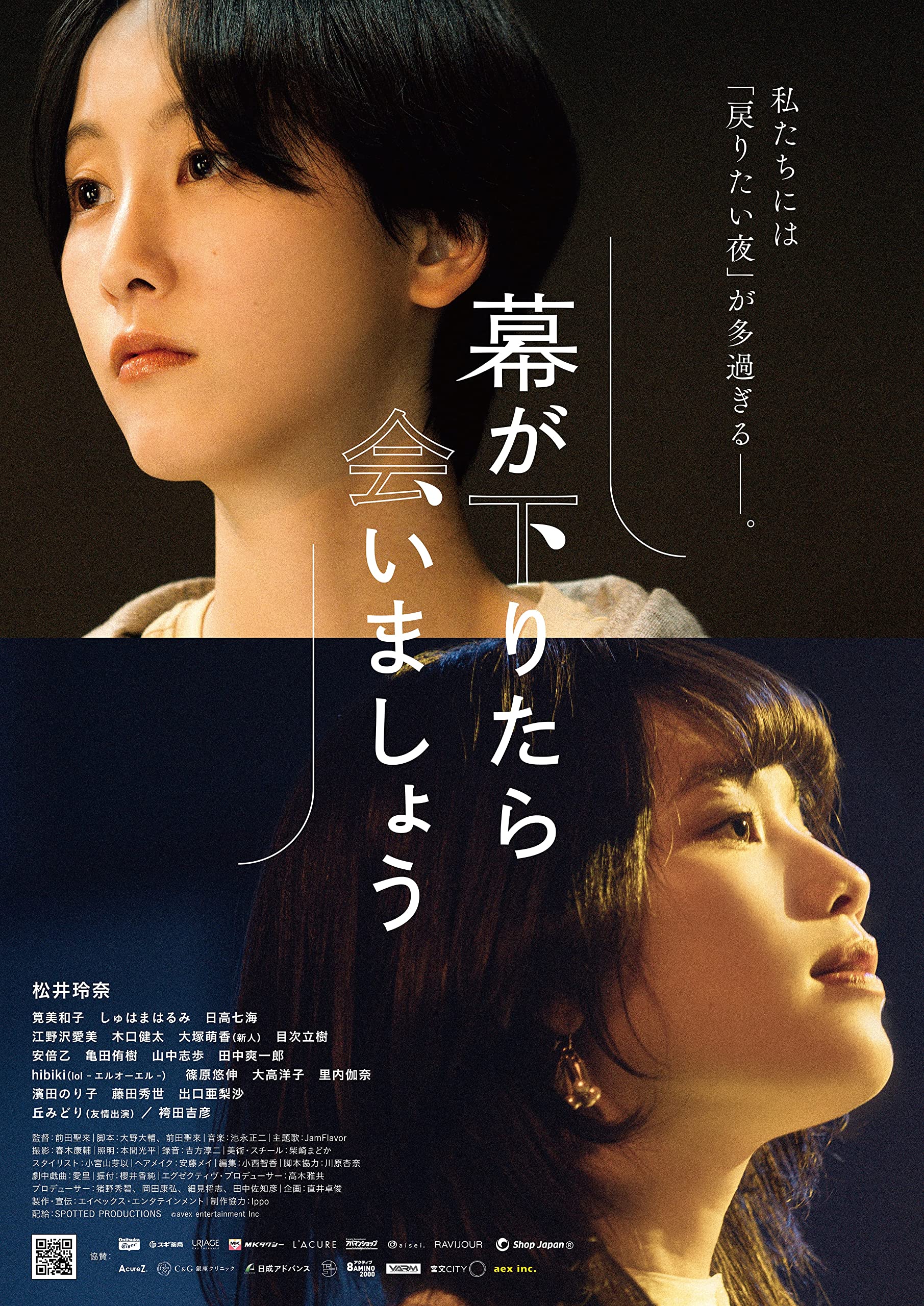
Back To That Day (幕が下りたら会いましょう, Seira Maeda, 2021)

A young woman facing a life crisis is forced to reevaluate her relationships with art, friends, and family after learning that her estranged younger sister has suddenly passed away in Seira Maeda’s indie drama, Back to that Day (幕が下りたら会いましょう, Maku ga Oritara Aimasho). Facing a patriarchal society, the young women at the film’s centre wonder if it’s better to chase your dreams even if they won’t come true or contend with the unfair demands of contemporary salaryman culture in the hope of achieving conventional success and a comfortable life. 

At around thirty, Manami (Rena Matsui) is beginning to lose patience with herself feeling that she’s achieved little in her career as a theatre director in the last 10 years while continuing to work part time at her mother’s hair salon. Her younger sister, Nao (Miwako Kakei), left abruptly for the city some time previously and the pair have hardly spoken since partly as we discover because of a high school falling out that continues to play on Masami’s mind in undermining her sense of confidence in her art. 

The two women have in many ways chosen different paths, Nao striking out by heading to the city and getting a regular office job and Manami staying at home trying to make it work in theatre but finding herself treading water. On the night that Nao dies, the sisters mirror each other each black out drunk collapsed in the street but only one of them is alone which in the end perhaps makes all the difference. Out to dinner with members of her theatre troupe celebrating an engagement, Manami has far too much to drink, much more than than anyone else or than is really appropriate becoming embarrassing in her belligerence as she lays into even her closest friends while others wonder why they bother with the troupe at all now that most of them are ageing out of their carefree days, have full-time paying jobs and growing familial responsibilities to take of. 

Nao, meanwhile as we discover, was pressured into drinking more than was wise by her boss at a semi-compulsory work do, an all too common form of power play in the contemporary working culture. Carrying her own share of guilt, Manami is alerted to this hidden source of her sister’s suffering by one of Nao’s colleagues, Mihashi (Manami Enosawa), who alone attended the funeral. Facing the same continued harassment, Mihashi is determined to confront her boss with the help of Niiyama (Kenta Kiguchi), an activist working on behalf of employees experiencing workplace bullying, but is later blamed herself with the implication that Nao drank on her behalf while she perhaps should have stayed to make sure she was alright before leaving for the last train. Her colleagues insist that Nao seemed cheerful and engaged with the party, while Manami and her actress friend Sanae (Nanami Hidaka) wonder if she wasn’t just playing the part, that in feeling disconnected from her family she wanted to feel accepted by those around her. 

In an unexpected turn of events, however, Manami decides to not to take Nao’s employer to task or attempt to change a dangerous and outdated workplace culture but to try and make peace with difficult relationship they had through restaging the high school play that set them apart which as it turns out was actually written by Nao but for which Manami had taken credit. Along the way she’s led towards a more commercial path by the duplicitous Niiyama who turns out to be a bit of a sleaze and not much better than those he claimed to be challenging. What she discovers is that restaging Nao’s play may not be the best way to honour her, gradually working through her grief and guilt by writing an original piece inspired by their relationship while reconsidering herself and her life up to that point. Of course, in one sense, she reduces Nao to a plot device in the mere motivation for her own creative rejuvenation while partially letting herself off the hook in discovering a family secret that explains a lot about her difficult relationship with her mother but does at least allow her come to terms with her sister’s death in letting her burn out bright just as in the alternate ending she’d crafted for Anna Karenina as a woman driven to extremes by the strictures of her society. 


Original trailer (no subtitles)

Last of the Wolves (孤狼の血 LEVEL2, Kazuya Shiraishi, 2021)

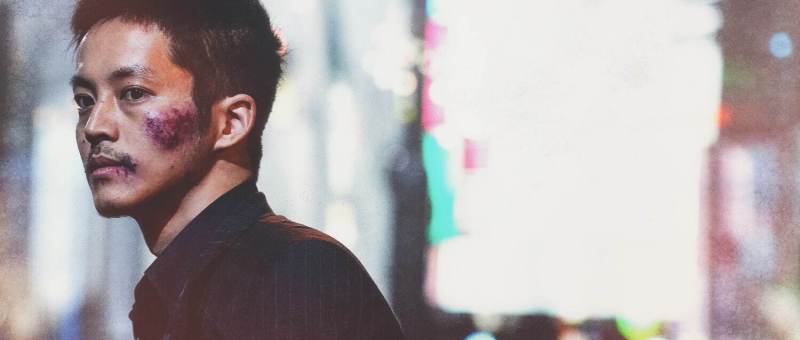
“The Showa era’s over. We don’t use guns now, business is our battlefield.” a recently released foot soldier is told, finding himself in a whole new world emerging from a not so distant past of turf wars and street scuffles into a late bubble wonderland of besuited corporatised gangsters. Set in 1988, Kazuya Shiraishi’s Blood of Wolves had been about the twilight of post-war gangsterdom forever associated with an era that was literally about to pass. Set three years later in the twilight of the bubble economy and an already established Heisei, Last of the Wolves (孤狼の血 LEVEL2, Koro no chi: Level 2) finds no longer rookie cop Hioka (Tori Matsuzaka) taking on the mantle of his late mentor Ogami, attempting to broker peace by getting uncomfortably close to yakuza. 

At the end of the previous film, Hioka had managed to engineer a truce between rival gangs Odani (with whom he is affiliated), and Irako through pushing top Odani guy Ichinose to take out boss Irako. Three years later, the peace has held and in any case Heisei yakuza no longer take violence to the streets. The release of crazed Irako foot soldier Uebayashi (Ryohei Suzuki), however, threatens to destabilise the local balance of power. Despite mournfully declaring that he doesn’t intend to wind up back in prison, Uebayashi’s first call on release is to the sister of one of his guards whom he rapes and kills in quite gruesome fashion. Hioka is put on the case and partnered with a genial veteran, Seshima (Yoshiko Miyazaki), weirdly excited about investigating a murder at this late stage of his career, but quickly realises that Uebayashi’s recklessness is primed to destroy everything he’s built. 

Having started out a straightlaced rookie, Hioka has fully incorporated the Ogami persona dressing in sharp suits and sunshades, driving a sports car, and hanging out with the Odani guys, while also using his girlfriend’s little brother Chinta (Nijiro Murakami) as a mole in rival gangs. As a cynical reporter points out, however, Ogami was essentially “undercover” in that he understood hobnobbing with yakuza was part of his job and something he did solely to keep civilians safe by preventing another street war. Hioka has started to lose his way, enjoying himself a little too much and already way out of his depth as the fragile peace he’d brokered by less than ethical means begins to crumble beneath his feet. 

Having been in prison, Uebayashi is unaware of the various ways in which the world has changed seeking to return to old school rules of gangsterdom, ironically lecturing his superiors on the absence of jingi (honour and humanity) in their new corporate existence. He’s a monster and a sadist, but his violence is also a result of the horrific abuse he suffered as a child which led to an equally heinous act of revenge while as a member of the ethnic Korean Zainichi community, like Chinta and his siblings, he continually faces discrimination and social oppression. His first act on release is of revenge against the guards who relentlessly tortured him in prison, the murdered woman’s brother confessing that they wrote him up as a model prisoner in the hope he’d be released early so they wouldn’t have to deal with him anymore.  

Yet what Hioka and Uebayashi have in common is that they’re both pawns in a game they were unaware was being played. As it turns out the police corruption Hioka discovered during the previous film did not go away, and in certain senses they liked things the way they were before. Hioka’s truce is very bad for business for a certain subset at least. They might be minded to let a dangerous killer go loose if it disrupts Hioka’s attempt to suppress the criminal underworld to manageable levels. Mimicking the classic jitsuroku, Shiraishi throws in occasional voiceover from an anonymous narrator along with freeze frame and montage while skewing still darker in the levels of depravity among these desperate men fighting over the scraps of a world already in terminal decline even as the bubble seems fit to burst. Shiraishi ends on a note of change with the institution of the organised crime laws which have contributed to the ongoing decline of the yakuza, a relic of the Showa era unfit and unwelcome in the modern society, but also discovers that for good or ill there may yet be wolves in Japan.


Last of the Wolves screened as part of this year’s New York Asian Film Festival.

Teaser trailer (English subtitles)

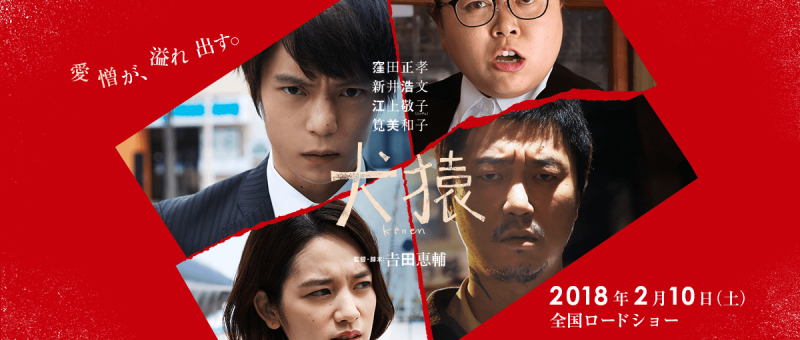
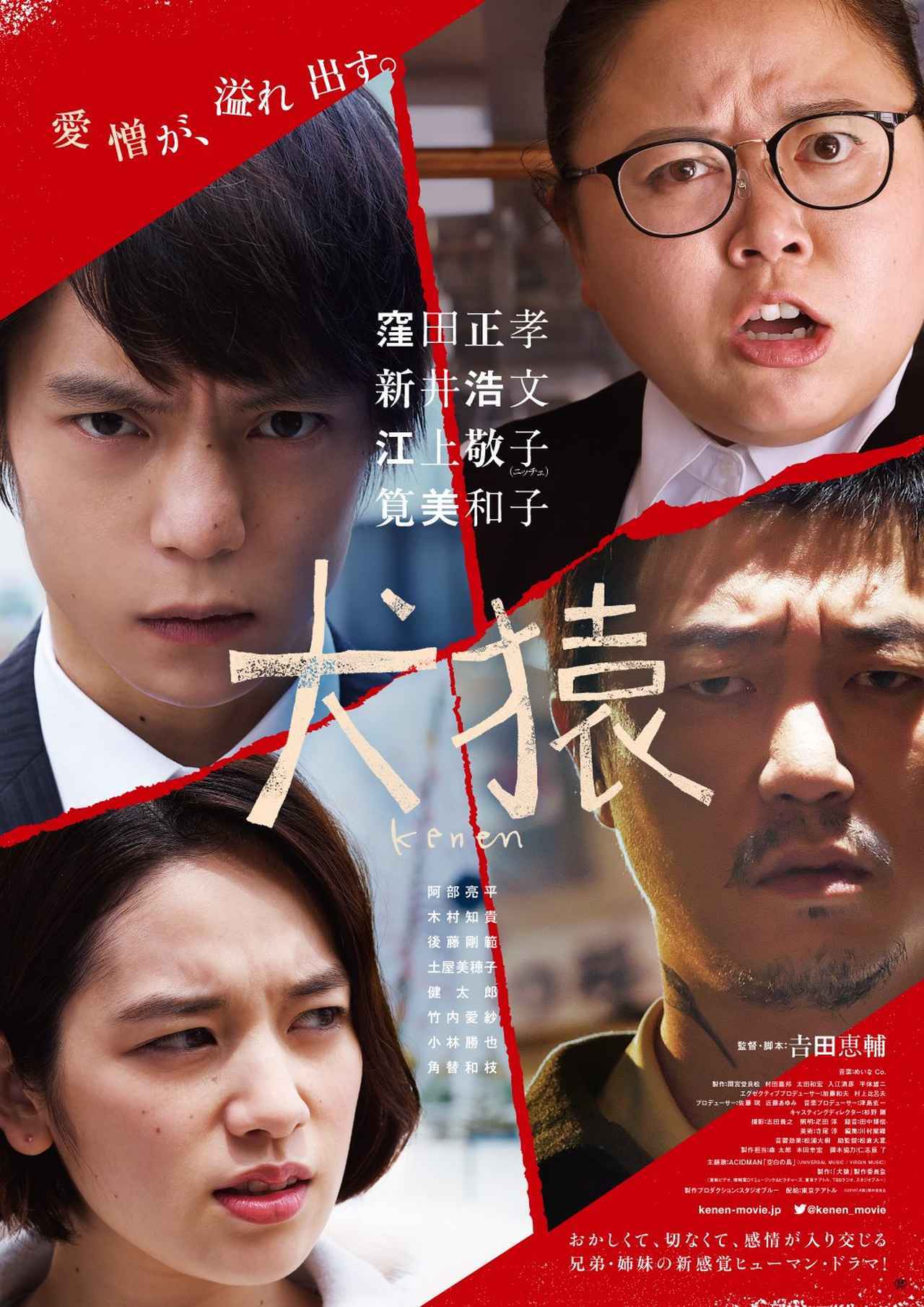
Thicker than Water (犬猿, Keisuke Yoshida, 2018)

Thicker than Water posterIn the long history of the Japanese family drama, the tensions are generally vertical rather than horizontal. Siblings are often engaged in trying to broker the peace or snatch a little bit of independent living away from an all consuming family environment. Then again, we meet most families when the kids are gown up and struggling with their approaching transition into other families or other lives. Kids fight, but grown up brothers and sisters are supposed to find a degree of civility at least even if the petty resentments of childhood never quite go away. For the parallel pairs of mismatched siblings at the centre of Thicker than Water (犬猿, Kenen), however, the reverse is true.

Older sister Yuria (Keiko Enoue) has taken over the family print shop now that her father is bedridden while her younger, prettier sister Mako (Miwako Kakei) is struggling to make it as an actress. Often resentful of her sister’s domineering, business-like attitude, Mako wilfully targets her weaknesses by making barbed comments about her weight and appearance of which she knows Yuria is insecure. Yuria, meanwhile, treats her sister as a foolish child, immediately taking over rather than let Mako do something “wrong” and thereby chipping into her insecurities about a lack of intelligence.

The spiky dynamic between the two sisters intensifies when Yuria develops a crush on a handsome young salaryman who makes regular visits to the shop to get his posters printed. Kazunari (Masataka Kubota), however, predictably falls for Mako (who is only interested in him as a way of annoying her sister). Meanwhile, he has sibling drama of his own in that his no good, thuggish older brother Takuji (Hirofumi Arai) has just been released from prison and made an unwelcome reappearance in his life.

What exists between the siblings isn’t quite “rivalry”, mostly they aren’t fighting over parental affection or esteem so much reacting against their obviously complimentary characteristics. Yuria envies Mako’s beauty, while Mako secretly envies her sister’s intellectual confidence even if she also resents her bossiness and affectation of superiority in order to mask her insecurity. Kazunari makes a show of his earnestness, that he’s doing everything “properly” – working hard, living within his means, paying off his parents’ debts and saving for his retirement, while underneath it all he envies his brother’s non-conformity even if its risks terrify him. Thus they snipe at each other. The thing about family is they know where all the buttons are and find pressing them extremely hard to resist.

That said, the familial bond is a strong one and perhaps they can snipe cruelly at each other precisely because it is unlikely to break. Nevertheless, when pettiness and cruelty intensify there can hardly be a positive outcome save perhaps to hit the reset button and send our warring siblings back to their idyllic childhoods in which they played together happily free from their adult resentments. Like children fighting over toys, each wants what the other has and seethes over the injustice of not being the one to have it. An extreme situation might seem to clear the air, repair the relationships and restore them to their original condition with each reaching an understanding of themselves and their opposite number, but old habits are hard to break and any thaw in relations is likely to be extremely temporary.

No stranger to extremes, Yoshida opens with a humorous sequence spoofing a trailer for a cheesy Japanese teen romance which is enthusiastically recommended by a series of vox pop champions, not least among them Mako who who somewhat unethically plays the part of a lovestruck young woman who over identifies with the movie’s themes. The trailer promises a “parallel love story” which, in truly Yoshida-esque irony, is more or less what we get as we witness the symmetrical tales of our two sets of warring siblings whose animosity almost tips over into co-dependency. Mirrors of each other, they love and loathe but remain unable to reconcile themselves to the various faults they see reflected in their opposing number and therefore unable to break free from the petty jealousies and resentments which define family life. There may be no escape from the intense self loathing unfairly projected onto an equally burdened sibling, but perhaps there is faint hope in the enduring continuity of their quietly simmering warfare even as it binds them in mutual misery.


Thicker than Water was screened as part of the 2019 Japan Foundation Touring Film Programme.

Original trailer (English subtitles)