Shrieking in the Rain (雨に叫べば, Eiji Uchida, 2021)

“Let’s change Japanese film” a duplicitous distributor tries to convince a diffident director though his “creators first” stance predictably turns out to be somewhat disingenuous. Inhabiting the same territory as Netflix’s Naked Director, Eiji Uchida’s meta dramedy Shrieking in the Rain (雨に叫べば, Ame ni Sakebeba) finds a young woman struggling to take charge of her artistic vision while plagued by workplace sexism, commercial concerns, and absurd censorship regulations but finally claiming her space and along with it her right to make art even if not quite everyone understands it, 

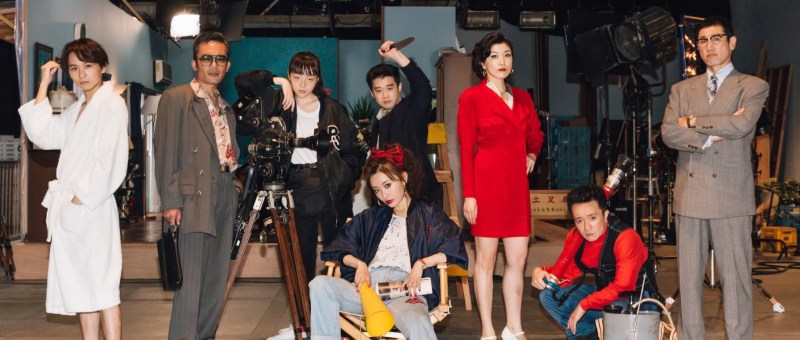
Set entirely on a Toei lot in the summer of 1988, the film opens with rookie director Hanako (Marika Matsumoto) locking herself inside a car with her hands clamped over her ears, fed up with the chaos that seems to surround her. How Hanako got the job in the first place is anyone’s guess, but it later becomes clear that she is in a sense being exploited by the producer, Tachibana (Kazuya Takahashi), who thinks a pretty young girl directing a softcore porno is a selling point in itself. Meanwhile, he’s teamed up with an US-based production company and its Japanese producer, Inoue (Kiyohiko Shibukawa), who seems fairly exasperated by the Japanese-style shoot and despite his pretty words is all about the business. For him, the main selling points are the actors, one a young idol star intending to boost his profile by getting into films and the other a veteran actress stripping off for the first time in an attempt to revitalise her fading career. 

Surrounded by male industry veterans, Hanako struggles to get her voice heard and feels under confident on set as they encircle her and bark orders she doesn’t quite understand. Her decisions are continually overruled by the male AD, cameraman, and finally Tachibana who always has his mind on the bottom line while Hanako’s inability to express herself to the crew results in endless takes of scenes that others tell her are “pointless” and should be cut despite her protestations that they are essential to the piece. A forthright female makeup artist (Chika Uchida) asks if filmmaking should really be this heartless as she watches Hanako humiliated by the chauvinistic cameraman who forces her to get on her knees and beg for help, while a more sympathetic grip (Gaku Hamada) later tells her that becoming a successful director has little to do with talent and a lot to do with the art of compromise. 

Nevertheless, Hanako tries to hold on to her artistic vision even while some roll their eyes considering the project is a softcore romantic melodrama revolving around a love triangle involving two brothers in love with same woman. Inoue claps back that film is a business, admitting that when he said creators first he just meant the ones that make money. According to him, anyone could direct the film because all anyone’s interested in is the actress’ bared breasts and the teenybopper appeal of top idol Shinji. Or in other words, it doesn’t really need to be good, it’s going to sell anyway. In any case, it seems incongruous to cast a squeaky clean idol in an edgy erotic drama especially considering that if they want to market it to his fans then they need to secure a rating which allows them to see it without adult supervision. Business concerns and censorship eventually collide when the rather befuddled censor puts a red line through some of their kink and explains that the actress’ third hip thrust has just earned them an X rating. 

Unlike Hanako and her similarly troubled junior camerawoman Yoshie (Serena Motola), veteran actress Kaede at least knows how to advocate for herself and get what she wants on set so that she can do her best work. Only in this case doing her best work means she wants to go for real with arrogant idol star Shinji who refuses to wear a modesty sock or trim his pubic hair to fit in with the arcane regulations of the censors board. Shinji is brought to task by aspiring actor Kazuto who is pissed off by his unprofessional behaviour while struggling to get a foothold in a difficult industry and apparently finding one through a romantic relationship with the producer which otherwise seems to be a secret from cast and crew. 

In any case a final confrontation prompts a rebellion against Inoue’s production line metaphor as the crew reaffirm that they are a team working together on an artistic endeavour not mere cogs in his machine. Reemerging in bright red lipstick, Hanako returns to retake what’s hers boldly claiming her artistic vision and taking charge on set before descending into an unexpected musical number. With a retro sensibility, the film neatly echoes late 80s production style with a cutesy background score often heard in movies of the era while posters for top Toei movies from the 70s and 80s such as Yukihiro Sawada’s No Grave for Us line the walls. A meta rebuke against the constraints placed on filmmakers by those who shout “creators first” to bolster their image but never follow through Shrieking in the Rain, is at once a homage to the classic days of low budget Toei erotica and an inspirational tale of an artist finding her voice in a sometimes repressive industry.


Shrieking in the Rain screened as part of this year’s Camera Japan.

Original trailer (no subtitles)
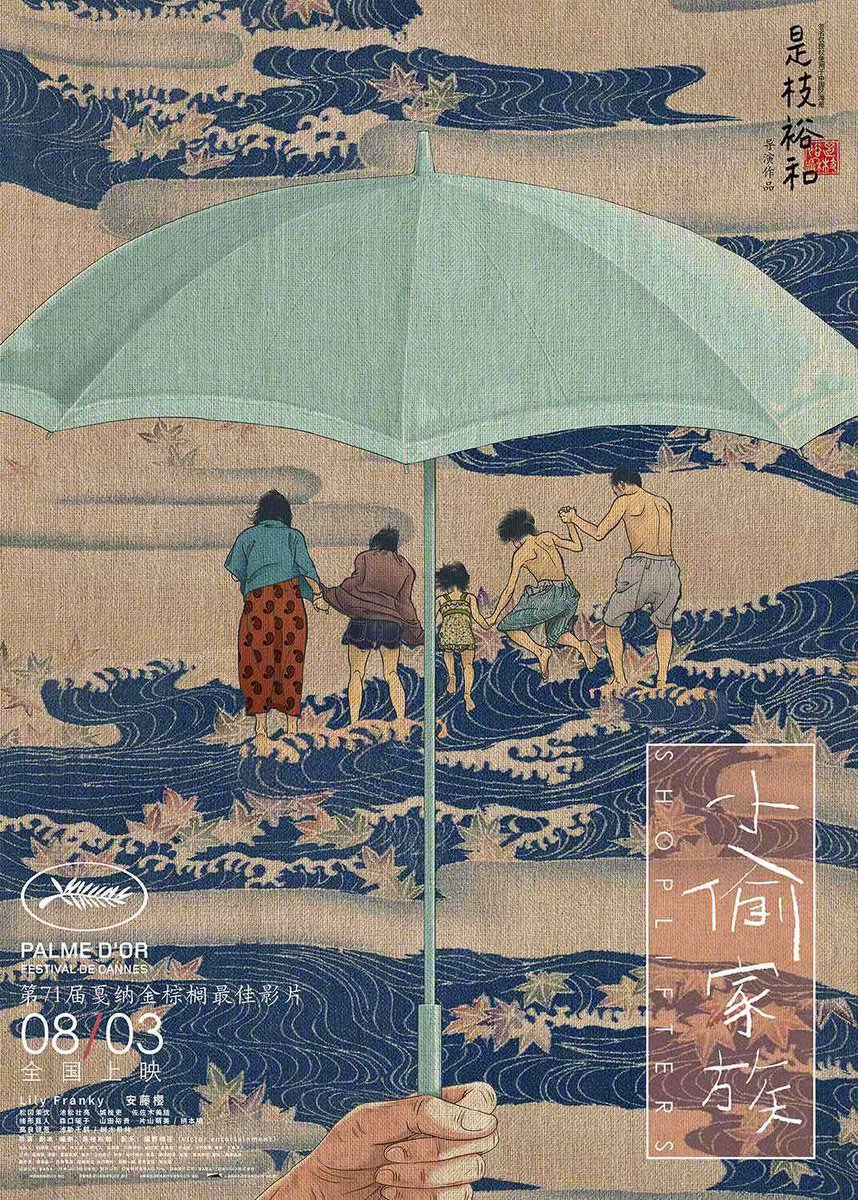
Shoplifters (万引き家族, Hirokazu Koreeda, 2018)

Shoplifters poster 2Tolstoy once said that all happy families are alike, but each unhappy family is unhappy in its own way. The family drama is the mainstay of Japanese cinema, though to be fair it rarely features families which are noticeably “unhappy” so much as struggling under the weight of social expectations. Nevertheless, since consumerism arrived in force, the concept of “the family” has come in for regular interrogation. That at the centre of Shoplifters (万引き家族, Manbiki Kazoku), Hirokazu Koreeda’s return to the genre with which he is most closely associated, are on one level among the happiest of families ever captured on film, but then again they are not quite like all the others.

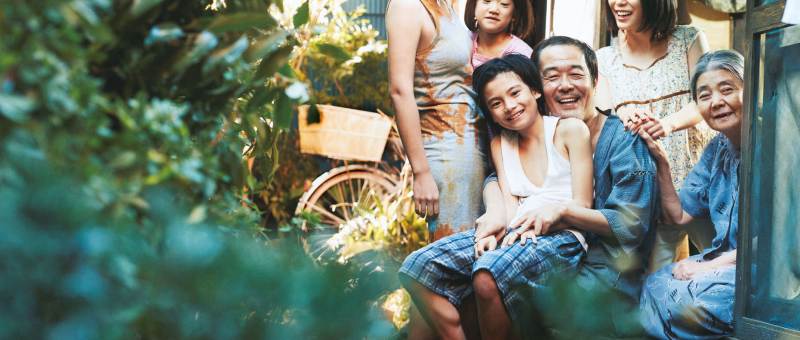
The Shibatas live in a small Japanese-style house owned by “grandma” Hatsue (Kirin Kiki) whose pension (or, to be more precise, that of her late husband) makes up a significant portion of the family income. Patriarch Osamu (Lily Franky) has a casual job as a day labourer while his wife, Nobuyo (Sakura Ando), works in a laundry. Her “sister” Aki (Mayu Matsuoka) tells people she works as a kind of hostess but actually dresses up as a schoolgirl and performs sex services behind a two-way mirror in a sleazy club. Meanwhile, Osamu and Nobuyo’s “son”, Shota (Jyo Kairi), alternates his time between homeschooling himself and helping out with the family’s only other source of income – thievery. It’s after one partially successful foray to the local supermarket that Osamu and Shota come across a little girl, Yuri (Miyu Sasaki), stuck out on a balcony alone in the freezing cold and decide to take her home for something warm to eat.

Of course, this family itself is the very definition of makeshift. Osamu and Nobuyo may be a “real” couple, but no one else is actually related. The Family Game may have attempted to take the family apart and expose it as an artificial mechanism devoid of real feeling in which each is simply playing the role expected of them, but Shoplifters asks the opposite – if a found family can actually be more “real” that the real thing because it has been chosen, is wanted, and continues to function because of an organic bond between individuals which exists in the absence of blood.

In a sense, the family itself has been “shoplifted”. Later, under questioning, Nobuyo is accused of “throwing away” Hatsue but she corrects them – she didn’t and she wouldn’t. Someone else “threw away” Hatsue and she found her. Hatsue was abandoned by her husband who fathered a family with another woman, but seemingly not with her. Alone she longed for a family of her own and most of all to avoid the looming threat of a “lonely death”. Whatever else they might have gained from the “arrangement”, Osamu and Nobuyo are at least able to offer her the thing that would make her life complete as she prepares to meet its end. By the logic of the family drama, one family must be broken in order to forge another and it’s true enough to say that each member of the Shibata clan has been pilfered from somewhere else but in the end perhaps it’s better this way, free of the cold obligation of a blood or legal tie.

Then again, there are cracks in the foundation. Little Shota, growing fast into a young man, is increasingly conflicted about the way the family makes ends meet. Trapped in low paid, casual employment, Osamu and Nobuyo are working but poor, unable to support their family on their wages alone. Injured at work, Osamu is left without compensation because he’s only a day labourer and therefore not entitled to workplace protections while Nobuyo is eventually forced into a “workshare” arrangement and then to resign when her boss cruelly tells her and a friend that they can decide between themselves which of them gets to keep their job. They steal because they’re hungry, but also perhaps because they enjoy this small way of rebelling against the system. Osamu tells Shota that stealing from stores is OK because no one really “owns” anything while it’s still on the shelf, but Shota begins to doubt his logic. It’s not just “taking”, it’s taking “from” and Shota is increasingly worried about who it is their way of life may be harming. He worries that in taking in Yuri the family is corrupting her, indoctrinating her into their morally dubious universe.

Morally dubious it may be, but life with the Shibatas is warm and safe which is a lot more than can be said for Yuri’s life with her birth parents who don’t even bother to report her missing – social services eventually figure out she isn’t around two months later and come to the conclusion that the parents may have got rid of her in some unspecified way. Which sort of “corruption” is worse – an upbringing filled with abuse and neglect, or one filled with love and habitual criminality? Yet it’s an act of love that finally breaks the family apart and leaves them at the mercy of cold and official forces too obsessed with their own sense of narrative to bother listening to the “truth”. Shoplifters wants to ask if the “natural” laws of society still serve us when little girls fall through the cracks and our definition of “family” is so narrow and rigid that it denies us a way of saving them. Sometimes the found family is stronger than the inherited one, but society is primed to crush it all the same in its relentless and indifferent quest to preserve the social order.


Shoplifters opens in UK cinemas on 23rd November courtesy of Thunderbird Releasing.

International trailer (English subtitles)