A Man and a Gisaeng (남자와 기생, Shim Wu-seob, 1969)

Under the authoritarian regime of Park Chung-hee, Korean Cinema was subject to increasingly stringent censorship and film was seen as an important means of moral instruction. The central message behind Shim Wu-seob’s raucous comedy A Man and a Gisaeng (남자와 기생, Namjawa Gisaeng) is that a man should be faithful to his family and avoid the double betrayal represented by drinking in the company of women which fritters away financial security and endangers his relationship with his wife. Yet the film is also subversive despite the underlying conservative message in making a mockery of so-called “traditional” gender roles.

Indeed, the film’s very thesis is that men are weak and women are strong. The men visit who gisaeng appear to have done so to reaffirm their dominant masculinity through their financial power in essentially paying women to be subservient towards them. Yet the gisaeng themselves are fully in control of the game they are playing as one makes clear when she tells a drunken businessman off after he gets handsy with her. She reminds him that a gisaeng is a person too, not a doll to be played with, and when he doesn’t listen she gets up and leaves proving who it is that has the upper hand in this situation. All the businessman can do is splutter and threaten the otherwise mild-mannered male manager. 

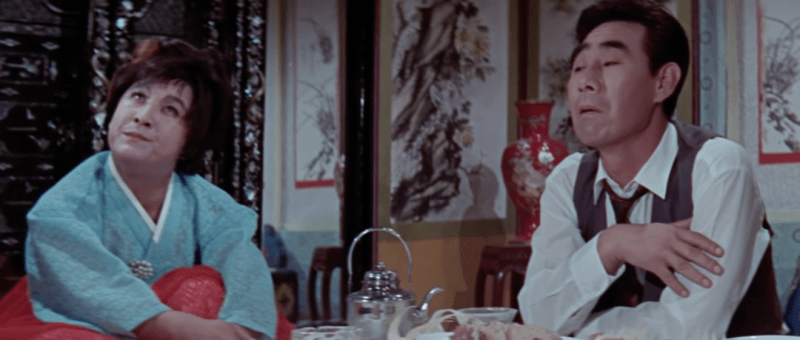
The hero’s boss, Heo (Heo Jang-gang), is a henpecked husband who visits gisaeng as a means of escape from his domineering wife (Do Kum-bong) who punishes him like a child. He asks Tae-ho (Gu Bong-Seo) to resign after catching him sitting at his desk darning socks to earn extra money and though it might be perfectly reasonable to fire an employee for brazenly doing another job on company time, Heo mainly lets him go because of his unmanliness. Tae-ho is a fully domesticated man who does work traditionally regarded as “feminine” in taking in sewing and looking after all of the domestic tasks such as cooking and cleaning as a “maternal” figure to his younger sister Tae-suk (Kim Chung-ja) who is then depicted as “manly” in her mastery of martial arts. 

It quickly becomes clear that the “effeminate” man Tae-ho is the film’s strongest character and the only one largely in control of his circumstances. He agrees to become a gisaeng partly because he needs to earn money after being fired, but also he claims as a “joke” before committing himself to punishing men who neglect their duty to their families by shaming them into changing their behaviour as he largely does with Heo who, bizarrely, develops a fascination with Tae-ho’s gisaeng persona San-wol as she apparently reminds him of the first love he was prevented from marrying because of her family’s disapproval. 

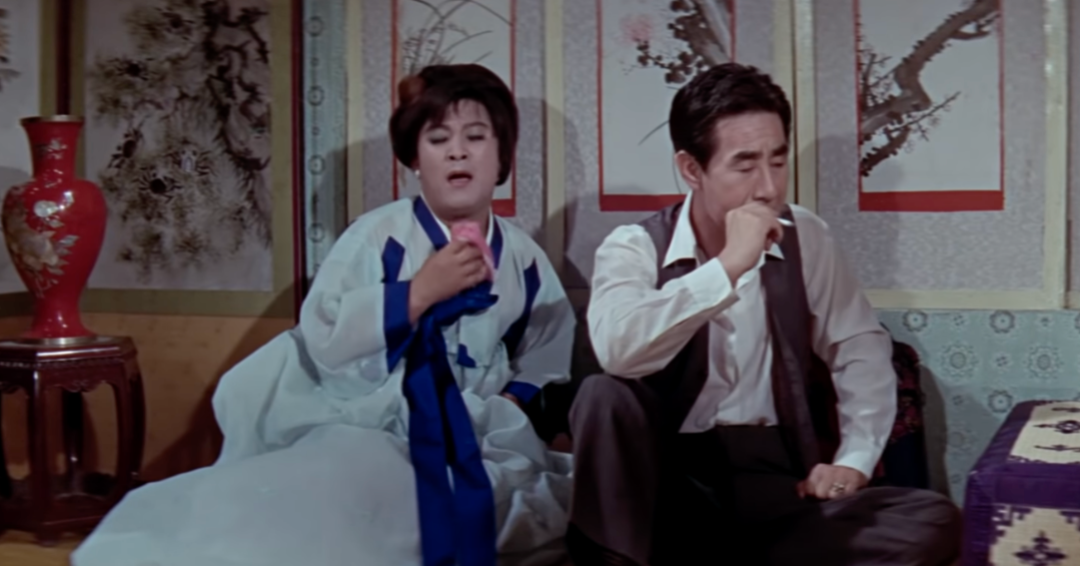
The gender subversion is in essence the joke, but there are also constant hints that it might not be and Tae-ho’s female persona is also authentic, not least among them the music cues which are extremely ironic. For example, the melody of “Don’t Fence Me In” plays over Tae-ho at the house of gisaeng, as do the strains of “Nature Boy” which also hint at a validation of Tae-ho’s expression of femininity. Before being fired, Tae-ho tells Heo that he’s repressing himself and it isn’t good for him, and there is a (joking) suggestion in the final scenes that Heo’s attraction to San-wol is partly born of her seeming masculinity. He did indeed unwittingly appreciate a drag performance from Tae-ho’s queer-coded musician friend, after all.

It’s also possible to read Heo’s reunion with his wife as a new appreciation for her own “masculine” qualities in her capacity to dominate him even if the film simultaneously suggests that the role of a “good wife” is to offer “affection” to her husband and if the husband visits gisaeng it’s the wife’s fault for not giving it to him. Even so, what the film’s conclusion implies is closer to a rebalancing than might be expected in allowing Jeong-mi, the gisaeng with whom Tae-ho falls in love to counter any suggestion of queerness, to open her own shop as an independent woman pursuing a relationship with Tae-ho who is then a travelling salesmen selling cosmetics. Jeong-mi asks Tae-ho to give up “knitting” before they get married which would signal a remasculinisation, but Tae-suk, though dressing in a more feminine fashion to meet her in-laws, is not directly asked to give up Taekwondo and it seems that her fiancé appreciates her feistiness rather than seeking to soften it. Even Heo’s wife if seeming more cheerful has not given up control in their marriage despite her own drag experience in the gisaeng house yet their relationship is now considered “repaired”. “Traditional” gender roles have ostensibly been reaffirmed, Heo’s marriage is saved and both Tae-ho and his sister are about to marry, but they’ve also been subverted and redefined in unexpected ways. Some of this may only be possible because A Man and a Gisaeng is an absurd comedy of the kind Shim was known for, but it nevertheless hints at an underlying plea for greater social freedom in an authoritarian era. 


A Man and a Gisaeng screened as part of this year’s Queer East .
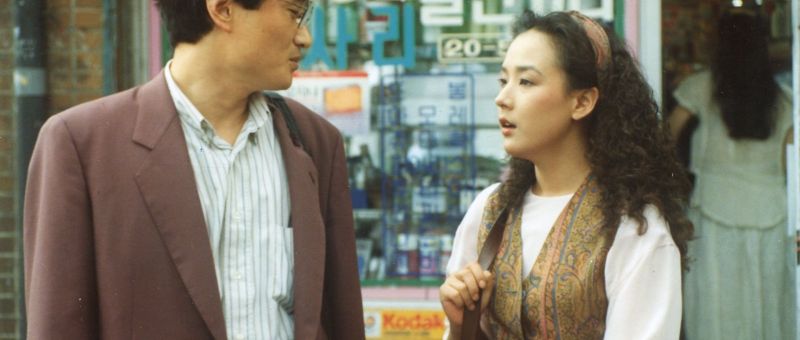
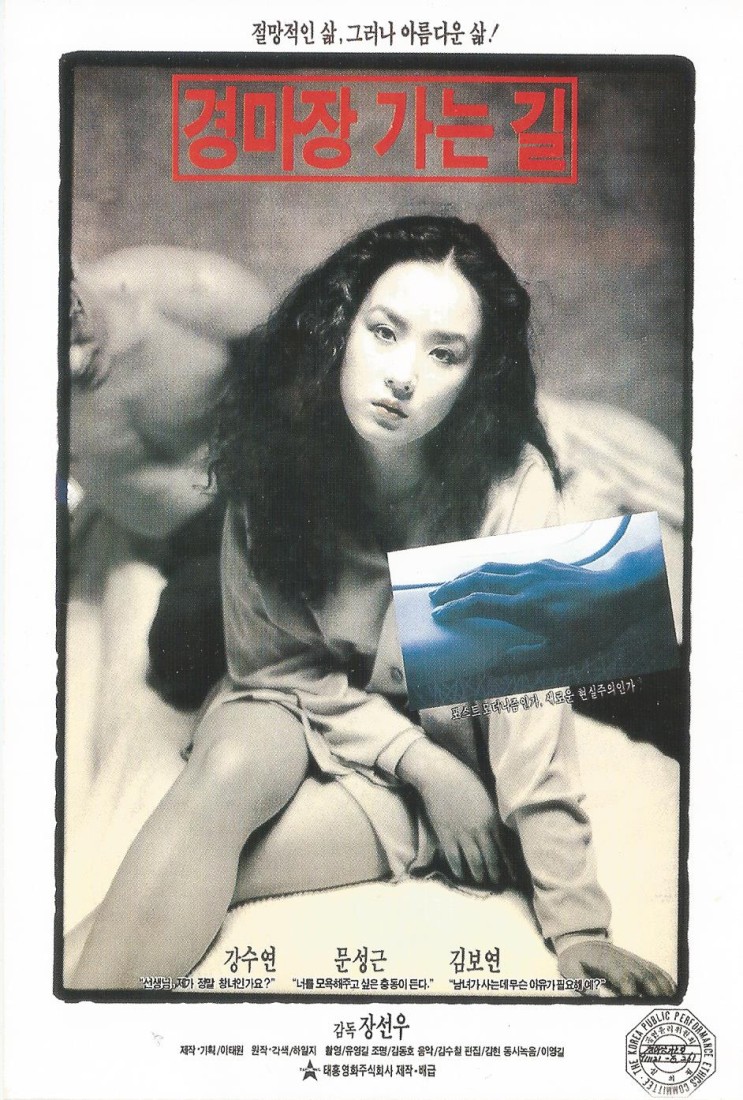
The Road to the Racetrack (경마장 가는 길, Jang Sun-woo, 1991)

A pompous scholar returning home after five years living abroad in France struggles to adapt himself to a changed Korea in Jang Sun-woo’s literary drama, Road to the Racetrack (경마장 가는 길, Gyeongmajang Ganeun Kil). Hoping to rekindle an affair with a fellow student with whom he lived for three and a half years, the man known only as R (Moon Sung-Keun) finds himself frustrated by the same patriarchal norms which he manipulates in an attempt to dominate and control his former lover while little realising that it is she who truly has the upper hand as he pathetically follows and entreats while begging her to sleep with him. 

J (강수연), as the woman is known, shows little desire to pick up where they left off and roundly refuses to sleep with R who can speak of little else. She tells him that things are different in Korea and hints that the cause of her reluctance is that R is still married and in fact has two children. While J had (seemingly) been content to live with R as his “wife” in France, in Korea she feels a need to be married herself and obviously cannot marry R as his wife will not divorce him. Old-fashioned in her thinking, R’s wife (Kim Bo-yeon) assumes the cause of the discord in their marriage is that she was not a virgin when they married though it seems clear that since obtaining his PhD in France, R has begun to look down on his humble family and no longer wishes to associate with his uneducated spouse. An ironic soap opera scene precedes one of their conversations in which a husband cooly tells his wife that he will do as he pleases and has no intention of granting her a divorce fully highlighting R’s hypocrisy though his own wife is depicted more or less like the one on screen eventually screaming at him and refusing his demands to end their marriage. 

Though R had told his wife that the fact she had lovers before they married is not a factor in his desire for a legal separation, discovering that J has met someone else and is thinking of marrying him sends R into a tailspin of jealously. Badgering J into sex, he is ultimately unable to perform and complains that the “shadow” of the other man is putting him off his stride. He demands that she makes a choice and encourages her to tell her new man all about their time in France whereupon he might like R abruptly dump her for being an impure woman. Meanwhile, R complains that she’s treating him “like a rapist”, which is ironic because that is exactly how he is behaving. She cries and refuses, asking him if they “really have to” and still he pushes on violently pulling at her clothes until she gives in. He can’t seem to understand why it’s “different in Korea” when they lived together for three years in France, as if a single instance of consent has eternal permanence. 

J always returns to him if for unclear reasons in the increasing toxicity of their relationship. She addresses him as “doctor”, while he repeatedly insults her and calls her stupid, mocks her middle-class background in an attempt to deflect the class difference between them, implies she’s useless without him and that all her achievements are really his own. He claims to have written her PhD thesis for her, and is irritated that she’s had some success since returning to Korea having completed her studies a year before him. He reads an essay she’s written and while he may have a point about an ambiguous turn of phrase, further insults her by claiming that the only good bits are the bits she ripped from an old essay of his, but is clearly annoyed that she’s managed to get an essay published after showing it to another man who further edited it for her. Suddenly he explodes in rage and claims he feels exploited, insisting that J pay him monetary compensation for his emotional pain. 

The relationship only begins to work again once it becomes transactional perhaps hinting at a societal change in an increasingly capitalistic society. As J is unable to pay the sum he asked for, R insists she work off the amount by becoming his personal prostitute. Though effectively constrained by his wife’s refusal to divorce him, he thinks that he controls J and is reasserting his patriarchal authority. But then he is clearly the one in thrall to J following her around and refusing to let her go while her decision to continue meeting with him seems like it may partly be born of fear and a sense of inadequacy if also a delight in wielding her power. His contribution to J’s PhD leaves her feeling underconfident and a fraud, fearing he’s right and she’s not much of a scholar just a girl with rich parents who could send her France to study. But she’s also tied to him in service to outdated patriarchal social codes that were not in play in France in which he is both husband and not. When he strikes her, she immediately apologises.

The contrast between the two cultures is clear on R’s arrival as he wonders at the thousands of neon crosses that now colour the nighttime skyline of Seoul, remarking that’s as if he’d found himself in a European war cemetery. Both he and J seem to be adrift in a new society, aimless and with no particular place to go. Hoping to rekindle their love, R tries to force J to go abroad again but she refuses and declines to give an explanation. Incredibly frank in its sexual language, the file presents an otherwise bleak view of the toxic relationship between the former lovers who inhabit a series of seedy motels and are seemingly unable to escape the destructive cycle of their love while the pompous hero can only comment on his inability to orient himself in a changing city by recording the number of steps from each direction to the racetrack as if trying to reassure himself of the geographical integrity of the landscape of his memory.


The Road to the Racetrack screened as part of this year’s London Korean Film Festival.

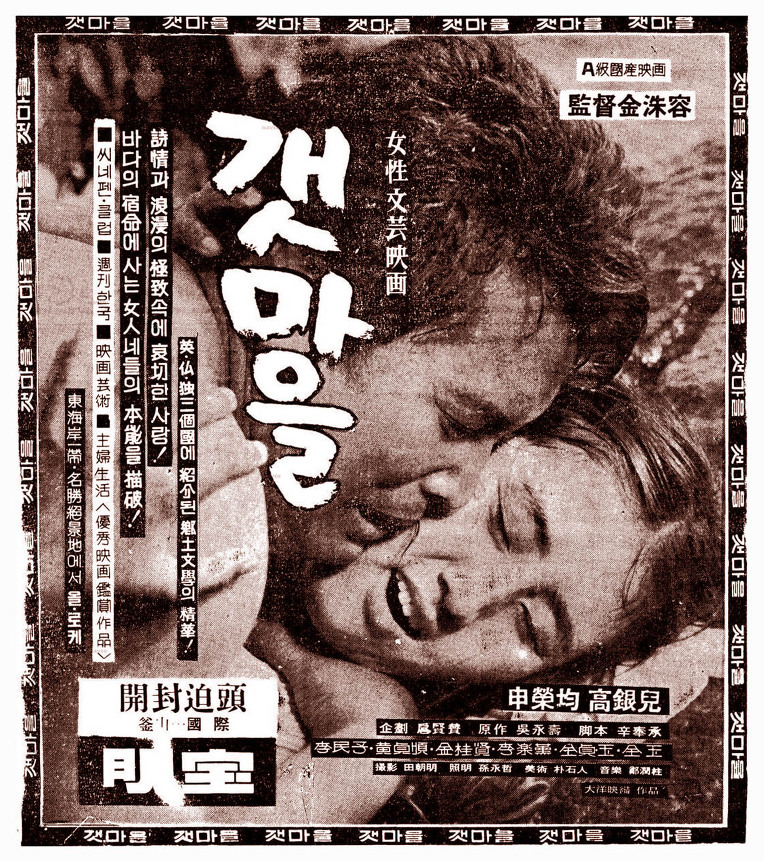
The Seashore Village (갯마을, Kim Soo-yong, 1965)

The Seashore village posterKorean cinema of the 1960s was a tightly controlled affair. The authoritarian government of Park Chung-hee had instituted the Motion Picture Law of 1962 which insisted on a studio system with stars under contract and a turnover of at least 15 films a year. The law intended to increase the amount of films produced for mass consumption, giving free reign to the melodrama and thereby accidentally undermining its more censorious aims. Nevertheless, The Seashore Village (갯마을, Gaenma-eul), adapted from a novel by Oh Yeong-su and part of the “literature film” genre for which director Kim Soo-yong would remain famous, goes much further than one would reasonably expect given the conservative nature of Korean filmmaking across the ages. A story of village life with all of its various superstitions and primitive practices, Kim’s film is a daring exploration of female sexuality and the collective power of women away from men.

An opening voice over introduces us to a melancholy fishing village where the life is hard and the people resigned to loss. The boats depart to great fanfare, but just as they are leaving someone remarks that he’s had a bad dream – bad dreams are one of many bad omens for sailors. New wife Hae-sun (Ko Eun-ah) doesn’t wait to watch her husband disappear over the horizon, she takes to the clifftop shrine of the Dragon King and prays for his safe return.

Her prayers are unanswered. A typhoon strikes and Hae-sun’s husband, along with another sailor, is killed. So young a widow, Hae-sun becomes an awkward problem for the villagers. Sang-su (Shin Young-kyun), a shady drifter, begins making subtle overtures which eventually turn into outright harassment and attempted rape. Hae-sun likes the family she married into and wants to stay true to her husband’s memory, but the forces of nature conspire against her.

While Hae-sun is a classically “good” woman who rejects the advances of Sang-su, the other village wives feel rather differently. Everyone except Hae-sun’s widowed mother-in-law (Hwang Jung-seun) knows about Sang-su’s obvious desire for Hae-sun but they see nothing wrong in it. Rather than the conservative atmosphere of the middle-class urban melodrama in which bodies of surrounding middle-aged women act as enforcers of moral discipline, these literal fishwives are of an earthier disposition. Many of them have been widowed with husbands lost at sea – the way they see it, you’d best take your pleasures where you can and there’s nothing wrong with a quick roll in the hay if it eases frustration and aids productivity. They laugh at Hae-sun’s prudery and marvel at her ability to carry on as normal after losing her husband not because of the grief, but because of the lack of intimacy.

It might be 1965 outside of the village, but the old ways still rule here even if they’re on their way out. In the old days, women did not remarry – a serious problem in a small village with few men around to replace those lost at sea. Hence, women have learned to live alone, supporting each other in place of men and often forced to do without them. In a surprising development, Kim flirts with the taboo of lesbianism – something which is addressed half-jokingly by the gossipy widows but eventually gives way to a literal roll in the hay with half the village women looking on in hilarity rather than horror. The women joke about living together but lesbianism does seem to be presented as an imperfect solution to their present problem in the lack of satisfaction available to them due to the absence of men. Far from a taboo, sexual desire is a normal part of life in the village – something ranked alongside eating and sleeping and no more or less embarrassing than any other bodily function. The widows crave men and are unafraid to say so even if some of them are content to make do with each other in resignation to their awkward status as older single women.

Hae-sun is in a slightly better position given that remarriage is apparently no longer so much of a taboo. Unfortunately that presents a problem for her as all she wants to do is stay with her family just as she is. She doesn’t like Sang-su and his increasingly aggressive behaviour towards her is unlikely to change that but nevertheless she eventually finds herself given to him almost against her will. Despite becoming a wife once again, Hae-sun’s beauty continues to curse her by causing problems between men wherever she sets foot. The problems, however, are definitively on the male side – men long to possess her, with violence if necessary, and ruin themselves in their immoral pursuit of a “pure” woman. The village widows rejoice in their earthy pleasures, finding comfort and release in each other but the male impulse, by contrast, is always towards conquest and control, domination rather than mutual support.

Life in the village is hard and often sad, but the women are happy and optimistic. They live the lives that are given to them, and do the best they can with what they have. The very antithesis of the lurch towards modernity, the simple life of the villagers harks back to something purer and more honest without the pretension of urban civility and apparently free from the political concerns of the day. Bold in its outlook, The Seashore Village is a surprisingly progressive effort from the Korea of 1965, subverting its “primitive” setting to present a positive picture of female power and sexuality.


Available on DVD as part of the Korean Film Archive’s Kim Soo-yong box set. Also available to stream for free via the Korean Film Archive’s YouTube Channel.