Ghost in Love (자귀모, Lee Kwang-hoon, 1999)

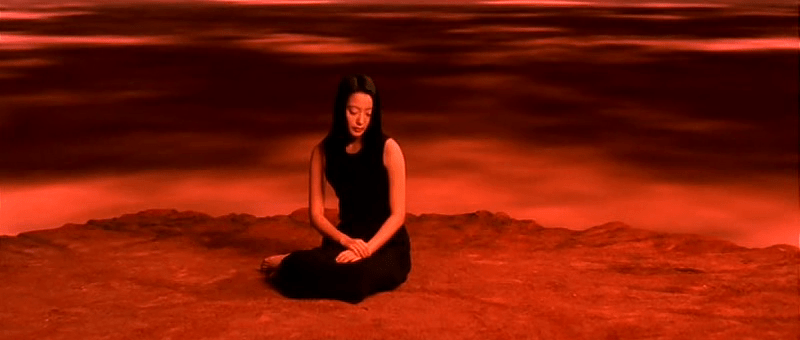
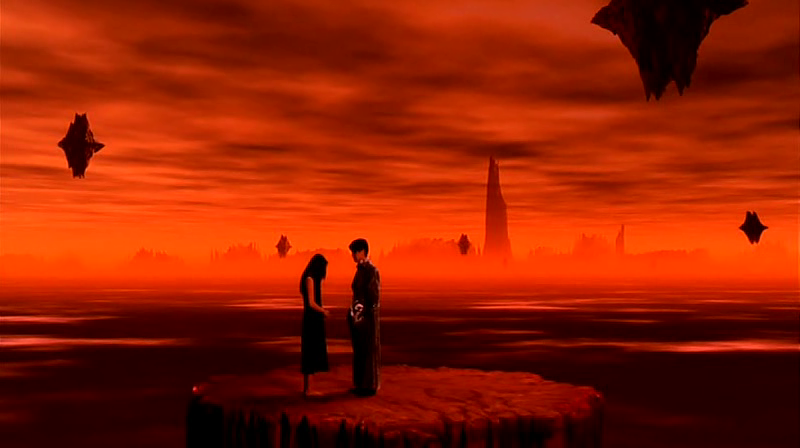
Caught in limbo, a young woman finds herself torn between the desire for revenge and letting go in Lee Kwang-hoon’s supernatural drama, Ghost in Love (자귀모, Jagwimo). Is love really what Chae-byul (Kim Hee-sun) was in, or is it more the sense of humiliation that’s she’s carried into the afterlife while obsessing over her cheating ex-boyfriend who was two-timing her with the boss’ daughter? Her colleague Kantorates (Lee Sung-jae), by contrast, had a love that was purer and reminds her that though it’s painful, if she really loved him, she’d be rooting for her ex’s future happiness rather than plotting how to mess up his life. 

Then again, the Korean title is “Suicide Ghost Club” and refers to the group into which Chae-byul is press-ganged after two of its grim reaper agents help her on her way having overheard her say she wanted to die because of all the romantic drama in her life. This literal purgatorial space located between heaven and hell is run like an exploitative company/cult in which the only metric of success is claiming more members. Chae-byul is warned that she doesn’t really have any choice but to join them, because otherwise she’ll become a vengeful spirit and lose all her memories, though she’s drawn to a mysterious presence known as Pale Face who does indeed become a terrifying spirit of vengeance, taking revenge primarily on the men who gang raped her while her fiancé, who later dumped her, looked on helplessly.

There is a kind of misogyny that’s most obvious in the afterlife but exists in the real world too. The film opens with a woman about to take her own life because of persistent fat shaming. She’s fat shamed by the grim reapers too and on into the afterlife, though in ghost form it’s revealed that she could be skinny if she wanted but is happiest in herself like this. Meanwhile, the grim reappears make other suggestive comments, leering over Chae-byul and remarking that a girl should have nice hips. Pale Face took her own life because of the trauma of her rape, the stigma of being a rape victim, and the betrayal of her fiancé who she says broke up with her because he thought that she was tainted. Even in the afterlife, she’s constantly washing in an attempt to make herself clean which is why she’s become so pale. 

Despite being told primarily from Chae-byul’s perspective, the film more or less normalises her boyfriend’s sexist views and behaviour in which he sees nothing really wrong with two-timing each of the women. Chae-byul tries to confront him, but he tells her Hyun-ju (Kim Si-won) was only visiting “to check on her stock transactions,” and shifts the blame onto Chae-byul for being paranoid and unreasonable. He says he liked her because she was “nice and comfortable,” but now she’s changed, so if she’s going to carry on “nagging” him like this, he may as well break up with her. HIs domineering attitude and characterisation of Chae-byul as a crazy girlfriend have the desired effect of causing her to back down and apologise to him. He may be a bit pathetic and materialistic in dating the boss’ daughter solely for advancement claiming it was his only chance to get on, but his behaviour isn’t really regarded as being particularly negative while Chae-byul’s desire for vengeance is, belittled in part because it involves disrupting not only his bright future but pointlessly harming Hyun-ju too.

Then again, perhaps these attitudes are intrinsic to the latent authoritarianism of the afterlife which is governed by the mysterious “messengers” who punish the transgressions of wandering ghosts. One grumpily rants about now having to work for a living, unlike in the old days in which some people would even try to bribe them for a longer life which they don’t do anymore in an allusion to Korea’s recent democratisation. The Messengers From Hades have a serious whiff of the KCIA mercilessly pursuing those who threaten to destabilise the system and then “disappearing” them. Nevertheless, Chae-byul eventually begins to come around to Kantorates point of view while quietly falling for him even as he struggles to move on from his own lost love. He knows he can’t be with her any more, but needs to find a way to tell her to move on so that he can do the same. A strange twist of fate gives them another chance at life and at love to live without wanting to die and try to find happiness even in a world of financial anxiety where consumerist desire has replaced spiritual fulfilment.
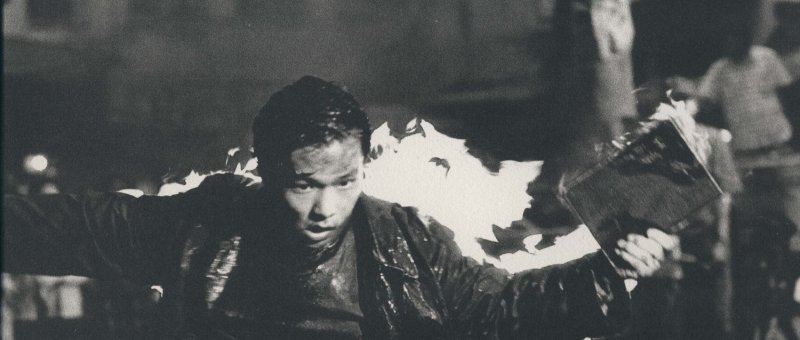

A Single Spark (아름다운 청년 전태일, Park Kwang-su, 1995)

In the present day, South Korea has become a prosperous society and leading world economy, but the miracle of its modernisation came at a heavy price. Socially committed filmmaker Park Kwang-su’s A Single Spark (아름다운 청년 전태일, Areumdaun cheongnyeon Jeon Tae-il) takes a trip back to the “truly dark days” of the Park Chung-hee dictatorship to expose the exploitation on which the modern society was, and in fact still is, founded, enabled largely by the wilful misuse of a fear of “communism” as manifested in the problematic presence of threat from “the North”.

Park filters his true life tale through the figure of a fictionalised author and activist, Kim (Moon Sung-Keun), who finds himself on the run from the authorities in 1975. Hiding out in a small town in a backroom rented by his pregnant factory worker girlfriend Jung-soon (Kim Sunjae), Kim is working on a biography of a labour rights activist, Jeon Tae-il, who self-immolated in order to protest the failure to properly enforce existing workers’ rights five years’ earlier in 1970.

Switching to crisp black and white, Park paints a bleak picture of working class life in the late 1960s as the oppressive Park Chung-hee regime imposed extreme export goals designed to boost the local economy. We first meet Jeon (Hong Kyeong-in), who was only 22 at the time of his death, selling umbrellas on the street before he is “lucky” enough to get a job in a tailoring factory. Committing himself to working hard and getting on, he is quickly disillusioned with conditions at the plant which has little light or ventilation and often forces its employees to work through the night without adequate breaks for food. When the young woman next to him begins vomiting blood and is sent home but subsequently fired, Jeon becomes radicalised. Told that there are no laws which protect workers, he is surprised to discover that there are but their existence has been wilfully kept from him. The law is written in a language which is almost impossible for him to understand, in highly formal text using Chinese characters which most ordinary Koreans, never mind those like Jeon denied a proper education, struggle to read.

Jeon begins agitating. He takes a copy of the statutes and a series of violations at the factory to those in charge, but no one is interested. Even when he convinces some of the other workers to come with him, the boss is eventually forced to make a token concession of listening to them but ultimately rolls his eyes and says it’s all very well but not good for business. Jeon isn’t asking for anything radical (save the later addition of provision for menstrual leave), only for better ventilation and for the existing laws to be obeyed.

Meanwhile, Kim meditates on his legacy in the dark days of 1975 where anti-communist sentiment runs high in the wake of the end of the Vietnam War. “Anti-communism” and the demonisation of the North were a central part of Park Chung-hee’s right-wing, nationalist military dictatorship and any attempts to form things like unions or left-leaning political associations were quickly decried as “communist”. Kim’s girlfriend Jung-soon is currently involved in trying to set up a union at her factory to combat many of the same kinds of issues that Jeon was fighting five years’ earlier, but she too is under a lot of pressure. Afraid of the authorities and of losing their jobs, many workers refuse to join and even after she reaches her quota the request for recognition is denied. She and the other activists are harassed by factory management beginning with a “friendly” meeting outside her home in which they try to bribe her with money and expensive fruits, and ending with a raid on the building in which some of the workers are holding a protest during which a woman falls ill and the others are badly beaten when they try to get her to a hospital.

Jeon and the others are lectured by management that they should try to feel more “patriotic” and be willing to suffer in order to raise the economy, bribed with false promises that they’ll all be driving luxury cars in 10 years’ time. Meanwhile, a woman coming to collect money from Jeon’s mother angrily exclaims that debtors should take rat poison and die (which seems counterproductive when they owe you money), and the managers dismiss workers’ concerns with the rationale that they obviously “aren’t hungry enough” to put up with starvation wages and poor working conditions. From the vantage point of 1975, Kim meditates on Jeon’s sacrifice as he witnesses the suicide of another young man, Kim Sang-jin – a student who quoted Thomas Jefferson’s words that democracy is an outcome of struggle at a rally at Seoul National University before publicly slashing his belly. He sees the tragedy of Jeon’s death as the “single spark” which lit a fire under the democracy movement, a torch he wants to pick up and keep aflame to guide them towards a better future.

20 years later, Park may be acknowledging that some battles have been won in a newly democratised Korea as Kim looks on with satisfaction in a peaceful marketplace while a student carries the book he has written about Jeon Tae-il under his arm, but implicitly suggests that not enough has changed and the same battles Jeon was fighting are still being fought. A melancholy meditation on political martyrdom, art, and legacy, A Single Spark pays tribute to those who gave their lives for a fairer world but is equally intent that their sacrifice must not be forgotten.


A Single Spark was screened as part of the 2019 London Korean Film Festival.

Maggie (메기, Yi Ok-seop, 2018)

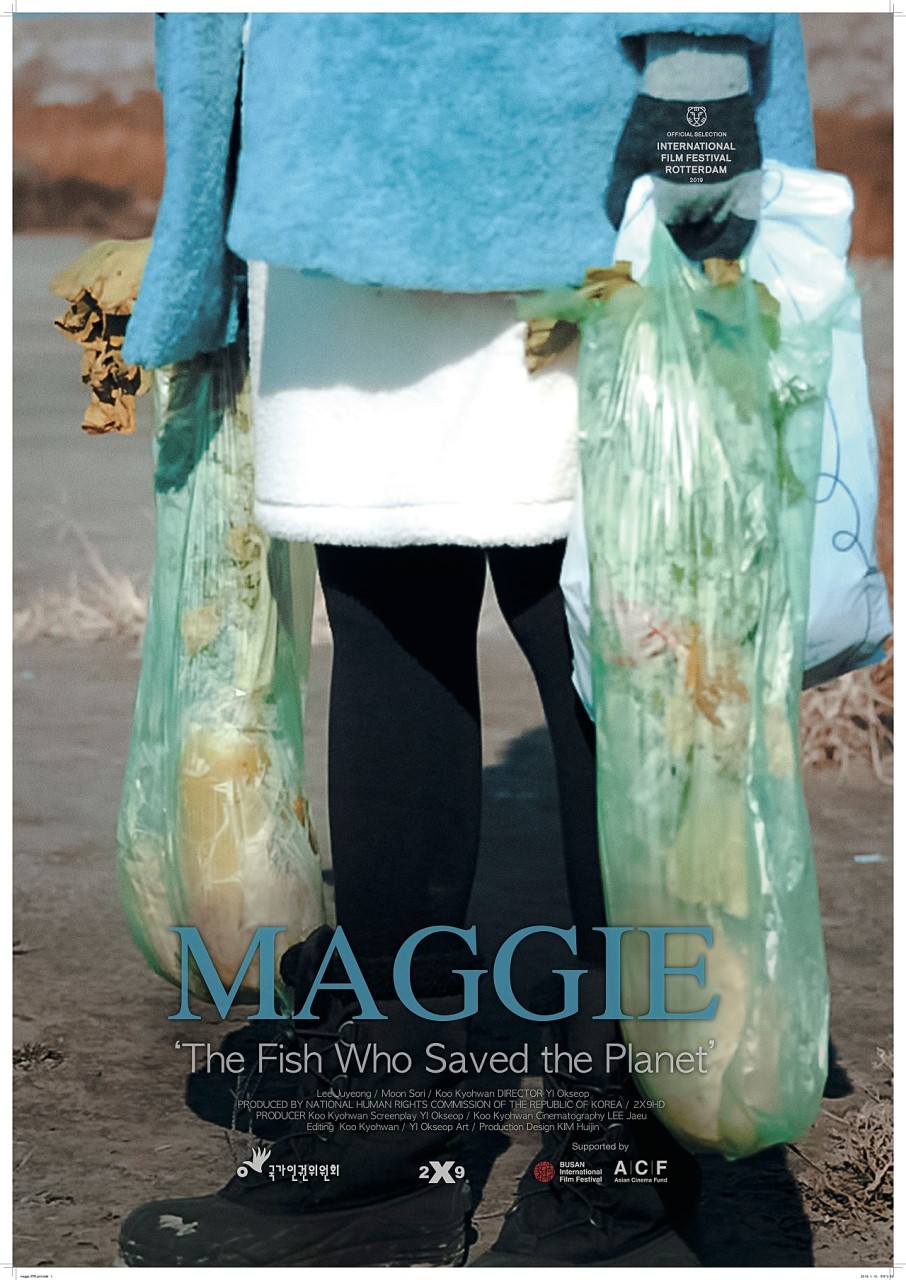
Maggie poster 1“When we fall into a pit, what we need to do, is not dig any further but quickly climb out” according to a mysterious post-it discovered by a nurse when picking up the laundry (apparently inexpertly performed by her preferred cleaning service). The aphorism turns out to belong to Doctor Lee (Moon So-ri), the head physician at Love of Maria hospital where the titular Maggie (메기), a catfish, lives in a small tank observing the life around her and sometimes predicting earthquakes and other earth shattering events. A surrealist odyssey across the “pitfalls” of modern society, Yi Ok-seop’s quirky debut feature ponders the ramifications of distance as her various heroes weigh up the nature of “truth” as an absolutist concept.

Narrated by Maggie, the drama begins when the radiographer and her boyfriend are unexpectedly snapped during an intimate moment in the X-Ray room. The picture is then stolen and held up for everyone to see, at which point nurse Yoon-young (Lee Joo-young) worries that she and her boyfriend Sung-won (Koo Kyo-hwan) have been caught out using the privacy of the X-ray booth for unintended purposes. As Maggie says, no one pays much attention to who took the photo only to who might be in it, which is why the entire hospital, except Doctor Lee, ring in sick the next day with only Yoon-young turning up in the morning with the intention to resign. Figuring out what must have happened (and seeing as she’s the only one not embarrassed we can guess who took the photo), Doctor Lee is very upset to realise that the entirety of her staff has probably lied to her. With her intense belief in humanity shaken, Doctor Lee decides to engage in a trust game with her new best friend, Nurse Yoon-young, and simply choose to believe what they’re told, testing their hypothesis by visiting a random employee to verify if they really are “sick”.

Meanwhile, as a result of the earthquakes Maggie intermittently predicts,  mysterious sinkholes have begun appearing all over the nation. This is good news in one sense because it provides lots of extra work for otherwise unoccupied young men like Sung-won who have lost out in Korea’s insanely competitive economy. Like Sung-won, the other men on his team are also well-educated types who otherwise wouldn’t be considering manual work and are hoping for something better once the sinkhole business finally clears up. Mistrust, however, also works its way into their relationship when Sung-won loses a precious white gold ring given to him by Yoon-young, later becoming convinced that one of his colleagues has swiped it.

The loss of the ring leads to an increasing unease between Yoon-young and her boyfriend which is deepened by a visit from Sung-won’s ex who suggests there may have been problems in their relationship which she feels Yoon-young ought to be aware of. Though Sung-won seems sweet natured and laidback, never having acted in any way that would have given Yoon-young cause for concern, she begins to doubt him – suddenly worried by his overly violent crushing of a can out in the street. Doctor Lee’s advice is to simply ask Sung-won directly if the accusations are true, but Yoon-young can’t seem to do it and continues living along side him somewhat resentfully as she eventually comes to the decision to “believe” her friend at face value without investigating further.

“The truth cannot exist wholesomely”, according to Maggie’s “father” (Kwon Hae-hyo). It will always be polluted by self-interest and personal bias. As Doctor Lee says, there will always be people who believe you and people who don’t, so perhaps a healthy level of cynicism is something you need to accept in order to go on living in the world. Even Love of Maria Hospital is not immune to the disease of misrepresentation – a former convent given over as a place of healing it was later bought by an arch capitalist and is now run as a private hospital business (not that it appears to have many “customers”), despite Doctor Lee’s rather amusing ad which proclaims it “of the patients, by the patients, for the patients”.

Finally Yoon-young concedes she’ll need to simply ask Sung-won about his past and gets an honest response, but his honesty only seems to see him falling into a deep pit of despair, calling out from the bottom in the hope of being understood. A surreal exploration of contemporary social woes from the rabidly capitalist society to the growing distance between people in an increasingly interconnected age, Maggie attempts to find the emotional honesty sweet spot but discovers that trust, like everything else, is a complicated business.


Maggie screens on 13th July as part of the 2019 New York Asian Film Festival. It will also be screening as part of the 2019 Fantasia International Film Festival on 17th/18th July.

Interview with director Yi Ok-seop from the Busan International Film Festival