
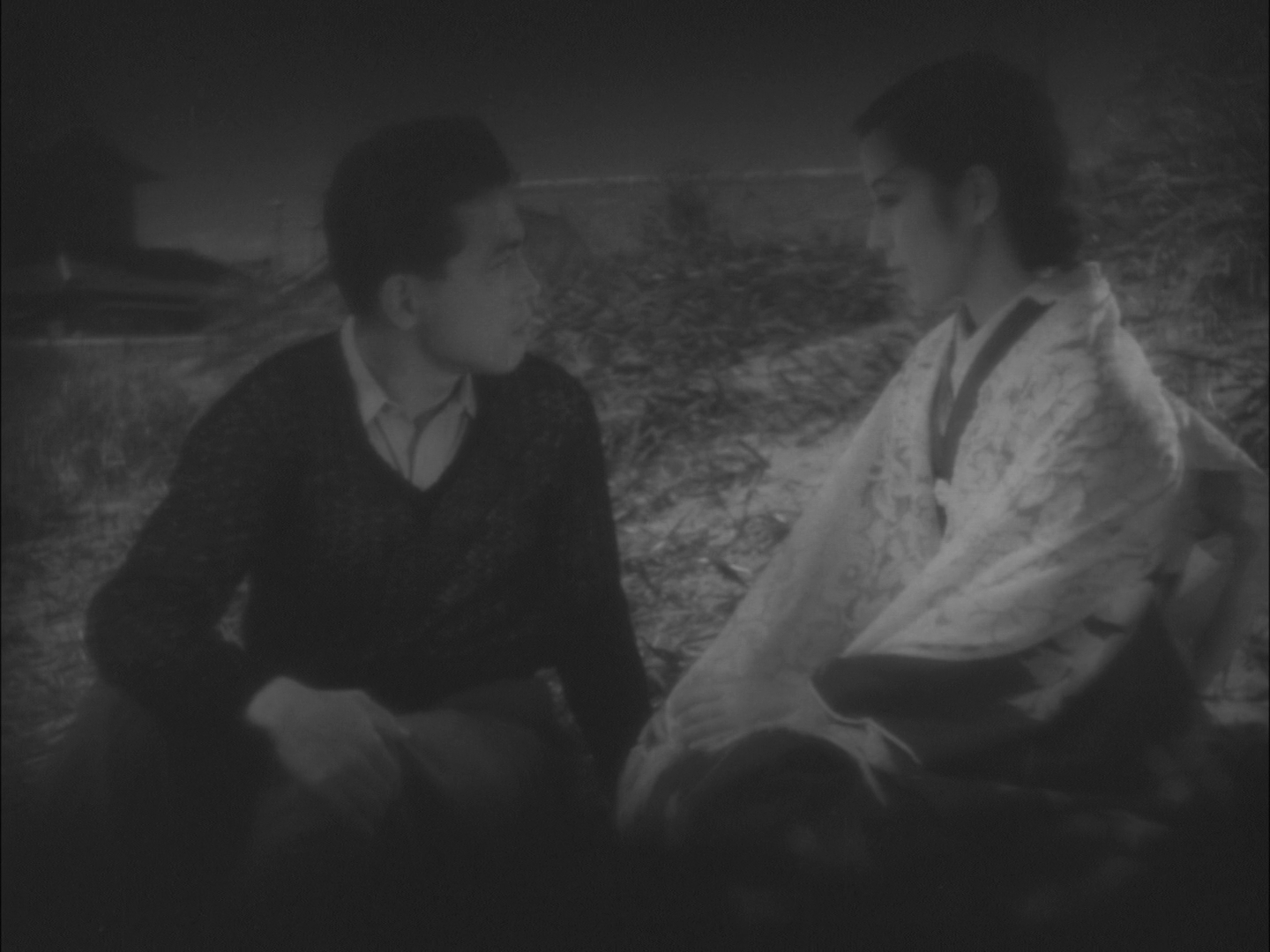
Changing class distinctions frustrate the lives of two bothers in Mikio Naruse’s The Road I Travel With You (君と行く路, Kimi to Yuku Michi). Adapted from a play by Yukiko Miyake, the film is in many ways about the limits of social change and in its rather melancholy conclusion eventually reinforces a conservative status quo in which the only way for the lovers to be together is death and that the love therefore must be willingly rejected.
Asaji (Heihachiro Okawa) is love with the young woman from across the way, Kasumi (Naoyo Yamagata), but cannot marry her because her family disapprove of his background as an illegitimate child, Kasumi’s conservative upbringing is signalled in the fact that she always appears in kimono unlike her best friend, Tsukiko (Masako Tsutsumi), a modern girl. Her family may be posh, but it’s also increasingly impoverished and Kasumi is to be promised to a wealthy older man who will, in return, save her family’s business. Asaji thinks he’s out of the running in two grounds, not only is he the son of a mistress but despite his comfortable circumstances is not in the position to be financially useful to Kasumi’s family. For her part, Kasumi is loyal to Asaji and says that she would rather die than marry someone else, but in reality has little choice. Her family gradually isolate her, preventing her from going out or seeing Tsukiko.
On one level, Asaji feels he should remove himself from the situation in order for Kasumi to make a good marriage. He feels that his situation is hopeless because neither he or his brother will ever be accepted by mainstream society. The fact that their mother (Tamae Kiyokawa) was a geisha and their birth illegitimate essentially means that they have no class status and no one quite knows how to place them. Asaji in particular resents his mother, finding her vulgar and irritated by her practicality in the conviction that she cares more about money than she does about them.
It may be that she’s more realistic and less sentimental than they are, as evidenced by her excitement that her younger son Yuji has received an offer adoption. Adoption to her doesn’t mean that she’d lose her son, rather she thinks she could accompany him, but that he’d be legitimised. As an adopted son-in-law, he’d no longer be a bastard child and would even be wealthy with an accomplished wife. Yuji, is however, not keen, in part because he’s seen a woman likes on the train that turns out to be Tsukiko, while he also doesn’t have the same sense of despair that prevents Asaji from moving forward. He rather amusingly suggests they’ll be able to coast on their good looks and thereby overcome the constraints of their class.
But Asaji is uncertain. If the world is such a romantic place, he asks why are things so difficult for them? The film begins like a romantic comedy in which the obstacles will somehow be overcome and the love between Kasumi and Asaji affirmed, but slowly the tone begins to darken. We realise that Kasumi is also a victim of her social class and gender. Essentially a treated as a tool by her father, her life and happiness have little value. Asaji is resigned to his fate and lacks the will to fight for their love, believing it to be impossible rather than challenging the status quo. These social conventions cannot in the end be overcome. Only through death can the lovers be together. She lived her life in her father’s house, Utsugi laments of Kasumi, she must have wanted to die outside it.
The boys’ mother meanwhile, rather insensitively suggests that Kasumi ended up like this because she didn’t listen to her parents. Essentially, she’s paid a heavy price for defying filial piety and desiring a happiness that only exists outside of conventional mores and patriarchal control. The modern girl, Tsukiko, now advises Yuji to accept the adoption offer. She too believes that their love can only end in death and has no viable future. She does not exactly as him to wait, but suggests that she might be strong enough one day to fight, though today is not that day nor is it certain it would ever come. Despite Yuji’s reprimanding of his mother and by extension everything she represents, the melancholy conclusion too seems resigned to the immutability of these social mores in which Yuji must give up on his impossible love and settle for a life of material comfort and respectability at the cost of emotional fulfilment.

