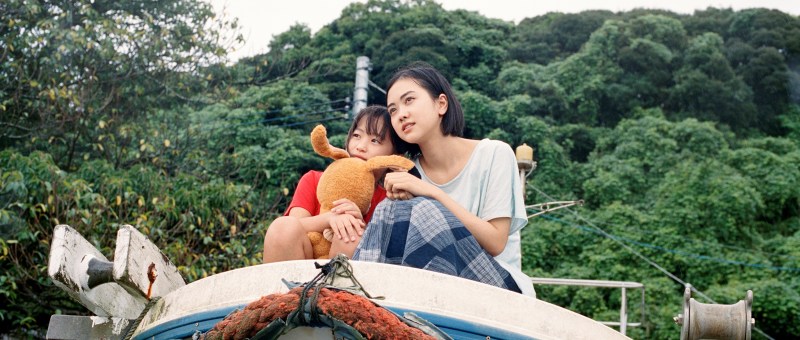

The Goldfish: Dreaming of the Sea (海辺の金魚, Sara Ogawa, 2021)

A young woman begins to come to terms with a painful maternal legacy while bonding with a neglected little girl in Sara Ogawa’s gentle coming-of-age drama, The Goldfish: Dreaming of the Sea (海辺の金魚, Umibe no Kingyo). As the title suggests, the heroine struggles with ambivalent feelings towards her future partly in the unresolved relationship with her mother but also in an unwillingness to move on without the firm anchoring of family, anxious about leaving the safety of her current life behind for the uncertainties of adulthood. 

About to turn 18, Hana (Miyu Ozawa) has been living in a children’s home for the past 10 years while her mother, Kyoko (Kinuo Yamada), has been in prison convicted of mass poisoning at a summer festival though she continues to protest her innocence. Part of Hana’s anxiety about the future stems from the fact that in order to apply for a scholarship to university she would need her mother’s signature, but she is reluctant to get back in contact with her and is even considering not going despite having studied hard with just that goal in mind. Perhaps surprisingly, Hana has kept her original surname and though seemingly living in a different area is largely shunned by her classmates, either because they know of her mother’s conviction or simply because she lives in a children’s home. 

Meanwhile, Hana finds herself bonding with a withdrawn little girl, Harumi (Runa Hanada), brought into the home for unclear reasons while remaining largely silent and keeping herself separate from the other children. Perhaps recognising something of herself in her, Hana takes the young girl under her wing and attempts help her adjust to life in care but is alarmed to notice scars on the back of her neck which may suggest she has been the victim of physical abuse. Of course, Hana has no way of knowing her family circumstances or if her mother was the one was harming her but is confused by Harumi’s obvious longing to return to a place in which she has been subjected to violence. As the sympathetic man running the home, Taka (Tateto Serizawa), reminds her, however, Harumi’s mother is the only one she’s ever known so of course like all children she wants to return to a familiar environment and continues to long for maternal love even if that love is also abusive. 

In her desire to protect Harumi Hana avoids reflecting on the similarities with her own life or relationship with her mother. Though many things remain unclear about her early years, Hana perhaps resents Kyoko for burdening her with a criminal legacy and essentially abandoning her into the foster system though it has to be said the children’s home is a warm and welcoming place where the children are each loved and well cared for. Nevertheless she fixates on her mother’s parting words to “be a good girl”, in a way like Harumi thinking that her separation from her mother is somehow her fault for being “bad” and if only she were good enough her mother would come back. Looking after Harumi she finds herself saying the same thing, fearful that she’s turning into her mother and that her maternity is necessarily corrupted beyond repair.  

Like the goldfish in her fishbowl, she longs for freedom and independence but is also afraid of it. Through the gentle bond they begin to build the two young women save each other and themselves, Hana giving herself permission to fail, to not always be “good” and to live her life in the way she wants unburdened by the stigma of her mother’s crime while Harumi discovers a kind of maternal love that is positive and supportive without the threat of violence. Nevertheless, the release she chooses despite its metaphorical qualities is also potentially destructive in that goldfish are freshwater creatures unlikely to survive in the highly salinated environment of the ocean. Even so in letting go of her trauma she begins to move forward into a more certain adult world, determined to take Harumi with her in providing the care and protection her mother was unable to give her. A gentle coming-of-tale, Ogawa’s subtle, empathetic direction lends a touch of melancholy but also a lyrical, hopeful sensibility as the young women discover in each other the means to overcome their trauma. 


The Goldfish: Dreaming of the Sea streams in the US until Sept. 2 as part of this year’s Japan Cuts.

Original trailer (English subtitles)

Inuyashiki (いぬやしき, Shinsuke Sato, 2018)

inuyashiki_poster_B1_0206D_fin_ol_3Japanese cinema has long been preoccupied by the conflict between age and youth though it usually comes down on the side of the youngsters, even when rebuking them for their selfish immorality. Inuyashiki (いぬやしき), adapted from the manga by Hiroya Oku, is similarly understanding but makes a hero of its sad dad protagonist whose adult life has been a socially acceptable disaster, while finding sympathy for his villainous teenage counterpart who resents his lack of possibilities in an already unfair world.

Unsuccessful salaryman Inuyashiki (Noritake Kinashi) has just moved into a new house of which he is very proud but his wife (Mari Hamada) and children find small and old fashioned. He’s bought sushi to celebrate the occasion, but the other family members ignore him and head out for dinner on their own. Held in contempt at home, Inuyashiki’s working life is also something of a disaster in which he is publicly berated by his boss who threatens to fire him, leaving Inuyashiki kneeling in supplication just to be allowed to work until retirement so he can keep up the mortgage payments on that new house (which he bought for his family who all hate him).

To make matters worse, Inuyashiki has also just received the news that he is suffering from terminal cancer and has only a few months to live. His only ray of sunshine appears when he finds an abandoned dog, Hanako, and decides to adopt her but his wife orders him to throw the dog out in case it messes up the house (that she already hates). Sadly walking Hanako to the park with the intention of sending her on her way, Inuyashiki is struck by a mysterious blast and later wakes up to discover he has become an all powerful cyborg with booster rockets on his back and guns in his arms.

Inuyashiki’s first instinct is that he can use his new found powers to save people. Contemplating his mortality, Inuyashiki was made to feel that his life had been a failure; he’d never done anything of consequence and had never been able to protect anyone. Reviving a wounded bird in the street, he realises he has the power to heal along with super sensitive hearing which allows him to hear the cries of those in peril.

Meanwhile, the teenager caught in the same blast, Shishigami (Takeru Satoh), is heading in the opposite direction. Shishigami is also filled with resentment though mostly as regards his poverty and comparative lack of possibilities. He hates that his single-mother (Yuki Saito) has to work herself to the bone because his father (Kiyohiko Shibukawa) left the family for another woman with whom he has built another home and become extremely wealthy. He hates that his video game otaku friend (Kanata Hongo) is mercilessly bullied and has stopped coming to school altogether rather than fight back. Filled with a young man’s rage and a mild kind of psychopathy, Shishigami doesn’t see why it’s wrong to become a bully rather than fighting them. Frustrated beyond reason he declares war on an uncaring society and sentences everyone in Japan to death for their indifference to their fellow citizens.

The conflict between the angel and the devil concludes in predictably bombastic fashion as our two cyborgs go head to head in a climactic battle for the soul of Japan. Strangely enough both men are motivated by love even if one’s actions are darker than the other’s. Inuyashiki wants to protect, to be someone his family can respect and depend on – he flees the scenes of his miracles because he isn’t interested in being a “hero”, just in being of use. Shishigami, by contrast, is motivated by love for his mother whose continuing suffering proves too much for him to bear though his attempts to take revenge only end in more tragedy. Mustering all the technology of the age from smartphones to live broadcasts, Shishigami makes himself a familiar face on TV sets and LCD screens across the country to preach his message of hate as a declaration of war.

Shishigami proclaims that Inuyashiki’s sense of justice is no match for his hate, but there is a definite irony in the squaring off of two men from different generations trying to figure out their differences by pounding the living hell out of each other and destroying half of Tokyo in the process. Still, that is in many ways the point as these two “gods” actively choose the sides of light and darkness, vying for the right to rule the future as forces of destruction or salvation.


Screened at the 20th Udine Far East Film Festival.

Original trailer (English subtitles)