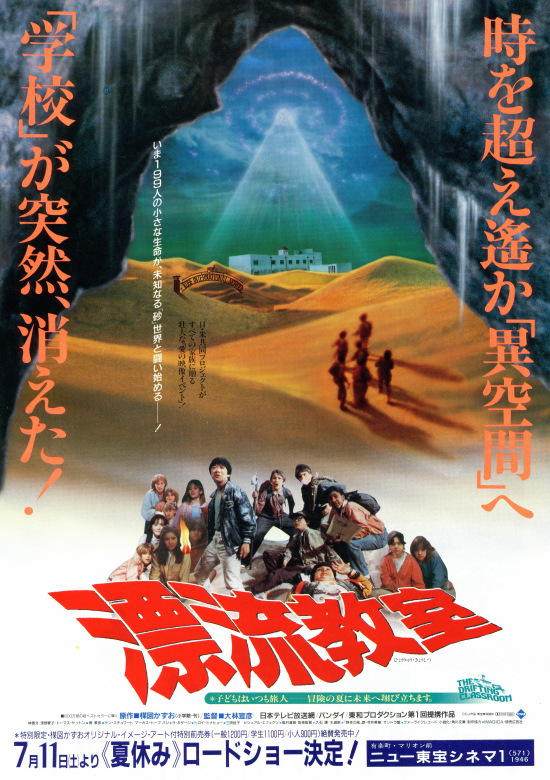
 Nobuhiko Obayashi may have started out as an experimental filmmaker and progressed to a lengthy narrative film career but he remains best known for his “what the hell am I watching?” cult classic Hausu. Aside from his 1983 take on The Girl Who Leapt Through Time, very little of his other work has travelled outside of Japan. In the case of 1987’s The Drifting Classroom (漂流教室, Hyoryu Kyoshitsu), this is doubly surprising firstly because it’s based on a hugely popular manga by the godfather of horror comics Kazuo Umezu and secondly because it’s set in an international school so around 80% of the dialogue is in English.
Obayashi jettisons most of Umezu’s original plot which involves an ordinary Japanese school being suddenly and mysteriously uprooted from its city centre location leaving only a gaping hole to mark its place. This time our hero is Shou – a teenage boy who has recently returned from living in LA and is attending Kobe International School until his Japanese improves enough to get into a normal establishment. Having lived abroad for so long, Shou is a totally Americanised boy with a rebellious, individualistic streak and just wants to hang out with his cool American pals rather than study like his parents want him to do so he can get a foot on the all important ladder of the Japanese educational system. Consequently he argues with his mother and says some very harsh things which leads to her telling him to get out and not to bother coming back – sentiments which both are about to spend the rest of their lives regretting.
Right before taking the register some weird shit goes down and there’s an intense storm which fills most of the school building with sand. Looking out of the windows, everything seems to have become desert. The kids and the two remaining teachers think about what to do and settle on practical things like rationing the food and water left in the school canteen. Back in Kobe, there’s just a giant hole in the ground and a whole lot of confusion….
For some reason, Obayashi decided to set the story in an international school which means that most of the dialogue is in English (though judging by the accents and languages there are some Europeans and students from other parts of Asia around too). This is the single worst decision of the adaptation as the dialogue, which is overly silly to begin with, is offered in stilted, halting tones by its disappointing child actors with the native English speakers not doing very much better than the Japanese kids who are at least trying their best. Perhaps for these reasons (or just out of operational necessities) the film is entirely shot in non-sync sound and the dubbing never quite links up either.
It almost seems as if Obayashi is targeting an overseas audience as his tone is very much indebted to ‘80s kids’ movies with its cast of slightly plucky (sometimes irritatingly so) youngsters trying to solve the mystery of their own disappearance. However, it doesn’t seem as if the film was ever released outside of Japan (where it has never even been released on DVD) despite the presence of one time American star Troy Donohue leaving the strange Americanisms as a sort of exotic plot element with no real resolution.
Though the story seems to be aimed at older children with the usual themes of perseverance in times of adversity and the importance of teamwork and friendship, there are a few scary moments including a psycho style gag where a teacher’s head spins round before dissolving into sand. However, the majority of the special effects are extremely unconvincing resembling an ‘80s kids TV programme with a host of matte paintings, bad green screen, early digital effects and even some tokusatsu style people in rubber suits playing strange cockroach-like monsters. Arguably the best of these is the friendly creature who hangs round with the kids from school and most closely resembles a disgruntled potato with legs (but may actually be giving the most accomplished performance in the entire film).
All of this could have added to the film’s kitsch, “bad movie” vibe but Obabyashi opts to get serious every now and then and ruins everyone’s fun in the process. Weirdly, everyone just seems to accept the “timeslip” argument right away as if that’s a perfectly normal thing that happens every now and then like sinkholes or spontaneous human combustion – there’s even a geologist (?) being interviewed on the news who just says “yes – it is probably a timeslip” when asked to provide some “scientific commentary” on the disappearance of the school children. Completely bizarre but not in a very interesting way, The Drifting Classroom is a misfire on all levels neither making a good adaptation of its source material or an entertaining movie in its own right. Camp classics enthusiasts or Obayashi fanatics only.
The Drifting Classroom was also adapted into a TV drama in 2002 under the title of Long Love Letter which is much better than this movie.
A short scene from the film starring its best character whom I have decided to name “Spuddy” (English dialogue):
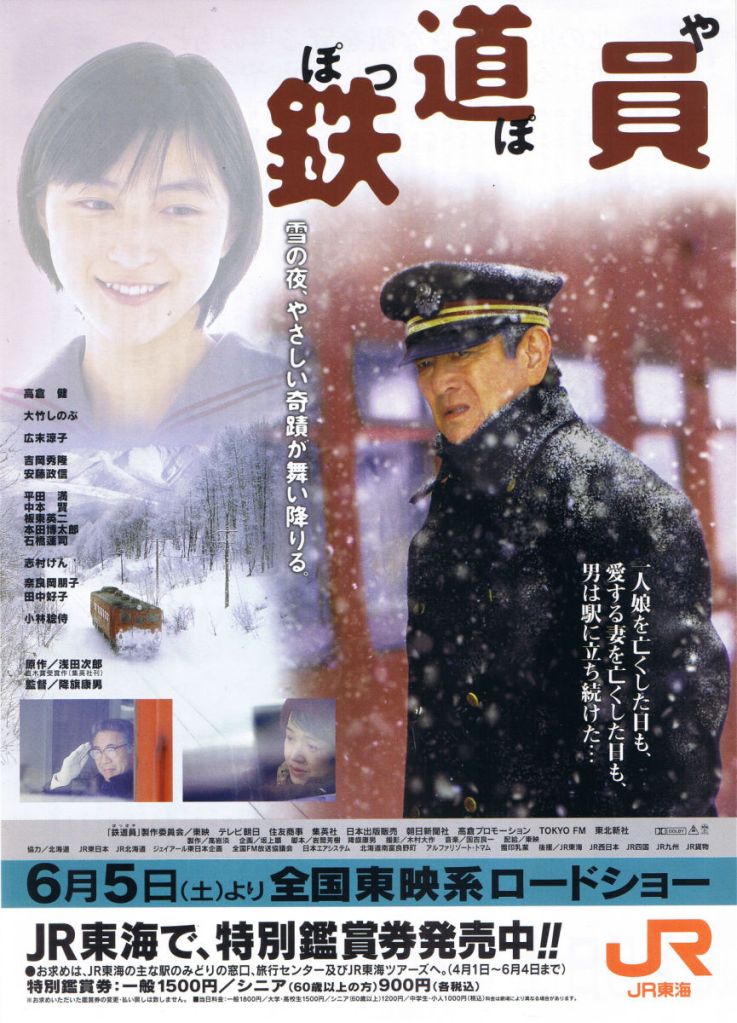 The late Ken Takakura is best remembered as cinema’s original hard man but when the occasion arose he could provoke the odd tear or two just the same. 1999’s Poppoya (鉄道員) directed by frequent collaborator Yasuo Furuhata sees him once again playing the tough guy with a battered heart only this time he’s an ageing station master of a small town in deepest snow country which was once a prosperous mining village but is now a rural backwater.
 Windows on Worlds