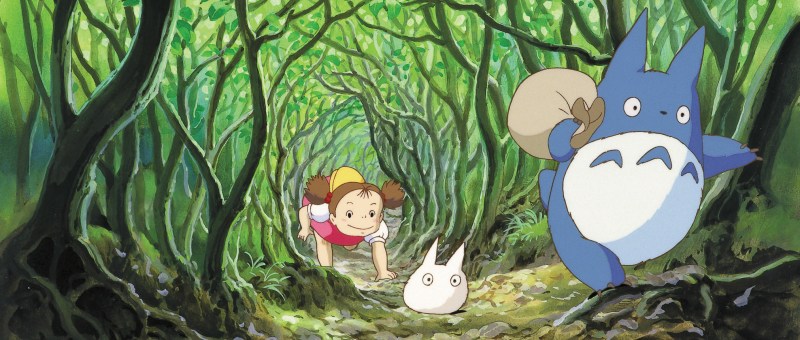

“Trees and people used to be good friends” explains a father to his little girls newly arrived in the idyllic countryside of post-war Japan seeking respite from the destructive modernity that has made their mother ill. Released alongside the harrowing wartime drama Grave of the Fireflies, My Neighbor Totoro (となりのトトロ, Tonari no Totoro) is a charming tale of childhood adventure if not quite without its shades of darkness in which two sisters embrace the wonder of the natural world while trying to come to terms with mortality and the uncertainties of adulthood.
Satsuki (Noriko Hidaka) and her younger sister Mei (Chika Sakamoto) have moved into a large, ramshackle house in a rural village on the outskirts of Tokyo for the benefit of their mother’s health while she remains in hospital a few miles away. Living with their cheerful father (Shigesato Itoi), a professor in the city, the girls rejoice in exploring their new environment learning of the dust bunnies that inhabited their home before they moved in. An old lady from the village (Tanie Kitabayashi) who’s come to help keep house until the girls’ mother returns home explains that she could see the “soot spreaders” too when she was a child but presumably not anymore. The idea that the soot speakers will soon move on appears to make the sisters sad, and everyone including the parents is quite excited about the idea of living in a “haunted house” even if it’s one that rattles a little in the wind. It’s younger sister Mei who later follows the trail of acorns that mysteriously appear in their home and encounters a series of strange forest creatures she names “Totoro” that eventually introduce the girls to a parallel world of magic and fantasy.
Their father probably doesn’t believe them, but indulges the girls’ stories and adventures while encouraging them to embrace a sense of wonder in their environment along with something deeper and older than contemporary modernity. “You probably met the king of this forest” he explains to Mei, pausing to offer a word of thanks to the ancient tree he says first drew him to the house that will be their new family home. Whether Totoro is “real” or simply a childish fantasy he helps the sisters escape their anxiety over their mother’s absence, not least by introducing them to new life in the seeds the girls plant in their garden and patiently wait to grow. The oldest, Satsuki, is perhaps a little more aware, worried that her father might not have told her everything about her mother’s condition and processing the idea that there is a possibility she won’t come home to them. She wants to protect her sister from the same fears but perhaps can’t, eventually losing her patience with her and instantly regretful when Mei goes off in a huff and gets lost.
There is darkness in the village too, a floating sandal in a nearby lake giving rise to fears that a child may have fallen in and drowned, but there’s also the gentle strength of the community in the kindly old lady and her shy grandson Kanta (Toshiyuki Amagasa) along with all the other villagers who come out in force to look for Mei fearing she may have tried to visit her mother at the hospital on her own. The old lady prays furiously while muttering Buddhist sutras and it’s probably not a coincidence that Mei sits by a row of Jizo statues after realising that she’s lost not knowing what to do. The girls are always careful to offer thanks at the Jizo shrine just as their father thanked the tree though it’s Totoro and the Catbus that eventually bring them back together echoing a sense that in a just world kindness will always be repaid.
The countryside is in many ways closer to that just world, largely free of the evils of modernity such as the pollution of industry that has corrupted the cities. Technology is often unreliable, dad’s train is late, telegrams bring bad news, and telephone calls result in anxious waits, but life in the village is peaceful and happy and the people help each other when times are hard. It may be an idealised vision of rural living, but there’s no denying its appeal. Evoking a sense of nostalgia in its beautifully painted backgrounds, Miyazaki’s gentle drama is like much of his work an advocation for the importance of nature as a source of healing but equally for wonder in the fantastical adventures of two little girls finding strength and possibility in the heart of the forest.
My Neighbor Totoro screens on 35mm at Japan Society New York on Nov.4 as part of the Monthly Anime series. Japan Society will also be hosting a talk with puppet artist Basil Twist on Nov. 10 delving behind the scenes of the Royal Shakespeare Company’s currently running stage adaptation.
Trailer (English subtitles)
Images: © 1988 Studio Ghibli
 The Japan of 2116 is a peaceful place. Crime is at an all time low thanks to the Sybil system which monitors the nation’s citizens issuing them a “Crime Coefficient” rating assessing how likely they are to commit a crime. When a potential criminal’s Psycho-Pass reaches an unacceptable level, the Public Safety Bureau are called in to hopefully put a stop to any criminal activity before it has the chance to occur.
 Windows on Worlds