City of Wind (Сэр сэр салхи, Lkhagvadulam Purev-Ochir, 2023)

Part way through Lkhagvadulam Purev-Ochir’s Mongolian drama City of Wind (Сэр сэр салхи), a young woman asks the hero if he’s ever felt as if he were split in two and there’s a part of him sitting somewhere else vaguely unfulfilled. It’s a feeling he might know all too well as he finds himself torn between the traditionalism of his upbringing and the pull towards the shiny consumerism of the modern city even as his school friend chuckles that he can’t wait to leave the country altogether.

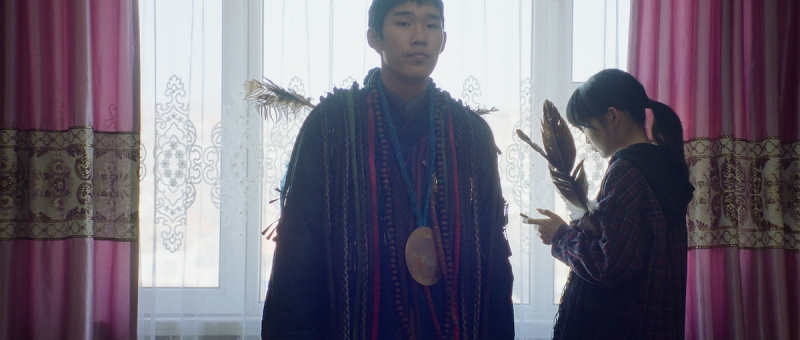
The juxtaposition is evident even in the opening sequence as a figure in a shamanistic outfit referred to by others as “Grandpa Spirit” attempts to reassure an elderly man who fears that his time is near and that his son isn’t ready. The figure speaks with the ominously deep voice of an ancient deity while a young woman translates back and fore between a more archaic dialect and modern Mongolian though when the figure removes its headress the face the behind the mask is that of a teenage boy far too young to offer such rich life advice.

Now 17 and about to leave high school, Ze (Tergel Bold-Erdene) is a top student only mocked a little by his classmates over his shamanistic side hustle while clearly a favourite of their ridiculously pompous teacher who is convinced he is a future saviour Mongolia. But despite the traditionalism of his homelife, Ze dreams of living in a fancy appartment in the city and frequently takes trips to wander around the shopping mall gazing at items he could never afford as if infected with an unstoppable consumerist virus. 

The irony is that the girl he fancies wants exactly what he has, a peaceful life in the country and the security of a family home her parents having spilt up and her father living abroad in Korea. He first meets Maralaa (Nomin-Erdene Ariunbyamba) when her mother hires him to do a blessing before she has a risky heart operation. She brands him a conman and he’s hooked. Nevertheless, the more he associates with her the further he travels from steadiness of his spiritual practice. She dyes his hair which raises eyebrows at school and at home, and takes him to nightclubs in the city where the strobe lighting seems to cause him an existential confusion as if parts of himself were blinking in and out. He leaves abruptly and explains that he doesn’t think he should be there, it seems to have upset his spirit.

Little by little be begins to rebel, acting up at school and tempted away from his home but seems genuinely worried by the prospect that his spirit may really have abandoned him and that in crossing a line in his relationship with Maralaa he may have unwittingly made a choice that can’t be reversed. Lkhagvadulam Purev-Ochir deftly scans the changing nature of Mongolian society in panning over the somewhat rundown area in which Ze lives where yurts are mingled with more modern-looking bungalows and neighbours are treated as members of an extended family. A Soviet-era mural peers down at Maralaa and Ze as they overlook the city with its myriad high rise buildings and discuss their ironically contrasting dreams for past and future respectively.

Ze’s teacher views him as a future CEO who will one day save Mongolia through his economic acumen, though it seems like he may end up rebuilding the nation in a different, perhaps more literal way. Despite his adventures in modernity he comes to understand the value of his gift which lies in his ability to provide comfort to those around him along with a sense of continuity and spirituality that anchors them in their ever changing world. Suburban setting aside, Lkhagvadulam Purev-Ochir captures a sense of beauty and serenity in the landscape through the snowcapped vistas that lie in front of Ze in the midst of his confusion as a young man torn in two, one looking toward the future with an irrepressible yearning, and the other towards the warmth and reassurance of the past while perhaps like his nation still floundering for balance and direction but always supported by the gentle love of those around him content to let him find his own way back to wherever it is he’s supposed to be.


City of Wind screened as part of this year’s Osaka Asian Film Festival.

Knockout (どついたるねん, Junji Sakamoto, 1989)

Knockout cap 1Thirty years after his debut, the career of director Junji Sakamoto has proved hard to pin down. An early focus on manly action drama gave way to character pieces, issue films, and comedy, but it was with his breakout first feature Knockout (どついたるねん, Dotsuitarunen) that something like a signature style was born. One of Japan’s many boxing movies (perhaps an unexpectedly populous genre), Knockout is once again the story of a man fighting himself as he struggles to overcome serious physical injury, emotional trauma, and his own fiercely unpleasant personality to finally become the kind of champion he has always feared himself incapable of becoming.

Dreaming dreams of boxing glory, Adachi (Hidekazu Akai) trained hard since he was a small boy and eventually became a champion of the ring. However, an ill-timed blow from a subpar opponent left him with an unexpected, life threatening injury requiring brain surgery after which he was advised to stay behind the ropes for the remainder of his days. A total asshole with a violent streak, Adachi can’t help alienating all those around him including childhood friend Takako (Haruko Sagara) whose father owns the National Brand gym where he used to train and had given vague promises of taking over once he retired. In his newly irritable state, Adachi has decided to start his own high class gym and has teamed up with a boxing enthusiast friend, Harada (Tetsuya Yuki), who runs a gay club, to buy National Brand’s promoter license to set up alone.

This being the kind of film that it is, it’s a given that Adachi will eventually want to get back in the ring despite all the inherent risks to his physical body. Nevertheless, the journey towards that realisation will be a humbling one as he is forced to confront the fact that he is a terrible person whose intense self obsession and intimidating behaviour has everyone around him walking on eggshells. Consequently, he does not make a particularly good boxing coach thanks to his didactic methods and rigid insistence on doing everything his own way. Only the kindly assistance of an older man, Sajima (Yoshio Harada), who also retired from the ring through injury, begins to show him the error of his ways but it’s not until he’s truly alienated all of his prospective pupils, as well as his patient backer, that he finally understands where it is that he belongs. 

Set in his native Osaka, Sakamoto weaves a rich tapestry of local life from the feisty Takako who dearly wanted to get in the ring herself only to be met with the constant refrain that boxing’s not for girls, to the mysterious Harada and his largely offscreen gay bar at which Adachi seems to be a frequent yet unwilling visitor who claims the place is too “weird” and fears interacting with others in the establishment. Meanwhile the applicants at his new gym which promises training with a “kindly” coach run from young toughs to softening salarymen desperate to engage with their dwindling masculinity. This is definitively a manly affair in which the frustrations of young(ish) men take centre stage though mainly through the destructive effects they have on the world around them – you’ll nary find a face around here that doesn’t have a bruise on it. While Adachi’s parents tiptoe around their own son as if he were some sort of gangster, Takako is the only one willing and able to stand up to him save the late entry of Sajima who appears to be dealing with some neatly symmetrical family issues of his own.

Starring real life boxer Hidekazu Akai, Knockout strives for realism in the ring even whilst emphasising the ongoing psychodrama that lies behind it. Adachi, like many boxing heroes, is engaged in constant battle with himself, trying to overcome the frightened little boy he once was rather than accepting him and admitting that even older he is often still scared and angry without really knowing why. Perhaps through his final, infinitely dangerous entry into the ring he will find some kind of answers to the questions he has been too afraid to ask but he has, in any case, become less of a problem for those around him in his continued quest towards becoming the best version of himself.


La La La at Rock Bottom (AKA Misono Universe, 味園ユニバース, Nobuhiro Yamashita, 2015)

プリントNobuhiro Yamashita has made something of a career out of championing the underdog and La La La at Rock Bottom (味園ユニバース, Misono Universe) provides yet another foray into the lives of the disposed and degraded. With a lighter touch than some of his previous work, the once again musically inflected film is another testament to the power of redemption and that you can still turn your life around if you only have the courage to take the chance.

The film begins with a young man being released from prison. The guard apologises about the smell of mothballs emanating from the man’s jacket, usually the family bring clean clothes. No family has come for this inmate though – just a couple of cool seeming characters who profess their gratitude for “what you’ve done for us” but the reunion is anything but warm. A little while later the man is unceremoniously bundled into a car and taken off to a quiet place where he is beaten half to death by thugs using baseball bats. After waking up, he stumbles around and eventually chances on a summer festival with a band playing on the mainstage. Zombified, the man grabs the mic and starts singing before promptly collapsing again.

The band’s manager, a young girl, takes the man home whereupon she discovers he’s lost his memory. Giving him the ironic nickname of “Pooch” (Kasumi also has a habit of picking up stray dogs), the band and local villagers quickly “adopt” the confused stranger and let him work at their karaoke rooms and studio whilst coaching him to become their new lead singer. However, as Pooch’s memories start to return it seems that his former life may not have been as tranquil as his laid-back amnesiac persona might suggest.

Like much of Yamashita’s previous work, music plays a central role with the one thing that Pooch remembers from his former life being the lyrics to a particular song and his innate singing talent. The leading role of Pooch himself is played by real life singing star Subaru Shibutani of Kansai based idol band Kanjani Eight who proves himself more than capable of belting out these hard rock/enka tracks as well as being able to imbue Pooch’s amnesiac blankness with his own specific character. He is ably supported by the popular young actress Fumi Nikaido who turns in yet another impressively nuanced performance as the older than her years Kasumi.

The beginning of the film gives us quite an idea of the man Pooch may have been and the kind of life he’s led. As the revelations pile on and Pooch’s memories inevitably return threatening the new life and personality he’s begun to build with the band and the possibility of fulfilling a long abandoned dream of being a singer, his dark side begins to break through and we’re shown a man lost in rage and violence left with nowhere to turn. At the end of the day, “Pooch” has been given a valuable opportunity to start all over again but it requires him to make the choice to do so. Go back to being “Shigeo”, a self hating thug who’s alienated absolutely everyone in his life or choose to become Pooch and earn a second chance to be the man he always wanted to be.

Like Yamshita’s previous film, Tamako in Moratorium, with which it also shares a lot in terms of style, La La La offers no great revelations or technical bells and whistles but revels in the simple pleasure of a tale told well. Like much of his other work, the central message is that it’s never too late to begin again (even if there are bridges which have been burned beyond repair) only that it requires you to make the sometimes scary choice to take a chance on something new. That choice rests with one person but is greatly aided by the support of others and the unusual bond between the two central characters (which stops short of romance) plus the uncompromising faith which Kasumi places in Pooch are some of the greatest joys of the film.

Perhaps not a career best from this still vastly underrated director, La La La at Rock Bottom is nevertheless another beautifully constructed addition to his filmography. Offering an extreme depth of performance from each of its ensemble cast, the film is rich with detail whilst also reflecting Yamashita’s trademark cinematic naturalism. Once again a musical feast for the ears, La La La at Rock Bottom is destined to become one of the director’s best loved films even in a career which has already offered so many as yet undiscovered gems.