After School (成功補習班, Lan Cheng-lung, 2023)

In an odd kind of way, Lan Cheng-lung’s autobiographically inspired coming-age drama After School (成功補習班) charts how far Taiwan has come since the mid-90s while pivoting around the figure of Mickey Chen, a hugely influential LGBTQ+ filmmaker who passed away 2018. Chen was in fact Lan’s own cram school teacher and in terms of the film a voice for the future giving the children the permission to be themselves in the post-martial law society even as they struggle to break free of the authoritarian and fiercely patriarchal past. 

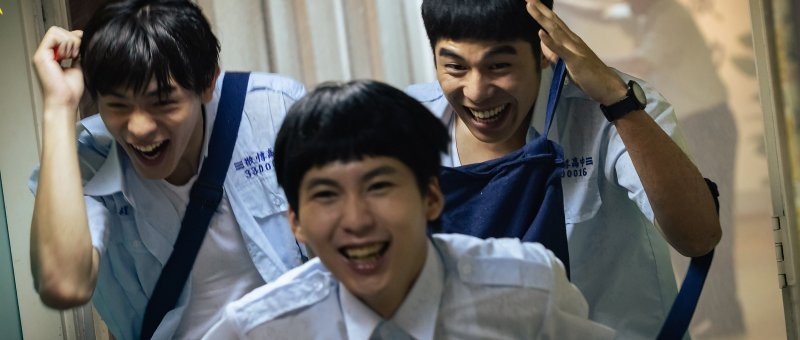
In a sense, cram school itself is the manifestation of that culture in that most of the kids have been forced to go there by their parents to pursue futures not of their choosing. The hero Cheng Heng (Zhan Huai-Yun), Lan’s stand in, wants to be a filmmaker but his dad wants him to be a maths teacher. That might be one reason he and his friend Cheng Hsiang (Chui Yi-tai), who lives with his family because problems with his own, spend most of their time messing around and playing childish pranks on the teachers and admin staff. Meanwhile, they’re far mare interested in potential romance than studying with Cheng Hsiang a bit of a ladies man and Cheng Heng nursing a crush on the school’s most popular girl Chen Si (Charlize Lamb). 

Nevertheless, the closeness between the boys gives rise to a few rumours that they may be gay. The idea is only further cemented by an ironic incident in which Cheng Heng sustains an embarrassing injury to his groin while watching a pornographic video he swiped from a cousin little realising that it was actually gay porn. His parents, or really more his father, do not take well to this and see it perhaps as just more evidence of his rebelliousness and lack of respect for his family in his desire to follow his own path rather than the one they’ve set down for him of getting a steady, respectable job as a teacher. 

That’s one reason that the arrival of Mickey (Hou Yan-xi), a recent graduate taking a temporary teaching job to save for studying abroad, is thought so disruptive because he encourages the kids to be who they are not who they’re taught to be. Mickey holds progressive sessions on sex and sexual identity, explaining concepts such sexual orientation and safe sex which is surprising not least because this is a cram school which exists solely to help kids do well on standardised tests rather than give them any broader kind of education. The headmaster, who is also the father of the boys’ friend Ho Shang (Wu Chien-Ho), is by contrast an authoritarian remnant of the martial law era who can’t permit any kind of liberalisation or individualisation and often inflicts corporate punishment on pupils deemed to have transgressed the rules of a polite society. 

But it’s Mickey who tries to help the boys accept and become comfortable with their sexuality and that of others, taking them to a gay bar where he interviews several of the regulars for his documentary. The barman once entered a marriage of convenience and had a child to please his parents but feels deep guilt and regret for the way he treated his wife and his since been disowned by his family. Now he hosts a New Year dinner for others like him who have nowhere else to go because their families have rejected them. The boys too are rejected by their fathers solely on the suspicion of homosexuality while the mothers remain broadly supportive of their children but trapped by those same patriarchal social codes caught between their authoritarian husbands and love for their sons.

Yet even with these more distressing themes, Lan’s film is at times a little too rosy, sticking to its lighthearted tone rather than fully address the implications of society’s attitude to the LGBTQ+ community in the mid-1990s as opposed to that of today in which Taiwan became the first Asian nation to legalise same sex marriage. Nevertheless, it presents a warm-hearted firsthand account of the effect Mickey had on those around him as the teens rebel against the authoritarian past to embrace their freedom and identities, no longer afraid to speak their feelings but determined to be themselves and accept the selves of others rather than live under the constraints of oppressive patriarchy and traditions.


After School screened as part of the 18th Season of Asian Pop-Up Cinema.

Trailer (Traditional Chinese / English subtitles)

Little Blue (小藍, Lee Yi Fang, 2022)

Mother and daughter find themselves in eerily similar situations when dealing with a social double standard in Lee Yi Fang’s pointed drama, Little Blue (小藍). At heart refreshingly sex positive, the film nevertheless asks why some people seem to be hung up on what is a perfectly normal part of life while simultaneously exploring how sexuality can be misused or exploited and mostly particularly that of the young and naive. “I sometimes feel like my body’s not mine,” the titular Xiaolan (Wang Yu-xuan) confesses to a befuddled teacher who explains to her that she’s gone “astray”, while she might as it happens have a point. 

The opening sequence is witness to the transformation Xiaolan subsequently undergoes. Describing herself as incredibly confused, unable to understand what the teacher is getting at when he asks her why she didn’t come to him when it started, this Xiaolan is wearing makeup and has a fashionable hairstyle. But flashing back a few weeks, the Xiaolan we then encounter is shy and mousy. She has long, lank hair and glasses in contrast to her more glamorous friend Kyueiyu who needles her about hair removal techniques and the realities of contemporary dating. 

This Xiaolan is mildly resentful of her mother whom the other kids brand as “hot” when she turns up with a lunch box Xiaolan had forgotten. Vivi (Helena Hsu) is an estate agent who works late and leaves Xiaolan to get her own dinner but also has a very active sex life and an annoying boyfriend who keeps sexting her and sending videos of questionable taste at inappropriate moments. There’s probably something in the fact that aside from Xiaolan’s high school boyfriend Wu Miao (Ye Ting-qi), the otherwise unavailable men all have Western names. Vivi’s sleazy boyfriend goes by Matt, while she later starts an affair with a married client, Kris, and Xiaolan finds herself drawn to a slightly older guy she hooks up with on a dating app who tells her that he has a girlfriend and his name is “Tim” (Roy Chang). 

Just as Wu Miao had after seducing her on a beach, Tim soon starts ignoring Xiaolan’s messages. After all, he has a girlfriend and probably doesn’t want to be bothered by a genuine connection with a dating app hook up. Xiaolan experiences a kind of breakdown after handsome footballer Wu Miao shares an explicit photo of her with a friend who then “accidentally” posts it on the class chat if only to delete it seconds later. Wu Miao isn’t visible in the photo even if everyone knows he’s on the other side of it, but in any case it’s only Xiaolan who suffers a repetitional loss and is shamed by her classmates. It’s in the wake of his shunning that Xiaolan turns to dating apps, hoping to satiate her curiosity and desire but in the end discovering only more loneliness. Taking her to task, Vivi claps back that at least she gets a “thrill” from her otherwise painful love affairs whereas Xiaolan doesn’t seem very happy at all and gives the impression that her dating app odyssey is at least in part an act of self harm. 

Nevertheless, mother and daughter eventually begin to bond over the irony of their parallel crircumstances if only in the knowledge that it doesn’t really get any better and in the end female solidarity may be all there really is. Lee shoots the changing Xiaolan in melancholy shades of blue that of course eco her name but also lend her world an isolating quality that traps her within her own shame and uncertainty. Even the teacher who attempts to talk to her about her waywardness ends up becoming inappropriately aroused. Xiaolan tells him that he’s “very normal” and hasn’t done anything wrong in a moment that seems both a mic drop and somehow transgressive, allowing Xiaolan to offer the sex positive message she should have received while ironically highlighting that the teacher’s response, as unconscious as it may have been, is necessarily problematic. 

In any case, Xiaolan is finally able to reclaim herself and sexuality as perhaps is Vivi as something that belongs to her alone rather than for others. She’d begun to change herself to be accepted, getting contacts, stealing her mum’s makeup and following her friend’s beauty techniques but still found herself rejected and reduced to a mere body much as Vivi is described as a spare time girl realising that Kris only sees her as a temporary escape from his familial responsibilities. Maybe Vivi saw it the same way, too wrapped up in her own problems to deal with her daughter’s, but what emerges between them seems to be healthier kind of emotional honesty that, ironically, neither found in the arms of their duplicitous men. 


Little Blue screened as part of this year’s London East Asia Film Festival.

Original trailer (Traditional Chinese / English subtitles)

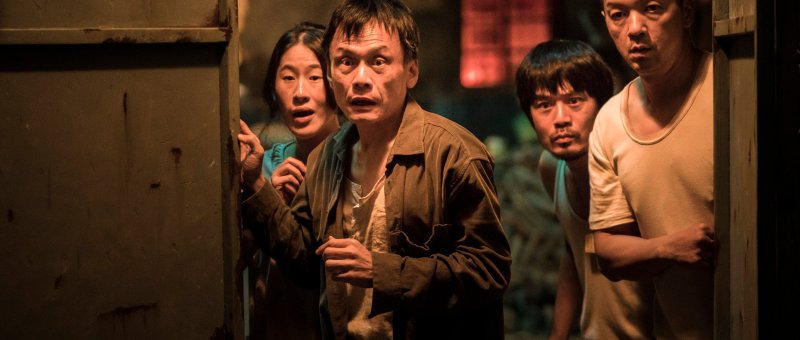
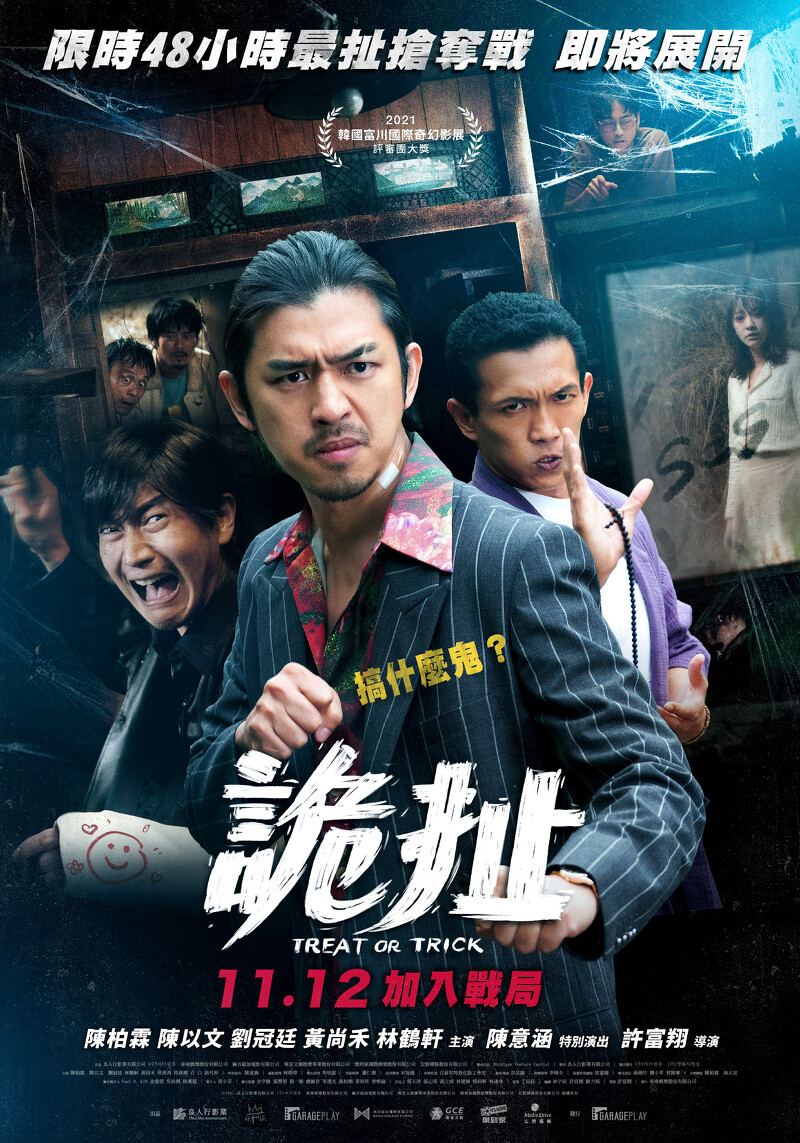
Treat or Trick (詭扯, Hsu Fu-Hsiang, 2021)

Diamonds, What it is it about them that makes everyone crazy? A bag of the elusive gemstones leads a series of corrupt cops towards a purgatorial hellscape deep in the mountains in Hsu Fu-Hsiang’s remake of the 2004 Korean film To Catch a Virgin Ghost, Treat or Trick? (詭扯, guǐ chě). The title could stand in for diamonds themselves which after all have little intrinsic value outside the illusionary desirability they evoke, but also hints at the “trickster” nature of its duplicitous hero. 

Corrupt cop Feng (Chen Bolin) admits that he didn’t join the police out of a fierce sense of justice, but because it was more convenient for his gangster lifestyle as he demonstrates in arresting a bunch of crooks only to stage a secondary robbery, getting his best friend Chiang (Yen Sheng-yu) to pose as a thief taking him hostage and running off with a bag of diamonds. Only, unbeknownst to Feng, Chiang has been picked as a fall guy for Boss Lin (Yu An-shun) to whom they were supposed to deliver the diamonds and has taken off with them. This is obviously a problem for Lin who takes cop Psycho hostage and charges Feng, his buddy Monk, and a guy from the gang Yang (Liu Kuan-ting), to track him down and bring the diamonds back. The trouble is that Chiang got into a car accident swerving to avoid the ghostly presence of a young woman and has wandered into a very weird village where everyone seems to be acting suspiciously. 

In many ways, you could see the village as a kind of purgatorial space inhabited by those trapped between two worlds towards which the gang of corrupt cops is beckoned to answer for their transgressions. Meanwhile, they’re also haunted by the figure of the mysterious woman whose presence is both help and hindrance hinting at dark goings on in this very remote area where visitors are a rarity. Having found out about the diamonds, the villagers are obviously keen to keep hold of them but then there are only so many to go round and it’s not as if you can cut a diamond in half, so the dilemma remains exactly who is going end up with the loot and how creating division on both sides. 

You couldn’t really say that either of these groups are the good guys, but it’s true enough that the villagers variously end up paying a high price for their greed usually caught out by their attempts to get one up on the cops, injured by backfiring weapons or caught in their own traps. Meanwhile, even Chiang falls victim to the essential weirdness of the village in succumbing to a freak accident which leads some to believe that he is dead though in a running gag he turns out to be more or less unkillable as if the eeriness of the place will not allow him to die no matter how many times he’s thrown off a hill, nailed in the head, crushed under falling objects, or set on fire. Yet Feng and his buddies remain largely untouched, outsiders in this strange world and completely by accident occupying some kind of murky moral high ground in trying to rescue their friend (along with diamonds which they need to get Psycho back and save their own lives by smoothing things over with Lin).

Hopping from the gangster movie to supernatural horror, martial arts, and mystery Hsu’s absurd morality farce throws in a series of running gags from “unlucky” Chiang’s strange ability to survive the unsurvivable to frequent allusions to the diamond sutra while possessing its own sense of karma as the greedy find themselves victims of their own scheming, but then perhaps not as the final twist might imply. Even so in this weird place, natures and destinies perhaps possess the ability to change, eccentric thug Yang getting far too into his role as a cop and finally deciding he’d like to be a “good guy” after all while guided by their brotherhood Feng and Monk too find themselves rediscovering a sense of justice in accidentally helping to solve a long dormant cold case. It’s all curiously circular, which is perhaps fitting for this farcical morality tale, but the jury seems to be out on whether even the brotherhood between Feng and his buddies not to mention their newfound sense of justice can survive the cursed allure of the stolen diamonds. 


Treat or Trick screens in Chicago April 9 as part of the 14th season of Asian Pop-Up Cinema.

Original trailer (Traditional Chinese / English subtitles)