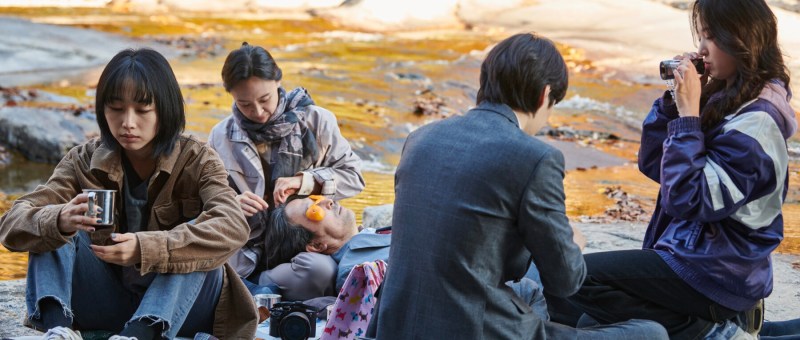
Silver Apricot (은빛살구, Jang Man-min, 2024)

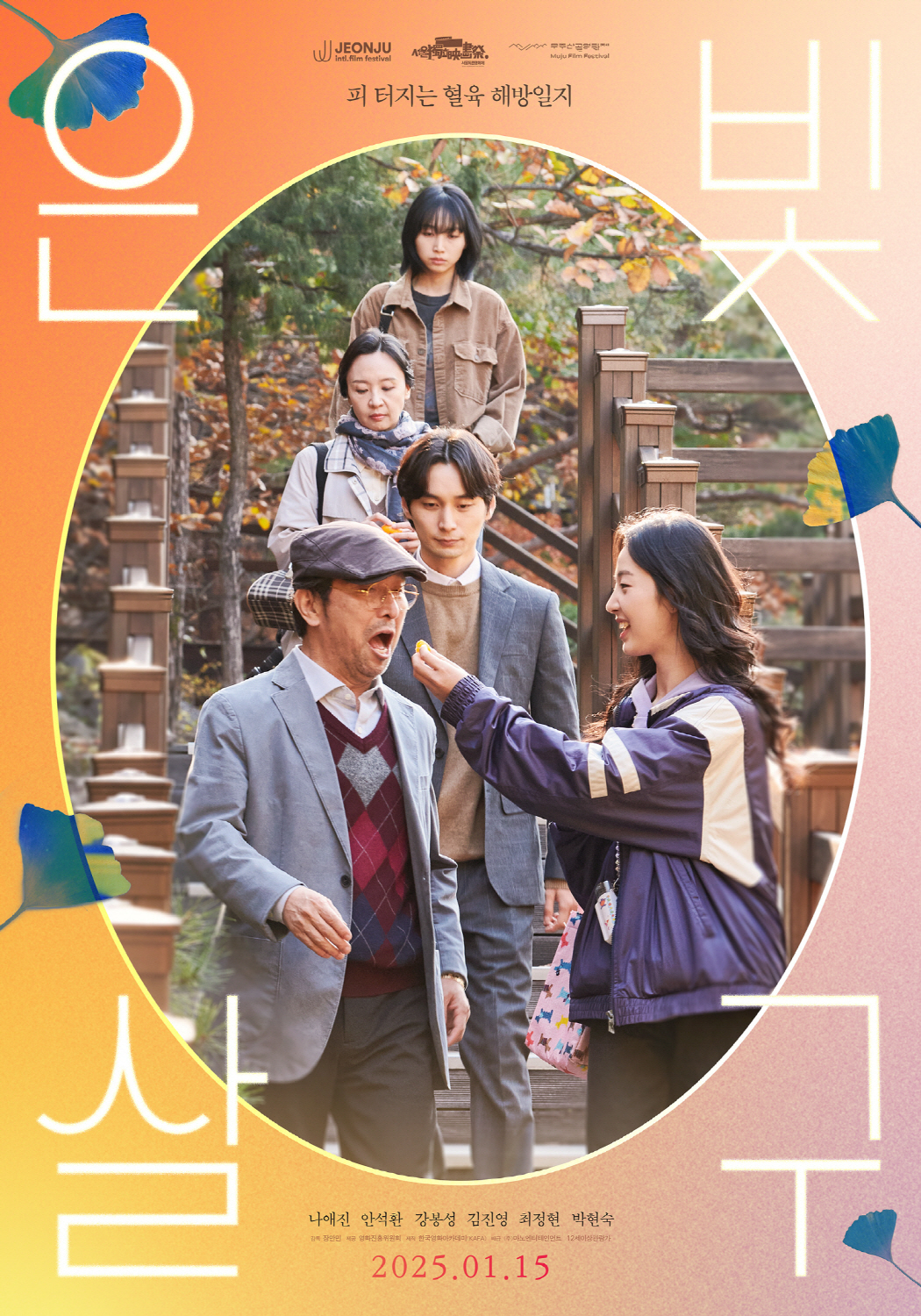
Money ruins everything. It eats away at even the most fundamental of human connections, rendering them all, in their way, transactional. But you need it, in the same way a vampire needs blood and it might be that the only way to get it is to suck it out of someone else’s neck. Or at least, that’s how it is for Jung-seo (Na Ae-jin) in Jang Man-min’s familial drama Silver Apricot (은빛살구, Eunbitsalgu). 

At 32 years old, she’s still being held on a temporary worker contract with her sleazy boss, who is low-key sexually harassing her, using the prospect of full, salaried employment to manipulate her working life. She works “overtime” making posters to advertise other exploitative jobs, such as gig economy delivery driver, with the cheerful slogan “anyone can do it” which she later acknowledges is probably “insulting” to those who do actually do it and are fighting for proper pay and recognition. Secretly, however, she’s working on a webtoon about a vampire, which is how she works out her anxieties and what she actually wants to do and would be doing if money wasn’t getting in the way.

The particular way it’s getting in the way right now is that she’s won an apartment lottery and urgently needs to get the money together for a deposit. Jung-seo plans on going halves with her fiancée Gyeong-hyeon (Kang Bong-sung), but he seems reluctant to put the money in and is clear he won’t make up the shortfall when she’s turned down for the permanent position and won’t be earning as much as she hoped. All that’s left to her is the bank of mum, but her mother’s fed up with her always asking for money and claims she’s saving too with the hope of opening her own restaurant despite the fact that Jung-seo suspects the owner of the place she works at now is romantically interested in her. Perhaps like Jung-seo, she’s lost the ability to trust anyone after having a bad experience with Jung-seo’s father who left them for another woman and still lives in their home town with a new family. 

Jeung-seo’s father Young-joo may also have had artistic dreams in that he was once a saxophonist but gave his sax to her mother as security for a loan he never repaid. Her mother suggests she ask him for the money back instead, but that means opening old wounds that may be better left unresolved. Young-joo (Ahn Suk-hwan) is like a vampire himself, draining those around him of their cash to fund one harebrained scheme or another from stock market speculation to spurious property investments that he swears will pay off but almost never do. Gyeong-hyeon may not be much better in this regard, himself dabbling in stocks despite Jeung-seo making him promise he wouldn’t in a way that makes it hard for her trust him and suggests that men are always hung up on potential future gains rather than what they have concretely right now. 

Predictably, Young-joo doesn’t really want to pay up and insists on meeting Gyeong-hyeon first in and old-fashioned bit of patriarchal nonsense which makes even less sense considering how little of a father he has been to her for all these years. Gyeong-hyeong, meanwhile, is instantly taken in by him and has all but fallen for one of his scams. Maybe it makes sense on paper to abandon the city and live in an area with a lower cost of living doing a less prestigious kind of job like running a cafe which would lessen your financial burden and allow more “free” time to practise your art even if would still be a side hustle, but Jeung-seo knows better than to believe her father’s lies and knows full well that he’s only changed his tune because he overheard how much profit they could make with the apartment and thinks he’s entitled to some of it if he gives them the money.

But it’s not even like Jung-seo is asking for money from him. She’s only asking for money that actually belongs to her mother. Money ruined their relationship too, and it even interferes in her connection with her younger half-sister Jung-hae (Kim Jin-young) who idolises her but also frames her for stealing her mother’s savings after asking her to secretly sign a lease on an apartment she could use for her own art, music, and as a safety net in case her mother really decides to leave Young-joo this time when his plan to redevelop a building in a nearby town inevitably goes belly up. Joo-hee (Choi Jung-hyun) may have this in the back of her mind herself, which explains her coolness toward Jung-seo, fearing her sudden need for the repaying of old debts will destabilise their family and mess things up for Jung-hae. 

Despite the familial tension, being back in her hometown where Gyeong-hyeong’s spineless pragmatism is all the more obvious forces Jung-seo to think about what the apartment actually represents and whether that’s what she wants. Once she signs, she’ll be locked into that very conventional life which is what everyone in Seoul strives for, but might not actually be right for her. Her friend in her hometown, Tae-joo, has joined the navy for the financial security and will be able to get a military apartment when he marries. He’s given up drawing webtoons, and possibly also on his romantic hopes for Jung-seo. When she makes overtures towards him, he replies that he’s not ready to give up on his civil servant girlfriend, suggesting that he isn’t brave enough to break out of this conventionality either. Jung-seo is essentially in a relationship of convenience with Gyeong-hyeon that is not based on love but solely on the ability to buy the apartment which is what he really wants from her. The question is whether she has the courage to get off this train or is willing to settle for a life of dull humiliation submitting herself to the whims of her bosses while gradually abandoning her hopes and dreams to live in an apartment that is itself not a home but an investment in a future that will never really be hers.


Silver Apricot screened as part of this year’s London Korean Film Festival.

Trailer (English subtitles)
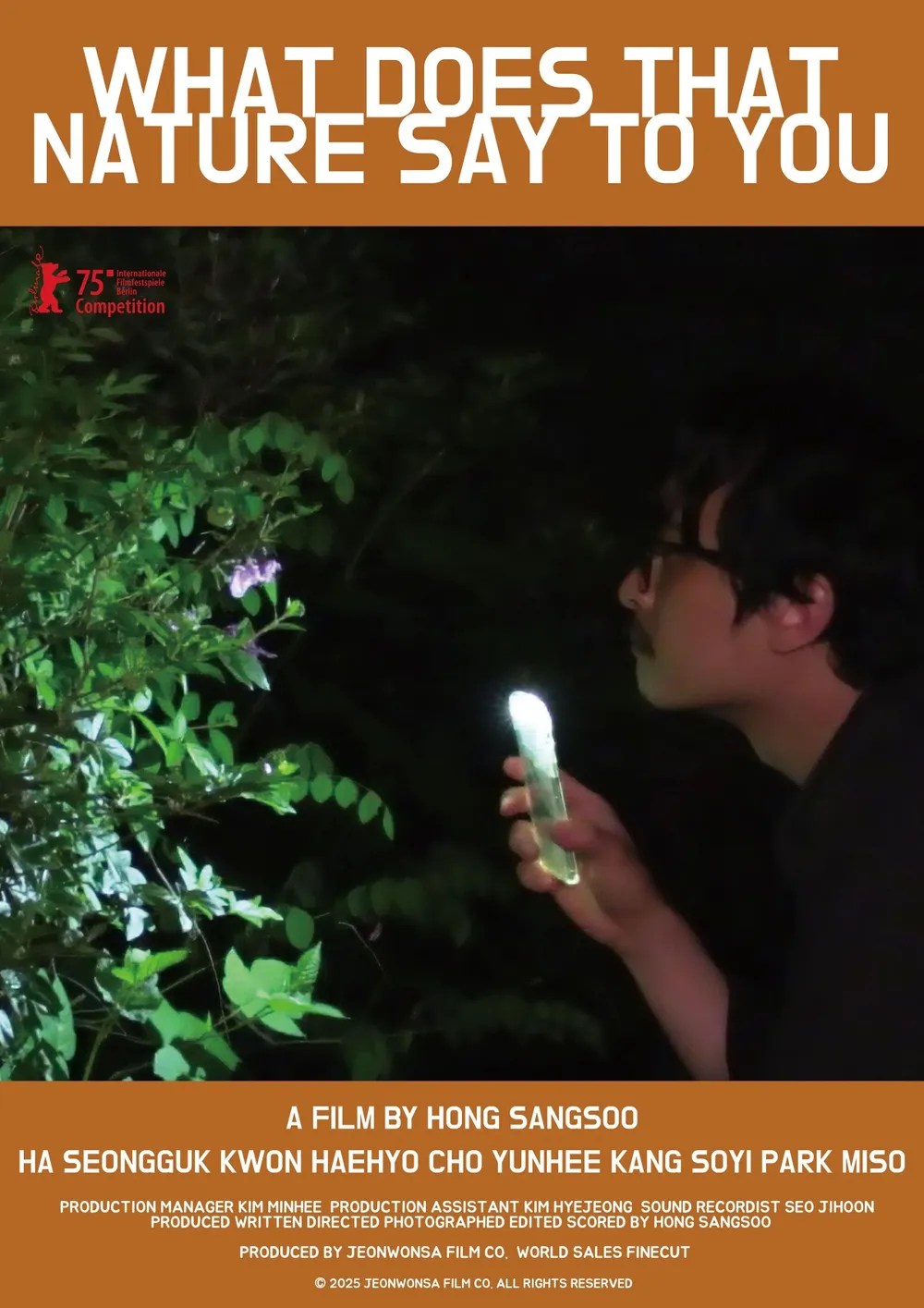
What Does That Nature Say to You (그 자연이 네게 뭐라고 하니, Hong Sang-soo, 2025)

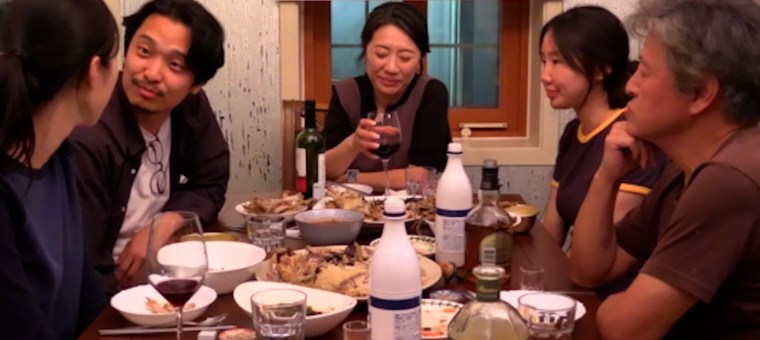
“But you’ve got your father behind you,” Junhee’s (Kang So-yi) older sister Neunghee (Park Mi-so) points to her sister’s boyfriend, Donghwa (Ha Seong-guk), meeting her family for the first time despite dating Junhee seriously for three years. But that’s not the way Donghwa likes to think about it, preferring to deny his privilege and insist that, as he does not take accept anything from his famous father, he’s an “independent” man. This notion is quickly squashed by Junhee who otherwise seems to have accepted Donghwa’s way of life when she admits that it’s more like Donghwa doesn’t like accepting anything from him, but will ask for money when he’s truly desperate. Neunghee subtly tries to remind him that whatever he might say about it, his life is only possible because he has a safety net and to insist otherwise is superficial and childish. But superficial and childish is exactly what Donghwa slowly exposes himself to be in Hong Sang-soo’s latest lacerating character drama, What Does That Nature Say to You? (그 자연이 네게 뭐라고 하니, Geu Jayeoni Nege Mworago Hani)

Donghwa is also, apparently, a little vain in that he needs glasses but doesn’t wear them so to him the world is always a little fuzzy around the edges. This might also explain why Hong films in low grade digital, much like In Water, rendering this otherwise idyllic mountain setting somewhat ugly and ill-defined. Donghwa wasn’t even supposed to be meeting Junhee’s parents today, which is why they sat in his car round the corner for ages after he drove her from Seoul before accidentally bumping into her father so he had little choice other than to stay. He said he’d come two years ago, but for whatever reason didn’t. Neunghee thinks it’s odd they’ve been putting off marriage, cautioning her sister that the “right time” never really exists and you don’t necessarily need to overthink these things, though increasingly she seems to come to the conclusion that the relationship isn’t strong enough because of Donghwa’s insecurities and Junhee’s lack of certainty. Junhee describes her as “depressed”, though Neunghee seems quite upbeat and though you could argue is basically doing the same as Donghwa in relying on her parents while she figures things out, seems to have more of a direction and self-awareness about the way she’s living her life. 

Though the initial meeting seems to go well and Donghwa bonds with his father-in-law Oryeong (Kwon Hae-hyo), he has a minor falling out with Junhee after she objects to some of his philosophical ramblings complaining that sometimes she thinks he waxes on about the ineffability of the universe in order to escape his problems. Oryeong later says something similar, that he spends his life evading things, while Jun-hee’s mother Sun-hee (Cho Yun-hee) laments that he hasn’t yet collided with reality and that’s why his poetry lacks substance even though he claimed to be a “poet”. When he says he likes the simple life and is wary of materialism, it’s difficult to know whether it’s a real position or merely an attempt to gloss over his lack of financial standing.

A now irritated Oreyong criticises him for not having his life more in order at the age of 35. Son of a famous TV lawyer or not, he doubts Junhee will be happy with a man still working part time at a wedding venue and as an ad hoc photographer on the weekends. Everyone keeps needling Donghwa about his old banger of a car, a Kia Pride from 1996 for which Oreyong thinks he paid too much seeing as it’s not old enough to be a “classic” car nor reliable enough for use as an everyday vehicle. Donghwa says he just likes it, before admitting that he doesn’t have the money for a new one anyway. The same goes for his recent adoption of facial hair with Oreyong criticising him for only doing it half-heartedly rather than going for the full bohemian poet aesthetic, though he’s likely done it to look a bit more manly and distinguished to gloss over his increasing insecurities about being the only son of a successful man who can’t escape his father’s shadow and still doesn’t seem to have figured himself out as an independent person.

Asking Donghwa what he likes about Junhee might not be entirely fair. It’s not as if love needs a reason. But his characterisation of her as an “angel” is also superficial, even if her family’s constant remarking on her upright character might be the same. Yet for all that, this awkward meeting filled with social niceties, and the wisdom of Junhee’s parents who think this relationship is not likely to last but know it’s better to let Junhee figure that out for herself, might be the collision with reality that Donghwa has been needing in showing him how childish and superficial his behaviour and lifestyle and have really been. Or at least, he’s beginning to realise they’re right about the car and maybe it’s time he set himself up straight if he is actually serious about his future with Junhee.


What Does That Nature Say to You screens as part of this year’s San Diego Asian Film Festival.

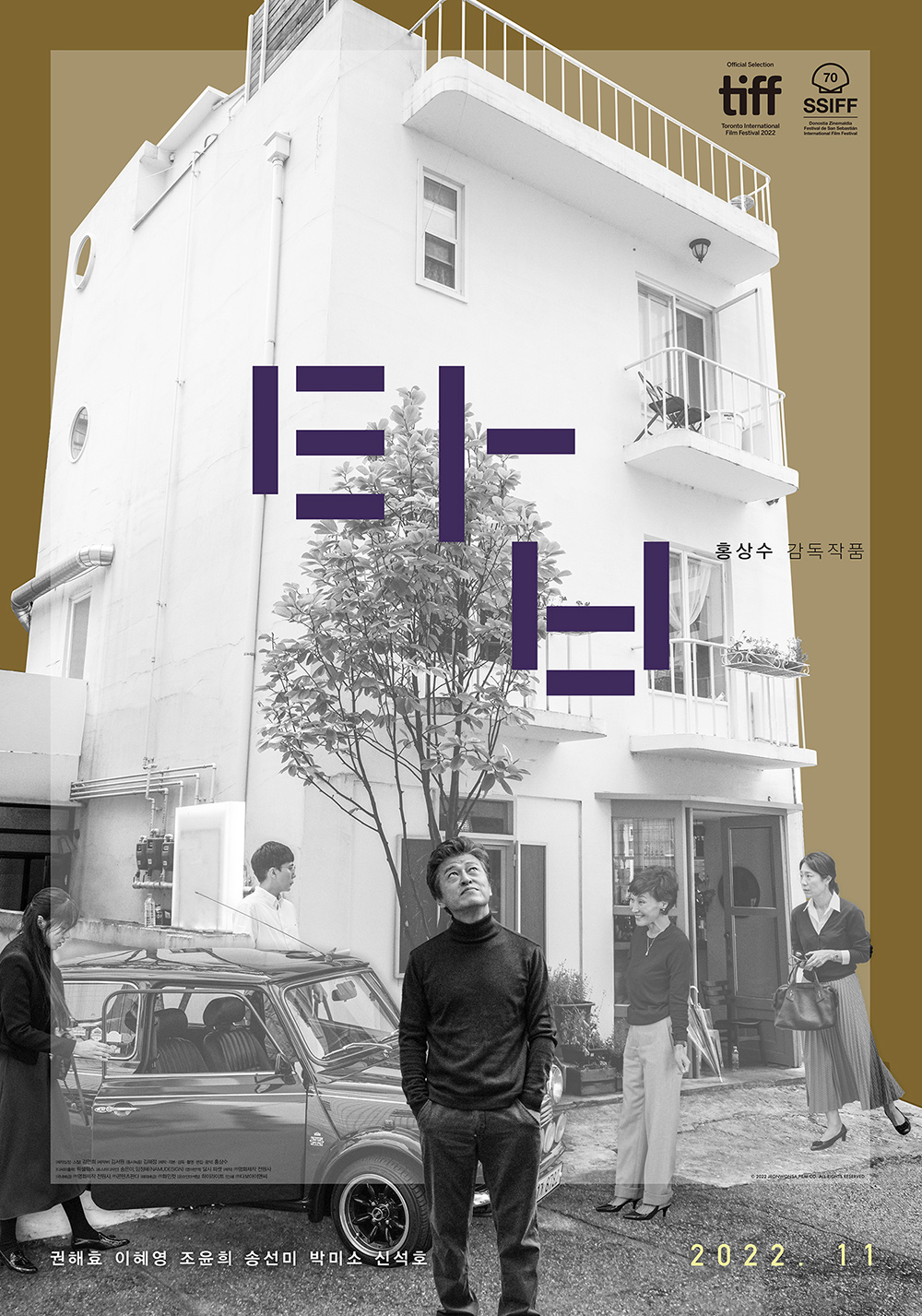
Walk Up (탑, Hong Sang-soo, 2022)

“Really all of us are like that. We’re different when we go out” an older woman tries to console, ”you want to believe that the person you see at home is the real him”. The second remark may come out more cuttingly than she means it, unsubtly suggesting that really you never know anyone and the intimacy you might believe exists within a family is just a performance. The director at the centre of Hong Sang-soo’s Walk Up (탑, tab) is indeed several different people with several different women across multiple floors of a small building owned by an old friend, Mrs Kim (Lee Hye-young), with whom he repeatedly checks in across the space of several years. 

Distance does seem to define Byungsoo’s (Kwon Hae-hyo) existence. When he turns up at Mrs Kim’s the first time, it’s with his daughter, Jung-soo (Park Mi-so), whom he later reveals he had not seen for five years. Jung-soo is there trying to make a connection, hoping Mrs Kim will take her on as an apprentice interior designer having experienced a moment of crisis on leaving art school and discovering that “art has nothing to do with money”. That’s also a problem that repeatedly plagues Byungsoo. During their conversation he’s called away to a meeting with a film producer, and later reveals that a project has fallen through after the funding was pulled at the last minute. Byungsoo embarks on a small rant about the commercialisation of the film industry in which artistic decisions are overruled by investors and no one really cares anymore about whether the film is any good only if it’s going to make money. 

Jungsoo had described her father as “feminine” and “domesticated” during her early childhood before her parents’ divorce, explaining that he seemed to change after his film career took off. Where once he’d been content to spend time a home, suddenly he was out all the time partying with actresses. Jungsoo seems to regard this personality shift as a kind of betrayal, hurt by Mrs Kim’s suggestion that Byungsoo may have been repressing himself at home and the “real” Byungsoo was the one who liked to go out on the town. Then again, people can be many things at once and perhaps there’s no one “real” Byungsoo so much as there’s the Byungsoo of the moment. Sunhee (Song Seon-mi), another failed painter who now runs a restaurant on the second floor, panders to his wounded ego repeatedly telling him how much she likes his films, though mostly for the things they’re not, and that she hopes that he will go on making films for many years to come. 

But it’s obvious that Byungsoo is deeply insecure, eventually drifting into an affair with Sunhee and living with her in the second floor apartment having taken a break from filmmaking due to ill health. He bristles when she tells him she’s going to visit a friend who slighted him on a previous occasion and tries to guilt her into not going, repeatedly texting her while she’s out to a degree that seems uncomfortably possessive and controlling. Yet he eventually ends up hugging his pillow and admitting to himself that perhaps he’s no good at relationships and deep down gets along better on his own. Even so, he later ends up with a third woman, an estate agent, who brings him wild ginseng to help with his health worries while he moves up to the studenty top floor flat which while barely big enough to turn around in comes with a spacious roofgarden. By this point his relationship with Mrs Kim, who basically begged him to move in when he first visited with Jungsoo, has clearly become strained, she perhaps also a little hurt in appearing to have carried a torch for him while hinting at feeling trapped in an unsatisfying marriage as the building itself continues on a course of disrepair. 

Mrs Kim too appears to have differing personas as she shuffles between the floors of the building she owns while each of the episodes replays with only slight differences and subject to the consequences of the last. Failed artists moving to Jeju to start again becomes a repeated theme, though it’s as if Byungsoo is resisting the pattern, talking of buying a dog with Sunhee when they relocate but then putting it off for another three years while they save money. By the time he’s made it to the top floor it’s like he’s hit rock bottom, raving about a vision from God telling him to move to Jeju and make 12 films while still ostensibly on an extended break from filmmaking. Shooting once again in a crisp black and white, Hong finally brings us back to where we came in leading us to wonder how much of what we’ve just seen really happened and how much was just a kind of thought experiment created by a bored and insecure director feeling maudlin and trying to figure himself out while his career collapses around his ears. Maybe you have to go up so you can come back down, but it doesn’t seem to leave you any less lonely as the melancholy Byungsoo discovers smoking a solitary cigarette looking up at the house from outside as if trying to decide where exactly he belongs. 


Walk Up screens at Ultrastar Mission Valley on Nov. 9 as part of this year’s San Diego Asian Film Festival.

Trailer

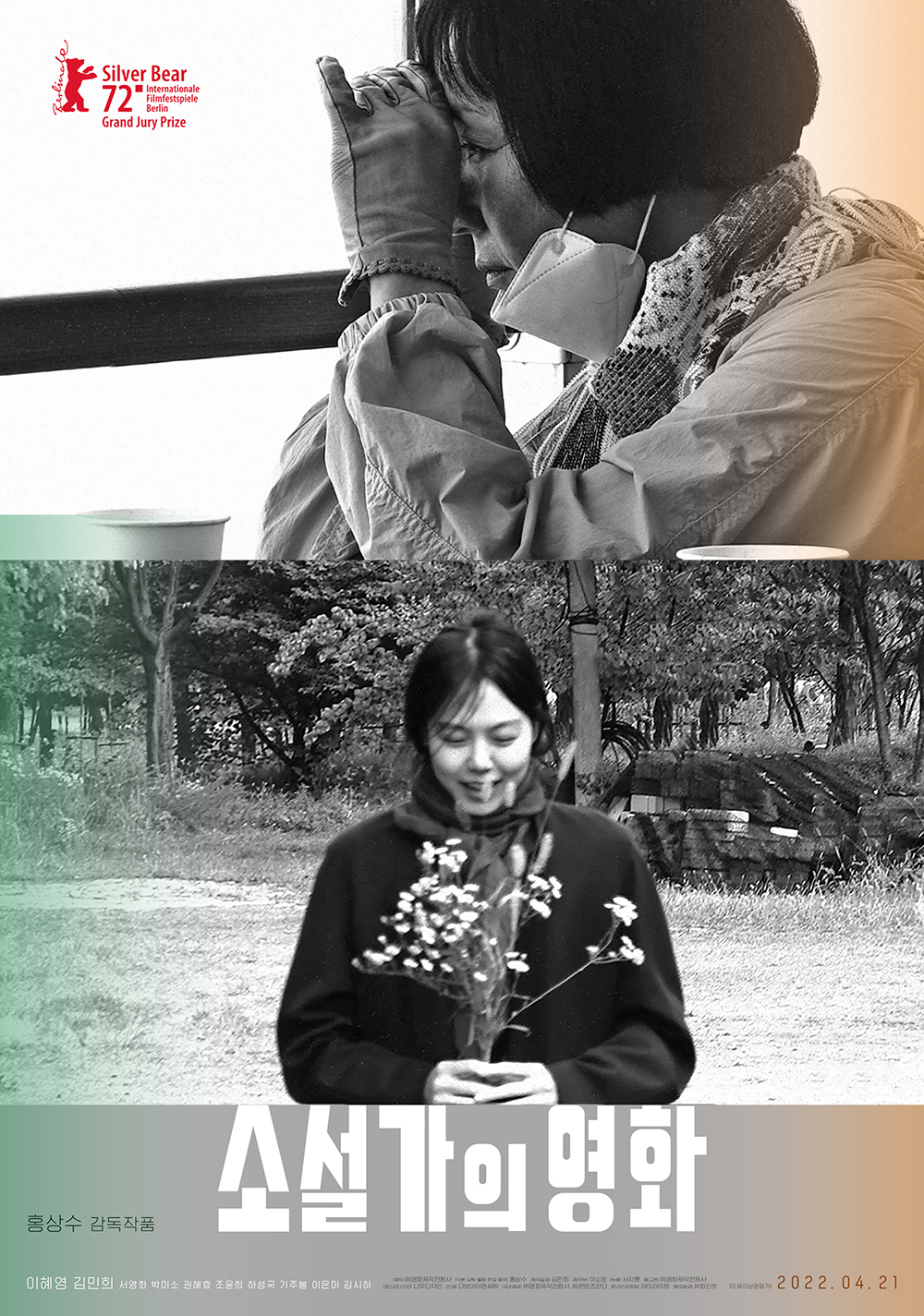
The Novelist’s Film (소설가의 영화, Hong Sang-soo, 2022)

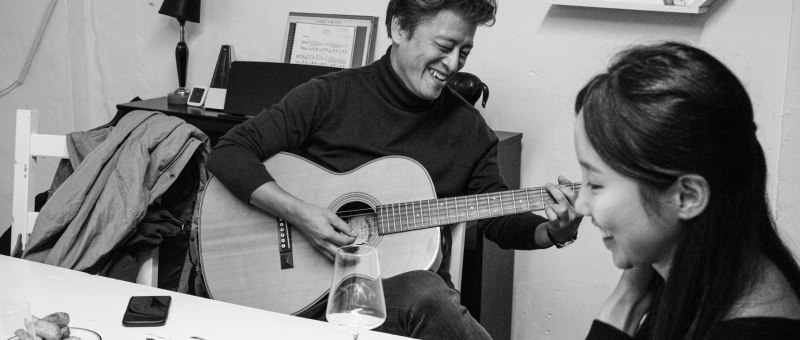
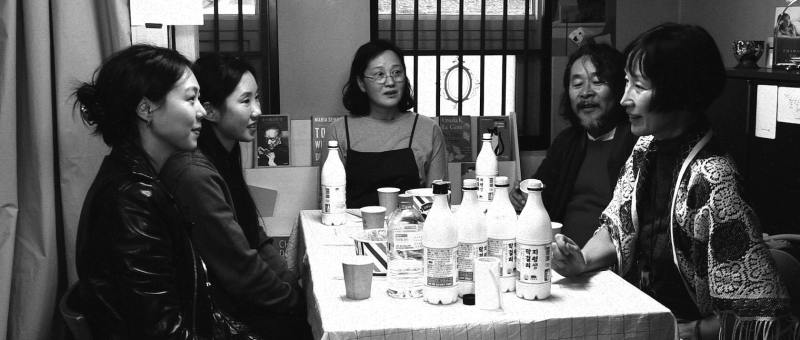
Once again in a meta mood, Hong Sang-soo’s The Novelist’s Film (소설가의 영화, Soseolgaui Yeonghwa) seems to be peopled by those who’ve already given up. The heroine’s friend has given up her writing career to run a small-town bookshop while she herself is struggling with writer’s block, her friend’s assistant has given up acting to learn sign language, and a movie star she later meets has apparently retired because she doesn’t feel the desire to act anymore. In similar fashion a director declares that some have perceived a shift in his career that leads him to concede that he just doesn’t feel the sense of “compulsion” that used to drive him and his work may have become freer and more authentic as a result. 

As usual, Hong may partly be taking about himself, about his relationship to filmmaking and to his muse Kim Min-hee who is herself given a meta moment when berated by the director, Park (Kwon Hae-hyo), who tells her that her decision to retire is a “waste” of her talent only to be shouted at by blocked novelist Junhee (Lee Hye-young) who is hoping to make a film in order to rejuvenate her creative mojo. Junhee tells Park in no uncertain terms that Kilsoo is not a child and if this is the choice she’s made he ought to respect it, circling back to the offensiveness of the word “waste” and its various implications. The situation is so awkward that it leads Park’s wife to leave it all together, but it’s true enough that after this outburst Junhee seems to find a more comfortable relationship with Kilsoo than with any of her old acquaintances as they bond in mutual admiration and shared creative endeavour. 

It’s with a sense of tension that the film opens, Junhee venturing into the bookshop run by an old friend (Seo Young-hwa) only overhear a heated argument between her friend and a younger assistant, Hyunwoo. As so often with Hong the nature of the relationship is unclear, the argument intimate in quality not really the kind one has with an employee or casual acquaintance and so awkward that Junhee decides to wait outside until it’s over. In any case, Junhee’s manner even with the friend she’s deliberately tracked down and come to see is somewhat accusatory and passive aggressive as if hurt by her friend’s decision to abruptly drop out of contact apparently having given up writing and intending to cut herself off from her city life in its entirety.

Her encounter with the director is similar in that she seems clearly annoyed with him, firstly pretending not to recognise his wife then accusing of them of deliberately hiding from her at a popular tourist attraction. Picking up on the vibes, he asks her if she’s still upset with him over a project to adapt one of her novels that fell through. She says she isn’t but is obviously annoyed about something while his wife elaborates on his creative process and the ways she thinks he and it have changed. Then again the wife is also a little strange, introducing herself to Kilsoo, whom they’ve randomly bumped into in a park, as someone who lives with director Park rather than as his wife answering Kilsoo’s question of how long she’s lived with him with a very matter of fact 30 years. Junhee is similarly vague about the extent of her relationship with an ageing poet and former drinking buddy (Gi Ju-bong) with whom she had herself lost touch or perhaps partially ghosted when his interest turned romantic. We hear brief snippets about Kilsoo’s personal life, an allusion to scandal and drinking problem but never see her offscreen husband, only his filmmaker nephew (Ha Seong-guk). 

Yet the the serendipitous connection between Kilsoo and Junhee allows each of them to reignite their creative spark while generating an unexpected friendship. The film novelist envisions is scripted but intended to capture something of Kilsoo as she is while ostensibly playing a character, exposing the reality of the vague relationships by cutting through artifice to the truth. In another series of meta comments, the poet reminds her she needs a hook to draw the audience in but she simply tells him she’ll figure that bit out later because the story is in its way irrelevant. “He writes what he lives” she later says of him, a little dismissively. In any case, the film she makes takes on another meta quality, Hong himself perhaps behind a camera as Kim Min-hee and another woman gather flowers eventually ending with a mutual declaration of love and a sudden burst of colour in what has been a static and monochrome affair which hints at the sense of freedom and comfort Hong like the director may have found in new artistic connection. 


The Novelist’s Film screens at Ultrastar Mission Valley on Nov. 4/7 as part of this year’s San Diego Asian Film Festival.

US release trailer (English subtitles)