The Call (콜, Lee Chung-hyun, 2020)

The call is coming from inside the house. It’s a final revelation intended to chill, the idea that the source of threat is located in the very place where you ought to feel safe, protected, invulnerable. Of course, there are many reasons someone might not feel completely safe at home, those who perhaps live with hidden threat every day, a hidden darkness that lies at the centre of twisty Korean thriller The Call (콜). Another in a small series of time travelling communication, The Call makes connection through outdated technology, an almost literal ghosting in a voice from the past that, like an inverted Strangers on a Train, offers the tantalising promise of mutual salvation only to prove extremely unreliable. 

28-year-old Seo-yeon (Park Shin-hye) has just returned to her rundown country home because her mother, whom she intensely resents blaming her for the death of her father in a fire, is suffering with a brain tumour. Though her strawberry farmer uncle Sung-ho (Oh Jung-se) describes the place as the most desirable property in town, the home in which Seo-yeon finds herself is cold and austere, a creepy old mansion decorated in an outdated style and filled with gothic furniture. To make matters worse, Seo-yeon has left her phone on the train but unexpectedly assures Sung-ho that she’ll be fine with the landline, later calling herself and getting through to a woman who claims to have found it but asks for a reward and then hangs up presumably to assess her options. Then, the landline starts ringing with calls from a young woman trying to reach a friend and claiming that her mother is planning to set fire to her. Though obviously disturbing, Seo-yeon assumes the calls are a simple wrong number until she discovers a hidden room with what looks to be some sort of tiled experimentation area along with a box of memorabilia which lead her to think the phone is somehow connecting her to the girl who lived in her room at the turn of the millennium. 

Also 28 only born 20 years earlier, Young-sook (Jeon Jong-seo) claims to be at the mercy of a wicked shamaness step-mother convinced that she has a dark destiny. The two women engage in a strange act of intergenerational bonding between two people who are the same age, Seo-yeon mystified by the meaning of the word “Walkman” while Seo-yeon struggles with the concept of the multifunctional smartphone. The force which unites them is parental dissatisfaction as Seo-yeon claims a hatred for her mother she does not perhaps really feel and cannot in any case compare with that of Young-sook for the religiously abusive stepmother who fully believes she is possessed by the devil. In in this the time difference proves useful, Seo-yeon realising that Young-sook has the power to prevent her father’s death, but only latterly that she also even from the future has the ability to change her new friend’s fate. 

Essentilally a Strangers on a Train scenario, the two women agree to save each other, Young-sook dutifully restoring Seo-yeon’s imagined fairytale future, the creepy mansion transformed into an elegant modern dwelling, her mother and father now both healthy and happy. Seo-yeon, however, begins to neglect her promise, too busy enjoying her repaired family life to remember that Young-sook is imprisoned in the house suffering horrifying abuse. Young-sook is, in a sense, the embodiment of Seo-yeon’s familial trauma, the violent resurfacing of a long buried memory that threatens to tear to her life apart but also has the ability to repair it in revealing the truth that allows her to reconnect with her mother who, we learn, has repeatedly sacrificed herself for her daughter’s sake. Nevertheless, you begin to wonder if the shamaness had a point and the lid was best left on Young-sook as her hurt and resentment in being neglected by her new friend eventually take a turn for the dark. 

In essence, Seo-yeon’s decision to interfere with the past engineers a chain of disastrous events robbing her of her illusionary happiness while eventually landing her right back where she started if perhaps with a little more insight and having healed her relationship with her mother. Part tale of millennial anxiety, part gothic nightmare, The Call may not always be internally consistent but charts a dark tale of trauma and response as a haunted young woman finds herself stalked by the psychopathic embodiment of her buried guilt only to discover that a call from the past is always hard to ignore. 


Original trailer (English subtitles)
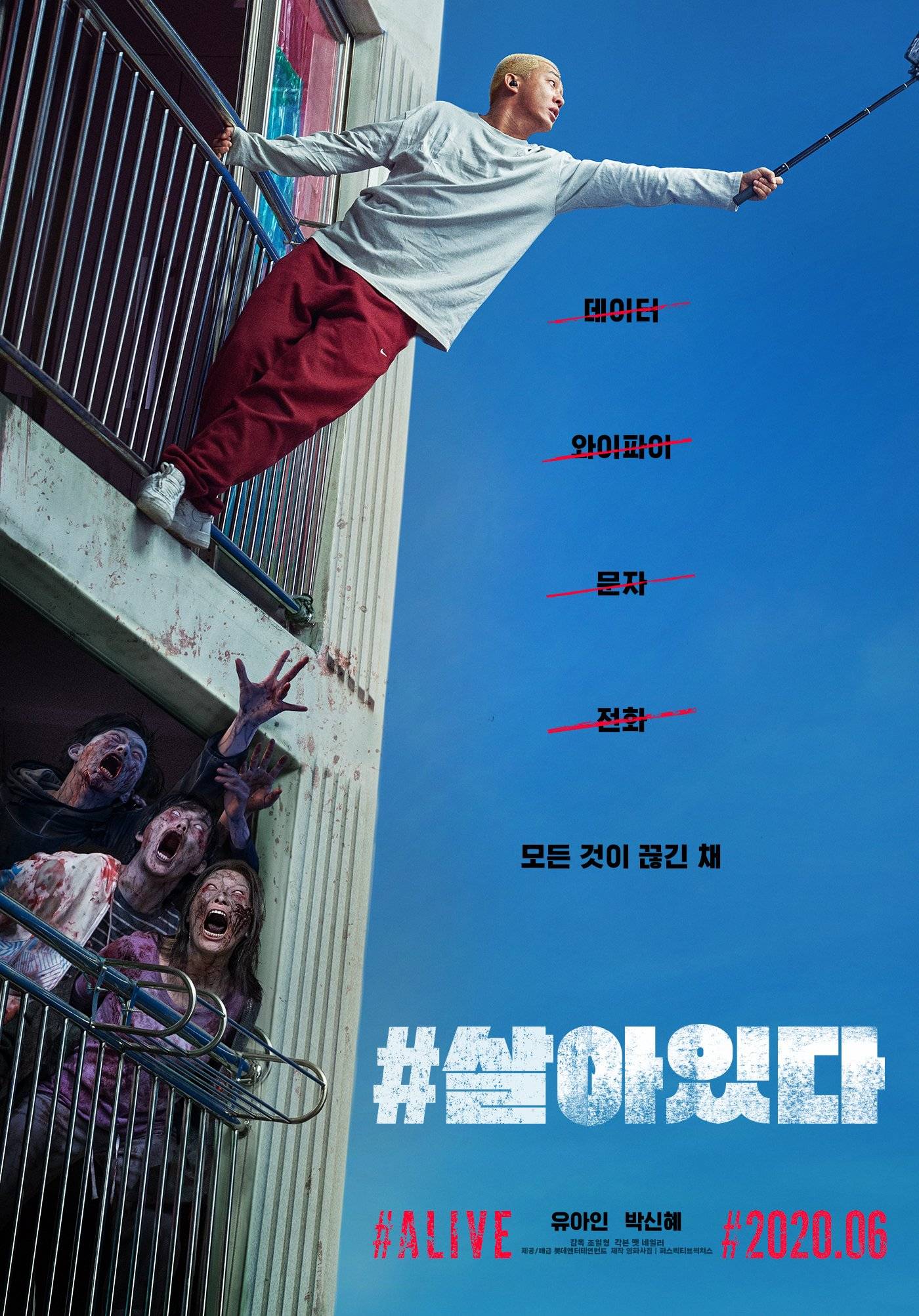
#Alive (#살아있다, Cho Il-hyung, 2020)

Is solidarity really the answer to alienation? The latest in a short line of zombie-related crisis movies, Cho Il-hyung’s oddly prescient #Alive (#살아있다, #Saraitda) presses directly into what it means to live in a time of isolation as its already introverted hero discovers the existential dread of true aloneness, orphaned by his society and quite literally surrounded by cannibalistic threat only to rediscover the desire for life in the company of others vowing to survive not out of obligation but individual will. 

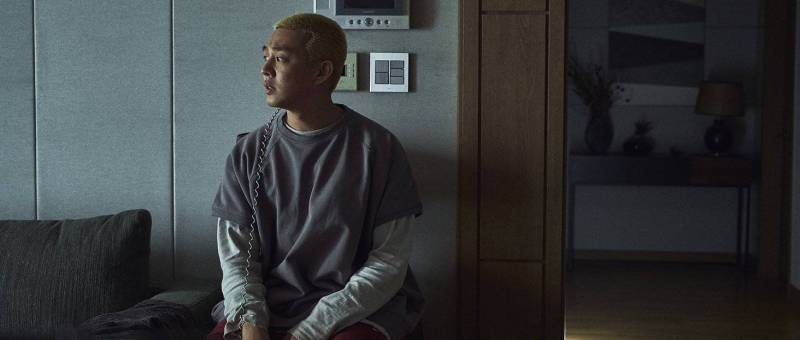
A young man in his 20s, Jun-u (Yoo Ah-in) lives at home with his parents and seems to be a virtual shut-in not quite supporting himself as a pro-gamer/vlogger. He ought to be in his element when he turns on his television one day to discover that a violent riot has apparently erupted all over the city, apparently spreading like a virus which causes aggressive behaviour and cannibalistic frenzy. Unfortunately, Jun-u’s parents left early that morning and didn’t have time to prepare food, leaving him money to go out for groceries but obviously it’s too late for that now and it looks like they won’t be coming home. Jun-u is entirely alone, and all the more so when his usual lines of communication are cut. 

Like the thematically similar EXIT, with which #Alive shares its faith in mountaineering, #Alive concerns itself less with the zombie threat than with youthful alienation and a sense of hopeless despair. Jun-u ought to be in his element, but finds himself ill-equipped for surviving the apocalypse given that he lacks basic adult life skills and those he does possess are now ironically unhelpful. Resourceful as he is, he remembers a smartphone app that would help him communicate via FM radio and all he’d need would be a standard earphone jack only all his earphones are wireless. Making the most of his unstable connection he uploads a single photo of himself holding his address written on the side of a cardboard box with the hashtag #I_MUST_SURVIVE to his Instagram in the hope that someone will see him but becomes increasingly despondent as his food and resources dwindle and he receives a disturbing voicemail which suggests his family may not have escaped the disaster. 

Hitting rock bottom he considers taking his own life but is saved by a literal light in the darkness, a laser shone from an opposing apartment signalling another presence he had previously missed. Believing he was alone in the world, Jun-u lost the will to live and faced with the prospect of waiting to starve to death or venturing out among the zombie hoards chose the only agency available to him in deciding the time and manner of his death. Realising he is not alone restores his desire for life, yet Yu-bin (Park Shin-hye), though much more well prepared, is also dealing with her own trauma in the face of crisis in the memory of a climbing fall that leaves her additionally anxious and fearful of physical risk. Where Jun-u flounders, lamenting as so many of us has in recent years, that no one seems to know what’s going on, the news continually flashing the same info screen while telling viewers only to stay home, Yu-bin has constructed a mini fort complete with a series of booby traps perhaps content in her independence having resolved to live and glad to have discovered she is not entirely alone. 

In contrast to disaster movie tropes, the pair instantly bond in their shared bounce back from despair, developing unconventional means of communication while Yu-bin willingly shares her food stash which in turn gives Jun-u the courage to venture outside for supplies. Eventually reuniting they do their best to withstand the zombie hoards, standing in as they are for the various anxieties which otherwise surround and oppress them, only to find themselves betrayed, worried that perhaps they have after all been abandoned and that no one is there looking out for them. Their salvation lies in their connection, the derided social media proving a lifeline that both affirms their existence and restores a sense of community that returns their safety, airlifting them from the locus of despair finally #Alive and returned to the world secure in the knowledge that they are not alone.


Netflix trailer (English subtitles)

Heart Blackened (침묵, Jung Ji-woo, 2017)

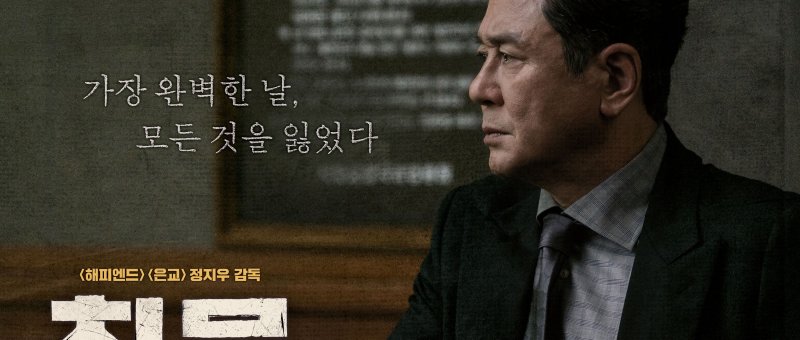
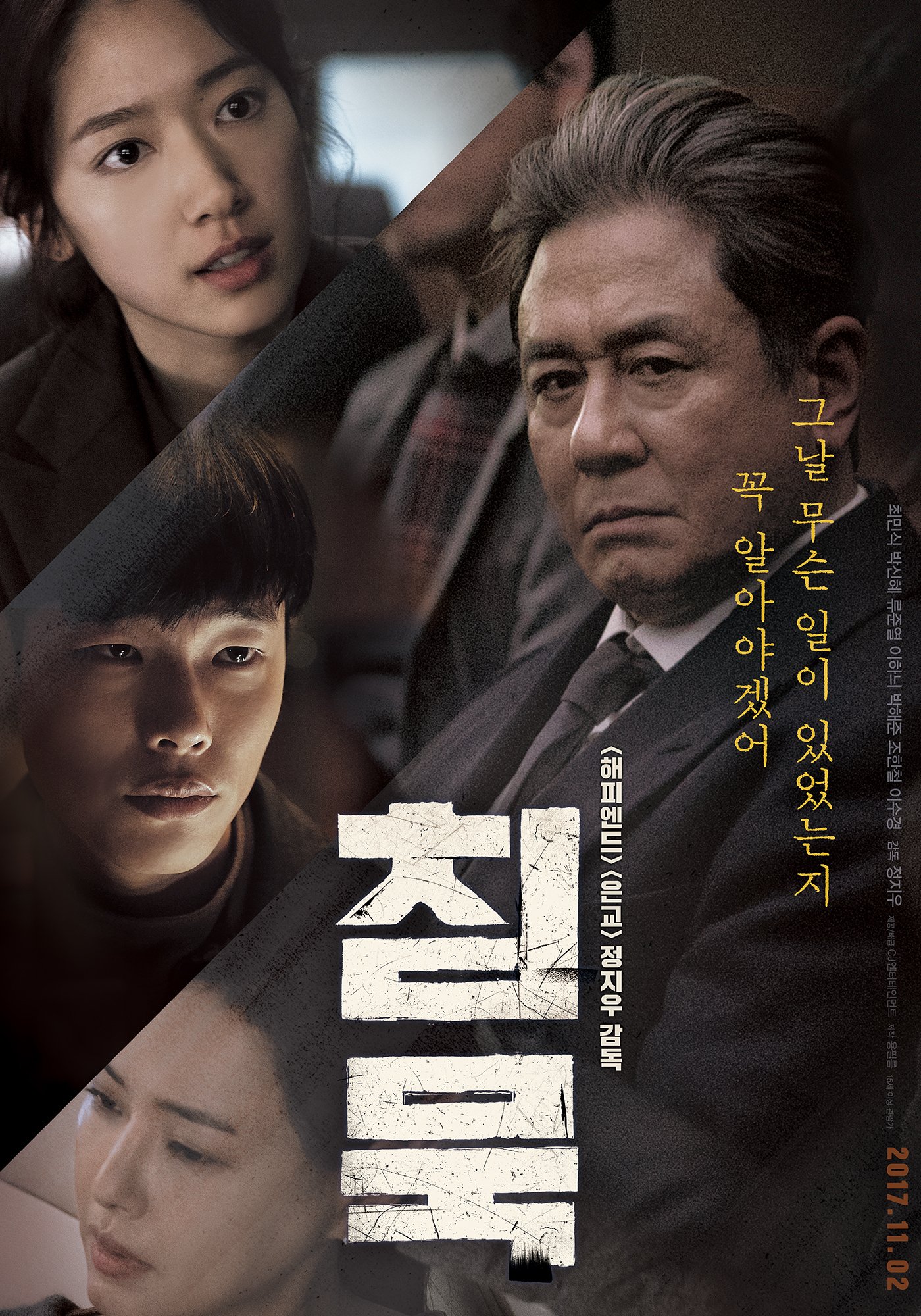
Heart Blackened posterMost of us like to kid ourselves that you can become rich and successful by working hard and playing by the rules, but it takes a certain kind of ruthlessness to climb the chaebol tree. Corrupt CEO Yim Tae-san (Choi Min-sik) is about to have his mettle tested in Jung Ji-woo’s Silent Witness remake Heart Blackened (침묵, Chimmuk). Wealth, money, power, networks of control and manipulation – Tae-san has all these, but a crucial failure to keep his house in order is about to bring it all crashing down. Unless, of course, he can find an acceptable way out. There are some difficult choices to be made but nothing is quite as it first seems in this world of interpersonal gamesmanship and high stakes machinations.

A widower, Tae-san is in a seemingly happy relationship with famous singer Yuna (Lee Honey). His dreams of familial bliss, however, hit rocky ground when his grown-up but still young daughter refuses to accept his new love. Despite Yuna’s attempts to win her over, Mira (Lee Soo-kyung) hates her potential step-mother with unusual intensity. Matters come to a head when some of Mira’s friends alert her to a sex tape going viral on the internet recorded some years previously and featuring Yuna with an old boyfriend. Mira demands a conference and Yuna dutifully comes, hoping for a rapprochement but getting a tirade of abuse. The next morning, Yuna is discovered close to death in the car park underneath her apartment building where a fire has been set presumably to destroy crucial evidence. Mira is arrested but can’t remember anything about the night in question. Tae-san hires an old friend of Mira’s, Choi Hee-jeong (Park Shin-hye), who has now become a defence attorney, in an attempt to get her some moral support from a compassionate lawyer.

Tae-san’s motivations remain opaque and inscrutable. He appears to think his daughter did it, so why does he hire a friendly but second rate, relatively inexperienced lawyer to defend her when he could use his vast wealth to hire the best of the best or even have the case thrown out altogether? As might be expected for someone in his position, Tae-san is a corrupt businessman with a shady past. He has a history with the prosecutor working on this case who has an interest in trying to get at him through his daughter but Tae-san tries buying him off anyway. To Tae-san money is everything. There is nothing which cannot be bought, nothing which cannot be done by a man with “means”, and no trap which cannot be sprung by a man in total control. So why is he letting his daughter go through all this when he could have found a way to pull her out of it?

As it turns out, there are things money can’t buy (but in a round about way, you might be able to make a cash sacrifice in order to prove how much you want them). As part of their investigations, Tae-san and Hee-jong rub up against creepy super fan Dong-myeong (Ryoo Joon-Yeol), otherwise known as “Cableguy”, who’s been stalking Yuna for years and has secret cameras installed all over her apartment building meaning he may have crucial footage of the incident. To Dong-myeong, however, money is “worthless” in comparison to love, family, and friendship (or so he says). Taking the stand, Tae-san amps up his fascistic chaebol survival of the fittest rhetoric in reiterating that “not all lives are equal” and that saying there’s nothing to be done is only the defeatist excuse of the perpetual failure. If he believes the things he says, then Tae-san is indeed a “vile man” as the prosecutor brands him, but then again Tae-san’s relationship to the “truth” is not altogether a faithful one.

Tae-san believes that “money fixes everything” and whatever else he may have done, it’s hard to argue with his final assessment. What Tae-san is experiencing may well be karma for his life of corporate machinations, but it’s not quite of the kind you might expect. Mira, the archetypal chaebol child – spoiled, entitled, selfish, and arrogant, has in a sense been ruined by her father’s failure to teach her there are things more important than money and it’s a lesson both of them will find hard to learn. A chaebol chastened, Tae-san is a man brought low by his own ideology but it’s hard not to feel sorry him as he finds himself back on the path to righteousness having lost everything even if the real villain is the world which blackened his heart to such an intense degree.


Heart Blackened was screened as part of the 2018 London Korean Film Festival.

International trailer (English subtitles)