Heremias (Book One: The Legend of the Lizard Princess) (Unang aklat: Ang alamat ng prinsesang bayawak, Lav Diaz, 2006)

heremiasLav Diaz has never been accused of directness, but even so his 8.5hr epic, Heremias (Book 1: The Legend of the Lizard Princess) (Unang aklat: Ang alamat ng prinsesang bayawak) is a curiously symbolic piece, casting its titular hero in the role of the prophet Jeremiah, adrift in an odyssey of faith. With long sections playing out in near real time, extreme long distance shots often static in nature, and black and white photography captured on low res digital video which makes it almost impossible to detect emotional subtlety in the performances of its cast, Heremias is a challenging prospect yet an oddly hypnotic, ultimately moving one.
Diaz begins with a long, static take of a roadway in which a convoy of pedlars is parked while the modern world passes them by in the form of speeding motor cars. Heremias (Ronnie Lazaro) is a member of this timeless nomadic community, travelling along the road selling handicrafts from a cart pulled by a cow. The other pedlars seem worried about Heremias, they describe him as seeming “unwell” and are concerned because he hasn’t been eating. Eventually Heremias makes the fateful decision to go his own way, leaving the safety of the caravan behind to tread his own path. Yet what he finds out on his own amounts to trouble and strife beginning with the theft of his cart and ending with his overhearing a gang of teenage boys outline their plan to rape and murder a local girl.

Diaz spends the first few hours of the film immersing us in the world of the caravan with its routines of singing and eating broken with children’s lullabies and games of basketball. Heremias, however, wants something more than his simple life of community and the security of the familiar. Rather than simply retread familiar routes alone, Heremias follows a solitary, untravelled path which promises little more than aloneness. His cow, in a fine supporting performance, is often less certain of the wisdom of his master’s decision and makes his displeasure known, though Heremias is unwavering. When the cow is suddenly removed from the picture, its absence is very much felt as Heremias is left entirely alone without hope or guidance.

On trying to report the crime to the authorities, Heremias finds that all of his faith in the rule of law has been misplaced. Though the police begin to investigate, it’s clear that they have little interest in solving the crime, eventually asking for a sizeable bribe to complete the job. Later, when Heremias hears the terrible plan of the drunken young men, he tries the police again but finds them unwilling to help as the young men in question are sons of important people. Finally Heremias turns to the church but the priest is unwilling to offer anything more than prayer to save the life of a vulnerable young girl. Heremias, disappointed and with his faith shaken to the core, is left with no other recourse than to strike a bargain with God. Fasting and wandering, Heremias hopes that God will save the girl whom he seems incapable of helping in any other way though Diaz offers no clue if his faith will be repaid.

The film’s title comes from the name of a town which Heremias passes through. A couple once lived there and had a beautiful daughter who was abducted and never seen again, save perhaps for a baby lizard appearing at her parents’ home. This story repeats itself in that of Helena – the young woman who will be raped and murdered according to the tale Heremias overhears whilst watching the young men waste their time on drugs and alcohol inside an abandoned home. Old stories seem to resurface in new but no less tragic ways as the lizard who can tell good men from bad gives way to a discussion of the Japanese who hid in the forests after the war, too ashamed (as the villagers describe it) to return home. Among the executed soldiers was a colonel, Oshima, but the men can’t decide if the Oshima who died was the bad Oshima or another one altogether or if the bad Oshima was really bad at all – he did, so they say, design the water sanitation system at the school to the great benefit of everyone.

Heremias wanders alone through the difficult terrain, falling ever deeper into despair. Though generally impassive, Heremias is allowed two great moments of emotion – the first as he’s overtaken by the enormity of the loss of his cart and cow, and then after his greatest test which leads him to make his fateful bargain with God. The police have failed him, the priest ignored him, and there’s nothing to say he’ll have any more luck with the invisible protector yet with this last descent into the depths of hopelessness he emerges changed, almost saintly, as he agrees to make a personal sacrifice for only the hope that the girl will be saved from her grizzly fate. Aimlessness gives way to purpose, as Heremias adopts the path of the fallen prophet.

Though the low res cinematography and extreme distance shots add to the film’s alienating approach, there are moments of rare beauty as Diaz captures the natural landscape even as it proves hazardous or threatening to man. Unusual sound design completes the effect as the boys’ loud rock music suddenly cuts out while they detail their heinous plans, or ancient folk songs float through the background, eerily echoing ongoing events. Oblique and detached, Diaz’s lengthy spiritual epic resolutely rejects connection yet the cumulative effect of its distancing approach leads to its ambiguous if ultimately moving conclusion.


Heremias loses his cow (dialogue free)

The Monster Chronicles: Tiktik (Erik Matti, 2012)

Tik tik posterReview of Erik Matti’s Philippine folklore/comic book inspired horror movie The Monster Chronicles: Tiktik (also known as Tiktik: The Aswang Chronicles) up at UK Anime Network.


An “aswang” is a supernatural monster from Philippine folklore which is basically a vampire, zombie and were-creature all rolled into one. Appearing just like everyone else in everyday life, the aswangs can disguise themselves as various animals in order to trick unsuspecting people into letting their guard down so they can feast on their hearts and livers. Aswangs are particularly fond of the flesh of unborn babies and will even attempt to sneak into the homes of unsuspecting expectant mothers to suck the child from their very wombs as they lie peacefully asleep.

All of this is very bad news for metropolitan city slicker Makoy who’s managed to trek all the way out to a remote village backwater hoping to win back his heavily pregnant girlfriend who has left him after finally becoming fed up with his total uselessness. However, his efforts seem to have been in vain as Sonia, the possibly ex-girlfriend, doesn’t even want to see him and her domineering mother Feley is dead against this dead beat city boy who’s got her daughter pregnant coming anywhere near her family ever again. Luckily, Sonia’s father, Nestor, is a little more open to the idea of a reconciliation with his grandchild’s father and eventually invites him to stay for Sonia’s birthday celebrations.

At this point Makoy decides to make himself useful by haggling down the price of a pig for roasting at the party, only after managing to pay a whole lot less he ends up with a whole lot more than he bargained for. The local villagers all turn out to be a colony of aswang and now they know about Sonia’s unborn baby it’s not long before all hell breaks out at the prospective parents-in-law of the previously feckless Makoy!

Director Erik Matti (perhaps best known for his urban crime thriller On the Job) opts for a comic book inspired aesthetic by emphasising the artificiality of his studio bound film through noticeably fake CGI backgrounds. Playing out like a Philippine From Dusk Till Dawn, the film has an ironic, pop-culture filled humorous tone and further brings out its comic book trappings through the frequent use of split screens which divide the frame almost like panels do a comic book page. The slightly old fashioned appearance of the split screens coupled with the heightened colour scheme and CGI graphics also add a retro appeal which helps to create the crazy, almost cartoon-like universe in which the film takes place.

However, even if Tiktik has a Saturday morning toon aesthetic, it’s very much an adult affair filled with blood, guts and viscera. An old lady sitting next to Makoy on the cart into town ominously seems to be carrying a large bag of intestines which only seems to foreshadow events to come which will see Makoy wielding a large pitchfork with the guts of an aswang coiled around it like the messiest spaghetti you’ve ever seen.

The aswang might be known for their transforming powers but the real transformation we’re being asked to witness of that of Makoy himself as he plays the classic “stranger in town” role whose arrival is the catalyst for everything going to hell. In the beginning Makoy is an arrogant townie who can’t quite believe the backwardness of this tiny village with no cellphone signal or transport options. He arrogantly assumes he can haggle and barter with the locals by treating them with a superior attitude and the distain of a recent visitor from “civilisation”. This only earns him the additional ire of the aswang who are now, quite literally, out for blood. Sonia may have left him because of his laid back, slacker ways but if he wants to save her and their baby from being devoured by slavering, ugly monsters that no one quite believes in anymore, he’ll finally have to man up.

Makoy manages a little better than Sonia’s father, Nestor – a mild mannered and kind man who loves his fierce wife very much but still can’t quite find the necessary strength within himself to protect his family. If Makoy is to succeed he’ll have to jump into the shoes of a father with both feet, taking charge of a situation which he is not fully equipped to understand.

The film neatly divides itself into two halves with the set-up economically established early on giving way to the aswang assault. Though the action scenes are often exciting and inventive with a fair bit of humour thrown in, Tiktik loses momentum when it switches from the CGI enhanced actors to the completely CGI creatures which are never quite convincing. A genre affair throughout, Tiktik will undoubtedly play better to the Midnight Movie crowd (as it is intended to do) but uninitiated viewers may find themselves tiring of the gore tinged action long before the last aswang is split in twain.


The Monster Chronicles: Tiktik is out now in the UK from Terracotta Distribution following its appearance at the Terracotta Festival in 2014.


Ruined Heart: Another Love Story Between a Criminal & A Whore

Ruined Heart
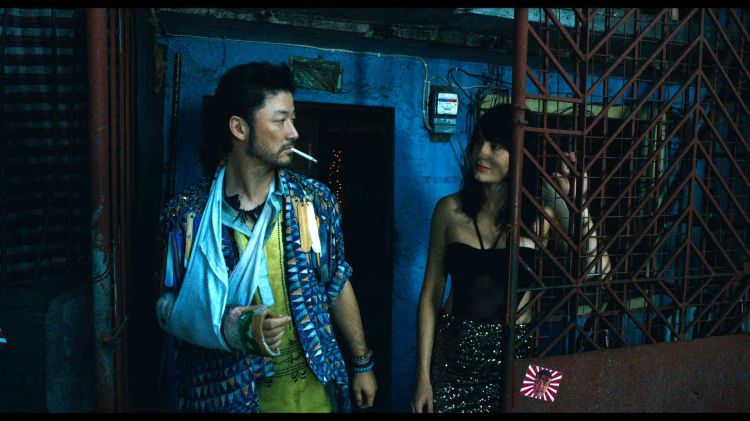
100% did not notice that sticker while I was watching the film…

Just “another love story between a criminal and a whore” –  so subtitles maverick Filipino film director Khavn his latest effort, Ruined Heart (Pusong Wasak: Isa na namang kwento ng pag-ibig sa pagitan ng kriminal at puta), though like much in the film you could read quite a lot more intro those few words than their subtext suggests. Light on conventional narrative and almost dialogue free, Ruined Heart is the deconstruction of the classic B-Movie. We have our noble, broken hearted outlaw and our damaged princess in need of rescue but what we’re denied is the sense of moral righteousness that generally pervades in a B-Movie and particularly in a film noir. The picture Kavn paints is of a hellish world where violence reigns and love will always be defeated.

There’s little point trying to tease out the plot bar the above ideas. What we are presented with at the beginning of the film is our dramatis personae – archetypes of this modern myth: The  Lover (Elena Kazan), The Criminal (Tadanobu Asano), The Friend (Andre Puertollano), The Whore (Nathalia Acevedo), and The Pianist (played by Khavn himself), each profiled against a butterfly patterned curtain neatly echoing Branded to Kill. Our hero, the Criminal, bonds with the Whore after offing one of her Johns, but their love is not to last after the Criminal decides to help The Friend rescue his Lover from the Godfather.

While all of this is going on we’re also treated to a far more surreal scene where the pianist reads out a street poem consisting of the repeated phrase “I am the poem of the world” before taking part in a bizarre ritual where he appears to resurrect the Godfather (Vim Nadera) who is now introduced for the first time. Is the pianist the god of this strangely operatic landscape, presiding over this violent world of song? For someone with such an elaborate introduction he makes relatively little impact thereafter. Is this hell, are we all dead already or merely doomed to relive these old stories over and over again to the point where names and language no longer have currency?

That said, there is something genuine to be found here in this otherwise cold landscape. The Criminal and The Whore find love against the odds though their romance is soon frustrated by the harshness of their world. They have fleeting moments of joy where they drink and dance and make music of all kinds. However, something is coming for them and however hard you try to escape there are things you cannot outrun.

Playing out more like an avant-garde opera than a conventional film, Ruined Heart offers little in the way of concrete explanations. Dripping with sometimes impenetrable symbolism the film paints an eerie, dream-like vision that often proves impossible to decode and like all the best poems, there are a hundred different ways to read it.

The score itself is an eclectic assault of catchy ’60s inflected broken heart ballads and electro pop, often repeating the same song in different arrangements (an apt stylistic choice given the nature of the film). Composed by a diverse collection of artists including French/German outfit Stereo Total who contributed to Third Window Films’ previous release pink musical Underwater Love, and Bing Austria & the Flippin’ Soul Stompers who provide the film’s catchy theme song, the musical element becomes the driving force of the film.

Shot with a youthful yet melancholy verve by Christopher Doyle, Ruined Heart is a high energy experience that proves difficult to digest, particularly on a first viewing. However, its extremely rich layers of symbolism and subversion of common archetypes lend it a mystifying and intriguing atmosphere that continues to fascinate long after the credits roll. More felt and experienced than understood, Ruined Heart may prove a difficult sell for some but comes bearing gifts for those that long to find them.


Ruined Heart is available on blu-ray in the UK now from Third Window films in a limited edition package which also includes a soundtrack CD (highly recommended for the CD alone). The blu-ray disc also includes Khavn’s short film with the same title and a similar theme (though filmed in an entirely different style and with a different cast).

First saw the film a couple of months ago and still can’t get this song out of my head.

Trailer for the film


Fires on the Plain (野火, Shinya Tsukamoto, 2015)

fires on the plain 2015 posterShinya Tsukamoto is back with another characteristically visceral look at the dark sides of human nature in his latest feature length effort, Fires on the Plain (野火, Nobi). Another take on the classic, autobiographically inspired novel of the same name by Shohei Ooka (previously adapted by Kon Ichikawa in 1959), Fires on the Plain is a disturbing, surreal examination of the effects of war both on and off the battlefield.

Late in the war when it’s almost lost though no one wants to admit it, Corporal Tamura (Shinya Tsukamoto) finds himself suffering with TB on the Philippine island of Leyte where supplies, and tethers, are running short. Shortly after being punched in the face by his commanding officer, he’s given five days’ worth of supplies and ordered to march to the field hospital for treatment as no one wants a sick man weighing down the unit. Only, when he finally arrives at the field hospital, they have their hands full (literally) with the battlefield wounded. Marching back to his unit again, Tamura is ordered back to the field hospital and told to use his grenade to ease the burden on his fellow soldiers if refused. So begins Tamura’s fevered, mostly solitary odyssey across the beautiful landscape of the Philippine jungle suddenly scarred with corpses, the starving and the mad.

Tsukamoto’s adaptation sticks closer to the original novel than Ichikawa’s 1959 version, though both eschew Ooka’s Christianity. Tamura is a man at odds with his fellow soldiers. Formerly a writer he’s “an intellectual” as one puts it, and a little on the old side for a corporal. Coughing and wheezing, he shuffles his way through just trying to survive. Unlike Ooka’s original novel in which the protagonist’s Catholicism makes suicide an unavailable option, it’s the memory of Tamura’s wife which stays his hand on the pin of his grenade. Tamura wants to go home, to escape this hellish island full of the walking dead, hostile locals and hidden clusters of enemy troops.

To get home, to survive, what will it cost? There was barely any food left to start with. The original five days’ worth of rations Tamura was given amounted to a handful of yams. On his second trip to the military hospital he was given nothing at all. There’s no wildlife, even if you manage to find some plant roots they’ll need cooking. Of course, there is one abundant source of food, except that it doesn’t bear thinking about. Tsukamoto’s version takes a less ambiguous approach to the idea of cannibalism than Ichikawa’s which removed Tamura’s moral dilemma by having his teeth fall out through malnutrition and rendering him unable to indulge in “monkey meat” even if he might have succumbed. Death feeds on death and there’s no humanity to be found here anymore where men prey on men like animals.

There’s no glory in dying like this. Half starved, half mad and baking to death in the heat of a foreign jungle abandoned by your country which cared so little for its men that it never thought to conserve them. When you make it home, if you make it home, you aren’t the same you that left. The things you had to do to get there stay with you for the rest of your life, and not just with you – with all of those around you too. Wars don’t end when treaties are signed, they survive in the eyes of the men who fought them.

A timely and a visceral look at the literal horror of war, Tsukamoto’s Fires on the Plain is a refreshingly frank, if stylised, examination of the battlefield. Limbs fly, heads explode, organs are exposed and brain fragments leak out of ruined corpses. At any other time, Leyte would be a paradise of lush vegetation, colourful flowers and beautiful blue skies but it’s corrupted now by the fruits of human cruelty. This is what it means to go to war. There’s nothing noble in this – just death, decay and eternal grief. Though the film often suffers from its low budget and some may be put off by the stark, hyperreal cinematography, Fires on the Plain is another typically troubling effort from the master of discomfort and comes as a warning bell to those who still think it is sweet and fitting to die for one’s country.


Reviewed at Raindance 2015.

Original trailer (English subtitles)

First published by UK Anime Network.