 Written by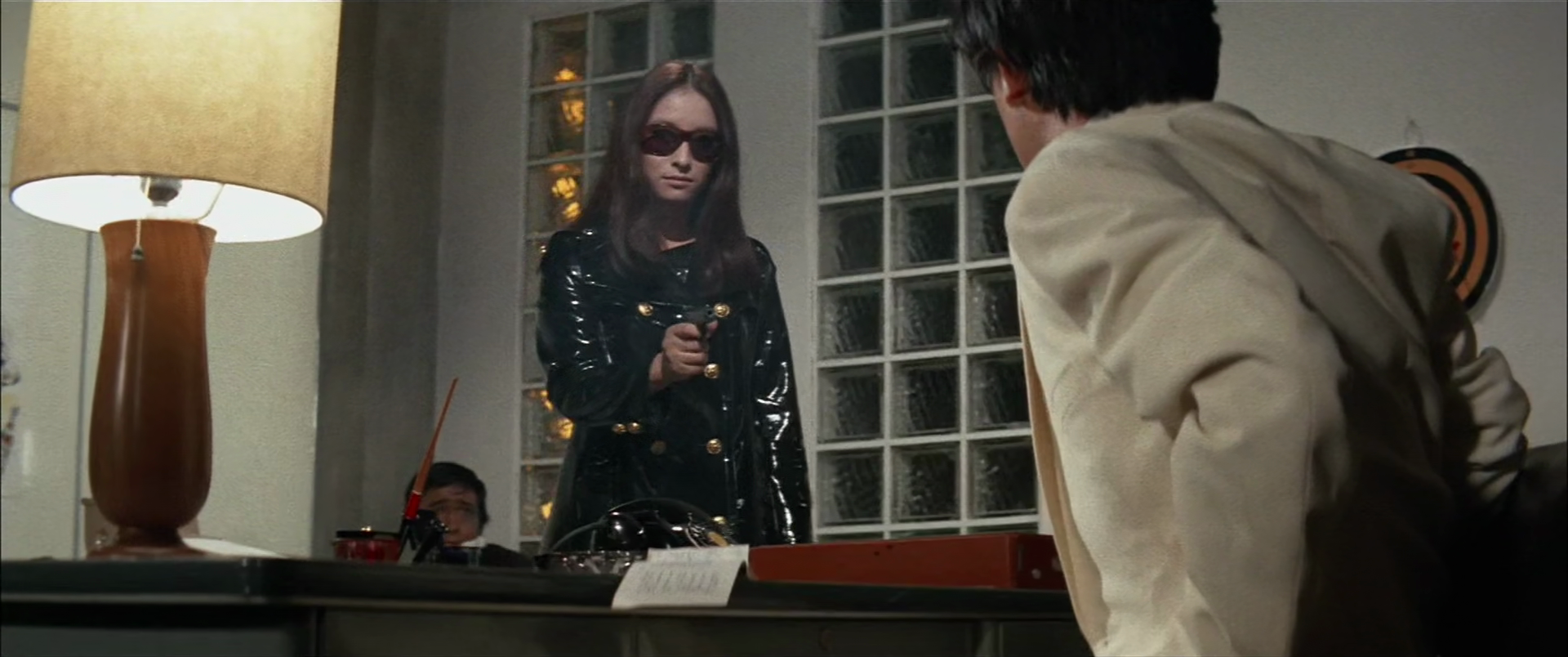
Kyoko Enami joined Daiei in 1959 and became one of its biggest stars seven years later when she played the lead in the 17-part Woman Gambler series that continued until 1971. The Art of Assassination (女殺し屋 牝犬, Onna koroshiya: Mesu Inu) shares many of the same members of the creative team while adapted from a novel by Shinji Fujiwara and written by Mitsuro Otaki who had adapted the Raizo Ichikawa vehicle Killer’s Key. Set in the present day, the film seems to be setting up another long-running series for Enami in its hints at the backstory of its hit woman heroine, though it appears not to have gone any further.
In any case, the film anticipates the paranoia cinema of the coming decade as the ice cool Kayo (Kyoko Enami) finds herself mixed up in shady political intrigue when a yakuza working for a regular company hires her to take out a would-be-whistle-blower. Tobita, a corrupt politician in cahoots with Toyo Trading CEO Abe, has evidently been up to no good and possibly unwisely chose to freeze out one of his co-conspirators, Ishizuka. Ishizuka has now been released from prison and is minded to spill the beans on their whole operation, so Tobita wants him taken out before he can reveal his explosive memo.
The relationship between Tobita, who is shameless in his corruption, Toyo Trading, and corporatising yakuza outfit Kijima Industries bears out a contemporary uneasiness regarding the interplay between politics, violence, and big business in the age of high prosperity. Kayo’s friend Mika works as an advertising model and has become the mistress of Toyo boss Abe to further her career. She tells Kayo that it was her dream to have her own place and live a life of luxury, which she’s ironically achieved through promoting consumerism and commodifying herself as Abe’s mistress. When Kayo is later forced to kill him, rather insensitively in Mika’s apartment, Mika seems less emotionally wounded by Abe’s death or shocked by learning the truth of her friend’s identity, than filled with despair that Kayo has now shattered her dreams. She won’t be getting any more work from Toyo nor will Abe be paying for her apartment, so she might lose everything she’s worked so build.
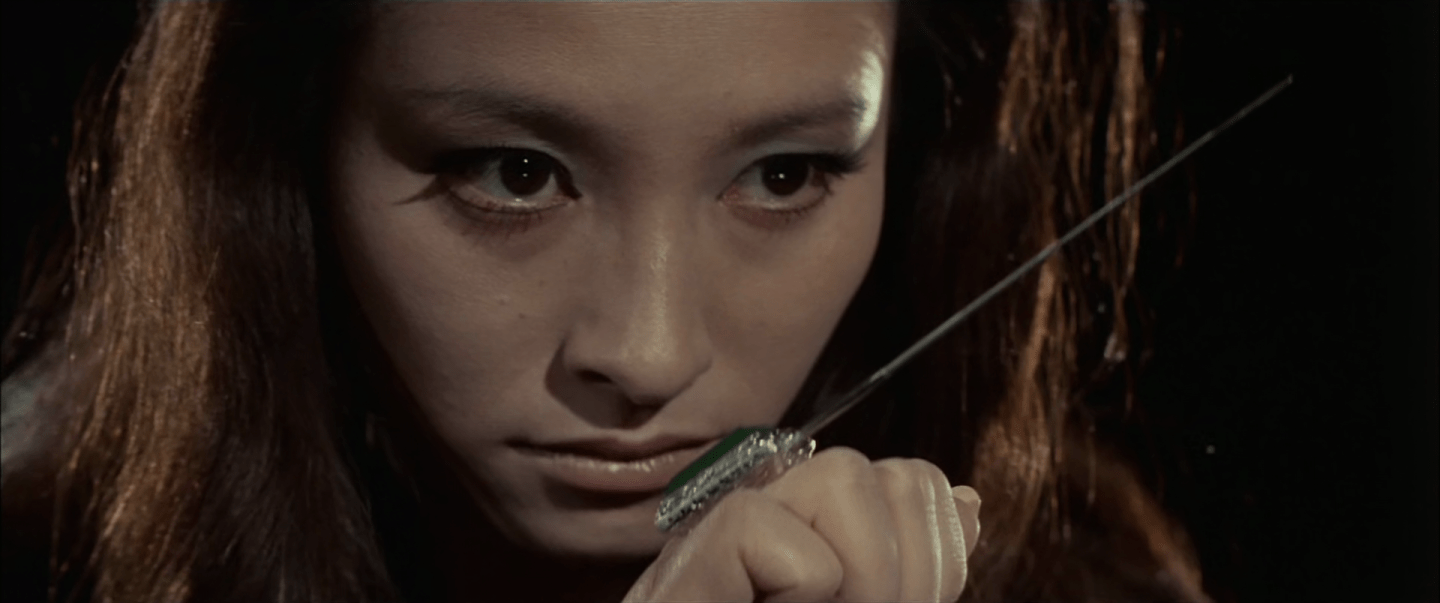
Kayo, by contrast, dresses in a kimono for her cover job running a cafe and presents as the exact opposite of a modern girl like Mika. Her favourite weapon is a chunky emerald ring that conceals an extendable needle she uses to silently take out her targets. She is only really able to operate in this way precisely because of her femininity. She manages to kill Ishizuka while he’s arrogantly lounging around in a public pool at the hotel where he’s holed up by swimming under his lilo and puncturing his neck from below. This way of dispatching her targets necessarily means she has to get in close and is able to do so precisely because no suspects her. She is, however, prepared to use guns where necessary and is meticulous in her work while seemingly having no inner personality outside of her identity as a contract killer. Mika thinks they’re friends, but Kayo uses her without a second thought and seems only mildly guilty about getting her involved, placing a share of the bounty in front of her by way of compensation.
The film flirts with a backstory, offering a few flashbacks to Kayo as a child sitting in a pool of blood, but never explains any further. It seems Kayo’s coolness is a trauma response, but this job has her feeling very annoyed. As she says, it’s the first time she’s ever killed for rage rather than money and demands vengeance from those who’ve doubled crossed her. In that sense, it doesn’t really matter that her ultimate targets are the evils of the age from corrupt politicians to amoral capitalists and disingenuous yakuza because her quest is personal and driven and her own particular code of ethics, but it does nevertheless say something about contemporary anxieties. That Daiei chose to advertise this using a poster with Enami in a swimsuit, which does admittedly appear in the film, along with the Japanese title (Female Killer: Bitch) which makes the film sound a little more salacious than it actually is, suggests they may have had a different audience in mind from their usual fare, but it is a shame that Enami did not get the opportunity to further flesh out this ultra-cool heroine.

