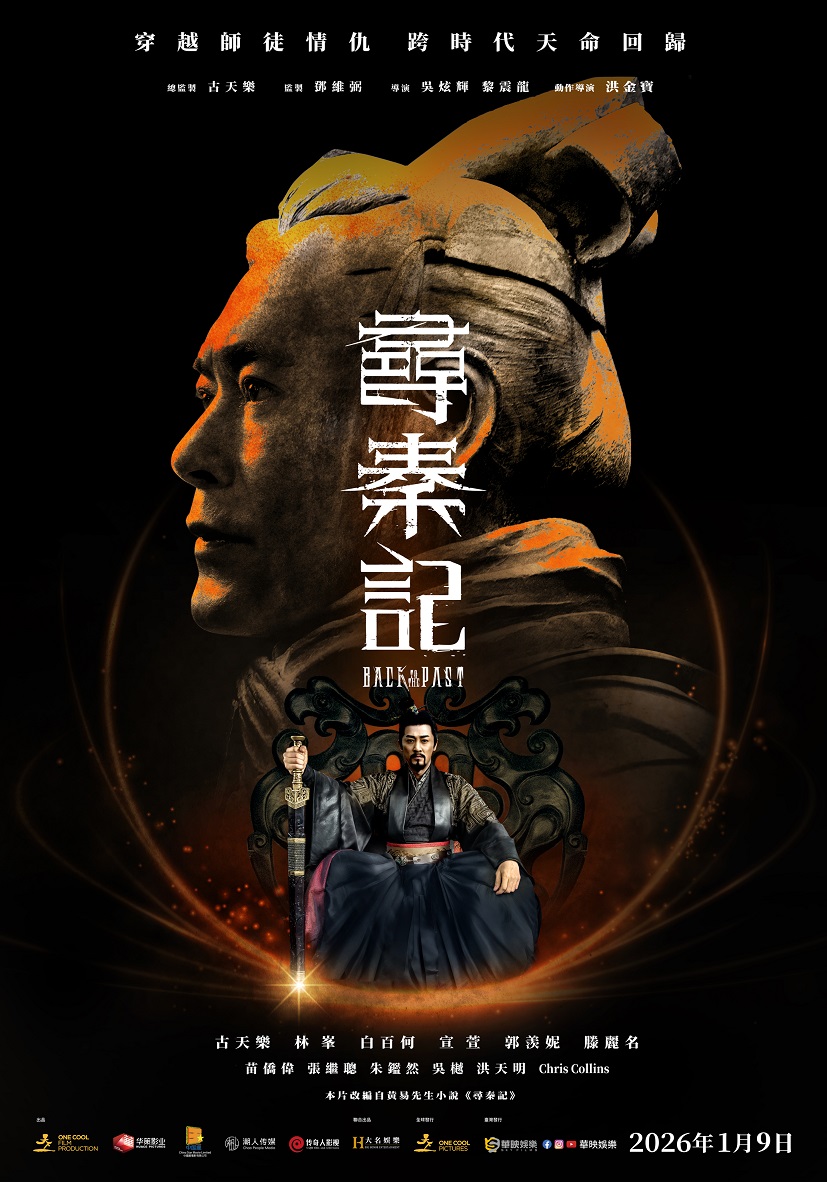
Back to the Past (尋秦記, Jack Lai & Ng Yuen-Fai, 2025)

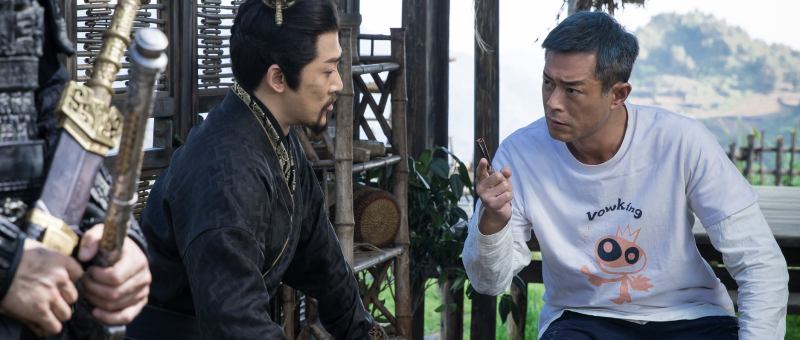
Can history be changed, and if it can, should it be? In a way, Jack Lai & Ng Yuen-Fai’s Back to the Past (尋秦記) is an attempt to change history in itself in that it’s a long-awaited sequel to a television series that concluded more than 20 years ago. A passion project from star Louis Koo, the film opens in contemporary Hong Kong where the inventor of the time machine that sent Hong Siu-lung back in time to witness the ascension of the Qin emperor is released from being “wrongfully imprisoned” for attempting to change history.

Lung (Louis Koo) seems to have told those back in the Qin Dynasty that he came from a mysterious “hometown” . He’s now estranged from his former pupil, Qin Emperor Poon (Raymond Lam), after becoming disillusioned with his despotic rule. It seems that Lung’s inability to return to the present due to a broken amulet somehow contributed to Ken (Michael Miu) getting sent to prison. Now he’s out, he’s sending himself back to the past because, for otherwise unexplained reasons, he wants to become the Qin emperor himself to prove that it is possible to change history after all. Though it is apparently still 2025 in contemporary Hong Kong, Ken and his team have access to a lot of futuristic gadgets like metal discs that can suddenly transform into motorcycles, transparent holographic communication devices, and a headset that can give you the appearance of another person.

Thus Lung is a man doubly trapped in the past in that he has no way of knowing how the society developed in the years since he left. He’s essentially fighting a war on two fronts as he’s ambushed by Ken’s team, some of whom are only there to loot “ancient antiques”, while in fear of his life from Poon who blows hot and cold over wanting to kill him as a potential traitor. The TV series had ended on a cliff hanger in which Lung’s son Bowie changed his name to “Yu”, meaning eagle, but also giving him the name of the warlord who overthrew the Qin emperor but ended up becoming a dictator himself.

The incongruity of Qin Dynasty warriors facing off against Ken’s ultramodern kit with bows and arrows is indeed fascinating, though the puzzling lack of confusion among Lung’s friends and family is possibly explained away by having seen various other odd things from Lung’s “hometown” in the past. No one is very surprised when he puts on his future clothes either, while the bun clip hair extension one of his wives made him wear gets dropped pretty quickly. Aside from the clash of eras, there’s also a commentary on the nature of family as is perhaps expected for a (Western) New Year movie. Ken is given the opportunity to trade his captured daughter for Lung’s captured wife, but refuses, insisting that he only wants the Qin emperor. When one of his men is killed, Lung tells Poon that he won’t help him any more so he’ll have to make his own way to back to the palace. His wives, however, tell him that Poon is still family even if he did turn a bit evil, and after all he risked his life to save Bowie, so it would be mean to leave him behind.

Poon is the spiritual son who has disappointed his father, Lung by turning to the dark side but Lung can never quite give up on him while as much as he bangs on about having Lung killed, Poon can’t bring himself to do it either and seems to still want Lung’s approval just not as much as absolute power. Trapped in the past, Lung has come to realise that it’s family that’s important so it doesn’t really matter where you are as long as you’re all together. A tacked on “alternate ending” sells the New Year theme with the entirety of the Qin Dynasty cast being beamed to 2025 to enjoy some nice food and a fireworks display all together as a family after which Lung returns to the past and says he’ll never come back to the future. It’s tempting to read his declaration as an expression of the nostalgia inherent in the premise, that Lung wants to go back to an earlier time when things weren’t as complicated as they are now even if he’s still living under an oppressive regime. But at the same time, history can’t necessarily be reclaimed in that way and even for him things have moved on, though of course for those in the present it is still possible to change “history” and perhaps more difficult to do so if you can’t let go of an idealised past.


Trailer (English subtitles)

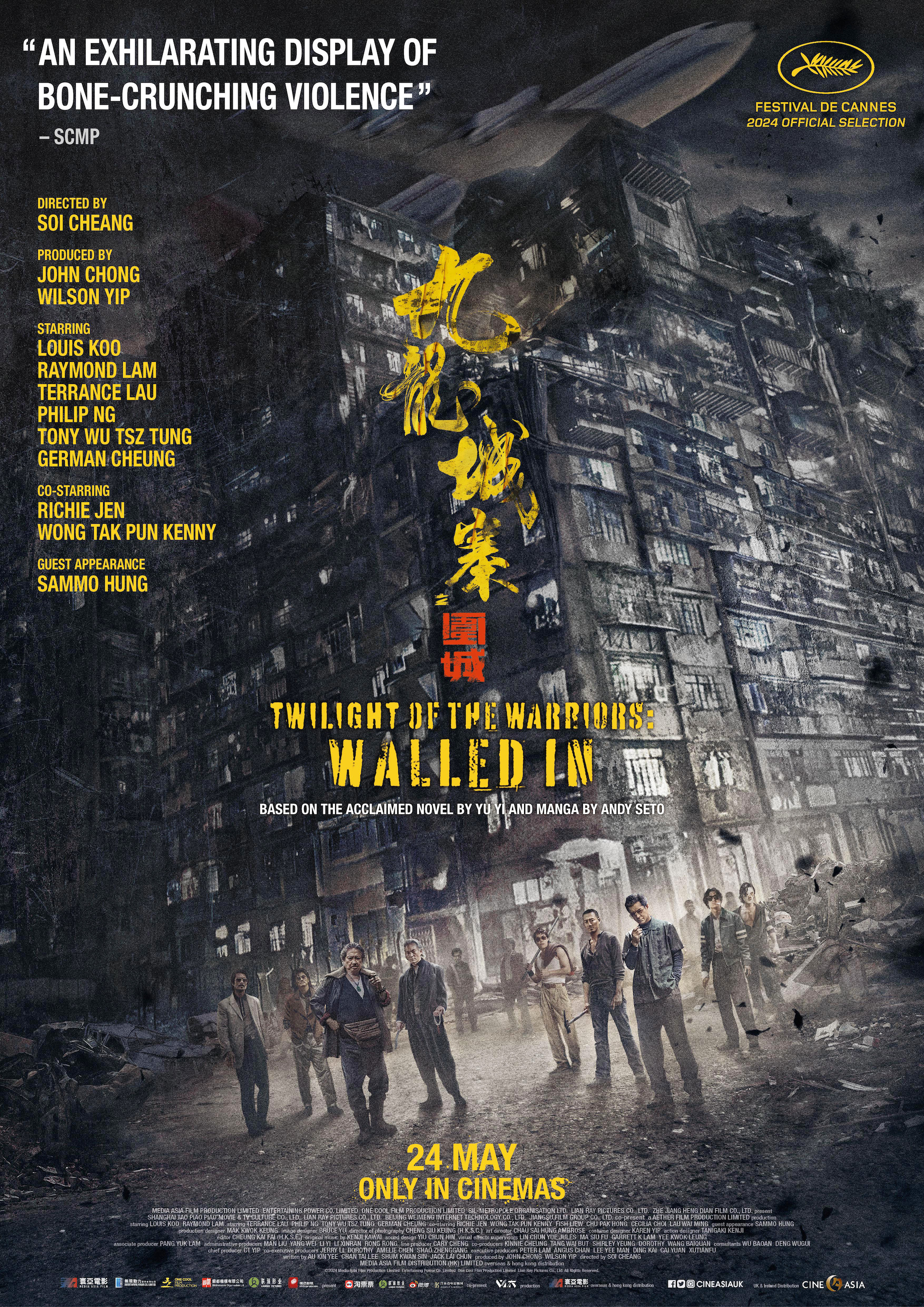
Twilight of the Warriors: Walled In (九龍城寨.圍城, Soi Cheang, 2024)

In Kowloon Walled City, you give help, you get help. Sometimes described as a colony within a colony, by the late 1980s the settlement was largely ungovernable and literal law unto itself save for the triads who maintained what little order there was. Yet in Soi Cheang’s Twilight of the Warriors: Walled In (九龍城寨.圍城) it’s a place of comfort and security, a well functioning community that as its leader Cyclone (Louis Koo Tin-lok) points out may be unpalatable for “normal” people but provides a point of refuge for the exiled and hopeless.

It’s difficult not to read it and Cyclone himself as embodiments of Hong Kong that is slowly disappearing. Dying of lung cancer, Cyclone is aligned with the fate of the walled city as someone whose time is running out, tired and world weary but still hanging on. In the opening sequence set 20 or so years before, we see Cyclone stand up to an apparent dictatorship and institute what seems to be a more egalitarian form of government though one obviously defined by violence. Nevertheless, when refugee Lok (Raymond Lam Wui Man) lands up there originally suspicious of Cyclone having been duped by local gangster Mr Big (Sammo Hung Kam-bo), he discovers him to be a stand up guy looking after those in his community and generally keeping the peace. Nevertheless, Lok’s arrival is the fatalistic catalyst for the opening of old wounds amid the free for all of the mid-80s society in which the Walled City, sure to be bulldozed, has just become a lucrative property investment.

Mr Big and his crazed henchman King represent this new order, amoral capitalistic consumerists who care little for the conventional rules of gangsterdom. Their bid to seize the Walled City has its obvious overtones as they seek to replace the (generally) peaceful egalitarian rule of Cyclone with something that appears much more authoritarian and ruthless. Believing himself to be a stateless orphan, Lok tries to keep his head down saving everything he can to buy a fake Hong Kong ID card which is also in its way a quest for identity not to mention a homeland and a sense of belonging. He finds all of these things, along with a surrogate father figure, in the Walled City only to have the new home he’s discovered for himself ripped out from under him because of a twist of fate. When he teams up with a trio of other young men who all owe their lives to Cyclone and the Walled City to attempt to take it back, it’s also an attempt to reclaim an older, more autonomous Hong Kong that exists outside of any kind of colonial control as evidenced by his final statement that no matter what happens some things don’t change.

This sensibility extends to the casting of the film which includes a series of Hong Kong legends including a notable appearance from the legendary Sammo Hung not to mention Louis Koo alongside a generation of younger stars such as Tony Wu and Terrance Lau Chun-him. Adapted from the manhua City of Darkness by Andy Seto, the film opens with a flashback to the original war for control of the Walled City that hints at deeper, extended backstories otherwise unexplored though equally mythologised by those who impart them to them Lok, a prodigal son and eventual inheritor of the City’s legacy. Even so, the comic book elements sometime distract from Soi Cheang’s otherwise evocative if hyperreal recreation of the Walled City slum or the political subtext that can be inferred in the presence of supernatural abilities such as those which seem to grant King near invincibility.

In any case, Soi Cheang looks back equally towards the history of heroic bloodshed in particular in his tale of brotherhood and loyalty in which the secondary antagonist is literally imprisoned by his own futile desire for a pointless vengeance on the descendent of a man who had wronged him but was already long dead himself. As he’d said, the future of the Walled City is in the hands of the younger generation who choose to end the cycle by setting him free rather than imprison themselves along with him while defending their home as well as they can. With some incredibly well designed action sequences including one that make its way onto a double-decker bus, Soi Cheang’s beautifully staged action thriller as its name suggests has a rather elegiac quality but also the spirit of resistance in its gentle advocation for the importance of supportive communities.


Twilight of the Warriors: Walled In is in UK cinemas from 24th May courtesy of CineAsia.

UK trailer (Traditional Chinese & English subtitles)