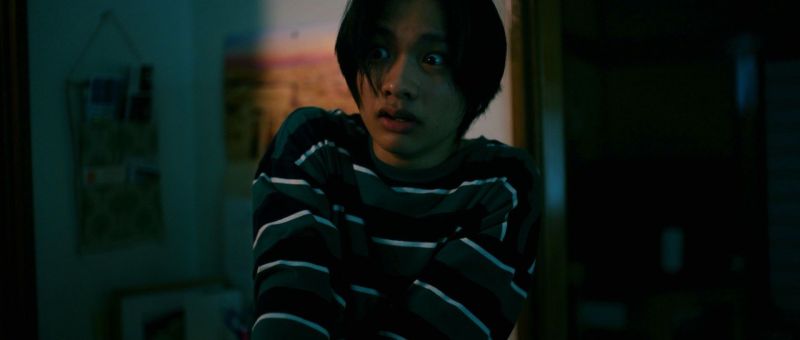

House of Sayuri (サユリ, Koji Shiraishi, 2024) [Fantasia 2024]

An excited family discover the perils of buying a “used” home in Koji Shiraishi anarchic haunted house horror House of Sayuri (サユリ, Sayuri). Unlike many other nations, Japan does not really have a comparable housing market as, given changing building regulations etc, it’s common to demolish the original structure and build a bespoke home in its place rather than move into one someone else has vacated. That obviously means that opting for an existing property can be a little bit cheaper, which is presumably how the Kakimis have finally managed to move into what they describe as the dream home, escaping a cramped city apartment for a spacious rural mansion with room enough for grandma and grandpa too.

Of course, this particular home is probably cheaper because something untoward once happened there, though the Kamikis probably don’t know that, and everyone who’s lived there since has moved out a short time later. In a way referencing Shiraishi’s previous work, we can’t really tell whether the malevolent spirit wants the family out or is merely trapped in a loop of revenge on the family that badly betrayed them. In any case, it makes its way through the Kamiki family unit starting with daughter Keiko and causing all manner of strange events in the house. Sensibly, older son Norio begins to ask why they don’t just move but the parents are so committed to their dream of homeownership that they can’t bear the thought and remain determined to hang on to it at whatever cost. 

In any case, some wise words from grandma advance a more positive way of battling the ghost, that they should fight it with the force of their lives. They laugh in its face and shout vulgar phrases that send it scuttling away in outrage. The best way to fight the darkness, grandma says, is to live well. Like the house itself, it seems grandma has a well hidden secret that makes her the film’s key asset, a hilarious force of nature and eternal wise woman otherwise ignored because her dementia undermines her credibility. Meanwhile, Norio makes an unexpected friend at school who just happens to be a psychic and is keen to warn that a little girl ghost has latched on to him and it would obviously be better if he could just move out on account of all the evil emanations that appear to be coming from his home.

But as grandma says, it’s the grudges of the living they ought to be afraid of. The house of course holds its secrets and its labyrinthine, multilevel structure is perfect for concealing them. Unfortunately the Kamikis have bought into this poisoned legacy and slowly start seeing their familial bonds fracturing while the ghost takes advantage of their vulnerabilities, their negative emotions and insecurities. In a sense it becomes a question of whether they can endure a place of trauma to maintain their dreams of homeownership or are prepared to make the more sensible decision of ceding ground and moving somewhere less toxic while Norio tries to reclaim his place in his family and protect what remains of it. 

Truly heading in some unexpected directions particularly in its unpredictable send half, the film takes on an absurdist quality but also returns to classic genre tropes of the legacy of child abuse and the betrayal of a parent who saw and did nothing perhaps because, like the Kamikis, they were prepared to accept this this kind of toxicity to maintain a happy family home and be seen as a model upper-middle class family living in a country mansion. It turns out, the only way to exorcise this much more literal ghost is by directly confronting the traumatic past and attempting to find accommodation with it be that through violence or forgiveness. But as grandma had said, the best weapon is love and life, throwing back at the ghost what it no longer has in a defiant expression of being alive and that joy contains which is also of course as grandpa had said a way of honouring the dead resolving to make the most of one’s remaining time in their memory. In any case, Norio discovers that you do not have to continue living in a haunted house but unlike a ghost are in fact free to leave the scene of trauma and seek new happiness in a less upsetting place.


House of Sayuri screened as part of this year’s Fantasia International Film Festival.

International trailer (English subtitles)

Liverleaf (ミスミソウ, Eisuke Naito, 2018)

(C)押切蓮介/双葉社 (C)2017「ミスミソウ」製作委員会

Liverleaf poster“How have things turned out this way?” Asks the heroine of Eisuke Naito’s Liverleaf (ミスミソウ, Misumisou) after receiving a poignant (non)explanation for the cause of all her sufferings. Adolescence is cruel at the best of times, but when you’re stuck in a tiny no horse town with nothing to do, violence can become an easy pastime. The kids of Liverleaf take the art of bullying to all new heights, stopping not at humiliation, ostracisation, or conspiratorial acts of emotional ruin but allowing their petty games to run all the way to arson and murder.

Haruka (Anna Yamada), unlike most of her classmates, is a relatively new resident of a small rural town where she and her family have moved for her father’s job. Her only friend at school, and the only one to stand up for her against the gang of popular kids making her life a misery, is another transfer student, Aiba (Hiroya Shimizu), living alone with his grandmother for mysterious reasons. The usual high school girl tricks of making another girl feel unwelcome – stolen shoes, name calling, silent stalking etc eventually progress into direct violence at which point her father (Masahiro Toda) tries to go to the school to complain. Unfortunately, Haruka’s teacher (Aki Morita) is an almost absent, hollow source of authority who cannot control the kids and nor does she try. She tells Haruka’s dad that as the school will be closing down at the end of the academic year it’s hardly the time to make waves and she sees no need to get involved in such trivial matters. Matters come to a head when the kids, egging each other on, set fire to Haruka’s house with her mother (Reiko Kataoka), father, and little sister Shoko (Sena Tamayori) trapped inside.

It’s true enough to say Haruka reacted to her bullying in the way that society expects – she kept her head down and tried to put up with it without making a fuss. Some may read Liverleaf as a tale of vengeance, but it isn’t. As passive as she’s always been, Haruka’s acts of violence are a matter of extreme self defence. She doesn’t go looking for the ones who’ve done her wrong, but they come looking for her and thereafter pay a heavy price for their continued campaign of subjugation.

Haruka became an easy subject for bullying because she was a literal outsider – Aiba escaped this particular fate through being male, conventionally attractive, and with a confidence and maturity which set him apart from the bratty kids trying to prove their status by belittling others. Once Haruka decides to sit out the rest of the school term rather than put up with constant torment, she activates an extreme chain of events when the next likely target, a strange girl with a stammer (Rena Ohtsuka), decides to do whatever it takes to become one of the bullies rather than their latest victim. Morality goes out the window when fear takes over and some will to whatever it takes to make sure it’s someone else in the firing line rather than themselves.

Yet for all the fear and violence, there’s another, perhaps more interesting, story buried under all the senseless bloodletting. It’s not so much that teenage emotions are running wild, but that they barely have them at all and those they do have find no available outlet. Romantic jealousy spirals out of control, turning in on itself as love denied masquerades as hate. Unable to freely voice their innermost anxieties, the kids take their resentments out on each other, getting their kicks through cruel games which bind them with complicity in the absence of real feeling.

Naito attempts to lend an air of realism to the increasingly bizarre middle school warfare but cannot escape the manga origins of his source material. The violence itself is cartoonish and absurd, but there’s also an unpleasant layer of fetishisation which takes over as the blood starts flowing, almost revelling in acts of extreme cruelty as a young man exults in beating the face of a young girl to a bloody pulp. Unremittingly bleak, Liverleaf makes a bid for pathos in its closing coda as it takes us back to a case of ruined friendships and broken dreams but it can’t overcome the uneasy stylisation of all that’s gone before in swapping emptiness for wistful melancholy.


Liverleaf screens as part of New York Asian Film Festival 2018 on 8th July, 7pm with director Eisuke Naito in attendance for a Q&A.

Original trailer (English subtitles/captions)