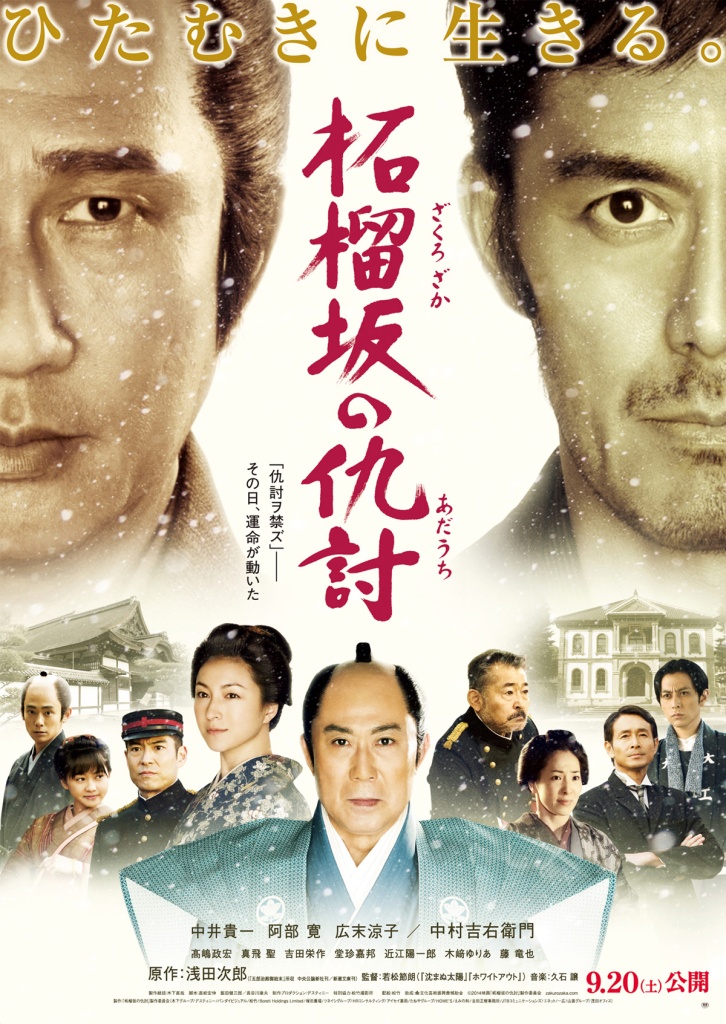
Snow on the Blades (柘榴坂の仇討, Setsuro Wakamatsu, 2014)

Snow on the Blades 2Times change, and men must change with them or they must die. When Japan was forced to open up to the rest of the world after centuries of isolation, its ancient order of samurai with their feudal lords and subjugated peasantry was abandoned in favour of a more Western looking democratic solution to social stratification. Suddenly the entirety of a man’s life was rendered nil – no more lords to serve, a man must his make his own way now. However, for some, old wounds continue to fester, making it impossible for them to embrace this entirely new way of thinking.

Kingo is one such man who finds himself frustrated by history in Setsuro Wakamatsu’s adaptation of a novel by Jiro Asada, Snow on the Blades (柘榴坂の仇討, Zakurozaka no Adauchi). In 1860 (as we count it) he married a beautiful young woman and received a promotion as the bodyguard for his lord, Ii Naosuke. However, one fateful day his progressive master is ambushed by a rival clan making a pretence of arriving with a petition that needs to be heard. Kingo and his men fail in protecting their lord and though many of the survivors commit suicide in shame, Kingo is charged with finding the remaining perpetrators and exacting his revenge. His quest spans almost fifteen years of turbulent Meiji era history as he trudges all over Japan looking for rumours of men who no longer quite exist all the while a lonely wife waits for him at home, becoming the sole breadwinner for this new life of forced “equality”.

The man Kingo has been looking for, Naokichi, is also living an unfulfilling life, hiding from retribution but also from himself and his own remorse over the deeds of a young man whom he no longer recognises. He has the possibility of building a new life with a local widow and her sweet little daughter who’s taken a liking to him, but like Kingo he’s held frozen by the old ways and can’t quite allow himself to bring a woman and child into his life of shame and fear.

Both men have been left behind by history. Kingo is the more obvious relic with his anachronistic top knot and old fashioned Japanese dress but Naokichi is also unable to move forward until he faces his past. For much of the running time Snow on the Blades plays out like a conventional mystery or revenge tale with Kingo on the road trying to track down those who he believes wronged his master in an attempt to atone for his failures through vengeance, but all that awaits him at the end of his journey is a lonely grave. The problem is, he liked his lord who was good and progressive man, filled with kindness and poetic sentiments. His regret over not being able to save him is more than failed duty, it is also personal grief and guilt though he finds little comfort in pursing those he believes to responsible.

Having spent thirteen years striving for something Kingo suddenly finds himself adapting to the times and beginning to believe perhaps this isn’t what his lord would have wanted anyway. Both men, confronted by each other and by several different kinds of history, are forced to face themselves as they are now and as they were then and assess what all of these codes and honour systems are really worth. Snow on the Blades is often beautifully photographed and filled with scenes as lovely as any woodblock painting but, it has to be said, somewhat dull as its central psychological dramas fail to ignite. Impressive production values and universally strong performances from its high profile cast lift the film above its fairly generic narrative but can’t quite save it from its rather trite message and run of the mill period drama aesthetic.


The assassination at Sakuradamon or Sakuradamon Incident is a real historical event in which the Japanese Chief Minister Ii Naosuke was murdered by ronin samurai working for the Mito clan outside the Sakurada Gate of Edo Castle in 1860. Ii Naosuke was a leading proponent of opening up to foreign powers (albeit as a sort of defense mechanism) but made an enemy of just about everyone through his tyrranical actions and was a very unpopular figure at the time of his death though his image has now been somewhat rehabilitated.
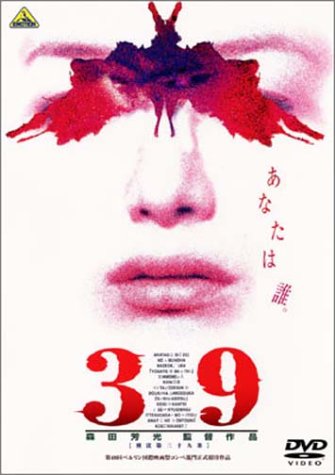
Keiho (39 刑法第三十九条, Yoshimitsu Morita, 1999)

keihoArticle 39 of Japan’s Penal Code states that a person cannot be held responsible for a crime if they are found to be “insane” though a person who commits a crime during a period of “diminished responsibility” can be held accountable and will receive a reduced sentence. Yoshimitsu Morita’s 1999 courtroom drama/psychological thriller Keiho (39 刑法第三十九条, 39 Keiho Dai Sanjukyu Jo) puts this very aspect of the law on trial. During this period (and still in 2016) Japan does nominally have the death penalty (though rarely practiced) and it is only right in a fair and humane society that those people whom the state deems as incapable of understanding the law should receive its protection and, if necessary, assistance. However, the law itself is also open to abuse and as it’s largely left to the discretion of the psychologists and lawyers, the judgement of sane or insane might be a matter of interpretation.
The case at the centre of the film centres around a young actor, Masaki Shibata, who has confessed to the murder of a pregnant woman and her husband after he argued with the woman at her place of work. Shibata acts strangely and makes a point of asking for the death penalty before spouting off about angels and demons and later displays evidence of a split personality. Everyone seems convinced he’s suffering from MPD and committed the murders during a dissociative episode but the assistant psychologist is convinced he’s faking. At the same time, one of the lead policemen on the case also thinks there’s more to this. On investigating further, he discovers the strange irony that the murdered man himself escaped prosecution by reason of insanity after committing a horrifying crime that lead to the death of a six year old girl.

The film may be about a murder but what’s really on trial here is the law itself. The murdered man, Hatada, committed a heinous crime but was a child himself at the time so received only a brief sentence served in a hospital. He was released, went to university, got a good job and got married – a normal life. The family of the little girl he killed, by contrast, will never be able to return to normality and will continue to live in torment for the rest of their lives knowing the man who so brutally took their child from them is still out there living just like one of us. The film does not go into why Hatada committed the original crime or the reasons he was later declared fit to return to society, but the film wants to question the idea of releasing back into the world someone who has done something as horrifying as the rape, murder and dismemberment of a child.

The case at hand is a complicated one which has so many layers coupled with twists and turns that it becomes unavoidably confusing. Playing with several literary allusions from the frequent quotations from the “mad prince” Hamlet to naming the assistant psychologist “Kafuka”, Keiho also wants to delve deep into human psychology with its questions of identity and self realisation. Both the accused and the psychologist have deeply buried memories of trauma the suppression of which has cast a shadow through the rest of their lives. Both of them are, in a sense (even if not quite in the way it originally appears), haunted by a shadow of themselves.

When it comes to the procedural aspects, the final “twist” is a step too far and perhaps undermines the groundwork which has gone before it. Something which is presented as an elaborate revenge plot against both the state and the original instigator of a crime also appears to originate with a clumsy motion of self preservation. The state’s failure to properly deal with the criminal in the first case has resulted the death of another innocent bystander, all of which might have been avoided if Article 39 had not come into play.

Kafka-esque is, in fact, a good way to describe the circularity of the narrative as the notion of an insanity plea becomes a recurrent plot device. Backstories are constructed and discarded, identities are shed and adopted at will and the past becomes a thorn in the side of the future that has to be removed so everyone can comfortably move on. Morita relies heavily on dissolves to create a floating, dreamlike atmosphere as memories (imaginary or otherwise) segue in and out like tides but he also shows us images reflected in other surfaces such as the Strangers on a Train inspired sequence which literally shows us events through someone else’s eyes as we’re watching them reflected doubly on the lenses of a pair of sunglasses.

Difficult, complicated and ultimately flawed Keiho proves an elusive and intriguing piece that is put together with some truly beautiful cinematography and interesting editing choices. Fascinating and frustrating in equal points Keiho is another characteristically probing effort from the wry pen of Morita which continues to echo in the mind long after the credits have rolled.


Keiho is available with English subtitles via HK R3 DVD as part of Panorama’s 100 Years of Japanese Cinema Collection.

http://www.youtube.com/watch?v=PrgZp2Bhizo


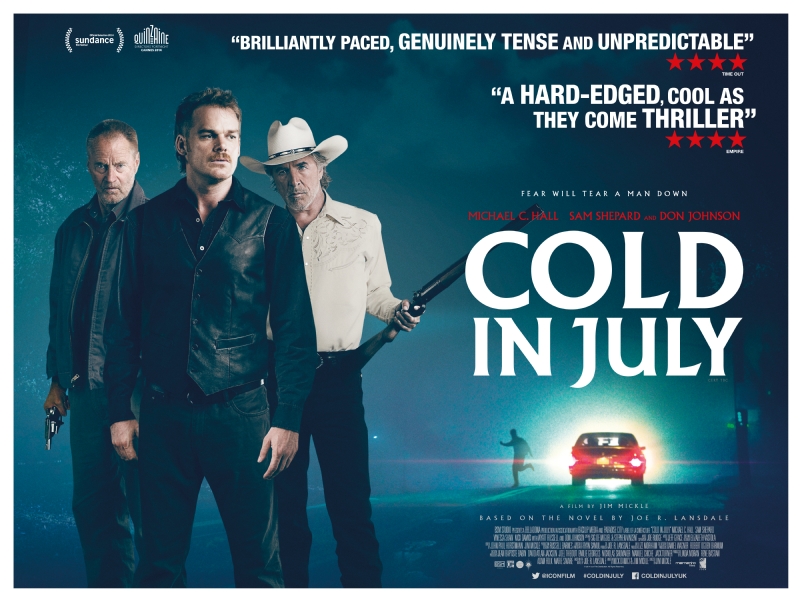
Cold in July

cold-in-july-quad-posterBased on Joe R Lansdale’s novel of the same name, Cold in July is an homage to classic ’80s neon tinged noir with a noticeable digression into Southern Gothic, revenge thrillers and B-movie heroics. Small town Texas picture framer Richard Dane (Michael C. Hall) is woken by his wife one night after she begins hearing strange noises from downstairs. Fearfully arming himself with his father’s old pistol hidden in a shoebox in his wardrobe, Richard tiptoes downstairs only to find a masked and hooded figure standing in his living room. In a halted moment Richard confronts the intruder with the gun and, hands shaking, uncertain what to do next locks eyes with the would-be burglar now held motionless as if in a tractor beam. As Richard holds his course, the mantlepiece clock begins to strike and whether accidentally or in panicked terror the gun goes off sending its explosive charge into the scenic landscape hanging on the wall by way of the burglar’s right-eye. The police arrive to find a traumatised Richard near catatonic in disbelief but oddly seem fairly congratulatory – “it must have been difficult, for a man like you” his Sheriff friend tells him, with heavy implications. Assured that it’s legally self defence and nothing further is likely to come of the matter Richard tries to return to his previous small town, family man life but the incident has left him jittery and with a noticeable ambivalence toward firearms. However, despite what the police may say it’s not quite over yet – the burglar had a father, and a psychotic one at that. An eye for an eye as they say, or a son for a for son – only, that’s not quite it either and before he knows it, Richard finds himself involved in a complex circle of crime and conspiracy.

Cold in July lines itself up with those late ’80s slightly sleazy, hyper violent crime thrillers in which one ordinary man must face off against some kind of larger danger which threatens the very foundations of his world. The period detail is exact with the book’s 1989 setting recreated faithfully down to every last detail from the bizarre red neck haircuts, giant portable telephones and floral furniture craze to VCRs and vintage 80s Apple Macs. The look has an appreciably 80s vibe with heavy grain despite having been filmed on digital RED cameras and the Carpenter-esque synth score give it the air of something that could have been made thirty years ago. Like all the best 80s small town crime stories there’s the melancholy and oppressive feeling of something not quite right, that there are no safe places and even in these cosy little towns there’s a great festering wound that’s rapidly turning rotten.

Like its ’80s settings, these are some old fashioned ‘heroes’ who display an unabashed adherence to ‘traditional’ ideas of masculinity. Richard is a mild mannered picture framer – work that requires skill and artistry rather than physical strength. After Richard shoots the man who threatened his home, the town’s reaction is less fear or sadness but almost joyful respect. “We didn’t think you had it in you” seems to be the general consensus from everyone from the local postman to the glowing write-up in the local paper. Before he was an emasculated husband and father, but now – having killed, he’s a man. Real men shoot first and don’t bother with questions at all. Despite Richard’s discomfort with his actions, with the reaction to his actions and even his own lingering feeling of inferiority he can’t escape the fact that something that he sees as weakness is being held up as heroism.

These old fashioned macho ideas are clearly something that continues to be passed from father to son – something that Richard begins to worry about when his own son playfully points a toy gun at him. The two older men – Don Johnson’s Jim-Bob the private-eye-cum-pig farmer and would be vengeful father Russell (Sam Shepard) are veterans of the Korean War and come from a generation steeped in conflict in which men are judged by their physical strength and survival techniques. Richard appears to have had some kind of strained relationship with his own (presumably deceased) father as though he keeps his gun in a shoebox at home, he seems pained every time the subject comes up. Russell hasn’t seen his own boy since he was a child and feels he’s failed as a father and perhaps as a man (in so far as a man is duty bound bring his son up right). What Richard learns from them is a lesson in old school masculinity – you carry the gun, you put things right. There’s an archetypal idea of chivalry there, that you stand up and protect your own and that the sins of the son are also visited on the father who must atone for failing to prevent such transgressive behaviour. There is something noble in it, but it is also dangerous – can a man who’s taken care of business, even in the name of his community, really return and live amongst other men?

Genre-busting as it is, the Cold in July mostly keeps itself together even as the action threatens to descend into the ridiculous. A thin stream of black humour helps to paint over its excesses as does its sheer joy in the larger than life elements such as the improbable Jim-Bob’s gaudy red cadillac, stetson hat and penchant for cool one-liners. There are undoubtedly a host of plot holes to the extent that it might be better to just avoid thinking about the sequence of events as a whole – the most obvious being a glaringly obvious loose end that everyone seems to have forgotten about. To be fair, no one leaves The Big Sleep shouting “yes, but who killed the chauffeur?”, a few potholes here and there don’t necessarily ruin the road and Cold in July is not a film about its plot. As an exercise in style, Cold in July excels but it also manages to pack in enough social commentary and primal melancholy to give its old fashioned morality tale some weight. Its politics maybe unpalatable and its outlook distinctly 1950s but Cold in July is among the best of recent retro exploitation B-movie throwbacks and walks its own path with considerable assuredness.

Tod Browning’s Freaks

SPOILER WARNING!!!

Tod Browning’s Freaks is notoriously the film that fell so foul with the studio and audiences of the time that even after cutting around a third of its running time the degree of revulsion it produced pretty much ended the director’s career. Having run away to join the circus as a teenager, Browning had spent spent much of his life around circus performers and felt them much maligned by society. Although he’d touched on similar themes before, Browning had always used professional actors made up to appear as if they were in someway different but this time he was determined to use genuine sideshow performers – a decision that would prove too radical for the society of the time.

Although it’s often placed into the horror genre, Freaks is really a tale of revenge and poetic mob justice in which the surrogate family of the carnival people punish the ‘normal’ couple who have tried to harm one of their own by the only method of justice that’s open to them – absorbing the miscreants into their own group. Hans is engaged to Frieda who like him is a midget but has become infatuated with the beautiful trapeze artist Cleopatra. Cleopatra, however, has recently stolen the boyfriend of another performer, the strongman Hercules, and together they mock Hans’ courteous courting whilst accepting his generous gifts and loans of money. When Frieda confronts Cleopatra about her treatment of Hans and lets slip that Hans has recently come into an inheritance, Cleopatra and Herman decide to trick Hans into a marriage and then do away with him for the money.

Hans is overjoyed to have married the most beautiful woman he’s ever seen but things turn sour at the wedding banquet when, in show of friendliness and inclusivity, the the carnival folk each drink from a large glass whilst chanting before offering it to Cleopatra who recoils in horror and screams ‘Freaks’ repeatedly. Prior to this she’s already been seen in an embrace with Hercules and has been drugging Hans’ champagne with some sort of poison. In a final humiliation, she makes several allusions to Hans’ childlike stature and manhood (or lack thereof) before putting him on her back as if he were a toddler.

Cleopatra then continues to slow poison Hans but unbeknownst to her he knows what’s up and he and the others plan their revenge. An opportune storm hits the convoy in which Hercules attempts to rape or kill his former girlfriend whilst Cleopatra runs off intro the storm pursued by the mob with knives in their teeth. In the extant version of the film this is all we see – we cut back to the sideshow proprietor who provided the opening of a framing sequence who shows us Cleopatra now disfigured and stuffed into some kind of chicken suit – a freak, like those she despised. In the full version we would have seen her legs be hit by a falling tree and her lover Hercules castrated – now emasculated he also joins their group as a member of the deformed.

We are told in the lengthy prose prologue about the code of the carnival freaks (a title they embrace for themselves), of how they stick together and a wrong done against one is done against all. Looked down upon by society and often cast out by their natural families, or even sold on to goodness knows what kind of horror in virtualised slavery who else do they have to turn to other than each other? Lacking any other recourse to justice or protection isn’t their turning on Cleopatra and Hercules who have, after all, attempted to murder and rob their friend, just natural manifest justice?

Some will argue that Freaks is exploitative, aren’t we being expected to flock toward this title to gawp at the oddities? Yes, and then again no. Browning knows we will do this, it’s part of the point of his film after all. We come as voyeurs – allured by the title and the film’s reputation but our expectations are subverted. The carnival folk are good, honest people who are kind and fiercely loyal to their friends. They are willing to welcome Cleopatra into their group yet she cruelly rejects their friendship and pays them back with scorn. The real freaks are the two ‘normal’ people who are prepared to dupe an unsuspecting man in love, exploiting his emotions for their own personal gain before dispatching him completely without a second thought.

In this way Freaks does what all horror should do, it reflects the part of yourself that is ugly, that you’d rather keep hidden. It isn’t ‘otherness’ that’s frightening, it’s your own greed and hate and prejudice. It’s just a shame that it took us so long to be able to face what we so loathe in ourselves that we can finally see Tod Browning’s Freaks for what we are.

Seen at the Prince Charles Cinema, 9th October 2012. 35mm