Woods Are Wet (女地獄 森は濡れた, Tatsumi Kumashiro, 1973)

As long as people live honest lives, eventually good things will happen to them, according to the sinister mistress at the centre of Takumi Kumashiro’s Roman Porno Woods Are Wet (女地獄 森は濡れた, Onna Jigoku: Mori wa Nureta). Perversely, she may actually believe this to be true but only in the most ironic of senses as she and her “cruel” husband enjoy incredibly happy lives together having decided to “honestly” embrace their true desires, which include things like rape, murder, and eating grapes off the corpses of their victims.

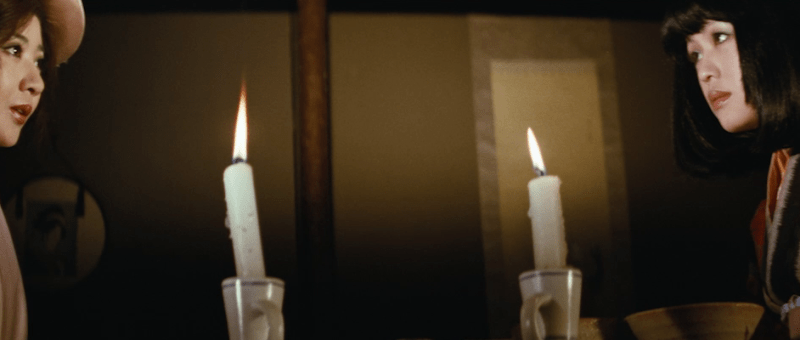
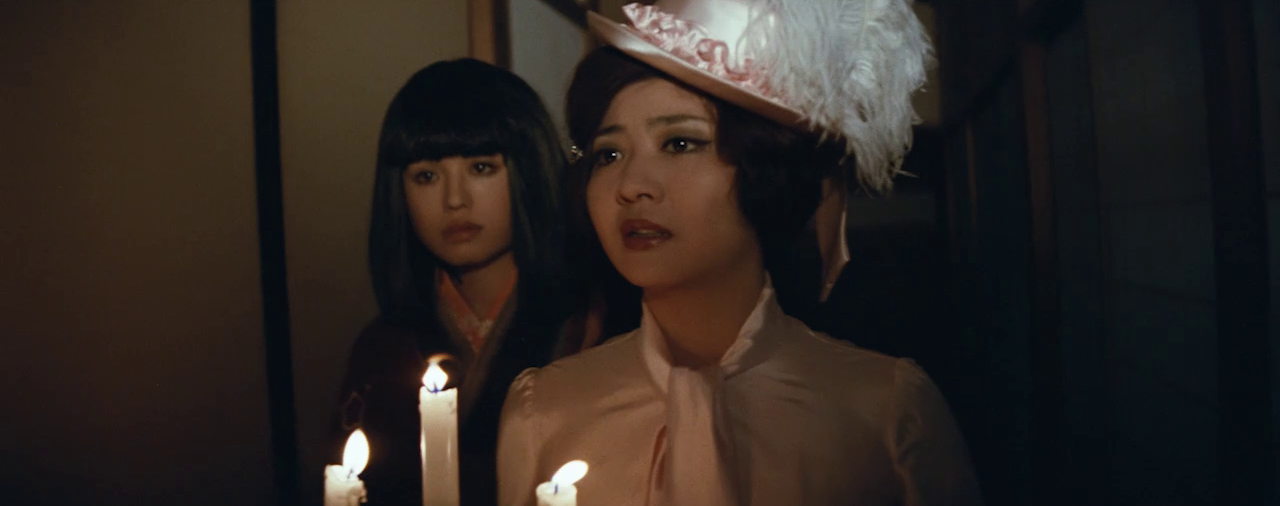
Inspired by the Marquis de Sade’s Justine and set in the Taisho era, the film begins in true gothic style as Sachiko (Hiroko Isayama), a runaway maid in flight from an accusation of having murdered her mistress, encounters Yoko (Rie Nakagawa), an upper-class lady who unexpectedly comes to her rescue in a small town. Yoko takes her back to the Western-style mansion she shares with her husband Ryunosuke (Hatsuo Yamaya) whom she describes as being incredibly cruel. Explaining that she’s been desperately lonely since her marriage at 19, Yoko begs Sachiko to stay but as her companion rather than a servant, which is another act of class transgression for which there will presumably be a price. 

In any case, the atmosphere changes when Ryunosuke arrives and reveals he knows all about Sachiko’s predicament and blackmails her into helping with his schemes to rape and murder guests at the hotel he runs. He explains that he’s very wealthy and does this for kicks not out of financial necessity but nevertheless uses her to spice up his game by directly telling her to warn the guests that their lives are in danger. If she manages to get them to escape, he’ll let her go too, but of course it’s not as easy as she’d assumed it would be, especially as the first two guests she’s sent to brutally rape her. Even so, she vows to escape with them, only they are not quite clever enough to beat Ryunosuke’s game.

Out in the middle of nowhere, the mansion is a true gothic fantasy lit by candle light due to an absence of electricity because of the Depression. Ryunosuke has adapted it so that it contains a series of prison-like doors with iron bars and locks that allow him to trap Sachiko and others exactly where he wants them. He is vile and depraved, as is Yoko, though they later brand themselves as simply liberated and living “honestly” having embraced their true desires. Ryunosuke paints himself as a quiet revolutionary, asking why he should conform with rules and laws dictated by a distant authority to which he himself does not subscribe. He describes commonly held visions of morality as nothing more than a tool of social coercion designed to control the common man (which he is not), in which he may have a valid point despite the depravity of his apparently honest nature. 

This aspect of Ryunosuke as an anti-social force was apparently something very much intended by Kumashiro, who was himself rebelling against a moral panic which had seen Nikkatsu’s Roman Porno line condemned under public obscenity laws. To make a point, he inserts large black blocks and lines throughout the film to mimic those sometimes demanded by the censors, though enlarged to an absurd degree and often not actually covering what they would presumably be intended to or actually drawing attention to it. In any case, what the censors objected to in this case was not apparently the sex itself but the violence which accompanies it, notably in the scenes in which blood-soaked sex continues after Yoko has shot one of the male victims she effectively raped at gunpoint. 

The central part of the film is a lengthy orgy scene in which Ryunosuke has his maids whip the victims while he anally rapes them while they are forced to have sex with Yoko and Sachiko on the pretext of saving their lives. It only gets grimmer from there, though there’s a censoriousness about Sachiko’s insistence that happiness should come from correctness to counter the “happiness” that Yoko and Ryunosuke exude in their embrace of their baser desires that undercuts her role as the innocent heroine standing up to their depraved inhumanity amid the absurd interruption of a radio taiso broadcast signalling the arrival of the next unhappy guests to rock up for a less than pleasant stay at this decidedly unluxurious hotel.

Love Hotel (ラブホテル, Shinji Somai, 1985)

love-hotel

Shinji Somai is not particularly well known outside of Japan but where his work is celebrated it’s mostly for his youth films of teen alienation and pop culture cool. Released in the same year as his iconic Typhoon Club, Love Hotel (ラブホテル) seems like something of an aberration in Somai’s career which leans towards the melancholic rather than the passionate. Somai had begun his working life apprenticing with Nikkatsu during their Roman Porno years and Love Hotel is, in someways, a return to this genre but is only accidentally a “pink film”, produced with Director’s Company and later acquired by the pink film giant. As such it contains a number of explicit sex scenes but maintains Somai’s characteristic long takes and contemplative approach rather than adhering to the often formulaic nature of the Roman Porno.

Failed businessman Muraki (Minori Terada) returns one day to find his office full of gangsters in the middle of raping his wife. Distraught, his first thought is suicide but then he decides on a little roundabout revenge before he goes. Dressed in a dark suit and sunglasses like some ‘60s Nikkatsu bad guy, Muraki holes up in a love hotel and calls down for a girl. “Yumi” (Noriko Hayami) arrives not long after. Handing the girl a vast sum of money, Muraki then instructs her to close her eyes because he’s also brought “a present”. He handcuffs her and reveals his true purpose by tearing off her clothes, tying her up and fitting her with a vibrator. He’s going to kill himself tonight, but he doesn’t want to go alone. In the end, he can’t go through with it, something in Yumi’s face changes his mind and he leaves her there, tied up and handcuffed.

Two years later, Muraki has divorced his wife (apparently to keep her safe from the yakuza who are still after him for his debts) and is now living an intentionally dull life as a taxi driver. One fateful day he runs into Yumi again, only she’s no longer “Yumi” but “Nami”, an office lady at a top company. Eventually recognising each other, the pair are each forced to face the circumstances surrounding the traumatic night of two years previously but doing so means risking everything they have now.

Love Hotel is a film of seeing and not seeing, of looking and refusal to look. The film opens with a semi-explicit sexual scene in which Muraki’s wife is raped by a loanshark in which we watch both Muraki’s horrified expression and the act itself by means of a well positioned mirror. Somai repeats the mirroring motif throughout the film both by showing us Nami repeatedly caught in mirrors and by the obvious tripartite glass arrangement of the love hotel’s headboard. Both Muraki and Nami have elements of themselves at which they’d rather not look but the ever present mirrors constantly prompt them into areas of self-reflection, ironically possible only by looking at the other.

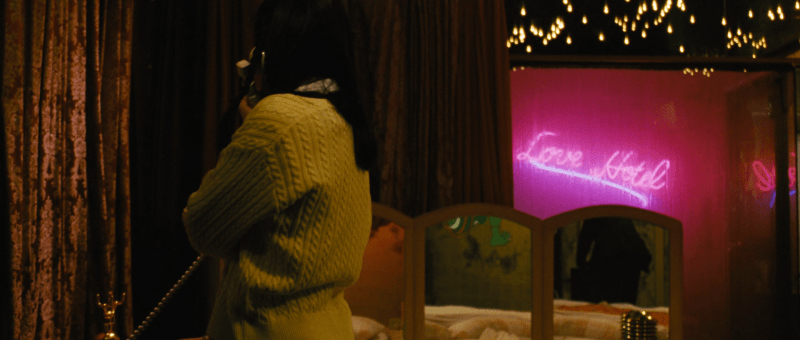
Where Muraki has chosen a life of austerity, separating from his wife who nevertheless continues stopping by to look after him in all of the wifely ways, Nami has tried and failed to put her traumatic past behind her by hopping into the consumerist revolution. Having supported herself through prostitution as a student, she’s managed to swing a pretty good job at top company only to find herself “prostituted” again through an ill-advised affair with her married boss. After his wife finds out and Nami loses her job and the entire life she’d begun to build for herself, she tries to call her former lover for consolation only to have him cruelly hang up on her. Nami continues her lamentations to the alarming trill of the dial tone in a heartbreaking moment of true loneliness.

Left with nothing else, the pair decide to revisit their unfinished love hotel business but their much more normal encounter changes each of them in different ways. It’s clear something has passed between the two, but Muraki’s final glance into the mirror perhaps shows him something he’d rather not have seen. Nami’s face, like Yumi’s face, may well have been “angelic” but cannot “save” Muraki in the same way twice – or at least, not in the way the restored Nami would have liked to save him. Dark, melancholy and fatalistic, Somai’s stab at Roman Porno is a sad tale of frustrated love, destroyed by the use and misuse of bodies speaking against each other and becoming a barrier to true connection. The Love Hotel is a place romance goes to die, and what the pair of damaged lovers at the centre of his noir-tinged tale of despair find there is only emptiness and pain devoid of any sign of hope.


Opening scene (no subtitles)

Masterfully constructed one take final scene (dialogue free)

The Assassination of Ryoma (竜馬暗殺, Kazuo Kuroki, 1974)

Ryoma AnsatsuSakamoto Ryoma is a legendary revolutionary of Japan’s Bakumatsu period which encompasses the chaos that ensued after Japan was forced open after centuries of self imposed isolation. Ryoma was a low level samurai from a small town who resented the unjust treated of the arrogant true samurai above him and skipped out on his clan without the proper permission to go study sword fighting in the city. After the arrival of the Americans and witnessing their far superior technologies, Ryoma was one of several men who became convinced that Japan needed to modernise quickly or become a slave to more advanced cultures. However, this was a turbulent era and there was general infighting among all factions and all sides and Ryoma was mysteriously assassinated in 1867 along with his friend and ally Nakaoka Shintaro.

In thinking about the legacy of Sakamoto Ryoma, it’s important to try and separate the man from the legend. His legacy has become somewhat romanticised as his visionary ideas of a modernised Japan free of outside influence but also of outdated, feudalistic ideals have developed into an easily cop-opted set of talismans. Kuroki Kazuo’s 1974 film The Assassination of Ryoma (竜馬暗殺, Ryoma Ansatsu) attempts to place Ryoma firmly back within the mortal realm as it explores the events of his last days in late 1867 when he was brokering the new world from the shadows.

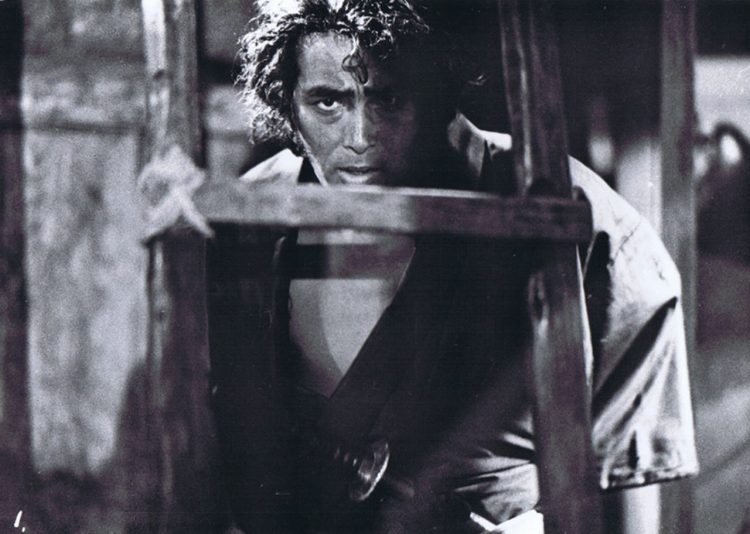
Played by Japan’s original ‘70s wild beast Harada Yoshio, this Ryoma is a slightly bumbling though thoughtful young man who likes to have a good time when he isn’t busy trying to overthrow the shogunate. An early scene sees him fiddling with a revolver which he claims is a better weapon to be in hiding with because it’s a little more portable and discreet than a traditional sword. However, he doesn’t quite know how to use it and can’t figure out how to make it fire in order to give his friend a demonstration. Later, having moved on slightly from his ideas of a peaceful revolution, his plan to buy a number of rifles backfires when he is sent a camera instead.

Ryoma is joined by two “allies” who both originally came in order to kill him but have apparently switched sides. The first is one of his oldest friends, Shintaro, who remained a member of a hard right revolutionary group in Ryoma’s home town which ran under the slogan “Revere the Emperor, Expel the Foreigners”. Understandably they haven’t taken too well to Ryoma’s change of heart regarding the modernisation of Japan and are committed to taking him out – hence dispatching Shintaro, though he proves reluctant to assassinate his friend. The other is a mysterious and largely silent assassin, Uta (played by Matsuda Yusaku), who also ends up forming an unlikely friendship with Ryoma which prevents him from carrying out his mission.

Kuroki shoots in black and white within a 4:3 frame and in gritty 16mm but also goes in handheld almost like newsreel footage shot by a frontline war correspondent. As well as using some silent cinema inspired compositional techniques, Kuroki also adds in a few intertitles either with historical information or to provide some additional commentary on the action such as when he tells us that violence from left wing samurai is a daily occurrence. Drawing a neat parallel between he chaos of the Bakumatsu era and its tussling between new and old, Kuroki leaves us with a sense of historical continuity by equating the left wing samurai rebellion of the 1860s with the left wing student moment of a whole century later.

However, Ryoma is just one man. In an enlightening metaphor about a cat who got stuck up a tree, Ryoma calls to it and tried to climb up to get the cat down but it just kept climbing higher and wouldn’t even take the mochi he tried to offer it on a stick. Eventually Ryoma wanted to cut the whole tree down in order to save the cat but everyone laughed at him – cut down a 10ft wide tree to save one skinny cat? At that time Ryoma laughed too but later it made him angry. He thought the idea of cutting down the tree should be allowed to be considered, that every option ought to be explored. The important thing is to see things from all angles and allow yourself the freedom to change your mind, reject all previous knowledge in the light of a new way of thinking. This kind of freedom is necessarily frightening and may lead others onto a path which you yourself do not wish to follow but all the same it is the very idea which gives birth to Ryoma’s entire philosophy.

Kuroki’s vision of this visionary hero is an unconventional one and one which was not universally accepted by the audience of the time. Just as radical as the man himself, Kuroki’s film portrays Ryoma as a modern revolutionary who lived a hundred years ago, yet wanted many of the same things that the youth of the day were still fighting for – personal freedom, equality for all, and a modern society which allowed his nation to stand independent, on an equal footing with its European counterparts. The assassination itself is brutal, bloody and efficient. It’s an uncinematic ending for a cinematic hero in which he’s violently cut down in a frenetic yet naturalistic fashion leaving a trail of polluting black blood spreading across the high contrast bright white background. His ideas were too radical for his era, and his tragic end a sadly predictable one but what does this say about the world of today and the would be revolutionaries whose voices appear to have been silenced?


(I’ve gone for surname first order here because that’s the most usual way of referring to historical figures – I accept that it’s confusing but it is at least consistant).

The life story of Sakamoto Ryoma has been dramatised many times, most recently as a Taiga drama, Ryomaden, directed by Rurouni Kenshin’s Ohtomo Keishi and starring Fukuyama Masaharu, which has apparently boosted Ryoma’s profile even more and created a raft of new tourist spots in various areas of Japan. (It’s obviously very long as it’s Taiga drama but is well worth the investment in time and effort.)

Unsubbed trailer:

http://www.youtube.com/watch?v=_9OiFk0E70I