Retreat Through the Wet Wasteland (濡れた荒野を走れ, Yukihiro Sawada, 1973)

Despite its lurid title which contains the classic signifier “wet”, Yukihiro Sawada’s Retreat through the Wet Wasteland (濡れた荒野を走れ, Nureta koya wo hashire) is more sleazy nihilistic drama than classic Roman Porno. Though it obeys many of the genre’s rules, the placement of its erotic scenes feels less formulaic and the film as a whole less about eroticism than abject despair in the wake of Asama-Sanso in a Japan that has become an authoritarian paradise ruled by bruiser cops driven fragile by egos and greed.

The central mystery is, for some at least, whether fugitive cop Nakamura (Hirokazu Inoue) is really “mad” or merely using the mask of mental illness to protect himself from his former colleagues who want him dead because he knows too much. The truth may be, however, that Nakamura has wilfully retreated inside his mind as a means of escape from a world of constant corruption. Or else, that his desire for the world to be better is in itself a mental illness that’s seen him institutionalised and tortured with shock treatment in an effort to cure him of his problematic humanitarianism. In any case, he has lost all his memory and knows himself only as “Number 19” having been robbed of selfhood and individuality. All of which might suggest that he isn’t as much of a threat to his colleagues as they seem to believe him to be, though the question is why exactly they fear him so much when it’s clear that they face no consequences for their actions.

The film opens with a gang of thugs raiding a church where the pastor has been collecting money to help villages in Vietnam rebuild after the war. The thugs beat the pastor and rape his daughter who is captured in a beatific pose with a crucifix on her chest as choral music plays. When the pastor calls the police, we see the policemen receive the call while one is busy stuffing the tracksuits the thugs were wearing into the boot. They are assigned to investigate the crime they have just committed while it appears that their superiors at the station are all well aware of these kinds of activities are taking place and are even encouraging of them. The police is now the biggest gang and anyone not a part of the corruption cannot tolerated in this system because it’s underpinned by an idea of mutually assured destruction. 

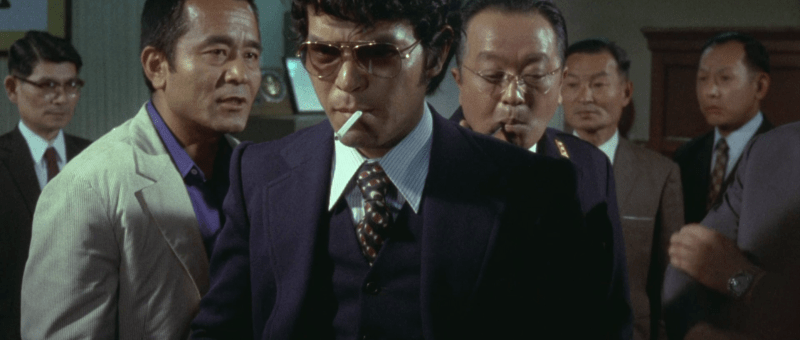
Nakamura appears to have been a more idealistic officer and though it is not clear whether he participated in the corruption himself, evidently opposed it at least philosophically, which is what has destroyed his mind. He was once Harada’s (Takeo Chii) mentor, cautioning against his desire to become stronger as becoming strong and powerful only makes you an oppressor which is not, evidently, what he considers the proper role for a policeman. To an extent, the film frames Harada as the hero as perhaps he would be in a certain kind of crime thriller. He’s effortlessly cool in his sunshades with a cigarette hanging from his lip, but he’s also a broken loser hollow on the inside and nothing without the authority granted to him by being a member of the police force. When he and Kato (Akira Takahashi) visit a sex worker, she complains that Harada can’t get it up as if signalling his essentially powerlessness and implying his violence is rooted in fear and insecurity.

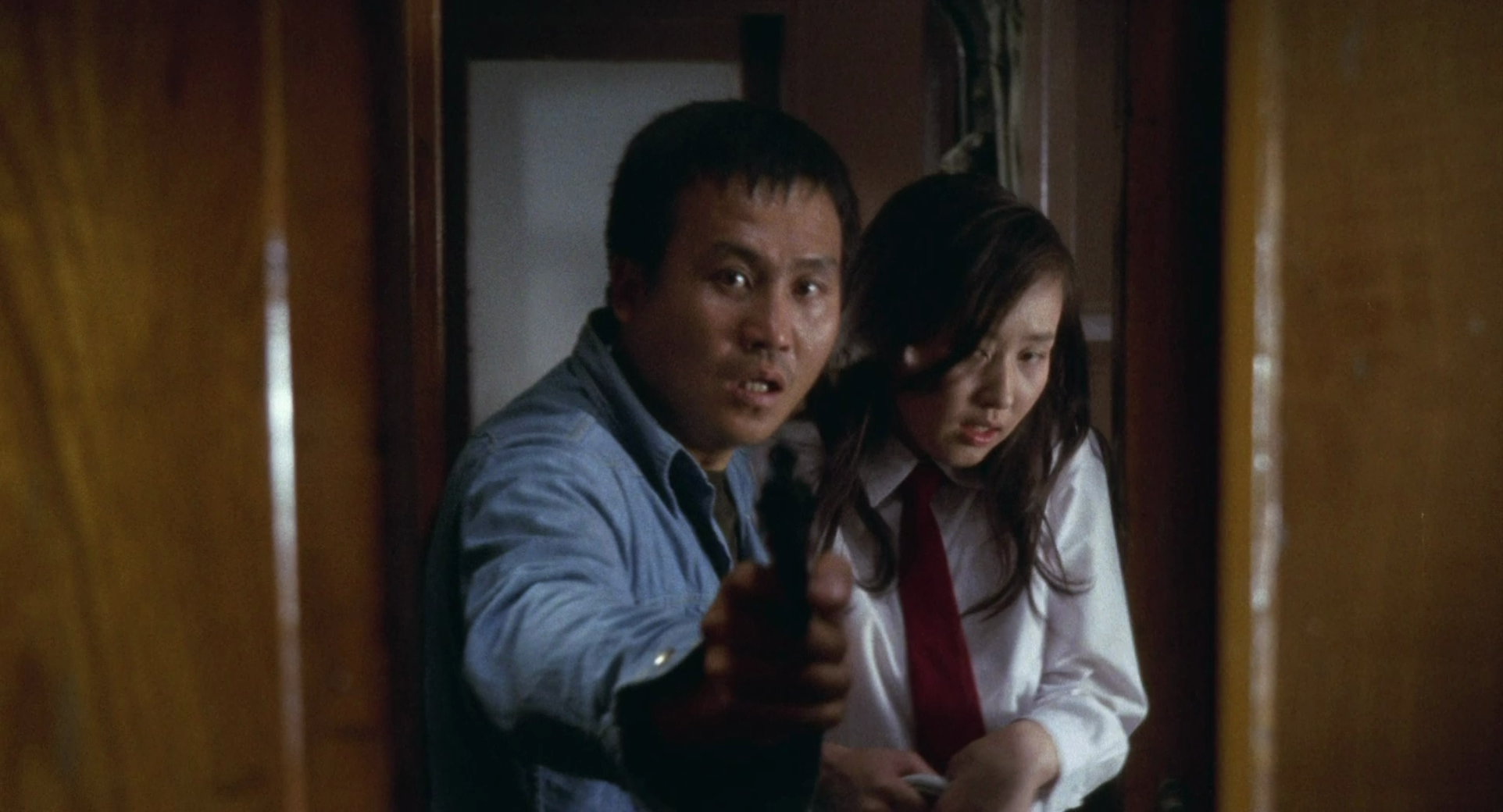
Haunted by what seems to be flashbacks to an Anpo protest, Nakamura is apparently a counter to these authoritarian instincts. Having escaped the psychiatric hospital, he’s accompanied by a young woman who seems to be something of an outsider herself and the film’s real moral compass. She feels sorry for Nakamura and sees his inner purity, while in turning to Harada at the film’s conclusion and exclaiming that she pities him too reasserts her power over him. It’s she who takes Nakamura to her cousin’s travelling theatre troupe wandering the “wasteland” outside of the cities and thereby wilfully existing outside of mainstream society. Nevertheless, they are at first invaded by Harada and his partner Kato who have brought along Nakamura’s wife, and then by rightwing bikers who destroy their camp. Even these small enclaves cannot be permitted to exist and no attempt to escape the system can be tolerated. Sawada expresses this oppressiveness though the overuse of censorship bars many of which are not hiding anything that might be considered objectionable but are, in a certain sense, merely decorative. In Harada’s final demonic grin as he retreats across the wasteland, the film seems to suggest that there is no other way to escape this world of corruption other than madness or death.


Retreat Through the Wet Wasteland screened as part of Japan Society New York’s Kazuhiko Hasegawa’s Anarchic Ethos.
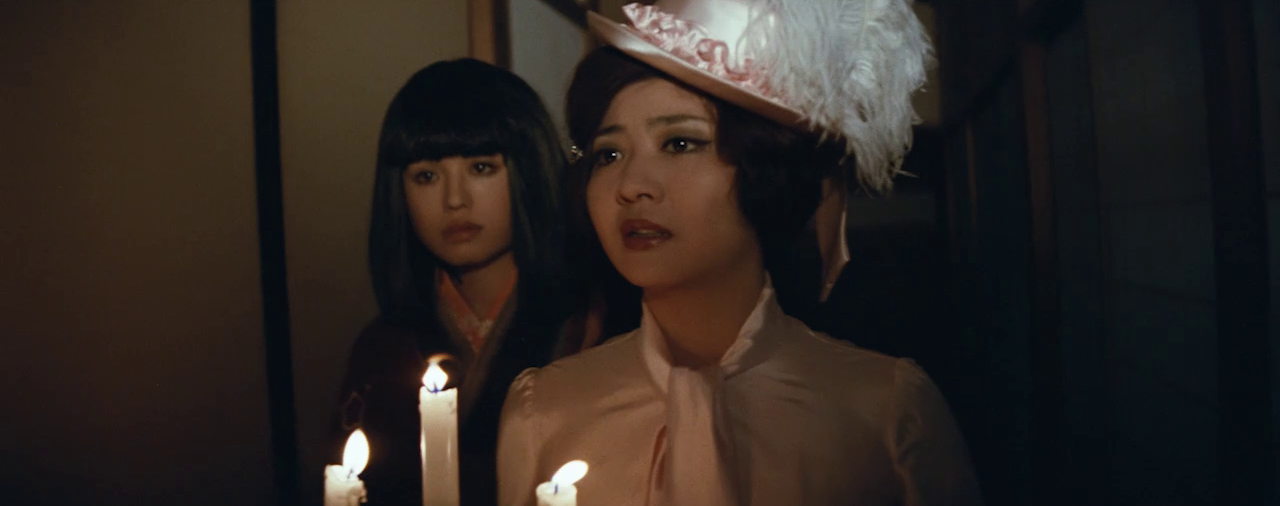
Woods Are Wet (女地獄 森は濡れた, Tatsumi Kumashiro, 1973)

As long as people live honest lives, eventually good things will happen to them, according to the sinister mistress at the centre of Takumi Kumashiro’s Roman Porno Woods Are Wet (女地獄 森は濡れた, Onna Jigoku: Mori wa Nureta). Perversely, she may actually believe this to be true but only in the most ironic of senses as she and her “cruel” husband enjoy incredibly happy lives together having decided to “honestly” embrace their true desires, which include things like rape, murder, and eating grapes off the corpses of their victims.

Inspired by the Marquis de Sade’s Justine and set in the Taisho era, the film begins in true gothic style as Sachiko (Hiroko Isayama), a runaway maid in flight from an accusation of having murdered her mistress, encounters Yoko (Rie Nakagawa), an upper-class lady who unexpectedly comes to her rescue in a small town. Yoko takes her back to the Western-style mansion she shares with her husband Ryunosuke (Hatsuo Yamaya) whom she describes as being incredibly cruel. Explaining that she’s been desperately lonely since her marriage at 19, Yoko begs Sachiko to stay but as her companion rather than a servant, which is another act of class transgression for which there will presumably be a price. 

In any case, the atmosphere changes when Ryunosuke arrives and reveals he knows all about Sachiko’s predicament and blackmails her into helping with his schemes to rape and murder guests at the hotel he runs. He explains that he’s very wealthy and does this for kicks not out of financial necessity but nevertheless uses her to spice up his game by directly telling her to warn the guests that their lives are in danger. If she manages to get them to escape, he’ll let her go too, but of course it’s not as easy as she’d assumed it would be, especially as the first two guests she’s sent to brutally rape her. Even so, she vows to escape with them, only they are not quite clever enough to beat Ryunosuke’s game.

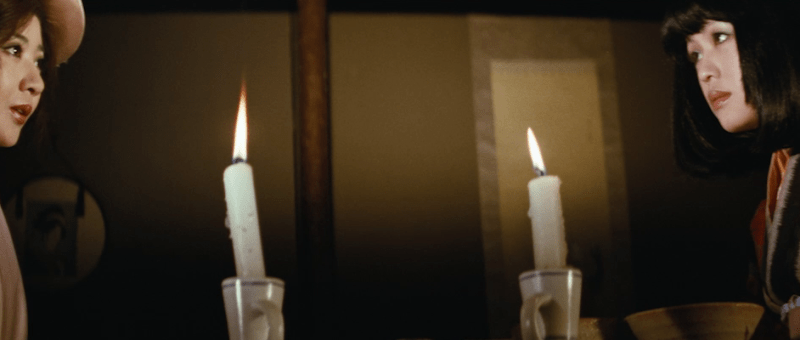
Out in the middle of nowhere, the mansion is a true gothic fantasy lit by candle light due to an absence of electricity because of the Depression. Ryunosuke has adapted it so that it contains a series of prison-like doors with iron bars and locks that allow him to trap Sachiko and others exactly where he wants them. He is vile and depraved, as is Yoko, though they later brand themselves as simply liberated and living “honestly” having embraced their true desires. Ryunosuke paints himself as a quiet revolutionary, asking why he should conform with rules and laws dictated by a distant authority to which he himself does not subscribe. He describes commonly held visions of morality as nothing more than a tool of social coercion designed to control the common man (which he is not), in which he may have a valid point despite the depravity of his apparently honest nature. 

This aspect of Ryunosuke as an anti-social force was apparently something very much intended by Kumashiro, who was himself rebelling against a moral panic which had seen Nikkatsu’s Roman Porno line condemned under public obscenity laws. To make a point, he inserts large black blocks and lines throughout the film to mimic those sometimes demanded by the censors, though enlarged to an absurd degree and often not actually covering what they would presumably be intended to or actually drawing attention to it. In any case, what the censors objected to in this case was not apparently the sex itself but the violence which accompanies it, notably in the scenes in which blood-soaked sex continues after Yoko has shot one of the male victims she effectively raped at gunpoint. 

The central part of the film is a lengthy orgy scene in which Ryunosuke has his maids whip the victims while he anally rapes them while they are forced to have sex with Yoko and Sachiko on the pretext of saving their lives. It only gets grimmer from there, though there’s a censoriousness about Sachiko’s insistence that happiness should come from correctness to counter the “happiness” that Yoko and Ryunosuke exude in their embrace of their baser desires that undercuts her role as the innocent heroine standing up to their depraved inhumanity amid the absurd interruption of a radio taiso broadcast signalling the arrival of the next unhappy guests to rock up for a less than pleasant stay at this decidedly unluxurious hotel.


No Grave for Us (俺達に墓はない, Yukihiro Sawada, 1979)

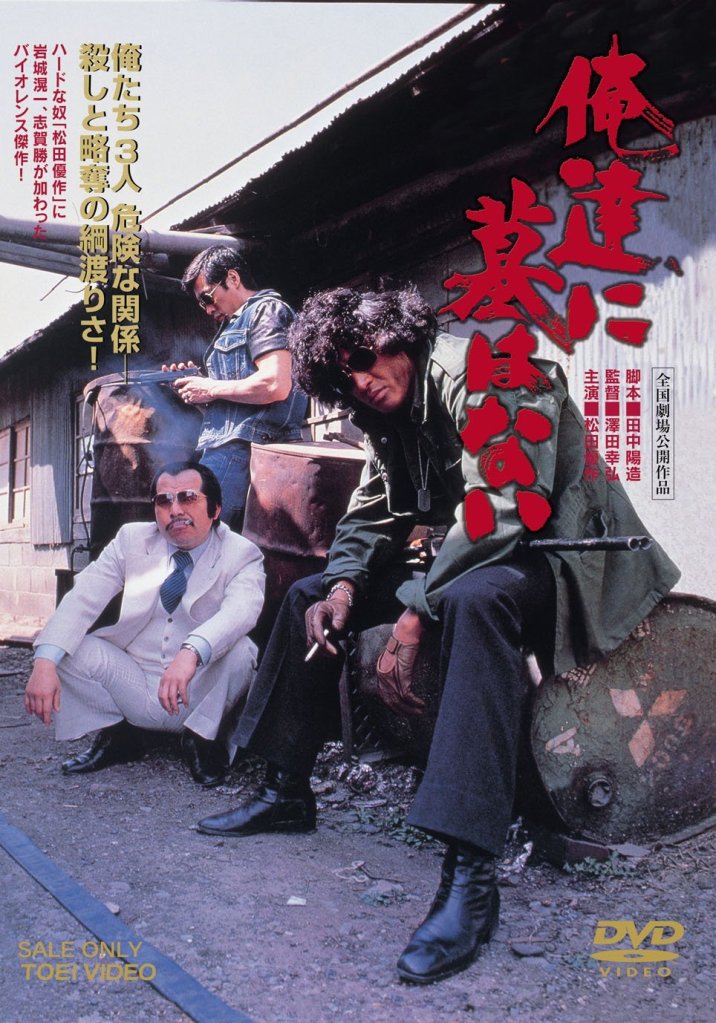
No Grave for Us posterThough he might not exactly be a household name outside of Japan, the late Yusaku Matsuda was one of the most important mainstream stars of the ‘70s and ‘80s. Had he not died at the tragically young age of 40 after refusing chemotherapy for bladder cancer to star in what would become his final film, Ridley Scott’s Black Rain, he’d undoubtedly have continued to move on from the action genre in which he’d made his name. No Grave For Us (俺達に墓はない, Oretachi ni Haka wa Nai) is fairly typical of the kinds of films he was making in the late ‘70s as he once again plays a cool, streetwise hoodlum mixed up in a crazy crime world where no one can be trusted.

The film begins with a humorous incident in which a man sets fire to a small parcel in the ladies’ area of a department store and loudly starts shouting about a bomb before using the resulting panic and chaos to calmly extract the money from the nearby tills. His plan is going perfectly except for one cashier who’s rooted to the spot, confused by the rat who lives under the counter who isn’t perturbed by the presence of a “bomb”. Shima makes off with his money and starts planning a new job which he plans to carry out with his longtime friend and brother in arms Ishikawa. The pair carry out a robbery on a rival gang but an ex-yakuza, Takita, tries to make off with the loot. Shima and Takita bond and agree to split the money but Ishikawa gets captured and subjected to humiliating treatment by the gangsters. The intrusion of Takita and of the resurfacing problematic shopgirl, Michi, slowly drive a wedge between the previously inseparable Shima and Ishikawa.

No Grave for Us is, as the title suggests, a noir inflected B-movie in which the lowlife punk Shima contends with the various trials and tribulations associated with a life of petty crime. Child of an uncaring society, he’s been in and out of trouble since adolescence. He met Ishikawa when the pair were both in reform school together, Shima for assault and Ishikawa for drug related offences. Shima is not a drug user and seems to disapprove of his friend’s habit but makes no great protest against it. When Michi turns up at Ishikawa’s bar (just by coincidence) she’s lost her job at the department store after being accused of taking the money that Shima stole. It turns out that she too is a junkie and has been living a life of dissipation since being picked up for prostitution during middle school. She fits right in with Shima and Ishikawa but, predictably, begins to prefer the more assured Shima to the loose cannon Ishikawa which begins to present something of a problem for the pair.

Shima and Takita originally reach an understanding based on a gangster code of honour which they both understand. Ishikawa aside, the pair would make a good team but their growing comradeship only adds to Ishikawa’s sense of insecurity causing him to take matters into his own hands with fairly disastrous consequences. A misunderstanding makes Takita and Shima mortal enemies putting an end to any kind of alliance that might have been possible. There’s no comradeship here, no true friendship. Every relationship is a possible betrayal waiting to take place, every warmth a weakness.

Director Yukihiro Sawada had mostly worked in Nikkatsu’s Roman Porno line other than co-helming Sogo Ishii’s first feature, Panic High School, the previous year but No Grave for Us is refreshingly light on exploitative content. There is some brief nudity but nothing particularly out of keeping for a regular studio picture of the time. Likewise, the fights are of a more realistic nature and bloodshed kept to a minimum. The look of the film is also very typical of its era though Sawada only rarely uses the extreme zooms which are the hallmark of ‘70s cinema opting for a more straightforward, often static, approach. The film’s jazz inspired score also helps to bring out its noir undertones as these three guys who could have been allies find themselves turning on each other for the most trivial of reasons.

In many ways there’s nothing particularly special about No Grave for Us save for being an excellent example of mainstream action cinema in the late ‘70s. The film is full of knowing references to other recent genre hits as well as popular culture of the time including a lengthy tribute to top idol group Pink Lady whose song Zipangu also features on the soundtrack, and has an all round “cool” sensibility to it that was no doubt very popular at the time of its original release. An enjoyable enough genre effort, No Grave for Us is an impressively handled slice of late ‘70s noir inspired B-movie action but perhaps has little else to recommend it.


Unsubtitled trailer:

and a clip of Pink Lady performing Zipangu, just because