Baian the Assassin, M.D. (Part 1) (仕掛人・藤枝梅安, Shunsaku Kawake, 2023)

A traumatised assassin takes it upon himself to get rid of a few villains on realising there’s something not quite right with his latest contract in Shunsaku Kawake’s classic jidaigeki homage, Baian the Assassin, MD: (Part 1) (仕掛人・藤枝梅安, Shikakenin Fujieda Baian). The titular hero is the protagonist of a series of novels by Shotaro Ikenami which have spawned several previous adaptations on the big and small screens. Produced in celebration of Ikenami’s centenary the film, one of two, harks back to the golden age of period drama if with a more contemporary sensibility. 

Baian (Etsushi Toyokawa) is ostensibly an acupuncturist though by night he uses his needles to kill rather than to heal. Hired to take out the second wife an inn owner, Omino (Yuki Amami), his suspicions are raised on realising that he had also been the assassin who killed the man’s first wife two years earlier. He blames himself in part for having agreed to assassinate a woman in the first place, and remains conflicted even after accepting the job wondering if Omino is next in the firing line or if she was actually the one who had the other woman killed in order to usurp her place. 

The film makes clear from the outset what a difficult place Edo could be for a woman as Baian carries out an assassination on a boatman who had raped a samurai’s wife and then blackmailed her into further sexual favours only for her to hire an assassin and then kill herself confessing all. Omino had apparently been the stepdaughter of a gang leader who sexually abused her and then died leaving her with no support and nowhere to turn except to sex work. Maybe no one could blame her for taking advantage of a besotted client to escape her terrible circumstances though getting rid of his wife would obviously be a different matter. Omon (Miho Kanno), a maid Baian takes a liking to while investigating, admits something similar that as a widow with a young son realistically speaking there is nowhere else that could she work to support him except on the fringes of the sex trade. Then again, as she says the previous mistress was strict but it was because she cared, whereas Omino is just mean and self-interested. She’s fired all the old staff and brought in pretty young women who are quite obviously being expected to entertain their male customers in more direct ways. 

In any case, Baian soon finds himself drawn into a wider series of plots when his friend Hiko (Ainosuke Kataoka), a skewer maker who assassinates people with poison darts, is tasked with taking out first a lascivious carpenter and then a rogue samurai who has supposedly raped and kidnapped the daughter of his lord which obviously turns out not quite to be the case. Rape and kidnap are depressingly common in Edo-era society where it is largely women who suffer under a patriarchal society with intensely oppressive social codes that demand female purity. In a post-credits sequence, we come to understand that Hiko too is seeking vengeance for the death of a woman who killed herself and her child after being raped by bandits. Meanwhile, Baian reveals that he had a mild hatred of women himself born of pain in having been abandoned by his mother who left with another man and took only his sister with her after his father’s death. He had to overcome that resentment in order to fulfil himself as a doctor treating women’s bodies but struggles when he realises that someone involved in the case is closely linked with his own traumatic past and death may be the only way to save them. 

Both he and Hiko end up breaking the assassin’s code but only in defence of justice, which might sound odd considering the nature of their work. Nevertheless, they each have their scruples and don’t like to think of themselves as having been used or inadvertently killed someone who didn’t really deserve it. As Baian puts it, the greatest villains may really be “well-meaning weak cowards” though perhaps corrupt lords can’t really complain about falling victim to their own tactics. With noticeably polished production values and atmospheric cinematography, Kawake pays tribute to classic jidaigeki and eventually sets his heroes back on the road awaiting the next battle for justice in the distinctly unjust feudal era. 


Baian the Assassin, M.D. (Part 1) screened as part of this year’s Camera Japan.

Original trailer (English subtitles)

Fukushima 50 (フクシマ50, Setsuro Wakamatsu, 2020)

The “Fukushima 50” (フクシマ50), as the film points out, was a term coined by the international media to refer to the men and women who stayed behind to deal with the unfolding nuclear crisis at the Fukushima Daiichi Nuclear Power Plant. Loosely inspired by Ryusho Kadota’s non-fiction book On the Brink: The Inside Story of Fukushima Daiichi which featured extensive interviews with those connected to the incident, Setsuro Wakamatsu’s high production value film adaptation arrived to mark the ninth anniversary of the devastating earthquake and tsunami which occurred on 11th March, 2011 and closes with a poignant callback to the plant’s role in Japan’s post-war reconstruction as the nation once again prepares to host the (now postponed) Olympics with a torch relay beginning at Fukushima as a beacon of hope as the country continues to rebuild in the wake of the disaster. 

Though inspired by real events Wakamatsu’s dramatisation is heavily fictionalised and while surprisingly frank for a mainstream film in its criticism of the official reaction to the disaster, is also quietly nationalistic while doing its best to pay tribute to the selfless sacrifice of the plant workers who stayed behind to do what they could many of whom had little expectation of surviving. Chief among them would be Izaki (Koichi Sato), an imperfect family man and veteran section chief, and the plant’s superintendent Yoshida (Ken Watanabe) who are both local men and old friends. Local, it seems, is later key with multiple appeals to the furusato spirit as each is at pains to point out that they stay not only to prevent a catastrophic meltdown that would leave most of central Honshu including Tokyo uninhabitable, but because they feel a greater duty to protect their hometown and the people in it. 

Meanwhile, they find themselves burdened rather than assisted by official support as government bodies’ political decision making undermines their attempts to avert disaster while the boardroom of TEPCO who operate the plant reacts with business concerns in mind. A few hours in the prime minister (Shiro Sano) decides to make a visit, in political terms he can’t not national leaders who don’t visit sites of crisis are never forgiven, but his presence actively hinders the recovery efforts. Referred to only as the PM, Wakamatsu’s film presents the man leading the nation as an ignorant bully overly obsessed with his personal image. He has little understanding of nuclear matters or the implications of the disaster, refuses to abide by the regular safety procedures required at the plant, and mostly governs through shouting. Beginning to lose his temper, Yoshida does his best to remain calm but resents the constant interference from those sitting in their offices far away from immediate danger while he does his best to contend with the increasingly adverse conditions on the ground, mindful of his responsibilities firstly to his employees and secondly to those living in the immediate vicinity of the plant who will be most at risk when measures taken to prevent meltdown will lead to an inevitable radiation leak. 

Yoshida’s hero moment comes when he ignores a direct order from the government to stop using seawater to cool the reactors, knowing that he has no other remaining options. Meanwhile, the government refuse offers of help from the Americans, who eventually make a strangely heroic arrival with Operation Tomodachi, discussing plans to move their families to safety while their commander reflects on his post-war childhood on a military base near the site of the nuclear plant. Japan’s SDF also gets an especial nod, granted permission to leave by Yoshida who is beginning to think he’s running out of time but vowing to stay and do their duty in protecting civilians in need. 

In essence, the drama lies in how they coped rather than the various ways in which they didn’t. The conclusion is that the existence of the plant was in itself hubristic, they are paying the price for “underestimating the power of nature” in failing to calculate that such a devastating tsunami was possible. They thought they were safe, but they weren’t. Perhaps uncomfortably, Wakamatsu mimics the imagery of the atomic bomb to imagine a nuclear fallout in Tokyo, harking back to ironic signage which simultaneously declares that the energy of the future is atomic while the plant workers reflect on the sense of wonder they felt as young people blinded by science back in the more hopeful ‘70s as the nation pushed its way towards economic prosperity. Frank for a mainstream film but then again perhaps not frank enough, Fukushima 50 is both an urgent anti-nuclear plea and an earnest thank you letter to those who stayed when all looked hopeless, suggesting that if the sakura still bloom in Fukushima it is because of the sacrifices they made.


Fukushima 50 is available to stream in the US until July 30 as part of this year’s Japan Cuts.

International trailer (English subtitles)

Danger Stalks Near (風前の灯, Keisuke Kinoshita, 1957)

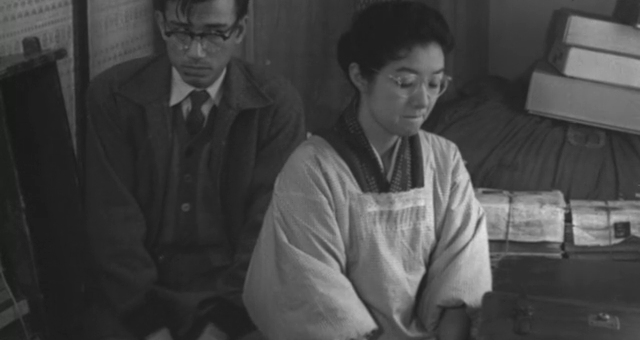
Keisuke Kinoshita is often regarded as a sentimentalist but he wasn’t completely immune to bitterness and cynicism as many of his farcical comedies bear out. Danger Stalks Near (風前の灯, Fuzen no Tomoshibi) begins in serious fashion as a trio of young toughs set on burgling the home of an elderly woman they assume has money but quickly descends into absurd dark humour as we discover there’s just as much money-grubbing thievery going on inside the house as out.

Two street toughs bully a nervous young man who needs money to get back to the country into joining them in a plot to rob a suburban house owned by a mean old woman whom they assume must be hiding a serious amount of cash inside. Having watched the place before, they know that it’s generally just housewife Yuriko (Hideko Takamine), her young son Kazuo (Kotohisa Saotome), and grumpy grandma Tetsu (Akiko Tamura) at home during the day after husband Kaneshige (Keiji Sada) has gone to work at his lowly job as a shoe salesman. Today, however, their aspirations towards crime will be thwarted because it’s all go at the Sato residence – flouncing lodgers, sisters with issues, tatami repair men, and mysterious faces from the past all mean that today is a very bad day for burglary but a very good one for entertainment.

Kinoshita deliberately upsets the scene by casting familiar actors Hideko Takamine and Keiji Sada in noticeably deglammed roles – she with a ridiculous pair of large round glasses and he with a giant facial mole designed to make them look “ordinary” but accidentally drawing attention to their star quality in the process. The Satos are, however, a very ordinary family in that they’re intensely obsessed with money and with their own precarious status in the improving but still difficult post-war economy. Tetsu is Kaneshige’s step-mother which is perhaps why he urges his wife to put up with her tyranny seeing as Tetsu is old and will probably not be around much longer, which means it’s just a waiting game until they inherit the house. Whatever else she may be, Tetsu is a mean old woman whose only hobbies are penny pinching and occasional trips to the cinema where she watches heartwarming dramas about filial piety. Her haughty attitude is perhaps why the crooks assume there is cash in the house but sometimes mean people are mean because they really don’t have money rather than just being stingy by nature.

Nevertheless, Tetsu’s iron grip is slowly destroying the family unit. Kaneshige (whose name ironically means “money multiplying” and uses a rather pretentious reading for his name kanji which are often misread by the postman etc) sneaks home to tell his wife he’s won second place in a competition, worrying that if Tetsu finds out she’ll expect her share of the prize money. The old woman is so mean that she even keeps her own stash of eggs in her personal cupboard along with tea for her exclusive use and takes the unusual step of locking the doors when Yuriko is out running errands because she feels “unsafe” in her own home – an ironic state of mind once we discover how exactly Tetsu was able to buy this house as a lonely war widow in the immediate aftermath of the defeat.

Tetsu is, in a fashion, merely protecting her status as matriarch in oppressing daughter-in-law Yuriko by running down her every move as well as those of her sisters whom she criticises for being dull despite their “cheerful” names but also chastises for lack of traditional virtues. Sakura (Toshiko Kobayashi) pays a visit to the Satos because she needs help – her husband has been accused of embezzlement, but is also hoping Yuriko is going to feed her in return for help with domestic tasks only the pair eventually fall out over a missing 30 yen and some crackers. Meanwhile, second sister Ayame (Masako Arisawa) also turns up but with a “friend” (Yoshihide Sato) in tow whom she hopes can become their new lodger after they ended up throwing the old one out because she burned a hole in the tatami mat floor through inattentive use of an iron. Neither Tetsu nor Yuriko could quite get their head around previous tenant Miyoko’s (Hiroko Ito) liberated, student existence of rolling in late after dates and lounging around reading magazines but a male lodger wasn’t something they had in mind either.

Persistent economic stressors have begun to wear away at family bonds – Tetsu is not a nice old woman, but it probably isn’t nice to be living in a house where you know everyone is just waiting for you to die. At least little Kazuo is honest enough to admit he only likes grandma when she gives him candy. Yuriko seems to be a responsible figure for both her sisters, but resents their relying on her for money while enjoying the various gifts they bring to curry favour including a large amount of fish cake from the prospective lodger/Ayame’s intended (if he doesn’t wind up being swayed by the dubious charms of the seductive Miyoko who insists on sitting in her empty room for the rest of the day because she already paid today’s rent). Meanwhile, Yuriko’s attempt to palm off a pair of unwanted tall geta that were a “present” from Kaneshige’s boss (who also heard about the prize money) leads to an accusation of attempted murder as if she hoped Tetsu might topple to her death after trying them on! The burglars have wasted all day sitting outside watching the ridiculous comings and goings as they bide their time waiting to strike only for the police to arrive on a completely unrelated matter. Turns out, inside and outside is not so different as you might think in a society where everything is a transaction and all connection built on mutual resentment.


Titles and opening scene (no subtitles)

Spring Dreams (春の夢, Keisuke Kinoshita, 1960)

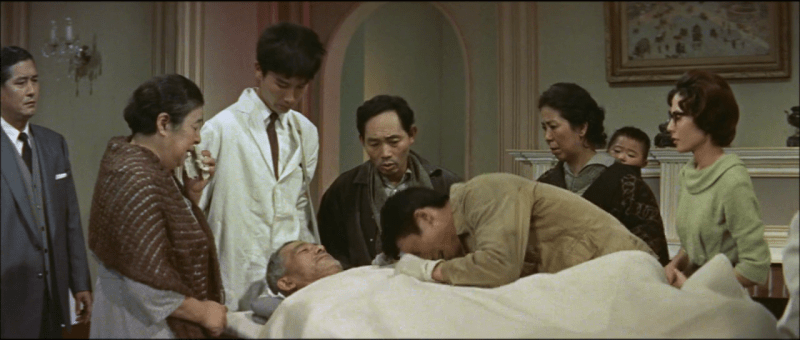
vlcsnap-2019-01-10-00h23m29s867Let them eat sweet potato? The heartless bourgeoisie at the centre of Keisuke Kinoshita’s absurdist satire Spring Dreams (春の夢, Haru no yume) have found themselves accidentally engulfed by the revolution which seems to be attacking them on every front including from inside their palatial, Western-style mansion. Things are about to change in the Okudaira world, but then again maybe not all that much.

The Okudairas are the owners of a large scale pharmaceuticals firm. Widowed patriarch Shobei (Eitaro Ozawa) is the CEO, but he’s at the constant mercy of his mother-in-law (Chieko Higashiyama) who acts as the guardian of the family business’ legacy. Meanwhile, he has three problematic children – oldest daughter Tamiko (Yatsuko Tanami) who has become a promiscuous playgirl with a taste for “mothering” college students, Chizuko (Mariko Okada) who is the only “normal” one in the house and has fallen in love with an impoverished painter, and Mamoru (Yusuke Kawazu) who is a kind of melancholy Hamlet waxing on his existential angst while eating everything in sight.

Into this already strained household comes the unexpected figure of sweet potato salesman, Atsumi (Chishu Ryu). With the house empty for a change, romantically conflicted maid Umeko (Yukiyo Toake) calls one of her boyfriends down at the fish shop to get the potato guy to come round. Kimiko (Meiko Nakamura), the other maid, goes out to pick some up but ends up flirting with a delivery boy so sends Atsumi inside where Umeko ropes him into helping shift some furniture which is how he ends up having a minor stroke in the Okudaira’s living room. Luckily for Atsumi, the person who finds him is Shobei’s compassionate spinster secretary, Kazuko (Yoshiko Kuga), who has some sad experience in this area as her father passed away after a stroke when she was a teenager, they say because someone moved him too early. A visit from the family doctor (Shuji Sano) backs up her advice and Atsumi will be staying put in the living room for the foreseeable future.

Of course, this doesn’t go down well with most of the Okudairas. Shobei wants him gone but what can you do? Atsumi stays because on balance it would be awkward if he ended up dying and staining the Okudaira name. Sadly, greed and indifference are not unique to the bourgeoisie as we discover when a parade of “well wishers” from Atsumi’s tenement house begin showing up to see how he is. Aside from the kindly, filial Eiichi (Shinji Tanaka) who has taken time off work to look after the old man, everyone else thinks Atsumi’s time has come. They know his tragic history, that he’s all alone now since both his sons were killed in the war and the rest of his family lost in the bombing. They want to get in with him to be remembered in the will, or even get their hands on his wallet for something like an advance. Poor old Atsumi is just an object fit for exploiting – a symbol of the Okudaira’s largesse, and of a potential windfall when the inevitable happens.

Meanwhile, the winds of change are blowing. Shobei is tied up with a labour dispute at the factory, obsessed with the idea of crushing the unions while the workers’ rousing chorus of the Internationale echoes ever more loudly in the distance. Grandma advises “just fire them all”, but things aren’t as easy as they were back in Meiji. Grandma thinks Shobei is a bit useless, especially since her daughter died and he’s been allowed to get off easy. She needs to find a successor seeing as Mamoru’s too weird to take over which means one of the girls needs to get married. Tamiko’s ruled herself out thanks to her eccentric love life, which leaves only Chizuko who wants to marry a painter and has no real interest in saving the family business. Chizuko is determined to oppose the idea of an arranged marriage, she’s a post-war girl after all, but grandma is firm. When she was a girl they made her give up on her first love, who happened also to be named “Atsumi”, to marry an Okudaira and so Chizuko is merely being unreasonable.

Nevertheless the presence of Atsumi begins to soften grandma’s heart with memories of her youth and the cruelty with which her youthful dreams were stripped away. Love blossoms in the cold Okudaira mansion, genuine bonds between people are recognised while the opportunist are rejected, and the young regain their freedom from the old who now recognise how destructive the old order could be. Will the house of the Okudaira’s fall? Probably not. Revolutions don’t take hold over night, but greed at least is on its way out paving the way for a better, kinder future for all.


Titles and opening (no subtitles)