A Place Called Silence (默杀, Sam Quah Boon Lip, 2024)

Can the hammer of truth break the rock of silence? At the end of Sam Quah’s remake of his own 2022 film by the same name, A Place Called Silence (默杀, mò shā), you might ask if you really want to or if some secrets are best kept that way. Then again, Quah’s persistent focus on leaky roofs suggests the truth will out and that the slow drip of quietly collecting water will eventually erode even the strongest stone.

Though remade for the Mainland market, the film takes place in the fictional city of Doma which like many recent similarly themed films is ostensibly not located China but another area of South East Asia, the police uniforms and complex mix of languages and cultures strongly echoing those of the original Malaysian setting. This also extends to the increasingly Christianising imagery which leads back to a cult-like local charity that pedals a good book full of aphorisms landing somewhere between Confucius and Proverbs and are at best a superficial salve for the deeply rooted problems in what turns out to be a judgemental and classist society. 

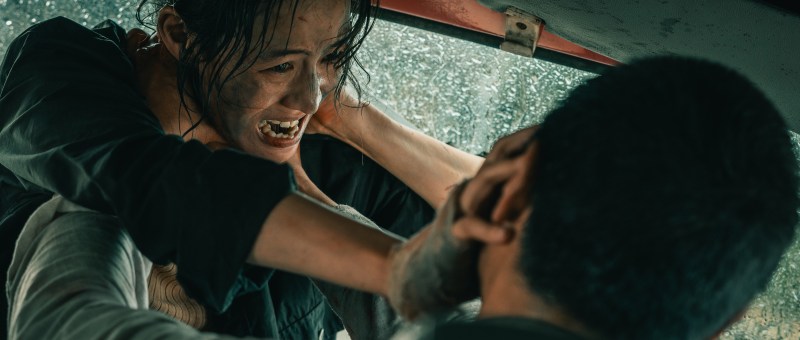
At least, the reason no one challenges the increasingly extreme behaviour of school bully and queen bee Angie is because she’s the headmaster’s daughter. Angie has been relentlessly tormenting Tong largely because she has a disability and had until recently been taught in the special needs class. According to her mother, Han, Tong has been mute since birth and it’s in an attempt to get her a better education that she’s given up her job in accounting and taken a position as a cleaner at the school. Her mother’s profession is also another reason for Angie to bully Tong, though she also accuses Han of having seduced her father which does not appear to be true though his later admission to an “abuse of power” that gives Han leverage over him puts a different spin on the situation and does not cast him in a very good light. 

Neither does the state of disrepair at the school which has a persistently leaky roof that is at least according to handyman Zaifu structurally unsound and may cave in any minute. Some of the blame is placed on a recent tsunami which caused mass loss of life, and the school seems to be proud of itself for having taken in pupils from another institution that was swept away though they don’t appear to have been welcomed by everyone. When a pupil ends up dying because of Angie’s bullying, the headmaster delays calling for help in part it seems to evade a scandal while planning to simply bribe anyone who tries to look into the matter. 

In short, it’s not difficult to see why someone may feel they’d have to take the law into their hands to break the persistent silence that protects the wealthy and the powerful from the consequences of their actions. Though, truth be told, not everyone is very interested in the disappearance of the girls, Han is driven to distraction when she suspects that Tong has been abducted by a serial killer with a very particular motive who also seems to be aware of some secrets she herself had been keeping. Then again there are a lot of wilful silences, like that of Mrs Xu who later snaps that the whole building knew Han had suffered domestic violence yet apparently did nothing help her other than maintaining superficial politeness by avoiding bringing it up. 

Silence seems to be the only refuge for the bullied whether in school or the wider world for there’s little good in speaking up anyway. Tong tries to help a bullied friend, but her mother stops her, wary of their own need for silence and that Tong will simply become the next target which of course she does. Terrible things are done in the name of protection, but sometimes silence is necessary too and a means of atonement if not a weapon against life’s unfairness. An ambiguous mid-credits sequence somewhat muddies the waters in its implications though perhaps a concession to the censors demanding that crimes must be answered, but Quah otherwise depicts a hellish society of violence and powerlessness in which the only choices are silent complicity or murderous revenge.


A Place Called Silence is in UK cinemas now courtesy of CineAsia.

UK trailer (Simplified Chinese / English subtitles)

Sheep Without a Shepherd (误杀, Sam Quah Boon Lip, 2019)

“Sheep are happy as long as they have grass to graze, they don’t care if you shear their wool” according to a vox popped farmer in the ironically titled Sheep Without a Shepherd (误杀, Wùshā). Inspired by the Indian film Drishyam, the Mandarin title of Malaysian director Sam Quah’s Chinese remake is simply “manslaughter”, but as the English title perhaps implies if ironically Quah circumvents the censors to issue an oblique broadside to oppressive authoritarianism largely by setting the film in Thailand. 

As the film opens, affable Chinese-Thai IT and internet business owner Weijie (Xiao Yang) is chatting about his favourite thing, movies, with the regulars at his usual haunt, a restaurant run by Uncle Song. Meanwhile, Song tells him about the latest local gossip, the murder of a man who’d recently won the lottery, which is why corrupt cop Sangkun (Shih Ming-Shuai) has been hanging around but not actually doing much investigating. It’s rumoured that hotshot female police chief Laoorn (Joan Chen), who has a fearsome reputation for being able to solve any case, is going to take over. She eventually does just that, fabricating evidence to push the suspect into confessing. Her tactics may be underhanded and unethical, but at the end of the day, as she points out, it doesn’t really matter. She wasn’t framing anyone and isn’t intending to submit the evidence in court, she correctly solved the crime and exerted psychological pressure to trick the suspect into thinking she had something she didn’t so he’d know the game was up. 

“As long as you are not scared, they can’t do anything” Weijie tells his daughter, reminding her that fear is the only leverage of those like Laoorn when they have no real evidence. Unfortunately for him, he’s become involved with the disappearance of Laoorn’s odious son Suchat (Bian Tian Yang) who, we discover, drugged and raped Weijie’s teenage daughter Pingping (Audrey Hui) during an excursion for bright high schoolers, going so far as to film the whole thing in order to blackmail her into providing further sexual favours. Pingping had been keen to go on the trip, somewhat snobbishly looking down on her lower-class family and seeing it as a networking opportunity to make elite friends. She is perhaps the film uncomfortably implies being punished for her unfilial elitism, but eventually finds the courage to tell her mother Ayu (Tan Zhuo) what happened. Ayu accompanies her to the rendezvous with Suchat and confronts him but he is unrepentant, reminding them that his mother is the police chief and his father a politician so he can do as he pleases before trying to force himself on Ayu at which point Pingping hits him with a hoe and knocks him out. Believing that he’s dead, Ayu buries the body with a recently interred family friend and waits for her husband to come home from a business trip repairing the internet in a hotel the next town over. He eventually returns early, worried that he couldn’t get though on the phone because youngest daughter Anan (Zhang Xiran) had left the receiver off the hook. 

A decent and kind man, well liked by everyone, all Weijie wants is to protect his family. What’s done is done, all he can do is try to mitigate it by utilising all his movie knowledge to change the narrative so that they are merely implicated in the crime rather than active suspects. In this, the mini-feud with useless cop Sangkun actually works in his favour. An earlier episode had him offer some advice gleaned from movies to an old man whose grandson had been assaulted by Suchat. Sangkun was in the process of pressuring him to accept a payoff to drop the charges (most of which he’d have pocked for himself). Another business owner privy to the incident apparently reported him anonymously and was attacked in the street only for Weijie to come to his rescue and be accused of assaulting a police officer. It’s very easy for him to claim that Sangkun is trying to frame him out of pettiness, and very easy for people to believe him because that’s exactly something Sangkun would do. 

Sangkun is the embodiment of casual abuse of power. He doesn’t care about serving the people or protecting the vulnerable, he is only interested in validating himself through authority. Laoorn is not quite the same, but she too is an aspect of the all-powerful state as she marshals all her resources against Weijie, an ordinary husband and father, against whom she has no hard evidence only her much vaunted intuition. She will stop at nothing to find out what’s happened to her son, while Weijie is determined to do everything in his power to protect his family. Laoorn underestimates him, as Pingping had, because he is a poor orphan with no education, only later realising that he is clever and resourceful even if he’s pinched his defence strategy from a lifetime of watching crime movies. The pair are engaged in a perfectly matched battled of wits, but only one of them has the power of the state behind her and a gradual erosion of civil rights to allow her to wield it against a personal enemy. 

Filming in Thailand, Quah has a much freer hand to broach the subject of official corruption even if it’s quite obvious that he’s making a point about the overreach of the Chinese state rather than that of Thailand. Weijie’s plight eventually sparks a large scale riot that spreads throughout the country as the populace declares itself thoroughly fed up with the Sangkuns of the world, not to mention the Laoorns or her mayoral candidate husband Dutpon (Philip Keung Ho-Man) who is almost entirely absent from the crisis because all he cares about is the election even if it’s a minor inconvenience not to have his family on show at hustings. Dutpon’s disinterested authoritarian parenting coupled with Laoorn’s indulgence and willingness to enable her son’s crimes through covering them up is perhaps blamed for the “monstrous” young man Suchat was becoming, himself standing in for a generation of wealthy, pampered sons of elites raised with improper boundaries who think they can do as they please because they are somehow above the normal morality. “Good parents” Weijie and Ayu meanwhile find themselves at the mercy of a corrupt faux-aristocracy, abused by Suchat and then rendered powerless in the face of an authoritarian regime. 

Weijie, however, rejects his powerlessness in an attempt to think himself out of the cage in which he finds himself imprisoned. A perfectly plotted psychological thriller, Sheep Without a Shepherd ironically satirises the much cited claim of authoritarians that humanity flounders without a leader as the populace begins to fight back against its toxic relationship with those in power. Nevertheless, its admittedly compassionate and humanitarian conclusion cannot help but feel like an overt concession to the Mainland censors’ requirement that crime can never pay and all transgressions must be owned (even if not directly by those who are literally guilty). Ultimately, however, Weijie redeems himself in the eyes of his daughter, and in doing so subtly reinforces the anti-authoritarian message in instructing Pingping never to be afraid of anything again, freeing her from the oppressive leverage of fear which itself constitutes authoritarianism.


Sheep Without a Shepherd opens in UK cinemas on 21st August courtesy of Cine Asia.

UK release trailer (English / Simplified Chinese subtitles)