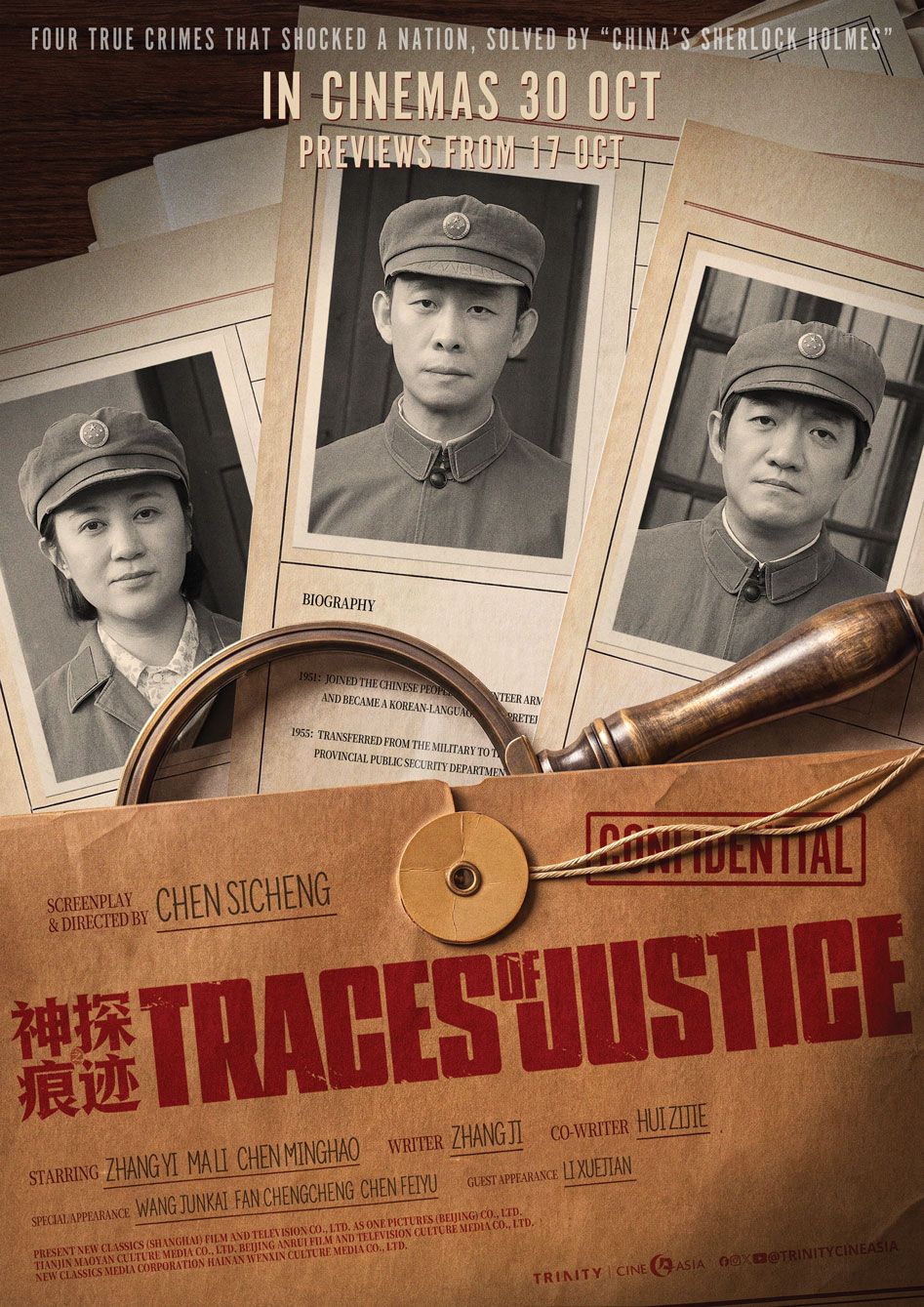
Traces of Justice (神探之痕迹, Chen Sicheng, 2026)

Best known for comedy including the incredibly popular Detective Chinatown series, actor/director Chen Sicheng has been in a more serious mood recently. Like 2024’s literary adaptation Decoded, Traces of Justice (神探之痕迹 shéntàn zhī hénjì) examines China’s 20th-century past but this time through the lens of forensics. Essentially a propaganda piece in praise of the scientific side of law enforcement, the film is in some ways surprising in its implications in hinting at the reasons why these crimes may have occurred along with difficulties of solving them which are often down to political realities.

In 2016, Cui Xun (Zhang Yi) prepares to accept a national honour for his contribution to police sciences while asked to consult on a serial killer case in which the police are struggling to find evidence to charge the suspect with the last remaining victim despite his confession. As evidence of law enforcement’s care for each and every citizen, the policeman in charge brushes off another’s insistence that they don’t need to charge him with the last case because the other 10 are watertight and enough to secure the death penalty. If they don’t officially link him to this case too, the little girl he killed and her family will not receive justice.

The serial killer case reminds Cui of one he investigated back in 1971 in which he pioneered dental indentations being used to identify suspects in the same way as fingerprints. 1971 is, of course, right in the middle of the Cultural Revolution and so Cui is hampered by persistent anti-intellectualism and distrust of science. The first thing he has to do is get his mentor out of a re-education camp, while a girl who narrowly escaped being caught by the killer was vulnerable in that she was currently living alone as both her parents had been “sent down”. The new local police squad leader, Wang (Chen Minghao), also gets in Cui’s way with his “old-fashioned” policing. His officers refuse to let forensics on site first and ruin the crime scene by stomping all over the evidence. One even triumphantly brings a nearby bicycle to dust for prints though his own hands have now been all over it, paying no heed to Cui’s rational response that they’ve no way of knowing if the bike even belonged to the killer.

By 1983, things are quite different. Wang no longer dresses in military uniform while Cui and his team have been given civilian outfits. Cui now has a sizeable team of assistants and students, while a school has been set up to teach modern forensics techniques. Wang secures the crime scene and grants access for the forensics team first. The issue this time around is the chaotic circumstances of the economic reforms. The prime suspect is a man with a rich and influential father who tries to frame a colleague as he had argued with the now murdered boss about black market profiteering. The suspect resents people mentioning the fact that he’s his father’s son, while simultaneously playing the rich kid card with the police by telling them they’re making a big mistake keeping him locked up. Cui is determined to use a broken fingernail found on one of the victims as an identification method, but again faces an uphill battle to have his ideas taken seriously.

One might think that these problems have then been resolved, but the 1998 sequence depicts much of the same anxiety as it begins to become clear that one of the men suspected of blowing up a bus was a disgruntled worker laid off amid the economic changes of the ’90s which saw many factories close. In an ironic touch, Cui’s investigation HQ is located in a disused factory. Like We’re Nothing At All which is inspired by the same incident, the film also suggests the two men involved were a romantic couple and that societal homophobia was a factor in their decision to end their lives.

Cui once again posits new methods of forensic investigation, but at the same time ends up alone with even his assistant leaving him to take up a position in Beijing. His dedication places a strain on his marriage as his wife, a doctor, is forced to pick up his slack given that he is often absent from the domestic space. Nevertheless, his contributions to science are well noted as is his legacy as “China’s Sherlock Holmes”. In some ways, the subtle implication is that the authorities will stop at nothing to catch wrongdoers, so the Chinese citizen is well protected, though this is, in other ways, a little oppressive in the “everything leaves a trace” messaging and may not reflect the reality of modern policing even if the film is surprisingly critical of law enforcement in places, depicting corruption and hinting at violence and forced confessions. Even so, it is at least keen to insist that the police force is a modern institution defined by science and rooted in forensics rather an irrational “gut feeling” or prejudice. Meanwhile, there is also something comforting in the idea that we all leave traces of ourselves in the world when we are gone that transcends a noirish sense of fatalism to become something richer and warmer in the positive impact our lives can have on those around us in whom we live on.


International Trailer (English subtitles)

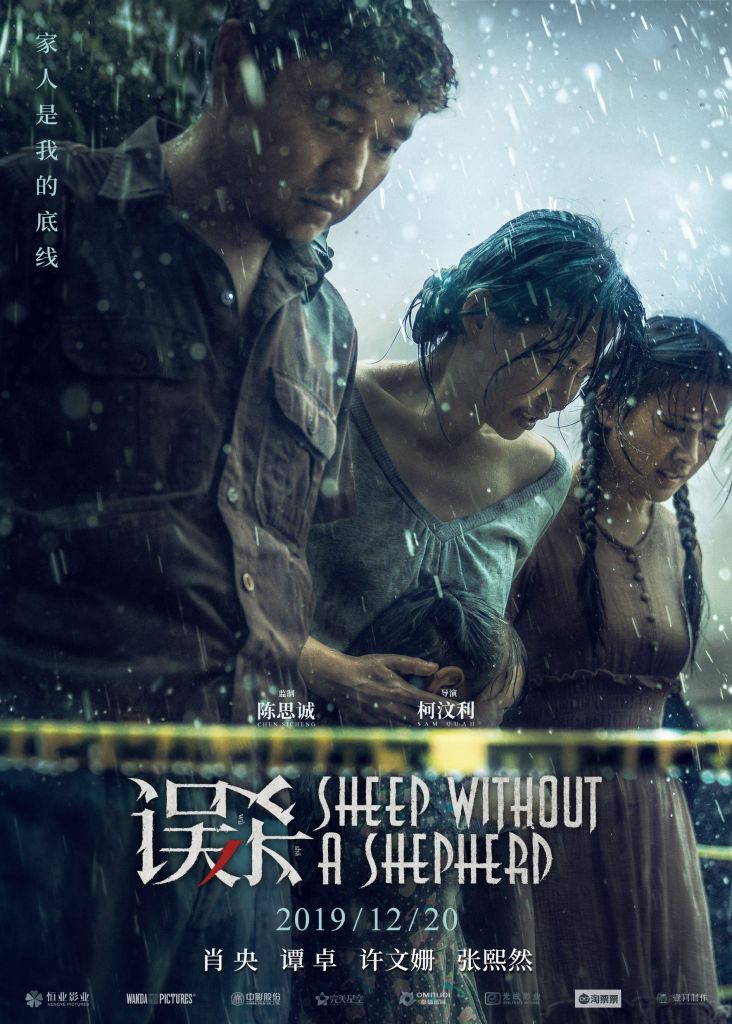
Sheep Without a Shepherd (误杀, Sam Quah Boon Lip, 2019)

“Sheep are happy as long as they have grass to graze, they don’t care if you shear their wool” according to a vox popped farmer in the ironically titled Sheep Without a Shepherd (误杀, Wùshā). Inspired by the Indian film Drishyam, the Mandarin title of Malaysian director Sam Quah’s Chinese remake is simply “manslaughter”, but as the English title perhaps implies if ironically Quah circumvents the censors to issue an oblique broadside to oppressive authoritarianism largely by setting the film in Thailand. 

As the film opens, affable Chinese-Thai IT and internet business owner Weijie (Xiao Yang) is chatting about his favourite thing, movies, with the regulars at his usual haunt, a restaurant run by Uncle Song. Meanwhile, Song tells him about the latest local gossip, the murder of a man who’d recently won the lottery, which is why corrupt cop Sangkun (Shih Ming-Shuai) has been hanging around but not actually doing much investigating. It’s rumoured that hotshot female police chief Laoorn (Joan Chen), who has a fearsome reputation for being able to solve any case, is going to take over. She eventually does just that, fabricating evidence to push the suspect into confessing. Her tactics may be underhanded and unethical, but at the end of the day, as she points out, it doesn’t really matter. She wasn’t framing anyone and isn’t intending to submit the evidence in court, she correctly solved the crime and exerted psychological pressure to trick the suspect into thinking she had something she didn’t so he’d know the game was up. 

“As long as you are not scared, they can’t do anything” Weijie tells his daughter, reminding her that fear is the only leverage of those like Laoorn when they have no real evidence. Unfortunately for him, he’s become involved with the disappearance of Laoorn’s odious son Suchat (Bian Tian Yang) who, we discover, drugged and raped Weijie’s teenage daughter Pingping (Audrey Hui) during an excursion for bright high schoolers, going so far as to film the whole thing in order to blackmail her into providing further sexual favours. Pingping had been keen to go on the trip, somewhat snobbishly looking down on her lower-class family and seeing it as a networking opportunity to make elite friends. She is perhaps the film uncomfortably implies being punished for her unfilial elitism, but eventually finds the courage to tell her mother Ayu (Tan Zhuo) what happened. Ayu accompanies her to the rendezvous with Suchat and confronts him but he is unrepentant, reminding them that his mother is the police chief and his father a politician so he can do as he pleases before trying to force himself on Ayu at which point Pingping hits him with a hoe and knocks him out. Believing that he’s dead, Ayu buries the body with a recently interred family friend and waits for her husband to come home from a business trip repairing the internet in a hotel the next town over. He eventually returns early, worried that he couldn’t get though on the phone because youngest daughter Anan (Zhang Xiran) had left the receiver off the hook. 

A decent and kind man, well liked by everyone, all Weijie wants is to protect his family. What’s done is done, all he can do is try to mitigate it by utilising all his movie knowledge to change the narrative so that they are merely implicated in the crime rather than active suspects. In this, the mini-feud with useless cop Sangkun actually works in his favour. An earlier episode had him offer some advice gleaned from movies to an old man whose grandson had been assaulted by Suchat. Sangkun was in the process of pressuring him to accept a payoff to drop the charges (most of which he’d have pocked for himself). Another business owner privy to the incident apparently reported him anonymously and was attacked in the street only for Weijie to come to his rescue and be accused of assaulting a police officer. It’s very easy for him to claim that Sangkun is trying to frame him out of pettiness, and very easy for people to believe him because that’s exactly something Sangkun would do. 

Sangkun is the embodiment of casual abuse of power. He doesn’t care about serving the people or protecting the vulnerable, he is only interested in validating himself through authority. Laoorn is not quite the same, but she too is an aspect of the all-powerful state as she marshals all her resources against Weijie, an ordinary husband and father, against whom she has no hard evidence only her much vaunted intuition. She will stop at nothing to find out what’s happened to her son, while Weijie is determined to do everything in his power to protect his family. Laoorn underestimates him, as Pingping had, because he is a poor orphan with no education, only later realising that he is clever and resourceful even if he’s pinched his defence strategy from a lifetime of watching crime movies. The pair are engaged in a perfectly matched battled of wits, but only one of them has the power of the state behind her and a gradual erosion of civil rights to allow her to wield it against a personal enemy. 

Filming in Thailand, Quah has a much freer hand to broach the subject of official corruption even if it’s quite obvious that he’s making a point about the overreach of the Chinese state rather than that of Thailand. Weijie’s plight eventually sparks a large scale riot that spreads throughout the country as the populace declares itself thoroughly fed up with the Sangkuns of the world, not to mention the Laoorns or her mayoral candidate husband Dutpon (Philip Keung Ho-Man) who is almost entirely absent from the crisis because all he cares about is the election even if it’s a minor inconvenience not to have his family on show at hustings. Dutpon’s disinterested authoritarian parenting coupled with Laoorn’s indulgence and willingness to enable her son’s crimes through covering them up is perhaps blamed for the “monstrous” young man Suchat was becoming, himself standing in for a generation of wealthy, pampered sons of elites raised with improper boundaries who think they can do as they please because they are somehow above the normal morality. “Good parents” Weijie and Ayu meanwhile find themselves at the mercy of a corrupt faux-aristocracy, abused by Suchat and then rendered powerless in the face of an authoritarian regime. 

Weijie, however, rejects his powerlessness in an attempt to think himself out of the cage in which he finds himself imprisoned. A perfectly plotted psychological thriller, Sheep Without a Shepherd ironically satirises the much cited claim of authoritarians that humanity flounders without a leader as the populace begins to fight back against its toxic relationship with those in power. Nevertheless, its admittedly compassionate and humanitarian conclusion cannot help but feel like an overt concession to the Mainland censors’ requirement that crime can never pay and all transgressions must be owned (even if not directly by those who are literally guilty). Ultimately, however, Weijie redeems himself in the eyes of his daughter, and in doing so subtly reinforces the anti-authoritarian message in instructing Pingping never to be afraid of anything again, freeing her from the oppressive leverage of fear which itself constitutes authoritarianism.


Sheep Without a Shepherd opens in UK cinemas on 21st August courtesy of Cine Asia.

UK release trailer (English / Simplified Chinese subtitles)