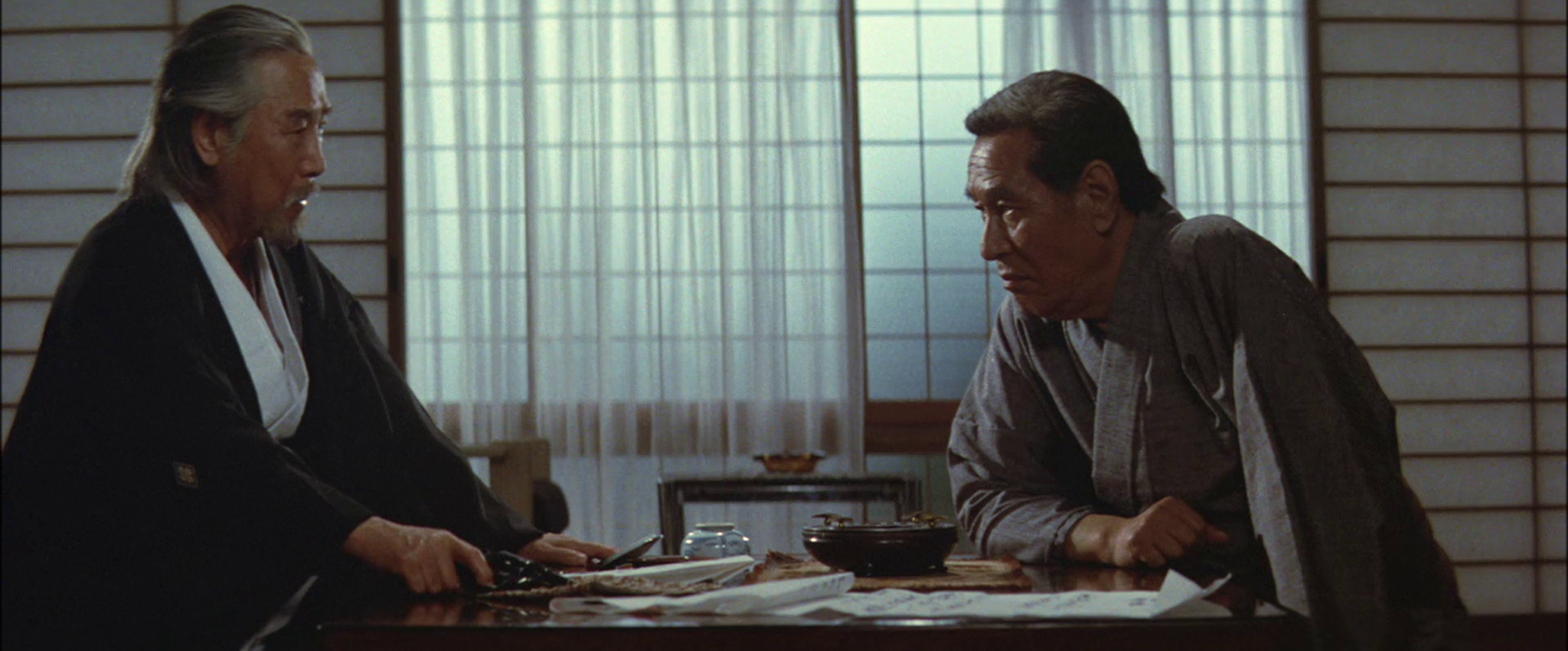
The Killing Machine (少林寺拳法, Norifumi Suzuki, 1975)

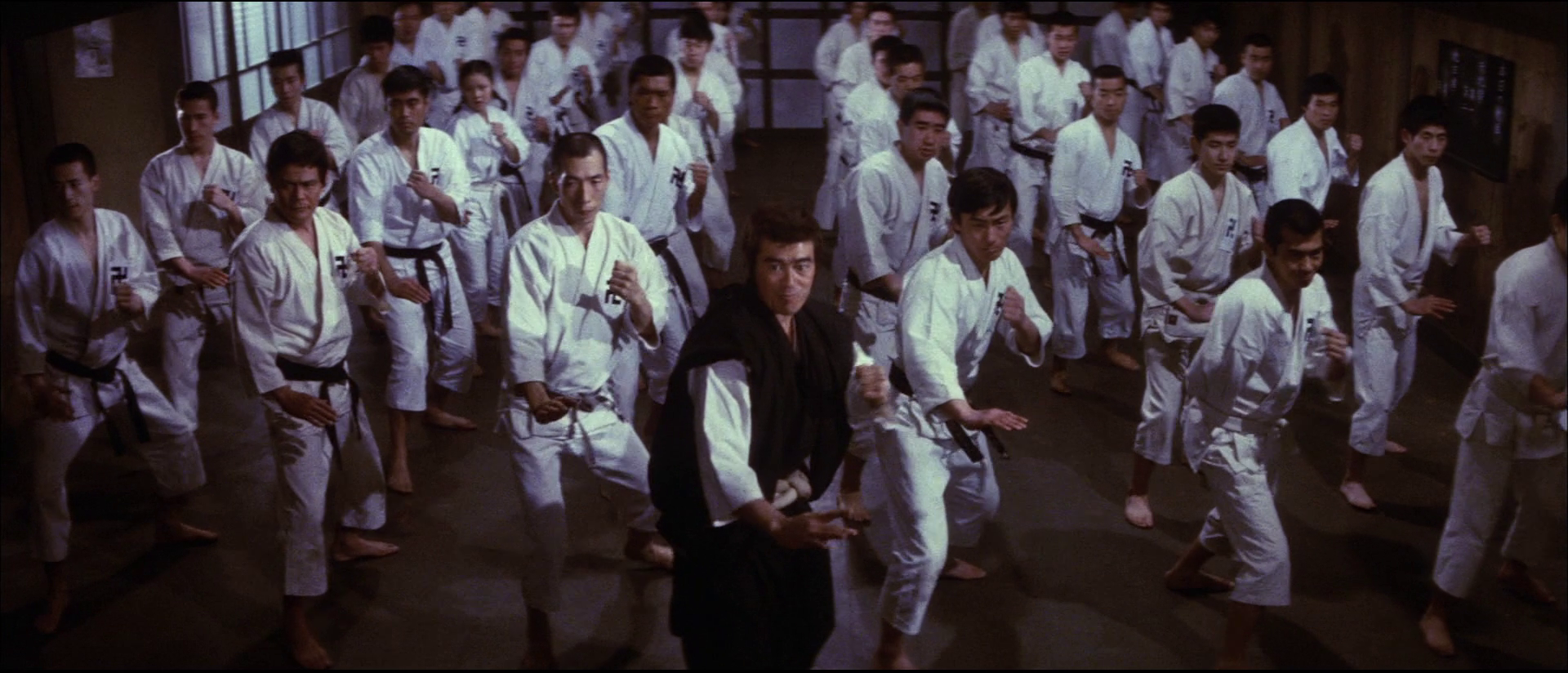
“As long as somebody like you is around, there’s hope for Japan,” an oddly sympathetic prison warden says to the last patriot standing in post-war Osaka. The title of Norifumi Suzuki’s Sonny Chiba vehicle The Killing Machine (少林寺拳法, Shorinji Kempo) maybe somewhat inappropriate or at least potentially misleading as the film is deliberately constructed as a martial arts parable emphasising the spiritual philosophy of self-improvement and compassion that is inextricable from its practice.

To that extent, the hero, Soh Doushin (Shinichi Chiba), is trying to fight his way out of the miasmas of the immediate post-war era. As may be apparent, Soh has taken a Chinese name, though Soh was apparently his along and belonged to a former samurai family whose nobility has been crushed by militarism. As the film opens, however, he’s a Japanese secret service operative in Manchuria blindsided by the news of Japan’s surrender. Soh is it seems a nationalist and a patriot, but a fairly revisionist one who stands up to the abuses of the Japanese army. He later says that he protested the way that the local Chinese population were often treated and he does indeed raise a fist toward an officer who wants to sell a young Japanese woman to a Chinese soldier in return for a guarantee of their safe passage to a boat heading out of the country. The young woman’s mother protests that she is an innocent virgin, a fact that has some later relevance. Soh refuses to let the officers take her, though evidently separated from her later.

When he meets the young woman again in the bomb-damaged backstreets of Occupation Osaka, she is dressed in Western clothing as opposed to the smart kimono she wore in Manchuria and is about to become a “pan pan” or streetwalking sex worker catering to American servicemen. Of course, Soh can’t let this happen either, but as she later tells him, she was raped by Russian soldiers during the retreat and now feels herself to be despoiled. She never wears kimono again and becomes a kind of symbol for a despoiled nation that Soh is reluctantly forced to accept he cannot save in part because his philosophy, which is still uncomfortably rooted in the philosophy of militarism, only valued strength when it should have valued love. The kind of love that Kiku (Yutaka Nakajima) had for her brother that made her willing to sacrifice herself for his wellbeing. 

Even so, Soh is doing his best to issue a course correction by caring for a small group of war orphans and helping them support themselves by running a rice soup stall so they won’t end up becoming dependent on the yakuza or the black market. It’s the yakuza and their increasingly corporatising nature that become Soh’s chief enemies, though standing right behind them are the Occupation Forces. They are, of course, just the biggest gang, as we can see when one of the kids steals a few tins from the gangster’s crate which is marked with text making it clear it came from the mess hall at the American base. The backstreets are full of sleazy soldiers and pan pans or otherwise the starving and dejected, sometimes violent demobbed soldiers filled with despair. It’s these men that Soh wants to buck up, telling them to rediscover their fighting spirit and giving them the opportunity to do so through learning Shaolin martial arts.

Of course there are those who don’t want to learn Chinese kung fu in the midst of their defeat, but what Soh is advocating is something that has a greater spiritual application even than karate can also have. It’s a kind of humanitarian riposte to the futility of the post-war society that might sometimes fail to recognise the depths of the impossibility faced by many in insisting they can be faced by discipline and moral fortitude but at the same time is not really judgemental except toward those who have deliberately abandoned their humanity, such as the trio of goons who rape a school for amusement (the girl is later seen among the students at Soh’s school along with the children from Osaka). The girl’s father reports it to the police, but the police and the gangsters are in cahoots, so nothing gets done. Soh cuts the guy’s bits off so he won’t be doing that again. Strength without justice is violence, he realises. But justice without strength is inability. Strength and love like body and mind should never be separated. The closing shots show an entire mountain covered in white-clad figures practising Shaolin kung fu and joining the humanitarian revolution rather than the cruel and selfish one represented by the gangsters with their red-light districts and black markets. It may be a simplistic solution, but it is in its way satisfying and at least a rejection both of the militarist past and the capitalistic future.


*Norifumi Suzuki’s name is actually “Noribumi” but he has become known as “Norifumi” to English-speaking audiences.

Wicked Priest 5: Breaking The Commandments (極悪坊主 飲む打つ買う, Buichi Saito, 1971)

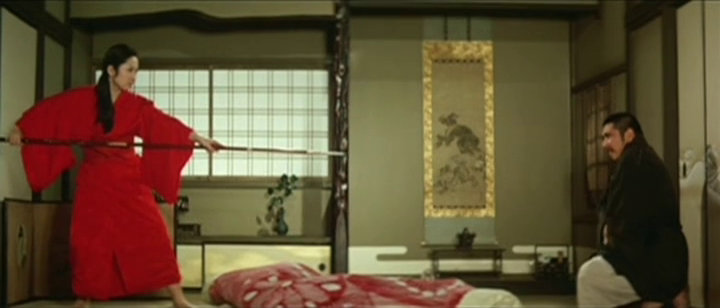
The Wicked Priest returns for his final adventure and once again finds himself tackling the corruptions of the mid-Meiji society. Titled in English “Breaking the Commandments” (極悪坊主 飲む打つ買う, Gokuaku Bozu – Nomu Utsu Kau), the Japanese title refers to something Shinkai (Tomisaburo Wakayama) admits part way through, that his ironically non-buddhistic life revolves around drinking, gambling, and women all vices he seems unable to give up even as he continues to fight justice for the oppressed little guy amid the burgeoning capitalist society of the new Japan.

Indeed the film opens with him in a brothel where he’s exhausting one woman after another and demanding she be replaced with a fresh model while simultaneously covering for petty crook Hideji (Teruo Ishiyama) who is hiding his sex worker girlfriend in the cupboard to save her from a local gangster. In the first few instalment, Shinkai is a lecherous yet lovable rogue who in his own way respects women but in these last two instalments is certainly less kind, treating these sex workers more or less as disposable while later threatening to rape a lady gambler who tried to trick him. In any case, after realising that even Hideji who he went out of his way to help is trying to deceive him, Shinkai ends up getting involved with a local dispute over transportation licences and a nefarious land-sharking plan run by thuggish gangsters with the collusion of the police chief.

The land sharks want to take over the abandoned mansion where Hideji and his family of crooks are currently living in the company of a former samurai lord who seems to be suffering with some kind of delusion that it’s still the Sengoku era. The police chief isn’t up for the idea at first but the gangsters falsely imply that those living in this area of town are merely “jobless people and criminals” that they don’t need to worry about. But their plan depends on bringing on board Wajima who holds the license for running freight carts but Wajima is an honest man who isn’t interested in bribes and has no respect for those who exploit others. He refuses to participate in the project.

Shinkai too refuses to let the gangsters get away with mowing over Hideji and the others and is once again saved by Ryotatsu (Bunta Sugawara) who agrees to put off their final fight until Shinkai is finished cleaning up this dirty little town. He largely does this by donning an elaborate disguise and teaming up with lady gambler Gin to trick conspirator Kawashima into giving back Wajima’s (Takashi Shimura) license after setting him up so he’d lose it. Meanwhile he also tries to repair another broken father-son relationship between Wajima and his errant boy Ryutaro (Kyosuke Machida) whom he’d kicked out some years previously after he became a yakuza and got into trouble with the law. 

What seems clear is that the chaos of Meiji has allowed the greedy to profit over the changing orders of the hierarchical society, no longer bound by traditional notions of good conduct or basic humanity. The police chief first objects to the plan, stating that many people living in the area the gangsters have earmarked for their docks are honest and hardworking and shouldn’t be lumped in with “criminals”, but is soon won over by a bribe and is also supporting a mistress in a separate household. Yet even so, Shinkai turns this same weapon back on Kawashima (Fumio Watanabe) in pretending to be a general from Tokyo who will soon be his father-in-law, leveraging his social advancement to bring him back into line in appealing to his greed and ambition while hinting at a militarist future in reminding him that Wajima’s carts were essential during the Satsuma Rebellion and may be so again should the occasion call.

After seeing off a series of bounty hunters, one sent in via a honey trap that suggests the gangsters really know their enemy, Shinkai has no option but to clear out the corruption himself at the point of a sword culminating in another bloody showdown which is also in its own way a means of protecting Ryutaro from a pointless revenge. “If I die the devil in hell will be in for a big surprise!” Shinkai cooly remarks as he marches off to fight for justice, but then there’s another battle waiting for him in the postponed grudge match with Ryotatsu as the two men tussle atop a sand dune ironically trapped in a co-dependent cycle of vengeance and salvation while Shinkai’s wandering most likely will never end.


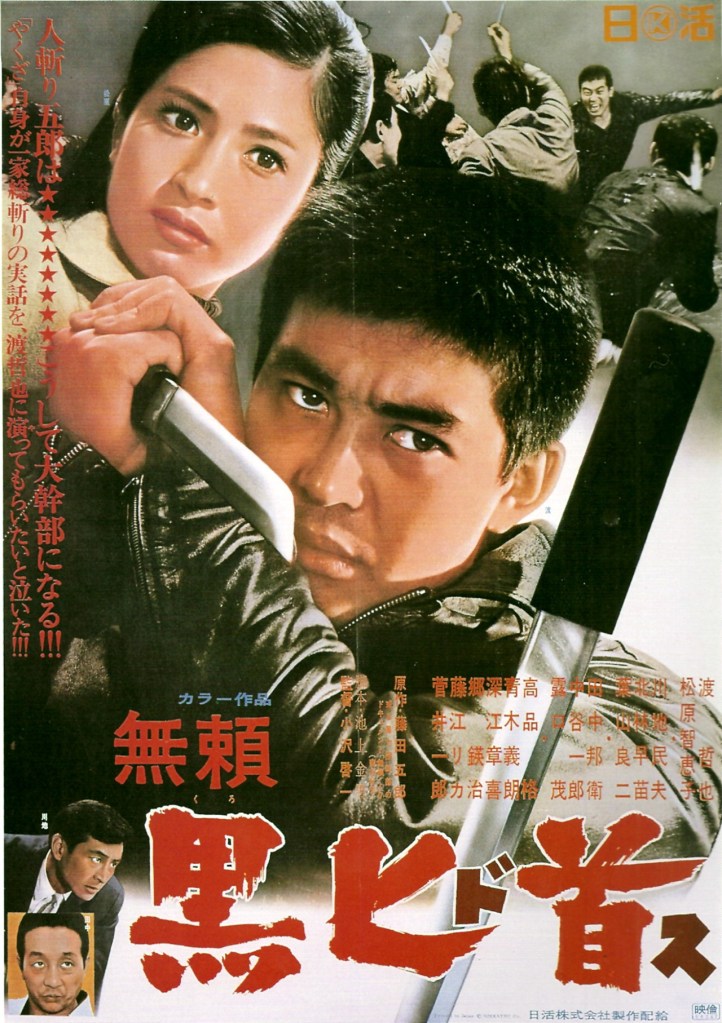
Outlaw: Black Dagger (無頼 黒ヒ首, Keiichi Ozawa, 1968)

outlaw black daggerGoro (Tetsuya Watari) just can’t catch a break. He sends his one true love off on a train to safety only to see her dramatically return because she can’t bear to leave his side. Her devotion costs her her life as she places herself between Goro’s manly chest and an assassin’s knife. Heartbroken, Goro gets out of town only to run into another old flame who is now a mama-san and has apparently married another yakuza (despite the fact that Goro parted with her because of his chaotic yakuza lifestyle). As usual, the past won’t let him go – this time in a more literal sense as Goro encounters another woman who looks exactly like the girlfriend who died in his arms….
This time for the fifth instalment in the Outlaw series, Black Dagger (無頼 黒ヒ首, Burai Kurodosu), it’s not so much family as romance which takes centre stage as we witness just how dangerous it can be to fall in love with a yakuza. Yuri (Chieko Matsubara), the girlfriend Goro couldn’t save, died because she loved him too much.  Saeko loved him too – he succeeded in getting rid of her but she ended up rebound married to another guy who kind of looks like him but isn’t as good, and now there’s Shizuko (Chieko Matsubara again) – a warmhearted nurse who’s once again fallen for Goro’s noble tough guy act. Goro knows the price of love and he thinks he’s no good so he tries to avoid letting himself fall, both for his own safety and for his prospective love, but in the end the one fight he can never win is the one against his own heart.

Oddly Goro gets on quite well with Saeko’s husband, though he’s not keen to get involved with his troubles. He warns him that it might be better to let Saeko go as in the end yakuza only cause suffering for their women and soon enough Goro is proved right when the local gang become intent on pimping Saeko out leaving her husband pretty much powerless to resist.

Apparently this cuts both ways as a sad song from a band of street musicians recounts that a good wife can be a man’s weakness. Again it isn’t really clear how this instalment fits with the others but Yuri’s story is certainly very similar to Yukiko’s as seen in the first two movies and Goro’s guilt over not being able to protect her comes to colour the rest of his life. Once again Goro tries to say goodbye to love, advising Shizuko of the folly of falling for a man like him – she should just find someone nice and be happy. Full of nobleness and conviction, Goro strides out to clean up the town for good, knowing he may not return to see the fruits of his labours.

Black Dagger is once again directed by Keiichi Ozawa and is more or less in keeping with his other efforts in the series, mixing studio bound action with occasional forays into wider outdoor expanses. The film opens with an impressive montage title sequence and fight scene, but other than that the only set piece we get is the street singer sequence towards the end though the final fight is once again action packed and impressively filmed. Black Dagger perhaps doesn’t bring anything too new to the franchise, but it does improve on its already familiar narrative with another doomed love story and a series of shattered dreams for poor old Goro. Unlike the more hopeful ending of the last film, Black Dagger ends on exactly the same note as the other Outlaw movies as Goro staggers away from the crime scene, knife in hand and ready for the next crisis to come his way.


Outlaw: Black Dagger is the fifth of six films included in Arrow films’ Outlaw: Gangster VIP The Complete Collection box set (which is region free on DVD and blu-ray and available from both US and UK).

English subtitled original theatrical trailer:

https://www.youtube.com/watch?v=XlPk35AXV2I

Outlaw: Gangster VIP (「無頼」より大幹部, Toshio Masuda, 1968)

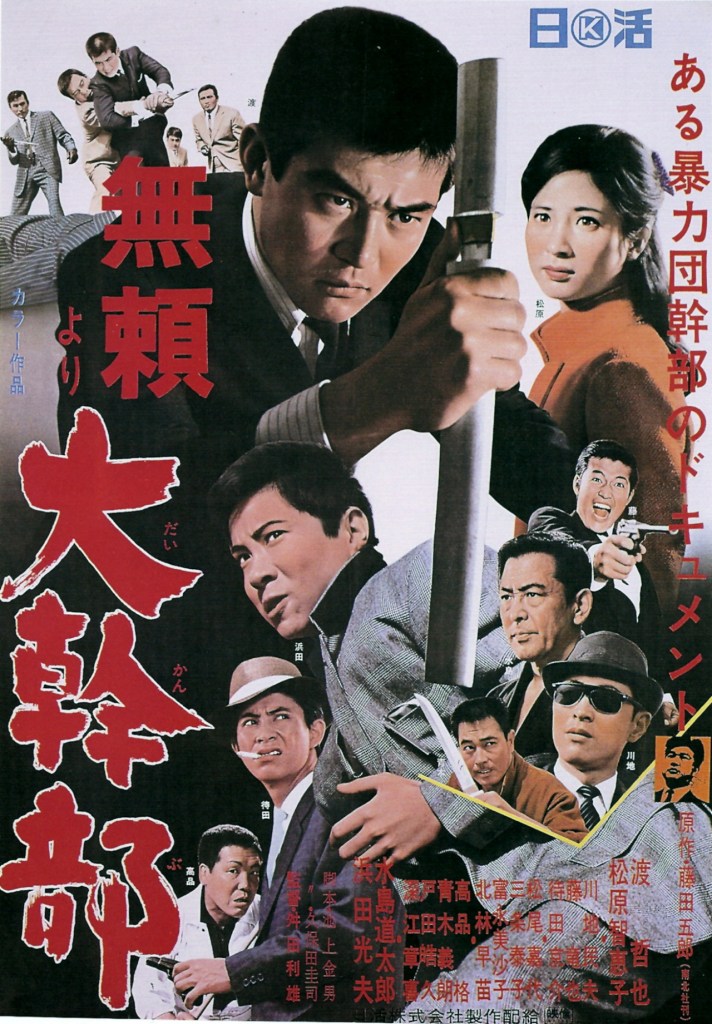
outlaw gangster VIP 1 posterBy 1968 the fate of the gangster movie was somewhat in flux as the old ninkyo style was on its way out yet the jitsuroku approach, later to find its zenith in the Battles Without Honour and Humanity series, hadn’t quite taken hold. Outlaw: Gangster VIP provides an essential bridge as it takes its inspiration from the writings of one time yakuza Goro Fujita but at the same time brings together many of the themes that were dominating Nikkatsu’s output at the time from their star led, youth appeal billboard cool to their noir inflicted, nihilistic crime thrillers as a kind of culmination of everything they had been producing up to that point.

The first film in the series, Outlaw: Gangster VIP (無頼」より大幹部, Burai yori Daikanbu) begins with a black and white prologue seemingly set around the end of the war in which a young boy endures firstly the death of his mother and then the younger sister who has been left in his care – presumably through hunger or at least ill heath exacerbated by malnutrition. Eventually he himself is arrested after being caught trying to steal food and is sent to a reform school from which he escapes alongside another boy, Sugiyama.

Flash forward to a grown up version of Goro (Tetsuya Watari) lounging around in a dingy apartment and the film expands into glorious, if garish color. Goro is summoned to a local drinking establishment where his yakuza boss is under attack. On getting to the bar and coming to his boss’ defence he finds that the aggressor is none other than Sugiyama. Saving his boss by stabbing his friend he nevertheless ensures Sugiyama’s survival with a carefully placed blow though both are sent back to prison. Goro gets out three years later to discover his girlfriend has married someone else and the yakuza world is just as dog eat dog as it was when he left it.

As in many other films of this burgeoning genre, the yakuza is more or less a surrogate family of grown up orphaned street kids who’ve bound together for increased odds of survival. There maybe strong bonds between brothers, but the old ways of samurai style honourable conduct are long gone (if they ever really existed at all). Suigyama’s gang have failed to protect his girlfriend who has been reduced to prostitution despite his sacrifices for them – an unthinkable act in traditional terms, but Sugiyama’s boss is the new kind of uncaring, ambitious yakuza who cares nothing for traditional ethics.

The yakuza as a home for waifs and strays is a theme which continues throughout the series with the constant references to “hometowns” and a desire to get out of the city for a simpler, more honest life. People keep telling Goro that he’s not a real yakuza, that deep down he doesn’t have a gangster’s heart. This is true, to an extent, as Goro is the kind of noble criminal seen in the ninkyo genre who clings fast to the old ways – loyal to his friends and his clan, seeking to protect those who need it over choosing to further exploit the already vulnerable. He’s a gangster because life left him with no other options. For a street kid and reform school escapee, what possible other place could there be for him to survive than in the arms of his yakuza brothers?

An exile from the world of conventional society, Goro cuts a lonely path which ties into the nihilistic noir themes of the genre as he wanders around in very cool looking leather jacket. Mostly still studio bound, Masuda opts for a fairly straightforward approach yet with some noir-esque canted angles and a few interesting set pieces. The unusual finale in which Goro faces the treacherous yakuza kingpins against the background of a cabaret act serves as impressive highlight of the film, perfectly contrasting its garish technicolor world with the darkness underneath as Goro staggers off along a street dark with something more night and towards an eventual salvation of one kind or another.


Outlaw: Gangster VIP is the first of six films available as part of Arrow’s amazing new blu-ray and DVD box set which is released in UK and USA and is completely region free (hurrah!).

I’ve also written a full writeup of the box set as a whole over at UK Anime Network which you can read right now if you’re the sort of person who likes to skip to the end. Otherwise, get ready for five more tales of broken hearted tough guys….

English subbed version of the original theatrical trailer:

https://www.youtube.com/watch?v=fQDtXkgzhaA