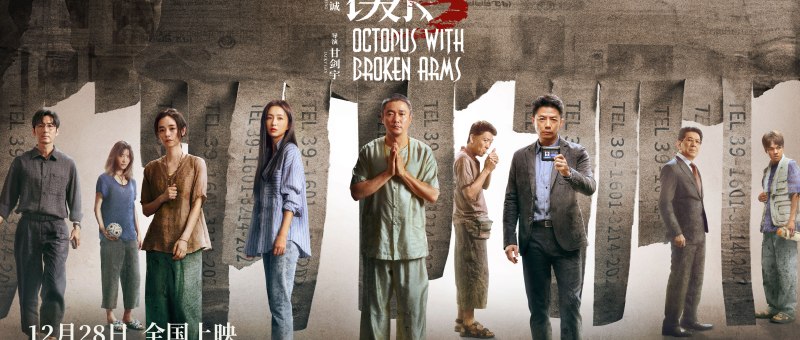
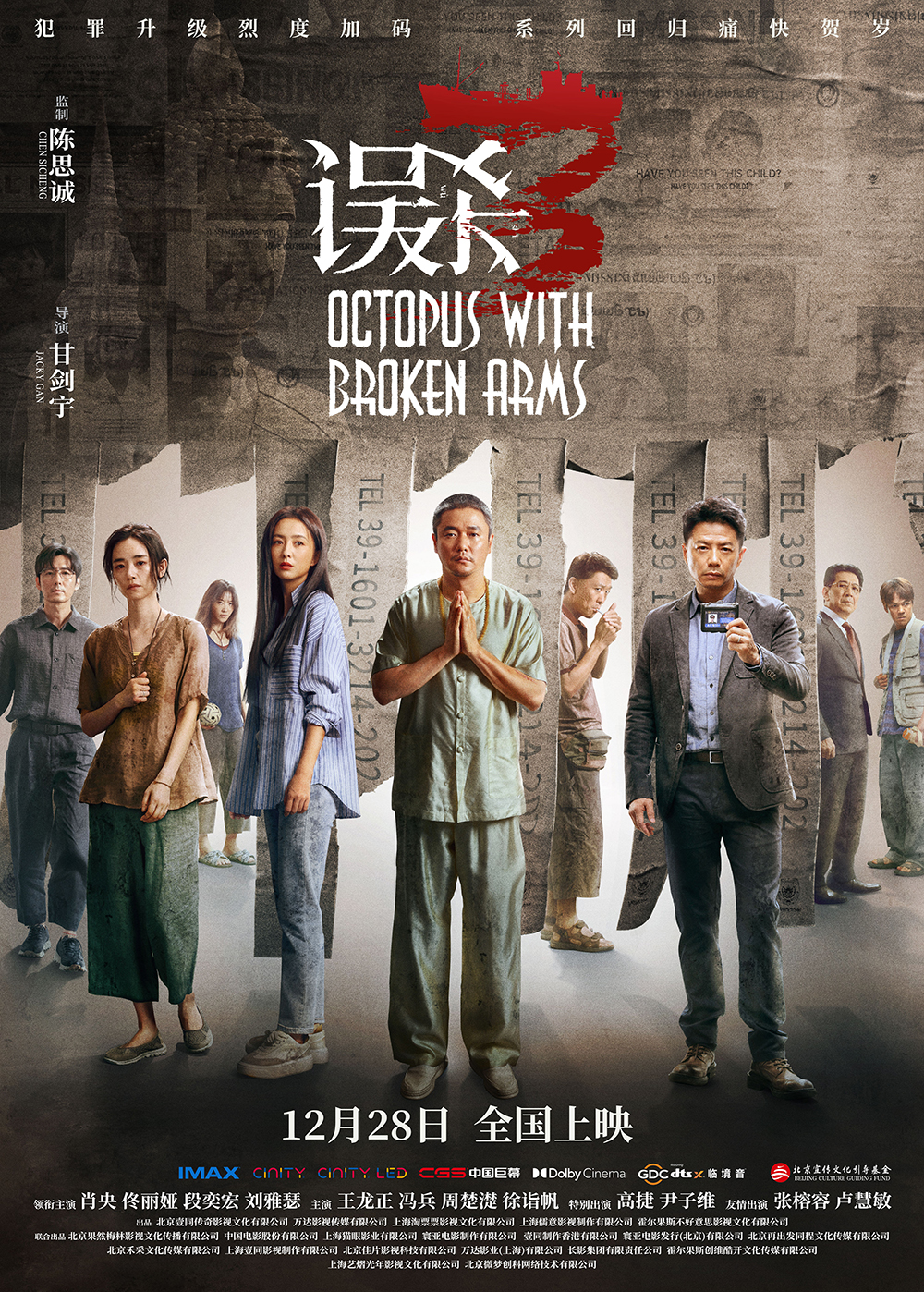
Octopus with Broken Arms (误杀3, Jacky Gan Jianyu, 2024)

It’s quite surprising, somehow, that Octopus with Broken Arms (误杀3, wùshā 3) gets away with as much as it does simply being another recent mainstream movie set in an unidentified South East Asian nation where, conveniently enough, almost everyone speaks Mandarin. The third in the Sheep Without a Shepherd series, it quite clearly takes aim at the tendency of authoritarian governments to cover things up and deny the public the truth in any situation. Ordinarily, the censor’s board wouldn’t like that pointed out, nor would it like implications of police violence and corruption though as this is all taking place in “Not Mainland China”, it seems to have passed them by.

Then again, by setting itself overseas the film also deflects the implications of its focus on child trafficking which is a huge and well documented problem on the Mainland though here it becomes something that only happens overseas. The closing title cards in English offer a series of statistics about missing children worldwide, but avoid mentioning the statistics in China where the One Child Policy contributed to a phenomenon of children being kidnapped from the cities to be raised on rural farms while the preference of sons often saw daughters otherwise sold off.

In any case, Bingrui (Xiao Yang) is an ethnic Chinese refugee raised in an orphanage who got a huge capital injection from a gangster after finding his missing child and turned it into an internationally successful cosmetics corporation. When his own daughter Tingting is kidnapped, he seems to know immediately that he’s not been targeted simply because he’s a wealthy man and suspects the involvement of Fu-an (Feng Bing), an old “friend” with whom he’d had “a few issues” who had approached him for money for his son’s heart transplant which he had given him. 

It doesn’t take long to figure out that Bingrui must have been involved in something untoward even if he’s now a devout Buddhist who’s just trying to be a good father having lost his wife in childbirth. Fed a series of clues to find his daughter, it’s clear he’s being led towards a kind of confrontation with his past along with a test of character. He may be able to say that he did the things he did because he had no other choice. If he had not joined the side of those acting against all common notions of humanity, he would simply have become one of their victims. But there is a choice involved all the same, and Bingrui chose survival through the sacrifice of other lives. 

The fact that the kidnapper lives streams much of the chase suggests they’re less interested in the money than truth and ultimately want Bingrui to blow the whistle on a vast conspiracy which otherwise can’t be investigated because it’s burrowed deep into the police force and perhaps beyond. As one of those working against him later says, there are too many secrets destined to remain so that should be brought out into the light. A newsreader, however, remarks on hearing about a possible cover up of the deliberate murder of a number of trafficked children passed off as “refugees”, that what he most fears is that the people have lost faith in their government. Nevertheless, there might be something quite subversive about the lengthy scenes of citizens expressing discontent with blatant lies from the authorities and openly begging for the truth given the famously tightlipped CCP’s usual approach to public information.

In any case, the more we learn about Bingrui the harder it is for us to sympathise with him and the film then becomes more about proper paternity and the willingness of a parent to surrender their own life for that of their child. The film takes its English title from an incredibly elaborate school play little Tingting is involved in at the beginning of the film about how Octopuses are all orphans because their parents abandon them soon after birth and then pass away. Bingrui wasn’t exactly an orphan, like many of the children he was kidnapped from a loving family, but became one and lost his sense of humanity in the process. The question is whether he will be able to abandon his instincts for self-preservation to save his daughter or if, in the end, he will choose to save himself just as he did when chose to join those who kidnapped him rather than become a victim. Like many similarly themed thrillers of recent years, the film is built around a series of outrageous twists many of which are startlingly obvious but in their way serve the shocking quality of those that aren’t. What’s truly shocking is the depth of this conspiracy which hints not just at children being stolen and sold to overseas adopters, but trafficked into sexual exploitation or for illegal organ harvesting. The barbarity knows no bounds, and while the actions of Tingting’s kidnappers are in themselves brutal it’s clear they have no other way to ensure the injustice they face will be addressed. Indignant but avoiding sentimentality, Jacky Gan Jianyu’s slickly designed B-movie thriller nevertheless ends on a note of karmic retribution that the “hero” may not have earned but does at least allow him to make good on his promise and symbolically atone for the all the pain and suffering his callousness self-interest has caused. 


Trailer (English subtitles)
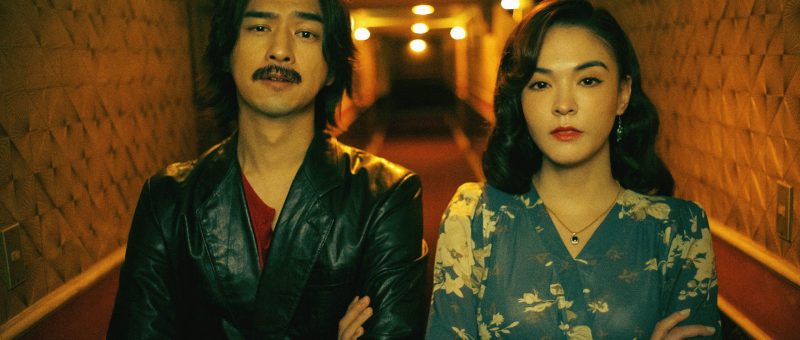
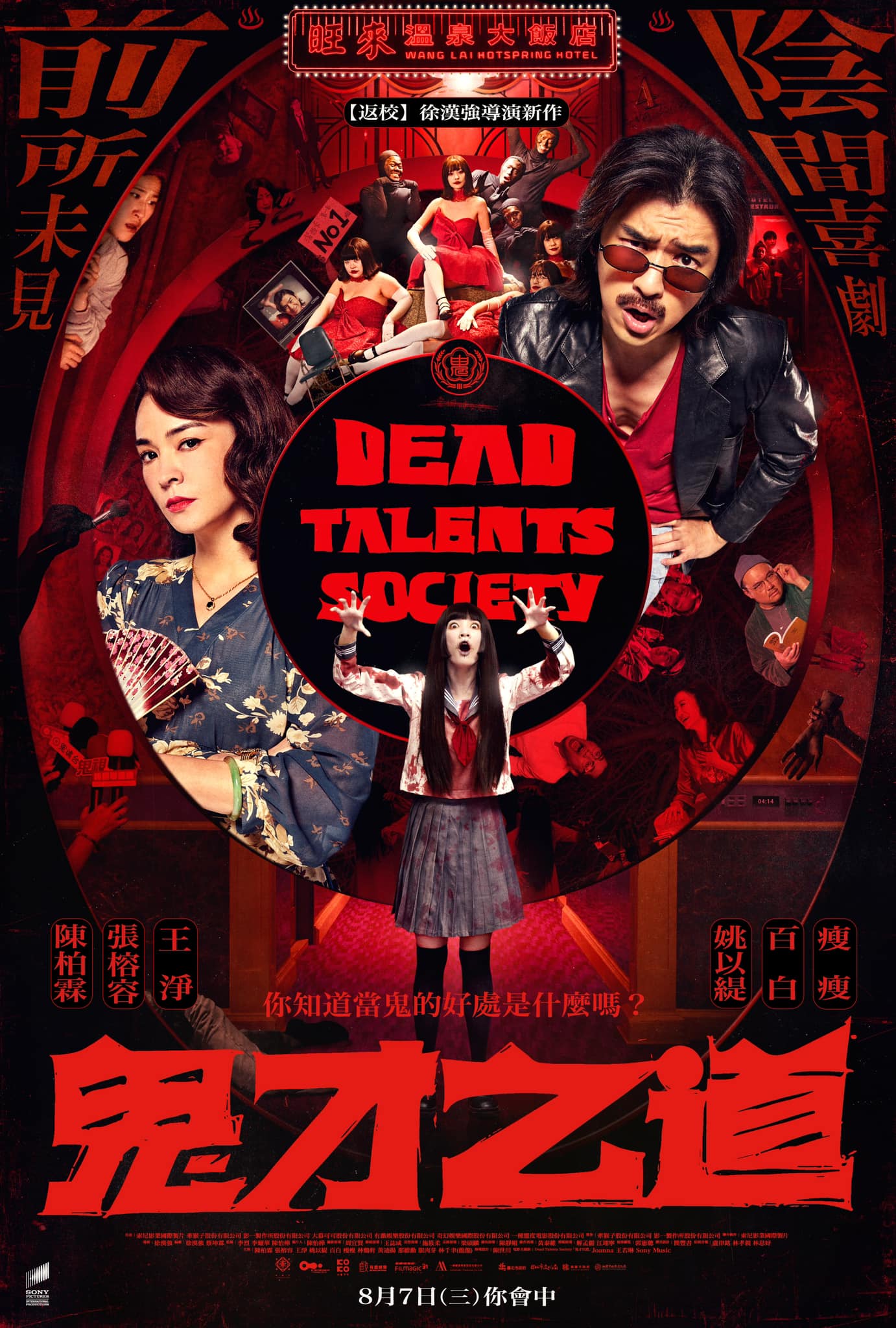
Dead Talents Society (鬼才之道, John Hsu, 2024)

“Why is it more tiring to be dead than alive?” A fed up ghost asks themselves and with good reason. If you thought you’d be able to rest easy in the afterlife, you’ve got another thing coming because it’s just as much of a capitalist hellscape on the other side as it is here. The central conceit of John Hsu’s Dead Talents Society (鬼才之道, guǐcái zhī dào) is that a ghost must must earn their keep by haunting the living in order to provoke large-scale appeasement rituals and the burning of vast amounts of ghost money or risk disintegration and finally disappearing from this world.

In a certain way, this is the paradox of the ghost. They fear being forgotten and only want to be seen mostly by the living but also by the dead in order to feel the validation that they exist and are appreciated. For Rookie (Gingle Wang) , a teenage girl who it later turns out was almost literally crushed by the weight of parental expectation, this was something she was never able to feel in life partly because of her father’s well-meaning attempts to boost her confidence by telling her she was “special”.  He even went so far as to mock up a fake certificate for her while leaving her to feel inadequate that her sister’s trophy shelves were full while hers were empty. It’s this certificate that’s gone missing during her family’s literal attempt to move on from her death and start again leaving her behind. With no place to return to, Rookie will disintegrate in 30 days if she can’t win a haunting licence which is a problem given her mousey personality and the lack of talent that left her feeling so inadequate in life.

Yet many of the pro ghosts are in the same position. Cathy (Sandrine Pinna) used to be the reigning queen, but her thunder was stolen by a former prodigy, Jessica (Eleven Yao), a very modern ghost who’s figured out how to haunt the internet and go viral for scaring influencers to death. In some ways, the living too are ghosts online haunting an alternate plane of reality while it’s through these online personas that we make ourselves seen. After all, in the modern world, there’s no better way to be “remembered” than by achieving internet fame. By contrast, all Cathy has is her decades old trick of backflipping on guests staying in the hotel room where she died in a lover’s suicide over a man who cared little for her. In a hilarious twist, the gang set up the trick on a harried businessman but he’s so busy he doesn’t even really notice any of their ghost stuff and remains entirely focussed on his work. 

Taken in by the gang, the realisation that rookie begins to come to is that she never really needed to be “special” but only herself and for someone to see her as she really was. Her anxieties are those of contemporary youth burdened by the weight of parental expectation and fearing they can’t live up to it. Manager Makoto (Chen Bolin) experienced something similar in life, struck by anxiety while struggling to make it as a early ‘90s popstar while unable to make his mark in the ghost world by virtue of being unable to scare anyone because he’s too good looking. As he tells it, the best thing about being dead is that you no longer need to worry about what other people think and Rookie is therefore free to become herself or else disappear forever. 

Even so, the irony is that the finale sees the central gangs take on unified appearances as if becoming one with one side doing better than the other in their genuine sense of mutual solidarity as a ghost world family. They watch J-horror-esque movies for tips and muse of the contradictions of fame that perhaps we accord those talented that are merely the most visible while these ghosts struggle to be seen in an increasingly haunted world of hollow influencers and illusionary online avatars. Rookie still doesn’t know what being seen means but has perhaps learned to see and accept herself thanks to her experiences in the afterlife. Charming and somehow warm in its lived-in universe of celebrity ghosts and professional hauntings, Hsu’s zany horror comedy may suggest there’s no escape from the living hell of capitalism but that dead or alive you might as well enjoy the ride as best you can before it all suddenly blinks out.


Dead Talents Society screens Nov. 9/10 as part of this year’s San Diego Asian Film Festival.

Original trailer (English subtitles)

Never Stop (超越, Han Bowen, 2021)

“And what comes after the finish line?” an anxious novice asks of his mentor who has little answer for him, his singleminded pelt towards the end of the road later convincing him “running never leads anywhere” even as he continues to run away from his sense of shame and inadequacy. One of a number of sporting dramas emerging in the run up to the Tokyo Olympics, Han Bowen’s Never Stop (超越, Chāoyuè) ultimately suggests that in life there is no finish line while “winning” is perhaps more a state of mind than a medal and a podium. 

This is however a lesson former champion Hao Chaoyue (Zheng Kai) struggles to learn after his sprinting career comes to an abrupt halt. In 2009, he won gold in the Asian Games and publicly proposed to his reporter girlfriend in the middle of a packed stadium. 10 years on, however, he’s a washed up middle-aged man whose business is failing and marriage falling apart. His protege, Tianyi (Li Yunrui), is still flying high but approaching his late ‘20s is now also experiencing similar problems as Chaoyue had previously compounded by the fact he suffers from ADHD and is prevented from taking his medication because of anti-doping regulations which has left him mentally drained through overstimulation. 

Later, Chaoyue describes the athletes’ existence as like that of a lab rat forced to run around for little more reward than food and water. Nevertheless the source of all his problems is in his stubborn male pride, unable to accept the reality which is that he lost to nothing other than time in the perfectly natural decline of his ageing body which coupled with the extent of his injuries left him unable to maintain the peak physical performance of his earlier career. Petulantly quitting his original team, he tries an international super coach who refuses to sugarcoat the reality that Chaoyue has simply aged out of international athletics while throwing in a few racist micro-aggressions for good measure. Unable to move on, he attempts to trade on past glory but ironically continues to run away from his problems in refusing to accept he has no head for business while discouraging his young son from pursuing athletics despite his apparent love and aptitude for sports. 

Tianyi’s plight meanwhile highlights the external pressures placed on sporting idols in the internet age, his career suddenly on the rocks when he’s spotted taking pills and and damages his reputation losing his endorsement deals. Having idolised Chaoyue and essentially followed in his footsteps he now finds himself directionless and wondering what to do with the rest of his life. The appeal in running for him at least may have been in, as Chaoyue had described it, the intense focus and single-mindedness of the short distance sprinter in which everything except the runner and the finish line disappears, but without his medication Tianyi finds it increasingly difficult to concentrate often slow off the blocks in his initial confusion. 

The problem the runners face is ultimately one of self-confidence, motivated to give up on believing that they cannot fulfil the internalised ideal they have of a champion. Chaoyue remains unwilling to “lose”, running his business further into the ground and damaging his relationships with those around him out of stubbornness rather than making a strategic retreat or attempting to reorient himself in accepting he may need help with making his sneaker shop a conventional “success”. Feeling betrayed, he refuses to let his son run because running doesn’t lead anywhere but continues to run away from the humiliating spectre of failure rather than face it head on. Tianyi meanwhile looks for guidance and unable to find it struggles to find independent direction, but in confronting each other the two men begin to regain the confidence to keep going redefining their idea of success as striving for rather than reaching the finish line.

An unconventional sporting drama, Han’s inspirational tale nevertheless promotes perseverance and determination as the former champions overcome their self-doubt to realise that you don’t have to just give up if you feel you’ve lost your way and that there are always other ways of winning. There may be no finish line in life, but there are ways to go on living when your sporting life is over not least in supporting the sporting endeavours of others or as the post-credits coda less comfortably suggests monetising your name brand to build a sportswear empire that enriches both yourself and the nation. A late in the game slide towards a patriotic finale cannot however undo the genuine warmth extended to the struggling athletes as they resolve to keep on running no matter what hurdles lie in their way.


Never Stop streams in the US Sept. 15 to 21 as part of the 13th Season of Asian Pop-Up Cinema.

Original trailer (English subtitles)