Lost in Forest (山中森林, Johnny Chiang, 2022)

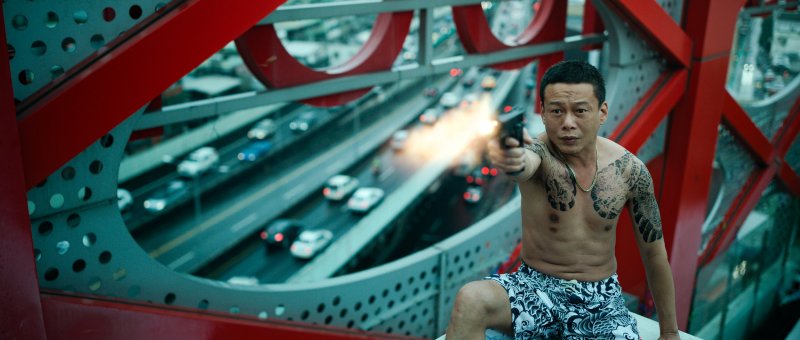
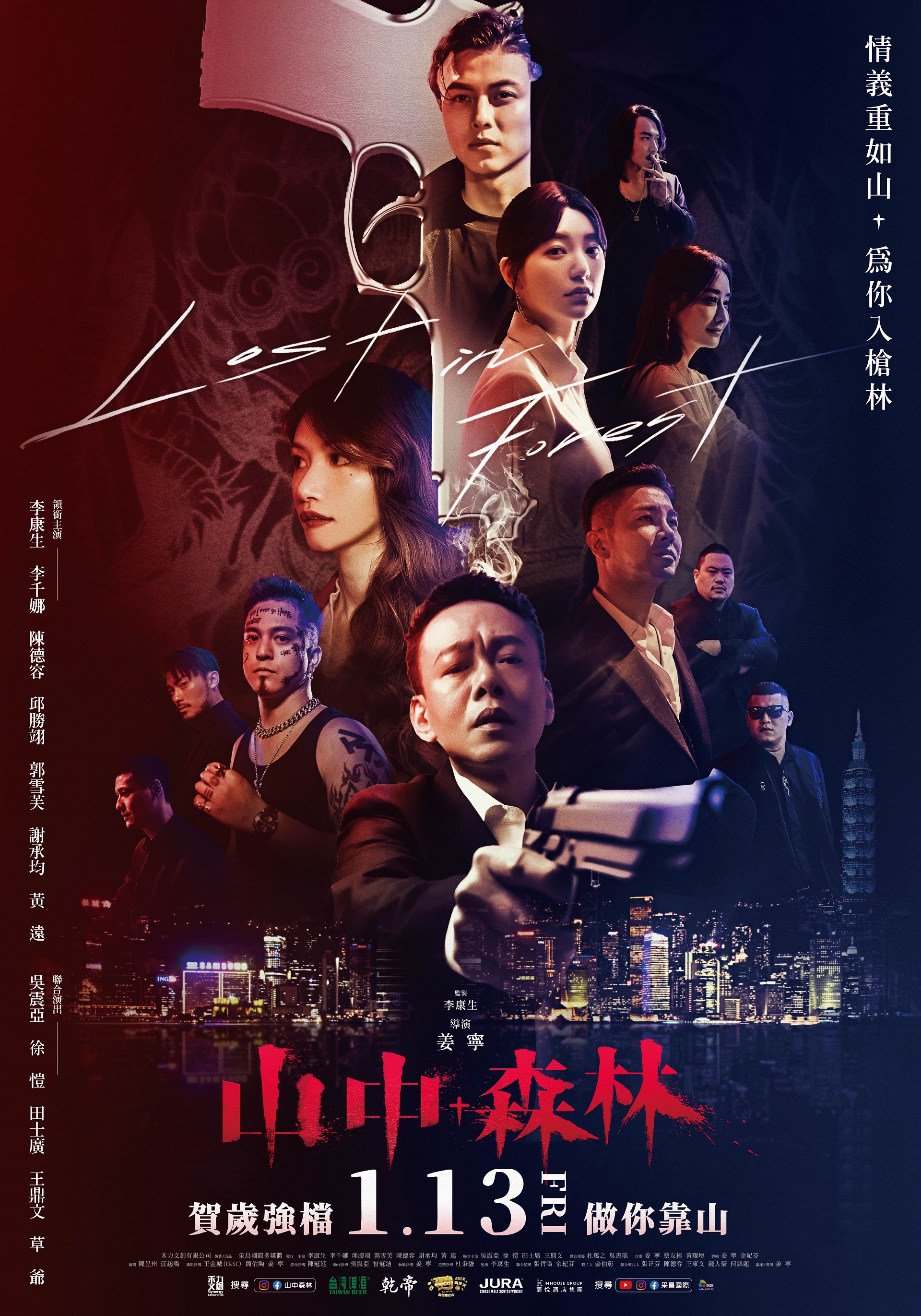
History repeats itself for a former gangster recently released from prison in Johnny Chiang’s melancholy neo-noir, Lost in Forest (山中森林, Shān Zhōng Senlín). Set in a neon-lit Taipei, Chiang’s moody crime drama finds its hero displaced in the modern society unable to look either forward or back while meditating on all he’s lost and another less corrupt vision of his home city as symbolised by his late father’s missing sausage bike and the changing back streets where it was once parked.

This Taipei is however a less wholesome place as suggested by Chiang’s frequent cuts to Christian churches and the giant neon crosses that sit above them as if looming in judgement on the chaos below. 12 years previously, Sheng (Lee Kang-sheng) opened fire on rival gang members who’d kidnapped his best friend and comrade Seagull (Angus Hsieh) who has now taken over the outfit while he’s been inside. Customarily, Seagull should have had someone come to meet him on his release, but Sheng exits the prison alone and is given a lift back into the city by the entourage collecting his prison buddy Ji despite the fact they are headed to an entirely different part of the country. Without a phone and not knowing where the gang even is anymore, all Sheng can do is hole up in a hotel until he finds out what’s going on. All of which suggests that despite his sacrifice, Seagull may not be particularly glad to reunite with him.

The conflict exists on three levels. Sheng must necessarily doubt his old friend Seagull, especially on realising that his new business model involves exploiting vulnerable women by pressing them into debt via high interest loans and then forcing them into sex work, while simultaneously worried about his guys who claim they have not been well treated while Sheng was away. But then it also becomes clear that much like many contemporary Taiwanese crime dramas, the real villain is institutional corruption as Seagull’s alliances with corrupt politicians and shady businessmen continue to destabilise the underground society thanks to the machinations of anarchic street punk Monkey (Sean Huang) who engineers a gang war by giving the businessman’s son a kicking as leverage in a dodgy land deal. 

On the one hand, Sheng watches history repeat itself as a handsome foot soldier, Chenghao (Prince Chiu), vacillates over leaving the gang for his respectable girlfriend Alice (Puff Kuo), while on the other Sheng becomes attached to sex worker Jing (Lee Chien-na), one of Seagull’s exploited women working for him to pay for her father’s medical bills. Sheng’s former lover tells him that if he really cared about her, he shouldn’t have sacrificed himself for Seagull just as Chenghao shouldn’t put himself in harm’s way out of a pointless sense of loyalty for a gang that has no real loyalty to him. Before his release, the prison warden had advised Sheng not to let his sense of loyalty get the best of him, but as he says Sheng no longer has much of anything else. His parents died while he was inside, the woman he loved married someone else, and Seagull can’t even remember what he did with Sheng’s dad’s sausage bike which is his only path back to a more wholesome existence. 

In a certain sense he’s powerless, unable to escape the inexorable pull of gangland karma until finally forced to reckon with the destabilising force that is Monkey to restore some kind of order and undermine the system of corruption that has arisen between underworld thuggery, local politics, and big business. The warden had also pointed at the fish in his tank and asked Sheng if it was happier in there or back in the sea but Sheng had merely said that it’s up to the fish to decide, hinting that in a certain sense it’s all the same and it’s just that one prison is bigger than another. At least the fish gets fed and is kept safe from predators even in its lonely isolation, which might be more than can be said for Sheng who can never truly escape his past even as he tries to free Chenghao and Jing from a similar fate. A melancholy mood piece, Chiang shoots night-time Taipei as a land of neon emptiness set against a classic jazz score that echoes Sheng’s deadpan ennui in a modern world of electronic smoke and rueful nihilism in which there is no escape from karmic retribution. 


Lost in Forest screens in Chicago April 16 as part of the 16th season of Asian Pop-Up Cinema.

Original trailer (Traditional Chinese / English subtitles)
Missing Johnny (強尼.凱克, Huang Xi, 2017)

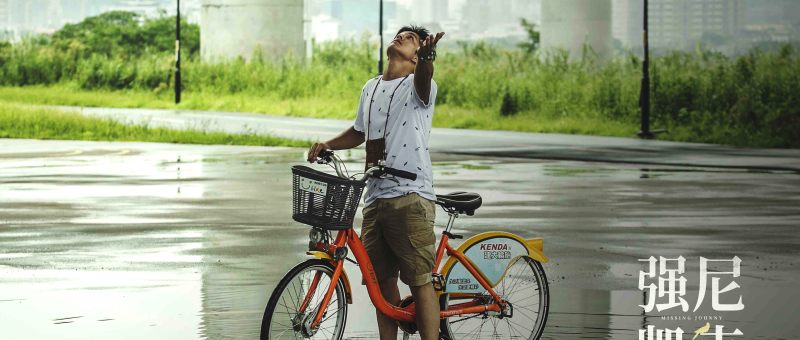
missing johnny poster 2“When people are too close they forget how to love each other” – so claims a lonely soul at the centre of Huang Xi’s debut Missing Johnny (強尼.凱克, Qiáng ní. Kǎi kè). A Taipei tale of urban disconnection, Missing Johnny is defined by mysterious absences and dangling connections as its three melancholy protagonists try to break free of their various obstacles to move towards a more fulfilling future. Family becomes both tether and support, a source of friction for all but very much a part of a the vice-like grip the traditional society is wielding over their lives. Yet there is hope for genuine connection and new beginnings even if you have to get out and push.

Casual labourer Feng (Lawrence Ko) has returned to Taipei after a failed venture only to see his car repeatedly break down, forcing him to seek help from a childhood friend. Meanwhile, Hsu (Rima Zeidan), a young woman living alone, fills her life with colourful birds which attract the attention of her landlady’s son, Li (Sean Huang) – a mildly autistic young man who finds it difficult to manage his life but resents his mother’s attempts to manage it for him. When Hsu’s newest parrot makes a bid for freedom, she enlists Li and Feng who has taken a job working on a nearby apartment to help her “rescue” it, sparking a series of connected epiphanies among the otherwise disparate group.

Each of them is, in someway, trapped. Feng is trapped by his difficult familial circumstances and resultant lack of social standing. His parents divorced when he was young and he came to the city alone for high school, forming a close bond with his teacher, Chang (Chang Kuo-chu), and his son, Hao (Duan Chun-hao). Feng is now welcomed as a member of their family but the Changs are not a happy bunch. Mr and Mrs Chang argue endlessly, usually ending with one of them asking for a divorce and Mr. Chang certainly seems to be a “difficult” older gentleman who requires all around him to walk on egg shells lest they say the wrong thing and set him off. Most of his scorn is reserved for Hao whom he regards as a disappointment in not having repaid on his investment. Divorced with a son and boomeranged back home, Hao resents his father’s moodiness and longs to move back out again but with things as they are, possibilities seem slim.

Money becomes a bone of contention for all. Hsu is involved in a long distance relationship with a controlling salaryman who tolerates her love of birds but doesn’t really want to be involved with them. It’s obvious the relationship has all but run its course and Hsu probably wants to end things but doesn’t quite have the energy so just doesn’t make as much time for him as perhaps she once did. Eventually we discover the boyfriend is married to someone else – a wealthy woman he married for her money which he now uses to “support” Hsu, her birds, and her business. Hsu’s boyfriend thinks the money he’s “invested” in the relationship means he’s bought something concrete, throwing it back in Hsu’s face just as Mr. Chang did to Hao. All he can offer her is a mistress’ life but he resents her desire to be free and expects her to be available to him whenever he wants as part of a reciprocal relationship. Mistaking the passage of money for genuine connection may be an ancient failing, but it seems one unlikely to go away.

Feng wants to build a family, despite himself, just a happier one than those he’s known while Hsu and Li are trying to assert their independence in a world which doesn’t quite want to give it to them. Li is almost a grown man but he can’t deny his mother’s suggestion that he needs some help here and there just to get by and that his life really does become confusing when he fails to read the notes she leaves for him reminding him what it is he’s supposed to do today. Like any young man, however, he wants to be free of his mother’s control to pursue his own destiny even if it might mean he gets lost along the way. His mother understands this, but she worries. She doesn’t stop him going but is hurt by his selfish refusal to accept that he causes her pain by wandering off for days on end without sign or warning.

And then what of “Johnny”? Hsu keeps getting calls on her mobile from various people looking for “Johnny” – presumably the same Johnny but really there’s no way to tell. Someone is missing him, anyway. Li asks Feng a philosophical question. He wants to know if birds in flight are still or in motion. A bird, flying, seems to be moving but it occupies a fixed point and is therefore “still” from moment to moment. The same could be said of our three protagonists, each living lonely lives of spiritual inertia carried along only by the rhythms of city life. Thanks to a missing parrot, however, they might finally find the courage to take flight even if they seem to stall at the beginning of their journeys.


Missing Johnny was screened as part of the 2018 New York Asian Film Festival.

Promo video (English subtitles)

https://www.youtube.com/watch?v=i9-Ozjp1xvQ